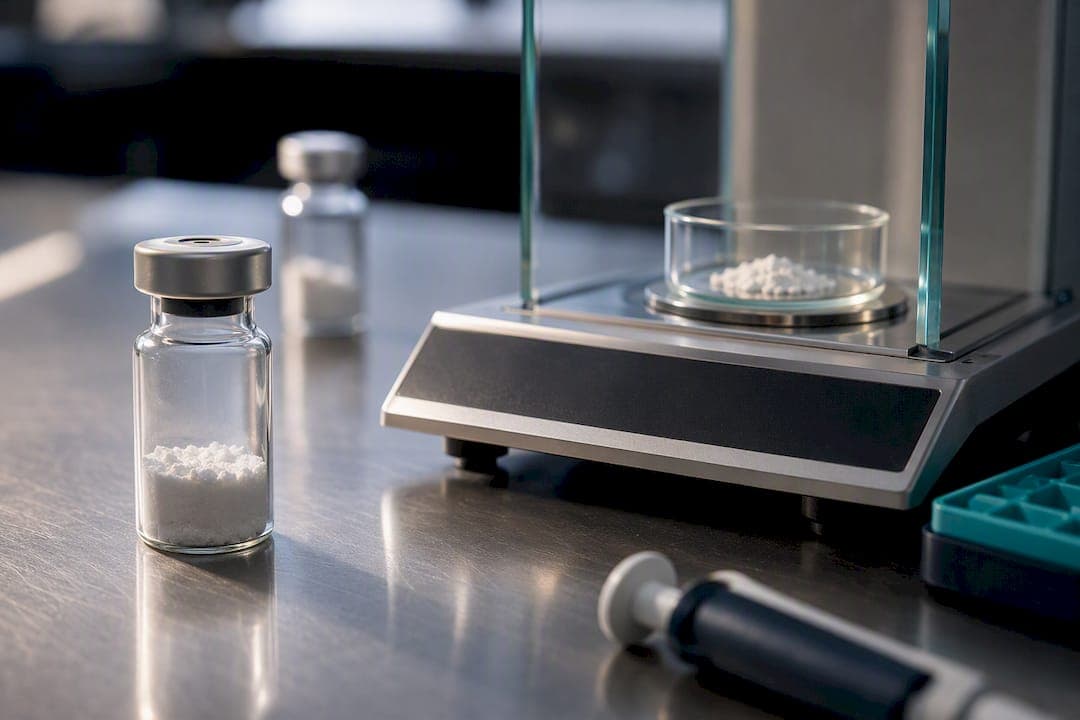
Most research-grade peptide vials commonly cost between twenty and one hundred dollars, but that number alone will not tell you if you are getting a fair price. The comparison that matters is price per milligram adjusted for documented purity, since a cheap vial with a small mass or unverified purity can cost more per usable milligram than a pricier one. Clinic programs and prescription formulations sit in an entirely different bracket because they bundle in consultations, administration, and monitoring.
TL;DR:
- Prices per milligram vary significantly depending on sequence length, modifications, and purity, with longer and more complex peptides costing more.
- Larger vial sizes often reduce the price per milligram but increase storage and degradation risks if the entire amount is not used promptly.
- Vendors' pricing depends mainly on sequence complexity, purity level, batch size, and verification costs such as analysis and shipping.
- Converting catalog prices into effective $/mg requires adjusting for purity; the median market price is around six dollars to eight dollars per milligram.
- Additional costs like independent testing, cold-chain shipping, consumables, and labor substantially increase the total budget beyond catalog prices.
Table of Contents
- How Much Do Research Peptide Costs Vary by Compound?
- What Drives the Price a Vendor Charges?
- How Do You Convert Catalog Prices Into $/mg?
- What Hidden Costs Should Labs Budget For?
- What Should a Vendor-Quality Checklist Include?
- How Do You Build a Peptide Budget for a Grant or Study?
- How USAPeptide.info Helps You Verify Price Against Quality
- Cost and Reproducibility Are the Same Decision
- Where to Verify Pricing and Documentation Before You Order
- Sources
- FAQ
How Much Do Research Peptide Costs Vary by Compound?
Prices differ substantially across compounds, and the gap often comes down to sequence length, modification complexity, and how much of the peptide market demand actually exists for that specific molecule. A short, simple sequence synthesizes faster and cheaper than a long, modified one. That structural reality shows up directly in the catalog price.
BPC-157 and TB-500 tend to sit at the more affordable end of the research peptide market because their sequences are relatively short and well-established in synthesis pipelines. GHK-Cu, a copper-binding tripeptide, is cheap to produce at small scale, but its stability and copper-complexing chemistry can push mid-tier vendors toward higher per-vial prices. CJC-1295 costs more due to its longer chain and, in some formulations, a drug affinity complex (DAC) modification that adds synthesis steps. Semaglutide and tirzepatide are the most expensive of the group in research-grade form, reflecting both their longer, more complex sequences and heavier demand pressure from the broader GLP-1 agonist category.
These figures reflect research-grade vial pricing, not clinic or prescription costs, which run into the hundreds or thousands per cycle once administration and monitoring are added.
Vial mass changes the economics more than most buyers expect. A handful of patterns hold across nearly every compound in the research peptide category:
- Doubling vial mass rarely doubles the price, because fixed costs (vialing, labeling, COA generation) get spread across more milligrams.
- A 10 mg vial priced at $80 works out to $8/mg, while a 50 mg vial at $220 works out to $4.40/mg of the same compound.
- Larger vials shift more handling and reconstitution risk onto the buyer, since unused material sits longer in storage.
- Vendors selling only small vials (2 to 5 mg) are common for higher-cost compounds like CJC-1295, where synthesis cost per milligram stays high regardless of batch size.
For a broader look at how buyers weigh these compounds against one another before ordering, USAPeptide's comparison of commonly researched peptides breaks down the practical tradeoffs by use case.
What Drives the Price a Vendor Charges?
Four structural factors explain nearly all the price variation you will see across vendors, and none of them are arbitrary.
Sequence complexity sets the baseline. Amino acid count is the single biggest driver of synthesis cost, since each residue added requires its own coupling and deprotection cycle. Modifications like cyclization, D-amino acids, or non-natural residues each add processing steps and, therefore, cost. Per-amino-acid pricing tables published by synthesis providers make this relationship explicit: longer or more heavily modified sequences cost more per residue, not just more in total.
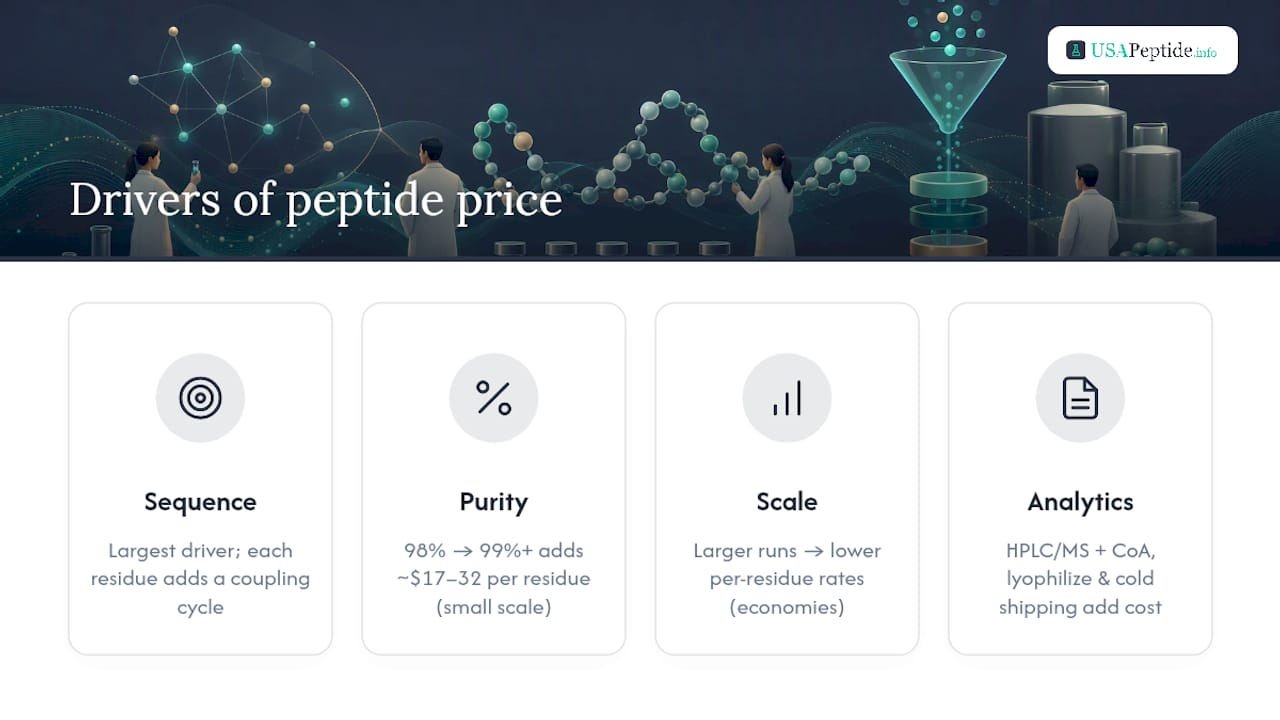
Purity tier compounds that effect nonlinearly. Moving from 98% to 99%+ requires additional purification passes that can raise per-amino-acid cost by a range of about seventeen to thirty-two dollars at small synthesis scales. That premium is the price of removing truncated sequences and diastereomers that a lower-purity batch tolerates.
Scale works the other direction. Per-aa pricing tables from synthesis vendors consistently show lower per-residue rates at larger production runs, since fixed equipment and labor costs get amortized across more product.
Analytical verification and fulfillment add a final layer that is easy to overlook. Producing a Certificate of Analysis, running HPLC and mass spectrometry confirmation, lyophilizing the product, and shipping it cold all cost money that gets folded into the sticker price whether the vendor itemizes it or not.
Pro Tip: *When two vendors quote similar $/mg for the same compound, ask each for their raw HPLC chromatogram, not just the summary purity number.
For a deeper walk-through of how these factors interact, USAPeptide's guide to peptide cost factors covers the procurement side in more detail, and the solid-phase synthesis protocol guide explains why sequence complexity adds real manufacturing steps rather than just marketing markup.
How Do You Convert Catalog Prices Into $/mg?
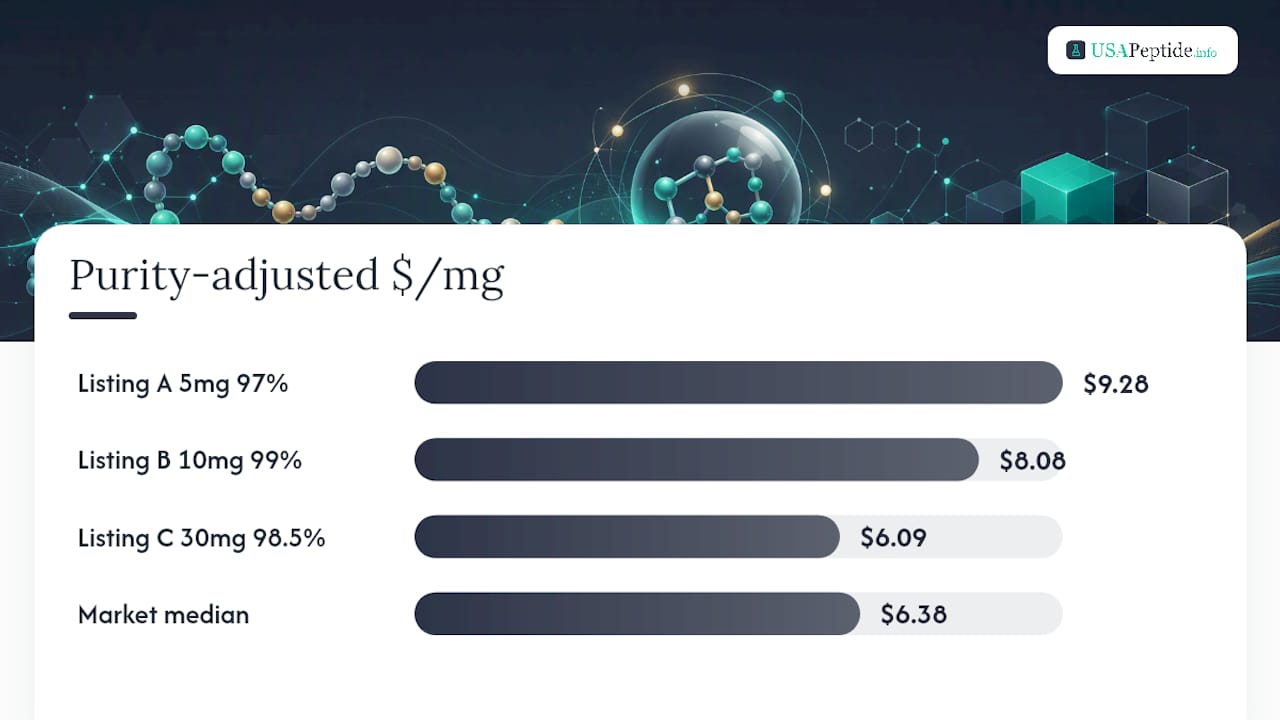
The formula is simple: take the vial price, divide by the labeled milligram content, then divide again by the purity fraction to get the effective cost of pure peptide. A $60 vial labeled 5 mg at 98% purity works out to $60 ÷ 5 ÷ 0.98, or roughly $12.24 per milligram of actual peptide, not the $12.00/mg you would get by skipping the purity adjustment.
Three listings show why this matters in practice:
- Listing A: $45 for a 5 mg vial at 97% purity. Raw price per mg is $9.00; purity-adjusted, it is $9.28/mg.
- Listing B: $80 for a 10 mg vial at 99% purity. Raw price per mg is $8.00; purity-adjusted, it is $8.08/mg, a better deal despite the higher sticker price.
- Listing C: $180 for a 30 mg vial at 98.5% purity. Raw price per mg is $6.00; purity-adjusted, it is $6.09/mg, the cheapest option of the three on a per-milligram basis.
A market-wide index tracking $/mg across 66 vendors puts the median at a median market price per milligram of about six dollars and thirty-eight cents, which gives you a rough benchmark for spotting outliers on either end.
Buying the largest available vial is not always the smarter move, though. If your protocol only calls for small doses over a short study window, a large vial means more freeze-thaw cycles, more reconstituted material sitting in storage, and more risk of degradation before you use it all. The per-mg savings on paper can disappear fast if half the vial goes unused past its stability window.
What Hidden Costs Should Labs Budget For?
The catalog price is rarely the full cost of getting usable, trustworthy peptide into a study. Several predictable line items sit outside the sticker price, and skipping them is how budgets run over.
- Independent HPLC/MS retesting through a third-party lab typically costs several hundred to several thousand dollars per sample depending on sequence complexity, and it is the only way to confirm a vendor's COA claims independently.
- Cold-chain shipping adds cost beyond standard freight, particularly for temperature-sensitive compounds; USAPeptide's storage temperature reference covers what proper handling actually requires and what happens when it is skipped.
- Consumables like sterile water for reconstitution, syringes, filters, and storage vials add a modest but recurring cost per experiment.
- Personnel time spent verifying documentation, reconstituting compounds, and managing storage logistics is real labor cost that rarely appears in a procurement line item but should.
- A contingency buffer covers failed lots, contamination events, or the need for expedited replacement shipping when a study timeline cannot absorb a delay.
Budgeting on sticker price alone is a common way projects underestimate total spend, since verification and logistics costs are the parts most often left out of a first-pass estimate.
What Should a Vendor-Quality Checklist Include?
A short, consistent vetting protocol catches most problems before an order ships, and it does not need to be complicated to be effective.
Request four documents before you buy: a lot-specific Certificate of Analysis tied to the exact batch you are purchasing (not a generic template), the raw HPLC chromatogram rather than just a summary purity percentage, mass spectrometry identity confirmation showing the correct molecular weight, and an endotoxin report if the compound will touch cell culture work.
Prefer vendors who can point to ISO 17025 accreditation for their testing lab, who publish third-party test reports rather than only in-house results, and who state their cold-chain shipping method explicitly rather than leaving it vague.
Red flags worth walking away from include COAs with no lot number, purity claims with no accompanying chromatogram, and pricing that sits dramatically below the market median with no explanation. A basic vetting sequence looks like this:
- Request the lot-specific COA and chromatogram before paying.
- Cross-check the stated molecular weight against published reference values.
- Confirm the testing lab's accreditation status independently rather than taking the vendor's word for it.
- Hold a small contingency budget for a confirmatory retest on your first order from any new supplier.
Pro Tip: Keep a simple spreadsheet logging every COA you receive by lot number. When a vendor reuses the same COA across multiple batches, a discrepancy in retest results becomes obvious fast. USAPeptide's six-point COA checklist walks through this process in more detail for labs building a formal sourcing protocol.
How Do You Build a Peptide Budget for a Grant or Study?
A workable budget template has five line items, and each one should be filled in with a real number before you submit a grant narrative or procurement request.
- Verified $/mg at required purity, calculated using the conversion method above, multiplied by the total milligrams your protocol requires.
- Independent testing, budgeted at the low end of the $800 to $5,000 range for at least one confirmatory retest per new vendor relationship.
- Shipping, including cold-chain premiums if the compound requires temperature control in transit.
- Consumables and supplies, covering reconstitution materials, storage vials, and any protective packaging.
- Contingency, set at a significant contingency percentage of the subtotal to absorb failed lots or expedited reorders.
A three-month small in vitro study using 10 vials of a mid-priced compound at $8/mg purity-adjusted, averaging 10 mg per vial, comes to roughly $800 in compound cost. Add one $1,200 confirmatory retest, $300 in cold-chain shipping across three shipments, $150 in consumables, and a 20% contingency of roughly $490, and the realistic total lands near $2,940, not the $800 the catalog price alone would suggest.
When writing the grant narrative, state your purity requirement explicitly and tie it to assay sensitivity. Reviewers respond better to "99% purity was selected because truncated sequences interfere with the binding assay" than to an unexplained purity number.
How USAPeptide.info Helps You Verify Price Against Quality
Comparing quotes across vendors is tedious when every listing formats price, purity, and vial size differently. USAPeptide's peptide database standardizes molecular profiles and documented purity data across compounds so you are not reconstructing that information from scratch for every quote.
A COA grading tool applies a consistent document checklist (lot number, chromatogram, mass spec identity) to supplier paperwork to streamline review. A peptide dosage calculator converts research dosing plans into milligram totals needed for budgeting, integrating pricing calculations smoothly.
The platform lists ISO 17025-accredited suppliers with downloadable COAs attached, helping to streamline the vetting process. The goal is fewer surprises between the quote you receive and the compound that shows up at your bench.
Cost and Reproducibility Are the Same Decision
Treating peptide cost purely as a line-item minimization problem misses what is actually at stake in most research budgets. When an assay's sensitivity depends on purity, a small "purity premium" is not overspending. It is the cost of an experiment that produces a result you can trust.
Institutional purchasing policies exist for a reason here too. Traceable, lot-documented sourcing is not paperwork for its own sake. It is what lets you explain, months later, exactly what went into a result that a reviewer is questioning.
— USAPeptide Team
Where to Verify Pricing and Documentation Before You Order
A dedicated platform supports comparison work by providing standardized reference data and verification tools in one place, along with referrals to ISO 17025-accredited suppliers.
Start with the peptide reference and tool hub to run a quote through the COA grading criteria before you commit to an order. If your study focuses on a specific research area, the curated pages for fat loss and metabolic research, tissue recovery, and muscle growth research narrow the comparison to compounds already relevant to your protocol. Check a listed supplier's current pricing and documentation directly on the site before finalizing a purchase order.
Sources
The price ranges and budgeting figures in this article draw on a small set of sources chosen for how directly they map to research-grade peptide procurement, rather than consumer or clinic pricing.
- How Much Do Peptides Cost in 2026? Price Guide by Compound - Stage and Cinema
- How to Budget for Peptide Purchases in a Lab — Peptide Insider
- Pricing | Peptide Synthesis — BioBasic
This article is general information, not a substitute for advice from a qualified doctor. Consult a qualified healthcare professional about your own circumstances before acting on anything here.
FAQ
Can Anyone Buy Research-Only Peptides?
Research peptides sold for laboratory use are intended for qualified researchers and institutions conducting in vitro or preclinical work, not for human consumption. Suppliers typically require buyers to acknowledge research-use-only terms before purchase.
What Is the Most Trustworthy Peptide Company?
Trustworthiness comes down to documentation rather than brand reputation alone: look for lot-specific COAs, ISO 17025-accredited testing, and published HPLC chromatograms rather than summary purity claims. USAPeptide's database lists suppliers that meet these documentation standards.
Where Can I Buy Research Peptides?
Research peptides are available through specialized suppliers that provide Certificates of Analysis and purity documentation for each batch. USAPeptide.info's reference hub lists ISO 17025-accredited suppliers alongside the molecular data and dosage tools needed to evaluate a quote before ordering.