Research-grade peptide prices are driven by seven factors: sequence length and complexity, purity target (crude versus HPLC versus ≥99%), synthesis scale in µmol tiers, chemical modifications, per-lot QC and COA depth, packaging format, and shipping logistics. A vendor quoting $200 for a 30-residue phosphorylated peptide with no lot-specific documentation isn't offering a deal. They're likely cutting one of these seven corners.
Before you sign a purchase order, confirm:
- Sequence length and any modifications (phospho, biotin, fluorophore, isotope labels)
- Target purity, tested via RP-HPLC with a matching chromatogram
- Batch size in µmol and whether the lot is dedicated or pooled
- QC scope: MALDI-TOF versus ESI-MS, endotoxin testing, residual solvents
- Packaging format (lyophilized vs. solution) and cold-chain shipping needs
An ISO 17025-accredited lab and a batch-matched Certificate of Analysis are the two line items that separate a defensible quote from a guess.
Pro Tip: Ask every vendor for the cost per COA-verified milligram, not the price per vial. It's the only number that lets you compare quotes apples to apples.
Key Takeaways
Peptide pricing is fair only when it's measured in cost per COA-verified milligram, not sticker price per vial.
| Point | Details |
|---|---|
| Normalize to verified mg | Divide total cost by purity-adjusted, COA-confirmed mass before comparing any two vendors. |
| Match spec to risk | Reserve ≥99% purity and full QC panels for GLP or in vivo work; 95% can suffice for in vitro screens. |
| Treat rock-bottom prices as flags | Prices far below market for long or modified peptides usually signal missing documentation. |
| Amortize fixed costs | Larger vial fills and consolidated orders lower per-mg packaging and QC overhead. |
| Verify before you buy | Use tools like USAPeptide.info's COA checker to confirm lot-specific documentation ahead of purchase. |
Table of Contents
- What Drives Peptide Cost Factors During Procurement Intake?
- Why Do Peptide Manufacturing Costs Vary So Much Between Vendors?
- How Do µmol Pricing Tiers Translate to Real Order Cost?
- What Red Flags Mean a Peptide Quote Needs More Scrutiny?
- How Can Labs Cut Peptide Costs Without Losing QC Rigor?
- How Do You Read a COA to Verify What You're Actually Paying For?
- Why Documentation Often Matters More Than the Sticker Price
- Where USAPeptide.info Fits Into Your Procurement Workflow
- Sources
What Drives Peptide Cost Factors During Procurement Intake?
Before accepting any quote, run it through a short checklist. This catches the documentation gaps that cause the most expensive downstream headaches: repeat purchases, failed assays, or unplanned third-party retesting.
- Confirm lot-specific COA availability. Ask whether the Certificate of Analysis is batch-matched to the exact lot you're buying, and whether the issuing lab is named and independently verifiable.
- Check the purity spec against COA-verified mass. A vial labeled 5 mg at 95% purity delivers less active peptide than a 5 mg vial at ≥99%. Calculate verified mg before comparing price.
- Identify the identity test method. MALDI-TOF and ESI-MS answer different questions about mass confirmation, and vendors don't always disclose which one ran.
- Verify packaging format and fill accuracy. Lyophilized powder and pre-dissolved solution carry different stability profiles and different per-mg costs; ask if fill mass is nominal or independently confirmed.
- Add landed cost before comparing totals. Shipping, cold-chain packaging, and minimum-order fees can shift the real price per lot, since shipping thresholds and flat-rate surcharges often push buyers toward larger orders than planned.
Pro Tip: Request an itemized testing quote and a sample COA from a previous lot before you place the order. A vendor who hesitates to share either one is telling you something.
Why Do Peptide Manufacturing Costs Vary So Much Between Vendors?
Every dollar on a peptide quote traces back to a specific technical decision. Here's the actual mechanism behind each one.
Sequence length and complexity. Solid-phase synthesis runs one coupling cycle per residue, and yield drops compound with every added amino acid. A 40-residue peptide with a difficult motif might require segment condensation or native chemical ligation, techniques that add both labor and purification steps. That's why per-residue surcharges scale non-linearly on long or structurally awkward sequences, not just proportionally.
Purity target and the purity cliff. Moving from crude peptide to HPLC-purified material captures most of the yield relatively cheaply. Manufacturing complexity compounds this effect: long, structurally difficult sequences already have low starting yields, so the purity cliff hits them hardest.
Scale and batch size. Setup costs, resin conditioning, and QC overhead get amortized across the batch. Order 1 µmol and you pay nearly the same fixed costs as someone ordering 25 µmol, just spread across far less material. That's the real reason a 5 mg custom lot costs more per verified milligram than a 50 mg lot.
Chemical modifications. Phosphorylation, biotinylation, fluorophore conjugation, and isotopic labeling each add discrete synthetic steps. Cost schedules from academic core facilities show these priced as flat per-modification fees or per-residue surcharges rather than folded into a single number, which is worth checking against any commercial quote you receive.
QC, testing, and documentation. ISO 17025 accreditation means a lab's testing methods, calibration, and reporting have been externally audited. Third-party testing panels covering HPLC, mass spec, endotoxin, and residual solvent analysis commonly add $50 to $300 per lot depending on scope.
Packaging and shipping. Lyophilization extends shelf stability but adds processing steps, and smaller vial fills carry higher per-mg packaging costs because labeling and handling overhead stays fixed regardless of fill size. Cold-chain shipping adds a separate line item on top.
Lead time and batch matching. Rush orders and resynthesis after a failed QC run both raise program cost, especially when low yield forces a full re-run rather than a partial top-up.
How Do µmol Pricing Tiers Translate to Real Order Cost?
A price sheet quoting "$3 per µmol" means little until you convert it into cost per verified milligram, adjusted for purity and add-on fees. Here's how that math plays out for two common order types.
Example 1: Short unmodified peptide, small scale. A 12-residue peptide at 25 µmol scale might list a base price around $150 to $250 depending on the vendor's tier structure. At ≥99% purity with a COA-verified mass close to the 15 mg label claim, that works out to roughly $10 to $17 per verified mg before add-ons.
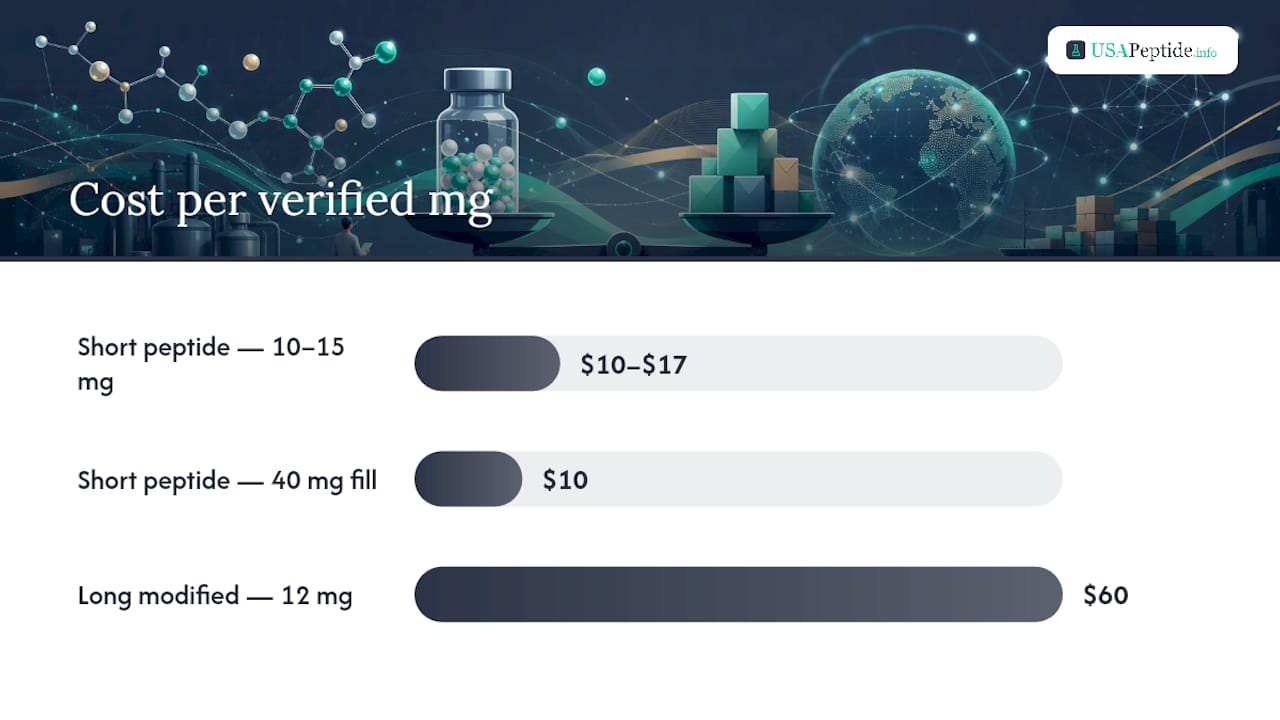
Example 2: Long modified peptide, typical research lot. A 32-residue peptide with a biotin tag at similar scale carries a base synthesis price plus a flat modification fee, commonly a discrete line item rather than a percentage markup. Add an ESI-MS identity check and endotoxin testing, and the per-mg cost can run two to three times higher than that of the short peptide above.
| Scale tier | Typical labeled mass | Base price range | Common add-ons | Approx. cost per verified mg |
|---|---|---|---|---|
| 25 µmol, short peptide | 10–15 mg | $150–$250 | MALDI-TOF (often no charge) | $10–$17 |
| 25 µmol, short peptide | 40 mg | $300 | ESI-MS ($30/sample) | $10 |
| 25 µmol, modified/long peptide | 12 mg | $400 | Modification fee + ESI-MS | $60 |
- Larger vial fills lower per-mg packaging cost, but only order beyond your near-term need if stability data supports long-term storage.
- Always recalculate cost per mg after applying the purity correction, not the labeled mass alone.
What Red Flags Mean a Peptide Quote Needs More Scrutiny?
A quote that looks too good usually is. Prices sitting noticeably below market averages for a complex or modified peptide correlate strongly with missing or fabricated documentation.
Watch for these before you buy:
- No lot-specific COA offered before purchase, only a generic "typical" one
- A COA issued by a lab you can't independently identify or contact
- Vial fill mass described as "approximate" with no COA-verified figure
- Payment restricted to non-reversible methods with no return policy
- Pricing dramatically undercutting comparable vendors for the same length and modification profile
Work through this order when a quote raises questions:
- Request the batch-matched COA and confirm the lot number matches what ships.
- Ask which lab ran the testing, and verify its accreditation independently.
- Request the raw RP-HPLC chromatogram and MS trace, not just a purity percentage.
- Decide whether the documentation is strong enough to accept as-is, or whether the experiment's risk level justifies independent re-testing, which can run several hundred dollars but often costs less than a failed study.
How Can Labs Cut Peptide Costs Without Losing QC Rigor?
Lowering spend doesn't have to mean lowering standards. A few tactics preserve documentation quality while trimming the bill:
- Order larger vial fills when your storage and stability protocol allow it, since fixed packaging costs shrink per mg as fill size grows.
- Consolidate multiple compound orders into a single batch or vendor relationship to amortize setup and QC fees across more total material.
- Specify your full test panel (HPLC, MS type, endotoxin, residual solvent) at quote request, not after the invoice arrives.
- Accept a vendor's COA at face value only when it comes from an accredited, batch-matched source. Anything less warrants independent verification.
- Match purity tier to experimental risk. In vitro screening studies can often tolerate 95% purity, while GLP or in vivo work generally calls for ≥99% and tighter COA scrutiny.
Pro Tip: Ask recurring vendors about pre-paid testing credits. Locking in a bulk rate on QC panels before you need them is often cheaper than negotiating per-lot.
How Do You Read a COA to Verify What You're Actually Paying For?
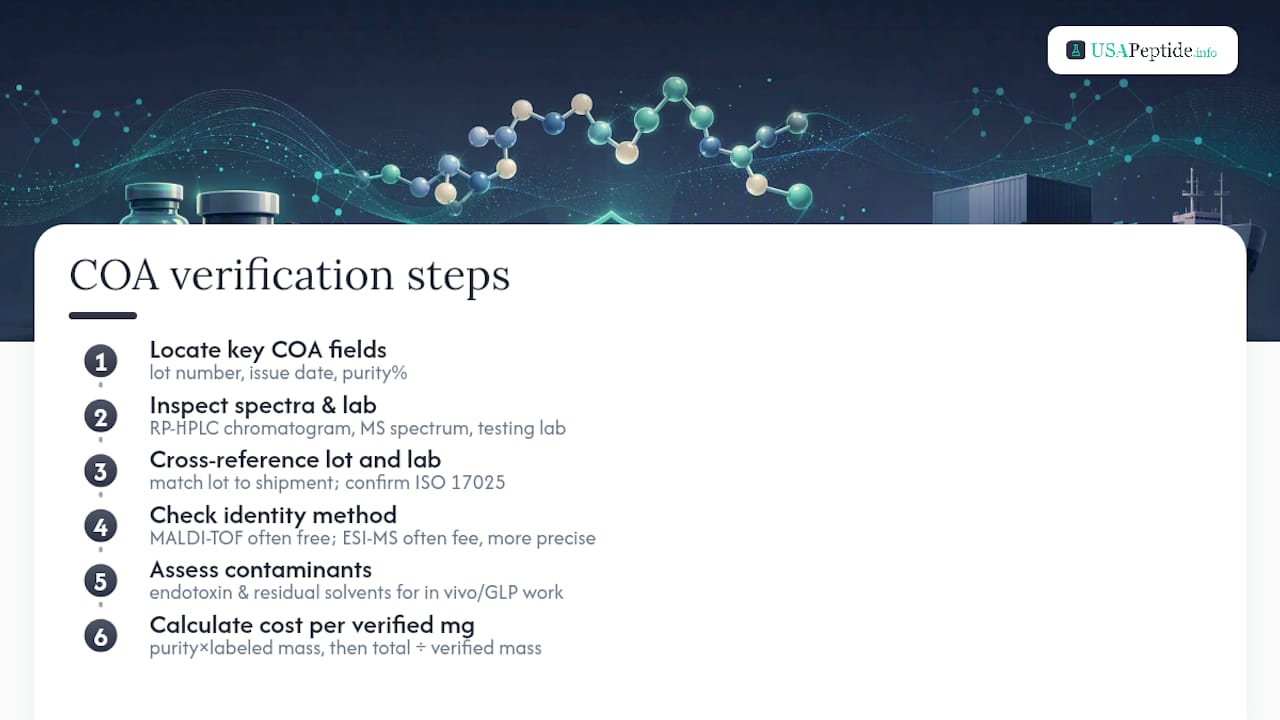
A Certificate of Analysis is only useful if you read every field on it. Locate the lot number, issue date, stated purity percentage, the RP-HPLC chromatogram itself, the MS spectrum, and the name of the testing lab. Cross-reference the lot number against your shipment before you run anything.
MALDI-TOF is commonly offered as a no-charge identity check confirming molecular weight, while ESI-MS often carries a per-sample fee and provides more precise mass accuracy for complex or modified sequences. Endotoxin and residual solvent data matter most for in vivo or GLP-adjacent work, less so for basic in vitro screening.
Once you have the purity percentage and labeled mass, multiply them to get COA-verified mass, then divide total cost by that number to reach true cost per verified mg. USAPeptide.info's COA checker automates that comparison, and the calculator handles the purity-adjusted math directly.
Pro Tip: Search the testing lab's name independently before trusting its ISO 17025 claim. A legitimate accreditation is verifiable in minutes; a fabricated one usually isn't.
Why Documentation Often Matters More Than the Sticker Price
Procurement teams that chase the lowest quote usually pay for it later, in failed assays or unplanned retesting. Documentation depth, specifically a batch-matched COA from a named, accredited lab, should weigh as heavily in the decision as the number on the invoice. Match your specification tier to how much risk the experiment can tolerate, and let that judgment, not the sticker price, drive the purchase order.
Where USAPeptide.info Fits Into Your Procurement Workflow
Comparing quotes across vendors gets a lot faster once you can grade a COA instead of guessing at it. USAPeptide.info's COA checker flags missing fields and inconsistent purity claims before you commit to a purchase order, and the calculator converts any vendor's price and label mass into a true cost-per-verified-mg figure in seconds.
Pair those tools with the peptide reference guide for molecular profiles and sourcing context on the compounds your lab actually orders. If you have a quote sitting in your inbox right now, the fastest next step is running its COA through the checker before you approve the invoice.
Sources
- Research Peptide Pricing Explained 2026 | PurePep Vital
- Peptide Prices Compared: Cost per mg Adjusted for Purity
- Why Some Peptides Cost More Than Others: Manufacturing Complexity Explained | Durham Peptides
- Peptides
- Cost Recovery Schedule for Peptide Synthesis (Pep Synthesis Charges) | UT Southwestern