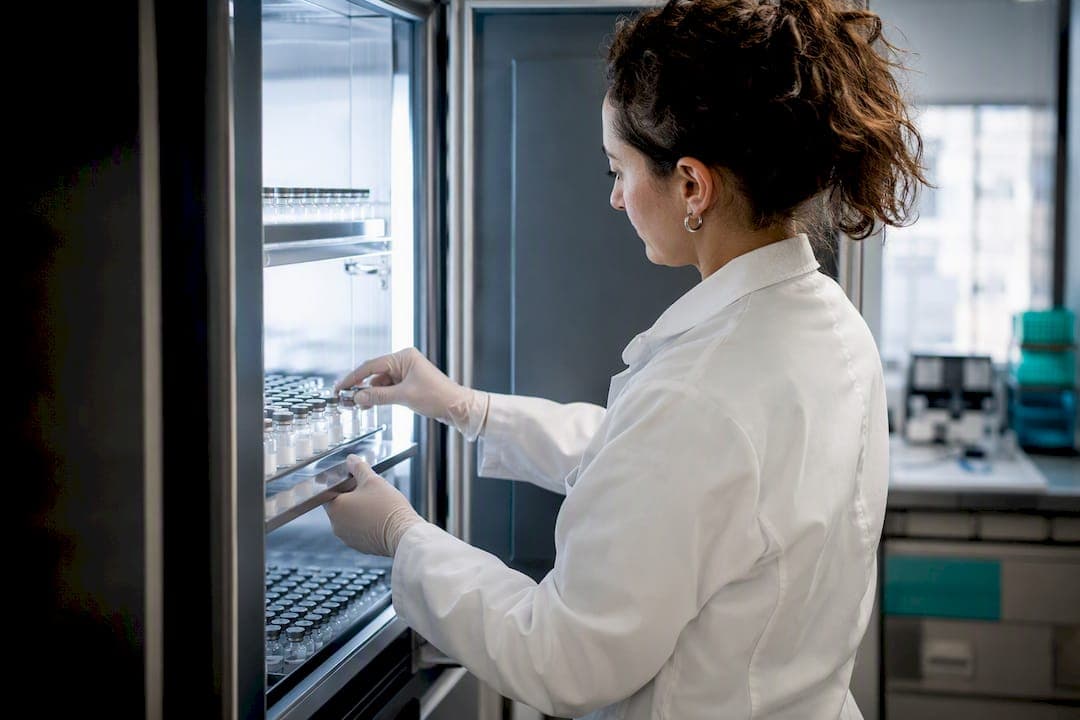
Lyophilized peptides belong in a freezer at −20 °C for routine long-term storage, with −80 °C reserved for maximal stability on sensitive sequences. A refrigerator at cool temperatures is acceptable when you need the material within weeks rather than years. Once reconstituted, the rules change: store the solution at 2–8 °C, and if you dissolved the peptide in bacteriostatic (BAC) water, plan on roughly 28 days of usable life after the first puncture. Do not refreeze an original reconstituted vial unless you have already split it into aliquots.
Three variables undo more research peptide than any of these numbers suggest: moisture, light, and repeated freeze-thaw cycling. Certain residues, including cysteine, methionine, tryptophan, aspartate, and glutamine, are disproportionately sensitive to oxidation and hydrolysis, so a sequence with several of these amino acids deserves more conservative handling than the baseline rule.
- Lyophilized powder: −20 °C long-term, −80 °C for maximum stability, 2–8 °C for short windows.
- Reconstituted solution: 2–8 °C, ~28 days with a BAC water preservative.
- Never refreeze an opened multi-dose vial; aliquot first.
- Watch for sequence-specific sensitivity (Cys, Met, Trp, Asp, Gln).
Key Takeaways
Peptide stability depends less on a single ideal temperature than on matching storage conditions, packaging, and handling discipline to whether the material is dry powder or reconstituted solution.
| Point | Details |
|---|---|
| Lyophilized storage | Keep dry powder at −20 °C for years of stability, or −80 °C for sensitive sequences. |
| Reconstituted limit | Store solutions at 2–8 °C; BAC water imposes a preservative-driven 28-day usage window. |
| Freeze-thaw discipline | Aliquot at receipt into sterile cryovials to avoid repeated thaw cycles that cause aggregation. |
| Equilibration matters | Warm sealed vials in a desiccator before opening to prevent condensation-driven hydrolysis. |
| Equipment choice | Use static, non-frost-free freezers with calibrated data loggers and alarm thresholds. |
Table of Contents
- How to Store Lyophilized Peptides for Maximum Shelf Life
- Storing Reconstituted Peptide Solutions Correctly
- Handling Peptides on Receipt Without Introducing Moisture
- Aliquoting Protocols That Prevent Freeze-Thaw Damage
- Equipment That Keeps Storage Temperature Stable
- What To Do After a Temperature Excursion
- Verifying Purity Before You Trust the Storage Clock
- Get Research-Grade Peptides With Verified Storage Documentation
- The Gap Between Storage Labels and Actual Peptide Chemistry
- Sources
How to Store Lyophilized Peptides for Maximum Shelf Life
Freeze-dried peptide material is stable primarily because lyophilization strips out nearly all residual moisture, and water is the reactant that drives hydrolysis, the main degradation pathway for peptide bonds. Analytical stability studies confirm that low residual moisture slows hydrolysis, oxidation, and aggregation simultaneously, which is why dry powder tolerates far more temperature swing than a solution ever will.
Realistic shelf-life windows scale directly with temperature. At room temperature, expect stability measured in days to a few weeks, useful mainly for transit. At 2–8 °C, most peptides hold for several months. At −20 °C, peer-reviewed stability data documents multi-year stability, and some vaccine-related peptides remain viable at −80 °C for five years or more. Supplier technical guidance from GenScript backs the −20 °C recommendation as the practical standard for most research peptides.
Packaging matters as much as the freezer setpoint:
- Keep desiccant packs in every storage container to intercept ambient moisture.
- Use tightly capped or amber vials to block light exposure, per NIBSC guidance recommending cool, dark, dry conditions.
- Vacuum-seal or nitrogen-flush vials for long-term archives when oxidation-prone residues are present.
- Avoid frost-free freezers. Their automatic defrost cycles introduce repeated warm-cool swings that mimic freeze-thaw stress on the powder itself.
Storing Reconstituted Peptide Solutions Correctly
Reconstitution changes the stability equation entirely. The peptide molecule itself often remains chemically intact well past a month in solution, but the 28-day usage window commonly cited for BAC water is a sterility limit, not a chemistry limit. Benzyl alcohol, the preservative in bacteriostatic water, only maintains antimicrobial protection for multi-dose access up to about four weeks. That distinction matters for how you interpret expiration guidance from different suppliers.
Store reconstituted vials at 2–8 °C, never at room temperature for anything beyond brief bench handling. Label each vial the moment you puncture the septum, recording the exact date and time, since that puncture is what starts the sterility clock, not the reconstitution date if the vial sat sealed afterward.
- Refrigerate immediately after reconstitution; do not leave solution on the bench between uses.
- Mark puncture date and time on the vial label, not just the reconstitution date.
- Treat multi-dose vials as sterility-limited even if the peptide itself would remain stable longer.
- If you need frozen storage, aliquot into sterile cryovials first. Never refreeze the original multi-dose vial.
Filtration through a sterile 0.22-micron filter during reconstitution reduces microbial load, and buffer pH should sit near the peptide's stability optimum, typically slightly acidic to neutral for most research sequences, to limit deamidation.
Pro Tip: If your protocol requires frozen aliquots of a reconstituted peptide, split the solution into single-use volumes immediately after reconstitution rather than after several uses. Every thaw cycle on a shared vial adds contamination risk on top of the freeze-thaw stress itself.
Handling Peptides on Receipt Without Introducing Moisture
Shipment exposure is rarely the failure point. Supplier packaging standards confirm that insulated shipping protects lyophilized peptides through days of transit, so a package that spent 48 hours at ambient temperature is not automatically compromised. The real risk window opens the moment you crack a cold vial open in warm, humid lab air.
- Inspect the shipment on arrival and log the date and time of receipt in your inventory system.
- Move sealed vials directly into the appropriate cold storage. Do not let them sit on a bench "for later."
- Before opening a frozen or refrigerated vial, let it equilibrate to room temperature inside a sealed desiccator. Opening a cold vial to open air causes atmospheric moisture to condense on the powder, triggering localized hydrolysis before you have even started your experiment.
- Store vials upright toward the back of the fridge or freezer, away from the door where temperature fluctuates most.
- Label each vial with peptide name, lot number, and date of first opening.
Pro Tip: A small desiccator cabinet on the bench, not just in the freezer, gives you a controlled space for equilibration and prevents the "cold vial meets humid air" mistake that ruins otherwise well-stored material.
Aliquoting Protocols That Prevent Freeze-Thaw Damage
Every freeze-thaw cycle forces ice crystal formation and thaw stress on peptide chains, and published research links repeated cycling directly to aggregation and measurable loss of bioactivity. Aliquoting at receipt, rather than after the third or fourth use, is the single highest-leverage habit in peptide storage.
- Reconstitute or portion the peptide into sterile cryovials sized for a single experiment's volume.
- Minimize headspace in each vial to reduce oxidation surface area.
- Freeze aliquots immediately at −20 °C (or −80 °C for sensitive sequences) rather than holding them at 2–8 °C first.
- Label every aliquot with concentration, date, and lot number.
- Organize aliquots in a freezer rack by peptide and experiment date for fast retrieval without prolonged door-open time.
- Cap freeze-thaw cycles per aliquot at one wherever the protocol allows; run an analytical check (HPLC or mass spec) on any aliquot that has been thawed more than once before trusting the results.
Equipment That Keeps Storage Temperature Stable
Frost-free freezers are convenient for a kitchen, not a peptide bank. Their defrost cycles push internal temperature up several degrees on a schedule, and that cycling adds up to a form of chronic freeze-thaw stress even when the vial never leaves the shelf. A static, manual-defrost freezer holds a flatter temperature curve and is the better choice for anything stored longer than a few weeks.
- Use a calibrated thermometer or digital probe placed at the shelf level where peptides actually sit, not just the unit's built-in display.
- Deploy a continuous data logger for any freezer or fridge holding valuable or long-term inventory, with alarm thresholds set a few degrees inside the safe range.
- Pair alarms with backup power or a generator circuit for freezers holding irreplaceable reference standards.
- Log temperature checks on a fixed schedule and keep the log with your COA and inventory records for full traceability.
What To Do After a Temperature Excursion
Not every warm-up event is a crisis. A lyophilized vial that spent under 24 hours at room temperature during a power blip is usually fine, particularly for sequences without heavy Cys, Met, or Trp content. Extended exposure, more than 24 hours, or any exposure above room temperature, deserves a more careful response.
- Quarantine the affected vials immediately and stop using them for active experiments.
- Document the exposure window: start time, end time, and estimated temperature if you have logger data.
- Inspect the vial visually for clumping, discoloration, or precipitate, all signs of physical degradation.
- Cross-check the incident against the manufacturer's Certificate of Analysis and stability notes for that specific peptide.
- When sterility of a reconstituted solution is in doubt, don't rely on visual inspection alone. Run HPLC or mass spectrometry verification if the material is valuable, or discard it if testing isn't practical.
Verifying Purity Before You Trust the Storage Clock
Storage guidance only works if you know what you are actually storing. A Certificate of Analysis tells you the starting purity and identity of a peptide, and that baseline shapes how conservatively you should treat every temperature decision afterward. USAPeptide works with suppliers offering ISO 17025-accredited testing and ≥99% HPLC purity documentation, the kind of paperwork that lets you distinguish a genuine stability issue from a peptide that was never fully pure to begin with.
- Run any COA you receive through the COA grading tool to confirm it reflects legitimate third-party testing rather than a boilerplate document.
- Use the peptide dosage calculator to plan aliquot volumes before you reconstitute, so you split material correctly on day one instead of after your first freeze-thaw mistake.
- Unfamiliar with a term like "residual moisture" or "deamidation"? The peptide research glossary defines the vocabulary this guidance relies on.
Get Research-Grade Peptides With Verified Storage Documentation
Storage temperature guidance only protects a peptide that was high purity to begin with. USAPeptide.info connects qualified researchers with ISO 17025-accredited, research-grade compounds tested to ≥99% HPLC purity, each backed by a documented Certificate of Analysis you can verify before it ever reaches your freezer. Browse the full peptide reference database for molecular profiles and sourcing details, or check peptides commonly used in tissue recovery research if that is your focus area. Same-day shipping from vetted suppliers means less transit time between order and cold storage, which is exactly the window where careless handling does the most damage.
The Gap Between Storage Labels and Actual Peptide Chemistry
The "30-day rule" is the most misunderstood figure in peptide handling, and it deserves more scrutiny than most protocols give it. That number describes how long benzyl alcohol keeps a multi-dose vial microbiologically safe, not how long the peptide bond itself remains intact. Conflating the two leads researchers to discard chemically sound material out of caution, or worse, to trust sterility past its real limit because "the peptide seems fine."
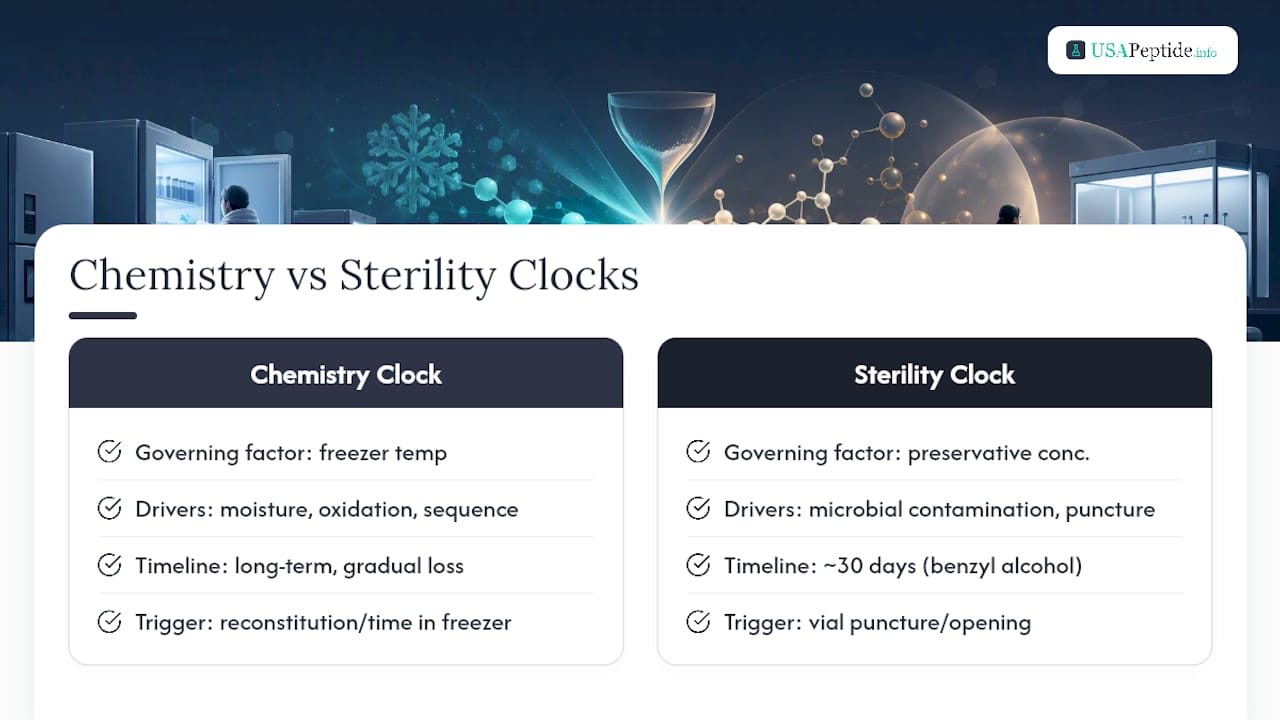
The more useful mental model separates two clocks running in parallel: a chemistry clock, driven by moisture, oxidation, and sequence-specific residue sensitivity, and a sterility clock, driven entirely by preservative chemistry once you puncture a vial. Freezer temperature governs the first. Preservative concentration governs the second. Confusing them is why so many labs either waste stable peptide too early or misjudge risk on contaminated solution.
The practical fix isn't more caution. It's better documentation: track puncture dates separately from reconstitution dates, verify purity against a real COA before assuming degradation explains an odd result, and let sequence-specific residue data, not a generic rule, set your storage timeline.
This article is general information, not a substitute for advice from a qualified doctor. Consult a qualified healthcare professional about your own circumstances before acting on anything here.
Sources
- Dx
- Peptide Storage and Handling Guidelines
- Pubmed
- Peptide Handling, dissolution & Storage
- How to Store Peptides: Shelf Life, Fridge vs. Freezer & the 30-Day Myth (2026)