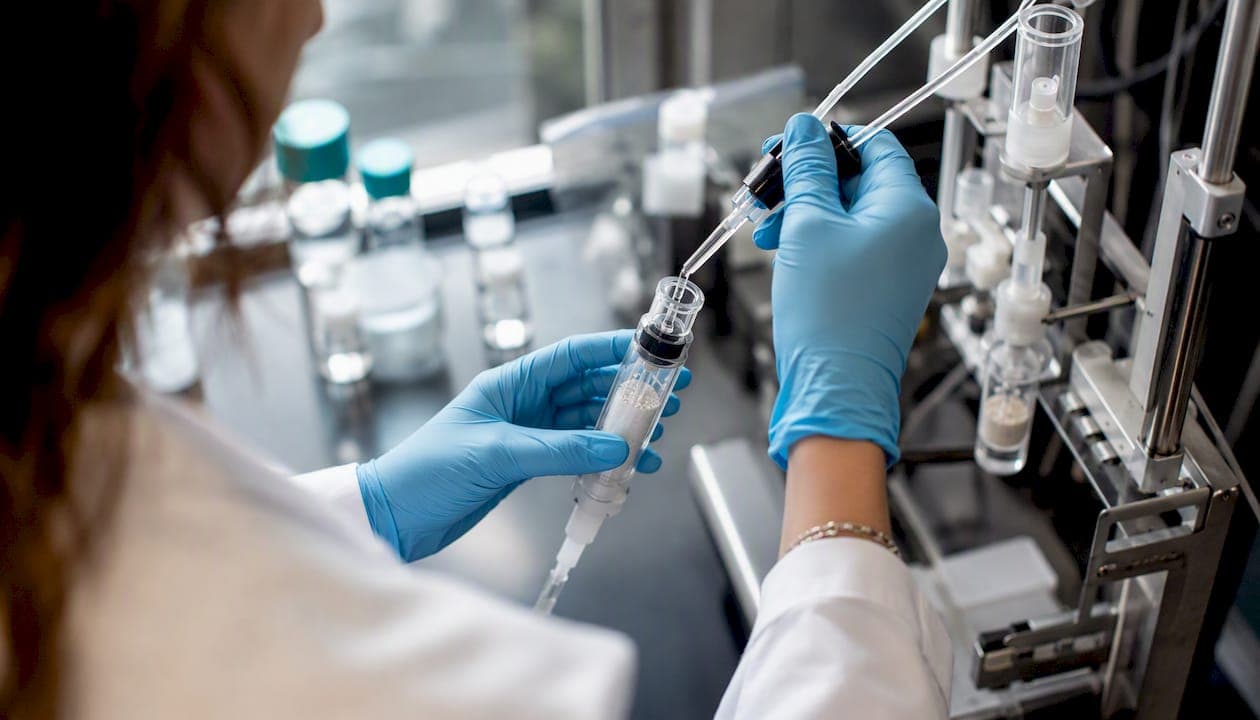
Solid phase peptide synthesis (SPPS) is a method for assembling peptide chains stepwise from C-terminus to N-terminus on an insoluble resin support, allowing each coupling and deprotection cycle to be driven to completion with large reagent excesses before washing away byproducts. The standard workflow proceeds in four repeating operations: attach the C-terminal amino acid to a resin-bound linker, remove the temporary N-terminal protecting group, couple the next activated amino acid, wash thoroughly, then repeat until the full sequence is assembled. Final global deprotection and cleavage release the peptide from the resin. For most academic research, the recommended default is Fmoc/tBu chemistry on Rink amide or Wang resin, activated with DIC/Oxyma or HATU, and cleaved with a TFA-based cocktail.
Quick-reference defaults before diving into the details:
- Protecting-group scheme: Fmoc/tBu for nearly all research applications; Boc/Bzl reserved for special cases
- Resin: Rink amide MBHA for C-terminal amides; Wang for C-terminal acids
- Coupling reagents: DIC/Oxyma or HATU/DIPEA at 3–6 equivalents relative to resin loading
- Cleavage: TFA-based cocktail, typically 95:2.5:2.5 TFA:H₂O:TIPS (v/v/v) for standard sequences
- First practical step: always run a small-scale test cleavage on a few milligrams of resin before committing the full batch
Key Takeaways
Solid phase peptide synthesis requires matching protecting-group scheme, resin, coupling reagents, and cleavage cocktail to the specific sequence, with on-resin monitoring and test cleavage at every critical decision point.
| Point | Details |
|---|---|
| Default strategy | Use Fmoc/tBu on Rink amide or Wang resin with DIC/Oxyma or HATU for most research applications. |
| Cleavage cocktail | 95:2.5:2.5 TFA:H₂O:TIPS is standard; add EDT for Cys/Met sequences; always test on a small resin aliquot first. |
| Coupling efficiency | Small per-step losses compound rapidly; use 3–10× excess reagents and monitor every 5–10 cycles for sequences above 30 residues. |
| Difficult sequences | Reduce resin loading, incorporate pseudoproline inserts, and switch to PEGylated supports before accepting poor crude purity. |
| Long peptides | Plan for NCL or fragment condensation when sequence length exceeds 40–50 residues; stepwise yield drops sharply beyond that range. |
Table of Contents
- How solid phase peptide synthesis works: the stepwise cycle
- Choosing between Fmoc/tBu and Boc/Bzl protecting-group strategies
- Selecting the right resin and linker for your target peptide
- Coupling reagents, activation strategies, and racemization control
- Final cleavage and side-chain deprotection: cocktails, scavengers, and special cases
- Automation, microwave-assisted synthesis, and scale-up considerations
- Troubleshooting difficult or aggregation-prone sequences
- When stepwise synthesis reaches its limits: long peptides and ligation strategies
- On-resin monitoring, analytical workflows, and quality assurance
- Safety, reagent handling, and waste disposal in U.S. SPPS labs
- In-house SPPS versus outsourcing: how to decide
- What the field gets wrong about SPPS protocol decisions
- Sources
How solid phase peptide synthesis works: the stepwise cycle
Each SPPS cycle consists of discrete, sequential operations. Understanding the timing and reagent concentrations at each step is what separates reproducible synthesis from variable results. The PMC introduction to peptide synthesis outlines the core Boc and Fmoc cycle logic that underpins all modern protocols.
Standard Fmoc SPPS cycle (per residue):
| Step | Reagent / Condition | Typical Duration |
|---|---|---|
| Resin swelling | DCM or DMF, room temperature | 20–30 min (first use) |
| Fmoc deprotection | 20% piperidine in DMF (2 × treatments) | 3 min + 7 min |
| Wash | DMF (3–5 × resin volume) | 1–2 min per wash |
| Amino acid activation | Fmoc-AA + DIC/Oxyma or HATU/DIPEA in DMF | 2–5 min preactivation |
| Coupling | Activated amino acid onto resin | 30–60 min (manual); 5–15 min (microwave) |
| Wash | DMF then DCM | 1–2 min per wash |
| Optional capping | Ac₂O/DIPEA/DMF | 5 min |
This chromophore signal is one of the most practical real-time quality checks available during synthesis.
Coupling equivalents for standard academic-scale runs typically fall in the 3–6× range relative to resin loading, with activator equivalents matched to the amino acid. Solvent choice matters: DMF is the standard, though NMP is a viable alternative for sequences that swell poorly in DMF. Capping with acetic anhydride after each coupling truncates deletion sequences by acetylating any unreacted amine, making downstream purification cleaner even though it sacrifices a small amount of full-length product.
Choosing between Fmoc/tBu and Boc/Bzl protecting-group strategies
The protecting-group scheme determines the entire chemistry of the synthesis: deprotection conditions, resin compatibility, cleavage reagents, and monitoring options all follow from this single decision.
Fmoc/tBu chemistry:
- Fmoc is base-labile (removed by piperidine); tBu side-chain groups are acid-labile (removed by TFA at cleavage)
- UV monitoring of Fmoc removal is straightforward and quantitative
- Compatible with automated synthesizers and standard DMF-based workflows
- Final cleavage uses TFA cocktails, which are manageable in a standard fume hood
- Default choice for the vast majority of research-grade peptide synthesis
Boc/Bzl chemistry:
- Boc is acid-labile (removed by TFA between cycles); Bzl side-chain groups require strong acid (HF) for final cleavage
- No UV monitoring equivalent to Fmoc; cycle completion relies on Kaiser or chloranil tests
- Requires anhydrous HF apparatus, which is a significant safety and infrastructure commitment
- Preferred for peptides containing acid-labile modifications that would not survive repeated TFA treatments, and for certain backbone amide bond-forming strategies
- Orthogonality advantage: Boc/Bzl allows selective manipulation of protecting groups not possible with Fmoc/tBu
The practical consequence of protecting-group choice extends to resin and linker selection. Fmoc chemistry is compatible with acid-labile linkers (Wang, Rink amide), while Boc chemistry demands linkers stable to repeated TFA treatment but cleavable by HF. For most U.S. research labs without HF infrastructure, Fmoc/tBu is the operationally sound default.
Selecting the right resin and linker for your target peptide
Resin and linker choice directly determines the C-terminal functionality of the final peptide, and the physical properties of the support affect swelling, mixing efficiency, and coupling kinetics throughout the run. Bachem's knowledge hub provides practical reactor sizing and swelling guidance for bench-scale work.
Key resin types and their applications:
- Wang resin (polystyrene-based): Acid-labile linker; releases peptide with a free C-terminal carboxylic acid. Standard choice for Fmoc synthesis of acid-terminated peptides. Swells well in DMF and DCM.
- Rink amide MBHA resin: Releases C-terminal amide on TFA cleavage. Preferred for peptides where C-terminal amidation is required for biological activity or stability.
- PEGylated supports (e.g., TentaGel, ChemMatrix): Better swelling in polar solvents; reduces aggregation for hydrophobic or difficult sequences. Higher cost per gram, but the improved solvation often justifies it for sequences above 30 residues.
- 2-Chlorotrityl chloride resin: Very acid-labile; useful for fragment synthesis (releases peptide with minimal side-chain deprotection under dilute AcOH/DCM), protecting acid-labile modifications during fragment condensation.
Loading considerations: Lower resin loading (0.2–0.4 mEq/g) reduces inter-chain aggregation for long or hydrophobic sequences. Higher loading (0.5–0.8 mEq/g) is acceptable for short, soluble peptides and reduces resin volume per batch. Mesh size (100–200 mesh is common) affects flow rate in automated systems; finer mesh improves mixing but can restrict solvent flow in column-format synthesizers.
Swelling the resin in DMF for at least 20–30 minutes before the first coupling step is not optional. Inadequate swelling compresses the polymer matrix and physically blocks reagent access to internal sites, causing coupling failures that no amount of excess reagent will fix.
Coupling reagents, activation strategies, and racemization control
Activation chemistry is where most coupling failures originate. The choice of reagent, equivalents, and preactivation time all influence both efficiency and the risk of racemization at the α-carbon.
Common activating systems:
- HATU/DIPEA: Among the most reactive uronium-type reagents; excellent for hindered or difficult couplings. Risk of guanidinium side-product formation if preactivation is too long (keep under 2 minutes before adding to resin).
- HBTU/DIPEA: Slightly less reactive than HATU; suitable for standard residues. Same guanidinium risk applies.
- DIC/Oxyma (OxymaPure): Carbodiimide/additive combination with a favorable safety and reactivity profile. Oxyma suppresses racemization more effectively than HOBt and avoids the explosion risk associated with HOBt at high concentrations. Recommended for most standard Fmoc couplings.
- DIC/HOBt: Established system; effective but HOBt carries a moisture-sensitive explosion risk at scale, and many U.S. institutions have restricted its storage.
Practical equivalents and solvent guidance:
- Use 3–6 equivalents of Fmoc-amino acid and activator relative to resin loading for standard residues
- For hindered residues (Aib, β-methyl, N-methyl amino acids), extend coupling time to 2–4 hours or use double coupling
- DMF is the standard solvent; NMP improves solvation for aggregation-prone sequences but has a higher boiling point, complicating evaporation during workup
- Preactivate amino acid and activator for 2–5 minutes in a separate vessel before adding to the resin to avoid direct contact of active ester with the resin amine, which can cause racemization
Temperature control matters for racemization-sensitive residues such as Cys and His. Keeping coupling reactions at room temperature and avoiding prolonged preactivation times are the two most reliable mitigation strategies. For sequences where racemization has been confirmed by chiral HPLC, switching from HATU to DIC/Oxyma and reducing preactivation time often resolves the problem. You can use the USAPeptide reagent calculator to plan equivalents relative to your specific resin loading and batch scale.
Final cleavage and side-chain deprotection: cocktails, scavengers, and special cases
Cleavage is the step where accumulated synthesis errors become visible and where sequence-specific side reactions are most likely. Getting the cocktail right for your specific sequence prevents oxidation, alkylation, and other modifications that compromise purity.
Standard and sequence-adjusted cleavage cocktails:
| Sequence type | Cocktail composition | Notes |
|---|---|---|
| Standard (no Cys/Met) | 95:2.5:2.5 TFA:H₂O:TIPS | American Peptide Society standard |
| Contains Cys or Met | 95:2.5:2.5:0 EDT:TFA:H₂O:TIPS | EDT scavenges thioalkylating species |
| Contains Trp | 95:2.5:2.5 + thioanisole | Thioanisole protects indole ring |
| Acid-labile modifications | Reduce TFA contact time; test at 30 min | Monitor by analytical HPLC |
Scavengers serve specific roles. Water and TIPS (triisopropylsilane) quench carbocations generated during tBu and Trt deprotection, preventing realkylation of nucleophilic residues. EDT (1,2-ethanedithiol) is the primary scavenger for Cys and Met protection, capturing reactive intermediates before they can modify the peptide backbone. Thioanisole protects Trp from acid-catalyzed alkylation.
Practical cleavage protocol:
- Add cold TFA cocktail to dry resin (10 mL per gram of resin)
- Stir or agitate at room temperature for 2–3 hours (standard sequences)
- Filter resin and collect filtrate
- Precipitate peptide by adding cold diethyl ether (10× volume of filtrate)
- Centrifuge, decant ether, wash pellet twice with cold ether, dry under nitrogen
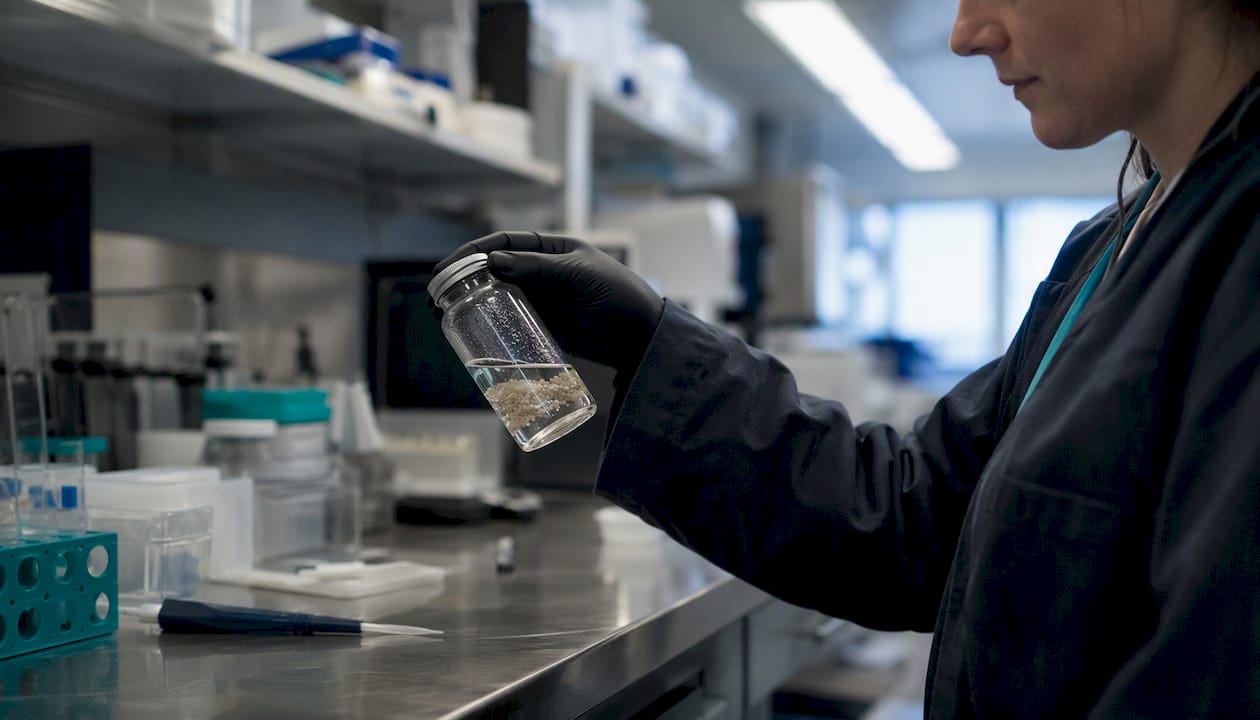
Before running this protocol on a full batch, perform a small test cleavage on 20–50 mg of resin. Analyze the crude product by analytical HPLC and LC-MS to confirm the expected mass and assess purity. Adjusting the cocktail at this stage costs minutes; adjusting it after losing a full batch costs weeks.
For Boc/Bzl chemistry, HF cleavage requires dedicated HF apparatus (Kel-F or PTFE reactors), specialized training, and institutional approval. The operational burden is substantial, and most U.S. academic labs have transitioned to Fmoc chemistry specifically to avoid this requirement.
Automation, microwave-assisted synthesis, and scale-up considerations
Automated synthesizers remove the manual labor from repetitive coupling cycles and improve reproducibility, but they introduce their own set of optimization requirements. Practical Protocols for Solid-Phase Peptide Synthesis 4.0 covers modern automation and flow approaches in detail.
Automation formats and their trade-offs:
- Batch automated synthesizers (e.g., Liberty Blue, Syro Wave): Standard for most academic labs. Handle 1–96 sequences in parallel. Reproducibility is high once protocols are validated; the main variables are resin swelling and reagent delivery accuracy.
- Microwave-assisted SPPS: Accelerates coupling and deprotection steps, often reducing cycle time from 60 minutes to under 10 minutes per residue. Particularly useful for difficult couplings and aggregation-prone sequences. Requires careful temperature control to avoid racemization and resin degradation.
- Continuous-flow SPPS: Reagents flow through a packed resin column rather than being added batchwise. Reduces solvent consumption, improves mass transfer, and enables faster cycles. Scale-up requires careful pressure management and column packing optimization. Active development area as of 2025–2026, with sustainability-focused reviews highlighting flow methods as a path to greener synthesis.
Scale-up practicalities:
- Resin swelling volume increases nonlinearly with batch size; reactor sizing must account for 3–5× the dry resin volume in swollen state
- Solvent consumption scales directly with batch size; DMF usage at preparative scale (>10 g resin) generates significant waste volumes
- Mixing efficiency degrades in large-batch reactors; overhead stirring or nitrogen bubbling must be validated at each scale
- For GMP or preclinical batches, consider outsourcing to a contract manufacturer with validated QA systems rather than scaling in-house
Automation improves reproducibility and throughput, but scale-up requires attention to resin swelling, solvent usage, and validated QA to meet research or preclinical requirements. When internal analytical capabilities cannot support full release testing at scale, outsourcing the scale-up step is often the more resource-efficient decision.
Troubleshooting difficult or aggregation-prone sequences
Aggregation during synthesis is the most common cause of poor coupling efficiency and low crude purity for sequences above 15–20 residues. The symptoms are recognizable, and the fixes are well-established.
Symptom-to-solution map:
- Incomplete coupling (positive Kaiser test after standard coupling): Double couple with fresh reagents; extend reaction time to 2 hours; switch to HATU or microwave activation; check resin swelling
- Aggregation (resin clumps, poor swelling, consistently low coupling): Reduce resin loading to 0.2–0.3 mEq/g; switch to PEGylated support; incorporate pseudoproline dipeptides at Ser/Thr positions; add chaotropic cosolvents (DMSO, 1–5% v/v in DMF)
- Aspartimide formation (Asp-containing sequences): Use Asp(OtBu) with backbone amide protection at the adjacent residue; add 0.1 M HOBt to coupling and deprotection steps; minimize piperidine contact time
- Deletion sequences (missing residues in crude HPLC): Implement capping after each coupling; confirm coupling completion by Kaiser/chloranil before proceeding
- Epimerization (chiral HPLC shows D-amino acid impurity): Reduce preactivation time; switch from HATU to DIC/Oxyma; lower temperature; avoid prolonged base exposure
Advanced sequence strategies used by experienced labs include backbone N-methylation protection (Hmb or Dmb groups on selected amide nitrogens), pseudoproline dipeptide inserts at every 5–7 residues in aggregation-prone regions, and temporary solubilizing tags (e.g., sulfo-tags) that are removed post-synthesis. For aggregation-prone sequences, deliberate reduction of resin loading and use of pseudoproline dipeptides are reliable strategies used routinely by experienced labs.
Pro Tip: Before committing to a full synthesis run for a difficult sequence, perform a rapid 5-residue test coupling on a small resin aliquot using the planned conditions. Analyze by analytical HPLC after test cleavage. This 2-hour investment identifies aggregation and coupling problems before they consume a full batch of reagents.
Monitoring signals that warrant protocol changes include: UV trace irregularities during Fmoc deprotection (suggesting incomplete coupling in the previous step), a positive Kaiser test after double coupling (indicating severe aggregation), and crude HPLC profiles showing multiple closely spaced peaks rather than a dominant product peak.
When stepwise synthesis reaches its limits: long peptides and ligation strategies
Stepwise SPPS is well-suited for peptides up to approximately 40–50 residues under standard conditions. Beyond that range, cumulative coupling inefficiencies reduce full-length yield to the point where purification becomes impractical. Wikipedia's peptide synthesis entry notes that stepwise elongation suits small peptides well, while longer polypeptides may require fragment condensation or native chemical ligation.
Why yield falls with length:
These numbers assume no aggregation, no side reactions, and no deletion sequences. In practice, difficult sequences perform worse. Planning for ligation strategies before starting synthesis of sequences above 40 residues is a sound default.
Native chemical ligation (NCL):
NCL joins two unprotected peptide fragments in aqueous solution through a thioester-thiol exchange followed by an S-to-N acyl shift, forming a native amide bond at a Cys residue. The workflow:
- Synthesize two or more peptide fragments by standard SPPS; the C-terminal fragment carries a thioester handle, the N-terminal fragment carries an N-terminal Cys
- Purify each fragment by preparative HPLC and confirm identity by LC-MS
- Combine fragments in ligation buffer (6 M guanidine HCl, phosphate buffer, thiol additive such as MPAA or TCEP)
- Monitor ligation by analytical HPLC; typical reactions complete in 4–24 hours
- Purify the full-length product by preparative HPLC; confirm by accurate mass MS
Fragment condensation is an alternative for sequences without convenient Cys residues, though it requires protected fragment segments and is more technically demanding. Desulfurization strategies (converting Cys to Ala post-ligation) extend NCL to sequences without native Cys.
Decision checkpoints for switching to ligation: sequence length above 40 residues, absence of solubilizing residues in the central region, confirmed aggregation in test runs, or downstream application requiring a specific ligation junction for isotopic labeling.
On-resin monitoring, analytical workflows, and quality assurance
Monitoring at multiple points during synthesis prevents the worst outcome: discovering a failed sequence only after cleavage. JPT's practical SPPS guide recommends on-resin tests and small-scale test cleavages as routine workflow checks.
On-resin tests:
- Kaiser test (ninhydrin): Detects free primary amines. A blue color indicates incomplete coupling (free amine present); colorless indicates complete coupling. Not suitable for secondary amines (Pro, N-methyl residues).
- Chloranil test: Detects secondary amines (Pro, N-methyl residues) where Kaiser fails. Yellow-to-blue color change indicates incomplete coupling.
- Fmoc UV monitoring: Measure absorbance at 301 nm of the piperidine wash after deprotection. Decreasing signal across cycles indicates progressive coupling failures; a flat signal confirms consistent deprotection.
Analytical workflow after cleavage:
- Crude peptide: analytical RP-HPLC (C18 column, acetonitrile/water gradient with 0.1% TFA) and LC-MS for mass confirmation
- Purification: preparative RP-HPLC; collect fractions, pool by purity, and lyophilize
- Final QC: analytical HPLC purity (target ≥95% for research grade, ≥99% for high-purity applications), accurate mass by ESI-MS or MALDI-TOF, retention time, lot number, and assay conditions documented in the COA
Extended characterization techniques:
- Amino acid analysis (AAA): Hydrolyzes the peptide and quantifies individual amino acids by HPLC; confirms composition and provides absolute quantitation for stock solution preparation
- Circular dichroism (CD): Assesses secondary structure content in solution; useful for confirming that the synthesized peptide adopts the expected helical, sheet, or random-coil conformation
- High-resolution MS (HRMS): Provides accurate mass to 4–5 decimal places, confirming molecular formula and distinguishing isobaric impurities that unit-resolution MS cannot resolve
Small drops in per-step coupling efficiency compound rapidly across a sequence. Labs synthesizing peptides above 30 residues routinely use large excesses of amino acids (up to 10× in some protocols) and monitor every 5–10 cycles to catch problems before they propagate. The USAPeptide COA check tool provides a practical framework for evaluating the completeness and legitimacy of COA documentation when sourcing research-grade peptides.
COA checklist for U.S. research labs:
- HPLC purity percentage with method conditions (column, gradient, detection wavelength)
- Accurate mass (ESI-MS or MALDI-TOF) with expected vs. observed values
- Retention time under stated HPLC conditions
- Lot number and synthesis date
- Impurity profile or peak list from crude and final HPLC traces
- Assay method reference (internal SOP or published protocol)
Safety, reagent handling, and waste disposal in U.S. SPPS labs
SPPS reagents include several compounds that require specific engineering controls and waste segregation. Institutional EH&S compliance is not optional; it is a prerequisite for operating a synthesis lab.
Reagent-specific hazards and controls:
- TFA (trifluoroacetic acid): Corrosive, volatile, and generates TFA vapor during cleavage. Use in a chemical fume hood; wear nitrile gloves, lab coat, and face shield. Neutralize spills with sodium bicarbonate solution. Collect TFA-containing waste in labeled halogenated organic waste containers.
- HF (Boc cleavage): Extremely hazardous; causes deep tissue burns with delayed symptoms. Requires dedicated Kel-F or PTFE apparatus, institutional HF training certification, calcium gluconate antidote gel on hand, and a two-person operation rule. Most U.S. academic labs avoid HF by defaulting to Fmoc chemistry.
- DMF and NMP: Reproductive toxins (Category 1B under GHS). Use in a fume hood; minimize skin contact. Collect as halogenated-free organic solvent waste. Some institutions have moved to greener alternatives (e.g., 2-MeTHF, Cyrene) in response to regulatory pressure.
- Piperidine: Flammable, corrosive, and has a strong odor. Handle in a fume hood; store in a flammable-materials cabinet. Collect piperidine-containing DMF waste as organic solvent waste.
- Thiol scavengers (EDT, thioanisole): Malodorous and toxic. Use in a fume hood; collect thiol-containing cleavage waste separately from standard organic waste. Many institutions require dedicated thiol waste containers with activated carbon odor control.
Waste segregation and disposal:
- Organic solvent waste (DMF, DCM, acetonitrile): collect in labeled containers; arrange pickup through institutional hazardous waste program under EPA RCRA guidelines
- Acidic aqueous waste (TFA/water cleavage filtrates): neutralize to pH 6–8 before disposal or collect as acidic aqueous waste per institutional protocol
- Thiol-containing waste: segregate from standard organic waste; label clearly; arrange separate pickup
- HF-containing waste: requires specialized neutralization (calcium hydroxide slurry) and disposal through a licensed HF waste contractor; never combine with other acid waste streams
Green chemistry reviews highlight solvent substitution (replacing DMF with less toxic alternatives) and reagent recycling as active development areas that reduce both hazardous waste volume and disposal costs. Continuous-flow systems also reduce total solvent consumption per synthesis cycle compared to batch methods, which is a practical sustainability argument beyond regulatory compliance.
In-house SPPS versus outsourcing: how to decide
The decision to synthesize peptides in-house or outsource depends on throughput, required purity documentation, available equipment, and the regulatory context of the research program.
In-house synthesis:
- Full control over sequence design, protecting-group choices, and protocol modifications
- Faster iteration for method development and analog series
- Requires upfront equipment investment (synthesizer, HPLC, lyophilizer, MS access) and trained personnel
- Appropriate for research-grade peptides where internal QA documentation is sufficient
- Learning curve is significant for new labs; first 3–6 months typically involve protocol optimization before consistent results
Outsourcing:
- Higher per-peptide cost, but no capital equipment requirement
- Contract manufacturers provide validated QA, COA documentation, and often GMP-grade synthesis for preclinical or regulatory submissions
- Turnaround times of 2–4 weeks for standard sequences; longer for difficult or long peptides
- Appropriate when GMP documentation is required, when internal analytical capabilities cannot support full release testing, or when batch sizes exceed in-house reactor capacity
Hybrid approach: Develop the synthesis method in-house at small scale (5–50 mg), confirm sequence and purity by HPLC/MS, then transfer the validated protocol to a contract manufacturer for scale-up or GMP production. This preserves internal expertise while offloading the regulatory and infrastructure burden of large-scale synthesis.
For researchers evaluating sourced peptide compounds, USAPeptide's COA grading tool and peptide research glossary provide practical frameworks for assessing documentation quality and understanding the technical terminology in supplier COAs. The USAPeptide platform also connects researchers with ISO 17025-accredited suppliers providing ≥99% HPLC purity compounds with full COA documentation for U.S. research applications.
What the field gets wrong about SPPS protocol decisions
The most common mistake in academic SPPS is treating the standard Fmoc/tBu protocol as a universal solution and applying it without modification to sequences that clearly need a different approach. A 15-residue peptide with three Arg residues and no hydrophobic stretch will synthesize cleanly under standard conditions.
The second mistake is skipping on-resin monitoring. Kaiser and chloranil tests take under five minutes. Fmoc UV monitoring adds no time to an automated run. Yet many labs run entire syntheses without a single coupling check, then spend days troubleshooting a crude HPLC that shows 12 peaks instead of one. The monitoring step is not a formality; it is the earliest point at which a failing synthesis can be corrected rather than repeated.
The third, and arguably most consequential, mistake is conflating crude purity with synthesis success. Amino acid analysis, high-resolution MS, and chiral HPLC are not optional for sequences where biological activity depends on exact composition and stereochemistry. The USAPeptide articles section covers application-specific QC considerations for peptides used in tissue repair, anti-aging, and metabolic research contexts.
The practical implication: design your monitoring and QA workflow before you start synthesis, not after you see a problem in the crude product.
Sources
The following sources provide peer-reviewed protocols, manufacturer guidance, and review articles for deeper methods work:
- American Peptide Society — SPPS basics
- Practical Protocols for Solid-Phase Peptide Synthesis 4.0 — MDPI
- Introduction to Peptide Synthesis - PMC - NIH
- Knowledge Hub - Bachem — Solid Phase Peptide Synthesis (SPPS) explained
- IOPscience review (2025) on peptide synthesis methods and sustainability