Dosing frequency for any peptide is set by its pharmacokinetics: half-life and receptor behavior, not habit or convenience, decide whether a compound needs multiple daily doses or tolerates a once-weekly injection. Short half-life peptides clear the bloodstream in minutes to hours, so researchers dose them daily or even multiple times a day to sustain exposure. Long-acting or chemically modified peptides, including the GLP-1 class, permit weekly dosing but require slow titration. Getting the schedule right starts with accurate reconstitution math, not a guess.
TL;DR:
- Peptides with short half-lives require multiple daily doses for effective exposure, while long-acting peptides can be dosed weekly to improve adherence.
- Accurate reconstitution math, including correct concentration calculations, is essential to prevent dosing errors that affect research validity.
- Titration and cycle lengths should follow receptor behavior and half-life, with conservative, evidence-based dosing to minimize side effects and ensure consistency.
- Missed doses impact short-acting peptides quickly but are less urgent for long-lasting compounds, and skipping or delaying doses should be managed carefully.
- Verification tools like dosage calculators and Certificate of Analysis grading are crucial for ensuring compound integrity and precise dosing in research protocols.
Table of Contents
- Dosing Frequency Peptides: The Main Scheduling Patterns
- Why Half-Life Determines How Often You Dose
- Representative Dosing Protocols By Peptide Category
- Reconstitution Math: A Calculator-First Workflow
- Administration Route, Timing, and What You'll Need
- Titration Rules, Cycle Lengths, and Handling Side Effects
- Quick Reference: Peptide Dosing Frequency at a Glance
- Using USAPeptide's Tools To Support Accurate Dosing
- The Case for Conservative, Evidence-First Dosing
- Where To Find Verified Peptides and Dosing Tools
- Sources
Dosing Frequency Peptides: The Main Scheduling Patterns
Most research peptide protocols fall into one of four scheduling templates, and knowing which template a compound belongs to tells you almost everything about how to plan a research timeline. Dosing guides that track frequency across compound classes consistently group peptides this way, and the pattern maps closely to each molecule's clearance rate.
- Multiple daily dosing. Peptides with very short half-lives, often measured in minutes, need two or three administrations spread across the day to keep exposure steady. Some GH-releasing secretagogues fall here when researchers want to mimic natural pulsatile release.
- Once-daily dosing. A large share of healing and repair peptides, including BPC-157, use a single daily administration or a dose split into two smaller injections. This keeps the compound present without requiring a researcher to plan around multiple daily windows.
- 5-on/2-off cycling. Several GH-axis peptides use five consecutive days of dosing followed by two rest days, mirroring the body's natural growth hormone secretion rhythm and giving receptors a short recovery window before the next block.
- Once-weekly dosing. Long-acting, modified peptides like semaglutide and tirzepatide, along with CJC-1295 formulated with drug affinity complex (DAC), stay active long enough that a single weekly injection maintains steady blood levels.
Choosing between these patterns is not really a choice once you know the compound's half-life. The real decision point is adherence. Spreading a short-acting peptide across three daily doses is pharmacologically correct, but it is also the schedule most likely to get missed on a busy week. Where a protocol allows some flexibility, such as consolidating BPC-157 into one daily shot instead of two half-doses, that flexibility usually favors better long-term consistency over marginal pharmacokinetic precision. Weekly compounds solve the adherence problem almost by design, which is one reason the GLP-1 class has become the reference point for how modified peptides are built.
Why Half-Life Determines How Often You Dose
Half-life is the time it takes for the concentration of a peptide in the bloodstream to fall by half. It is the single most useful number for predicting a dosing schedule, because it tells you how fast a compound disappears and therefore how often it needs replacing.
The rule of thumb is straightforward: shorter half-life means more frequent dosing, and longer half-life means less frequent dosing. A peptide that clears in 30 minutes cannot maintain meaningful blood levels on a once-weekly schedule no matter how large the dose. A peptide engineered to persist for days, on the other hand, would accumulate to excess if dosed daily at the same rate.
Steady state is the point at which the amount of peptide entering the body with each dose equals the amount being cleared, so blood levels plateau instead of climbing or falling. As a working estimate, steady state is typically reached after about four to five half-lives, which is why weekly compounds like semaglutide take several weeks to reach stable exposure rather than acting fully from the first injection. This is also the mechanical reason titration schedules are paced in monthly steps instead of jumping straight to a maintenance dose.
Missed doses matter differently depending on where a compound sits on this spectrum. Skip one dose of a multiple-daily peptide and levels drop fast, though the next scheduled dose usually restores them within hours. Skip a weekly injection of a long-acting compound and the effect lingers longer, but the recovery period is also longer and less urgent. During an active titration phase, a missed dose can shift the entire escalation timeline, since each step is calibrated to build on stable exposure from the step before it. Reconstitution accuracy compounds this: a dose calculated from the wrong concentration undermines the entire steady-state timeline before it even starts, which is why precise half-life data for compounds like BPC-157 is worth checking before setting any schedule.
Representative Dosing Protocols By Peptide Category
Every peptide category has its own dosing logic, shaped by half-life, receptor mechanism, and research goal. There is no universal peptide dose. Appropriate ranges depend on the specific compound, research goal, body weight, and individual tolerance, so the figures below are reference points for building a protocol, not fixed prescriptions.
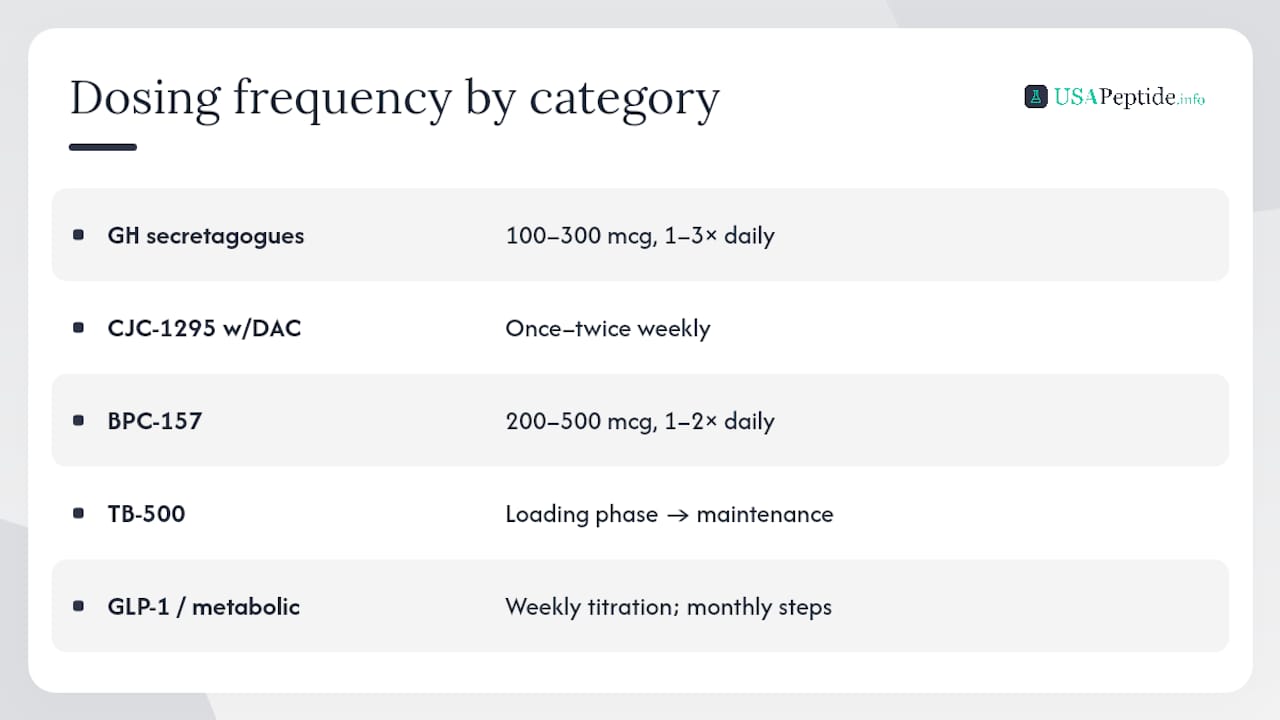
GH secretagogues like ipamorelin and CJC-1295 without DAC are typically dosed in the range of 100 to 300 mcg per administration, one to three times daily, timed around fasted windows to avoid blunting the natural GH pulse with circulating insulin. CJC-1295 with DAC behaves differently because the DAC modification extends its half-life dramatically, which shifts it to a once or twice weekly schedule instead of daily dosing. Combination protocols pairing a GHRH analog like CJC-1295 with a GHRP like ipamorelin are common in research settings because the two act on separate receptor pathways.
Healing and repair peptides follow a different curve. BPC-157 is commonly referenced in research protocols at roughly 200 to 500 mcg per day, split into one or two administrations, and local subcutaneous injection near an injury site is a common administration approach in the literature. TB-500 protocols often use a loading phase, followed by a reduced maintenance schedule once the initial research window closes. This loading-then-maintenance structure appears across multiple recovery-focused protocol frameworks, largely because tissue-repair compounds are thought to need sustained exposure during an initial active phase before tapering.
GLP-1 and metabolic peptides require the most rigid frequency structure of any category. Semaglutide protocols typically start at a low weekly dose for several weeks, then step up on a monthly cadence toward higher maintenance doses used in clinical trials. Tirzepatide follows a comparable weekly titration logic. The reason for ramping is not caution for its own sake. GLP-1 receptor agonists slow gastric emptying, and jumping straight to a maintenance dose overwhelms that system, producing nausea and other gastrointestinal side effects that a monthly step-up schedule is specifically designed to avoid. Anyone exploring this category should review how titration and monitoring are structured in semaglutide protocols before assuming a faster schedule is safe.
Other categories carry their own conventions. Cosmetic peptides like GHK-Cu are frequently dosed daily at low microgram-to-milligram ranges for skin and connective tissue research, often in cycles of several weeks followed by a break. Mitochondrial-support peptides tend to follow shorter research cycles, with frequency decisions driven largely by the specific outcome being measured rather than a fixed industry convention.
One point applies across every category on this list: prescription GLP-1 medications are regulated pharmaceuticals, and any human use must be managed by a licensed clinician, not self-directed from a research protocol. The ranges above describe published research dosing structures, not medical advice.
Reconstitution Math: A Calculator-First Workflow
Reconstitution errors are one of the most frequent, and most avoidable, mistakes in peptide research. Getting the concentration math wrong at the reconstitution stage corrupts every dose calculated afterward, which is why a calculator-first workflow matters more than memorizing dosing ranges.
The concentration of a reconstituted vial is simply the total peptide mass divided by the volume of bacteriostatic water added. Choosing a bacteriostatic water volume that produces a round, easy-to-verify concentration removes most of the guesswork before you draw a single unit into a syringe.
- Confirm the vial's total peptide mass in milligrams, exactly as printed on the label or Certificate of Analysis.
- Select a bacteriostatic water volume that yields a clean concentration. A 5 mg vial reconstituted with 2 mL of bacteriostatic water yields 2.5 mg/mL, a figure that divides cleanly into most target doses.
- Convert your target dose into the same unit as your concentration. If the protocol calls for 250 mcg and your concentration is in mg/mL, convert 250 mcg to 0.25 mg first.
- Calculate the injection volume by dividing the target dose by the concentration: 0.25 mg ÷ 2.5 mg/mL = 0.1 mL.
- Convert that volume into syringe units. A standard insulin syringe marked in units, where 1 mL equals 100 units, means 0.1 mL corresponds to 10 units on the syringe barrel.
The most common pitfalls at this stage are mixing up milligrams and micrograms, using the wrong bacteriostatic water volume from the intended protocol, and shaking the vial hard enough to damage the peptide structure instead of rolling it gently to dissolve. Standardized reconstitution and dosing calculators exist specifically to catch the unit-conversion errors that manual math tends to produce under time pressure.
Pro Tip: Before drawing a dose, run two different target amounts through your calculator, not just the one you plan to inject. If both conversions land on numbers that make sense on your syringe's markings, you've caught most decimal and unit-entry mistakes before they reach the vial.
Reconstituted peptides are also biologically fragile once mixed. Store reconstituted vials refrigerated, avoid direct light, and use them within the window specified for that compound rather than assuming an open-ended shelf life.
Administration Route, Timing, and What You'll Need
Route selection depends on the peptide's target tissue and molecular size. Subcutaneous injection, delivered into the fat layer just under the skin, is the standard route for most research peptides, including BPC-157, TB-500, and the GH secretagogues, because it allows slow, steady absorption. Intramuscular injection reaches deeper tissue and is occasionally used for compounds where researchers want faster systemic uptake. Intranasal and topical routes appear in a smaller subset of protocols, generally for peptides where local or rapid absorption through mucous membranes or skin is the specific research interest.
A basic injection checklist keeps technique consistent across sessions:
- Select an injection site, commonly the abdomen or upper thigh for subcutaneous work, and rotate sites to avoid tissue irritation.
- Clean the site with an alcohol swab and let it dry completely before inserting the needle.
- Insert at roughly a 45 to 90 degree angle for subcutaneous injections, pinching a fold of skin if using a shorter needle.
- Inject slowly and steadily, then withdraw and apply light pressure with a clean gauze pad.
- Dispose of the needle immediately in an approved sharps container.
Timing rules matter as much as technique for certain categories. GH secretagogues are typically administered fasted, often at bedtime, because circulating insulin and food intake can blunt the natural growth hormone pulse the peptide is meant to support. A basic supply list covers bacteriostatic water, appropriately sized syringes, alcohol swabs, and a sharps disposal container. None of these steps are optional extras. Skipping sterile technique or site rotation is a common source of avoidable irritation in longer research protocols.
Titration Rules, Cycle Lengths, and Handling Side Effects
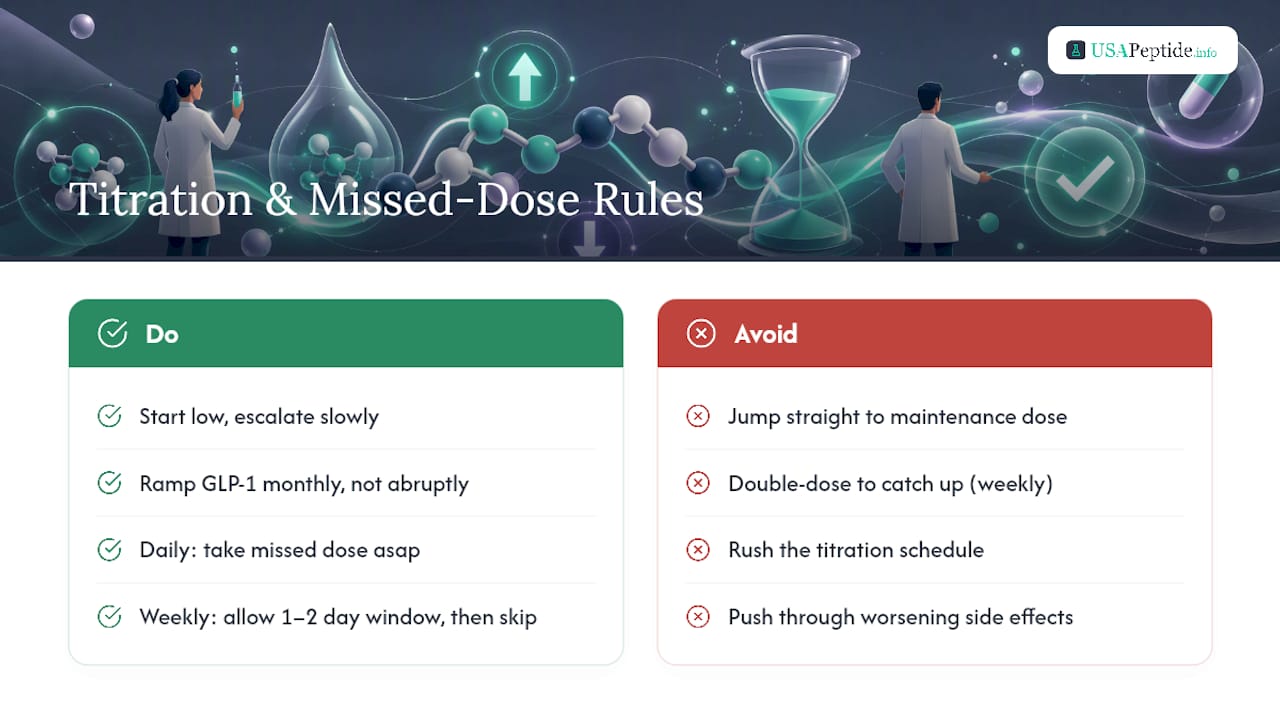
Titration exists to let the body adjust gradually to a compound's mechanism, and the GLP-1 class is the clearest example of why the pace matters. Ramping semaglutide monthly, rather than jumping to a maintenance dose, gives the digestive system time to adapt to slowed gastric emptying, which is the direct cause of the nausea that shows up when this schedule is skipped or rushed.
Cycle length conventions vary by category for similar physiological reasons. GH secretagogue protocols often run in blocks of eight to twelve weeks, sometimes with the 5-on/2-off structure built in, followed by a rest period intended to preserve receptor sensitivity. Healing peptide courses like TB-500 tend to follow a defined loading phase before tapering to maintenance, rather than continuing indefinitely at the initial dose.
Missed-dose handling depends heavily on the schedule type. For daily peptides, taking the missed dose as soon as it's remembered, then resuming the normal schedule the next day, generally avoids double-dosing. For weekly compounds, most protocols allow the dose within a day or two of the missed date, but skipping ahead to the next scheduled injection is usually preferable to doubling up. Peer and protocol references generally favor starting low and escalating slowly, since consistency at a lower dose outperforms isolated higher doses for most research goals. Common side effects, whether GI discomfort from GLP-1 compounds or injection-site irritation from subcutaneous peptides, are usually managed by slowing the titration pace or adjusting injection technique rather than pushing through at the same dose.
Quick Reference: Peptide Dosing Frequency at a Glance
The table below compiles representative research dosing patterns discussed throughout this guide. These figures are for research reference only and are not medical advice.
Using USAPeptide's Tools To Support Accurate Dosing
A dosing schedule is only as reliable as the math and the material behind it. A dosage calculator can handle the mg-to-mL-to-syringe-unit conversion described earlier, letting researchers verify a target dose against a specific vial concentration before drawing a syringe, rather than doing that arithmetic by hand under time pressure.
The COA grading tool addresses the other half of the accuracy problem: whether the compound itself matches what the label claims. It evaluates a Certificate of Analysis for the markers that indicate a legitimate, third-party-verified report, rather than a fabricated or copy-pasted one. Compounds tested to ISO 17025-accredited standards with HPLC purity verification of 99% or higher give researchers a documented basis for identity and purity, not just a vendor's claim.
For deeper protocol detail on specific compounds, the BPC-157 reference page and half-life breakdown linked earlier in this guide expand on administration options and clearance data. Pairing that molecular detail with the calculator and COA checker turns a generic dosing range into a protocol built on your specific vial and your specific research question.
The Case for Conservative, Evidence-First Dosing
Every dosing question in peptide research reduces to the same underlying discipline: start at the low end of the published range, verify the compound before you verify the dose, and treat any prescription-grade compound, particularly GLP-1 agonists, as something that belongs under clinical supervision rather than self-directed titration. That is not a hedge. It is the pattern that shows up across every category covered in this guide, from GH secretagogues to healing peptides to metabolic compounds.
The calculator-first approach matters because reconstitution errors are silent. A miscalculated concentration doesn't announce itself; it just produces a dose that's wrong by a fixed multiple every single time you inject, which is far more dangerous than an occasional missed dose. Reproducibility, the ability to know that today's injection matches last week's in both purity and quantity, is the actual foundation of usable research data, and it starts well before the needle touches skin.
The role of a trusted reference is to treat dosing math and compound verification as the two problems worth solving well, rather than the ones easiest to skip.
— USAPeptide Team
Where To Find Verified Peptides and Dosing Tools
Getting the frequency right only matters if the compound in the vial is what the label says it is. USAPeptide's dosage calculator, COA grading tool, and peptide database exist for exactly the gap this guide has walked through: converting a target dose into an accurate syringe volume, and checking whether a Certificate of Analysis reflects genuine third-party testing or a copied template.

These tools are built for qualified researchers, laboratory staff, and clinicians who need dosing math they can trust and sourcing they can verify, not for casual guesswork. The calculator removes the mg-to-mcg conversion errors that cause most reconstitution mistakes, and the COA checker flags the red flags, missing accreditation numbers, inconsistent purity figures, that separate a legitimate report from a fabricated one. If your current protocol involves BPC-157 or TB-500, the recovery-focused peptide category page breaks down sourcing considerations specific to those compounds. Start by running your next planned dose through the calculator before your next reconstitution, and check the vial's COA against the grading tool the same day it arrives.
Sources
- Peptide Dosage: The Complete Guide to Dosing Every Category 2026
- Peptide Dosing Chart & Guide — Peptide Hub
- Peptide Dosage Chart: 20+ Peptides
This article is general information, not a substitute for advice from a qualified doctor. Consult a qualified healthcare professional about your own circumstances before acting on anything here.