
Research peptides remain legally available for laboratory use in the United States, but no peptide discussed here is FDA-approved for human treatment, and legality turns entirely on intended use and marketing, not the molecule itself. A July 2026 advisory vote recommended loosening compounding restrictions on six peptides, yet nothing changes operationally until the FDA completes formal rulemaking. Researchers should secure proper "research use only" labeling, retain Certificates of Analysis, and consult legal counsel before any activity that could be read as human-directed use.
TL;DR:
- Loosening of compounding restrictions depends on FDA rulemaking, which could take over a year to finalize after the July 2026 advisory vote.
- Practitioners must rely on proper "research use only" labeling, Certificates of Analysis, and strict documentation to avoid enforcement actions.
- Federal movement toward bulk-drug listing doesn't grant over-the-counter access; state pharmacy rules ultimately determine real-world availability.
- Marketing language, bundling supplies, and shipping records that imply human use can trigger FDA and FTC enforcement, even with RUO labeling.
- Establishing a thorough procurement trail with accredited labs, SOPs, and oversight is essential for defending research activities amid regulatory scrutiny.
Table of Contents
- Research Peptide Regulations US: The Legal Framework Behind "Research Use Only"
- What the July 2026 PCAC Vote Actually Means for Compounding
- How 503A Compounding Works and What It Would Actually Unlock
- Enforcement in Practice: What Triggers FDA and FTC Action
- The Compliance Playbook: What Labs Should Document Right Now
- Timeline: What to Track Over the Next 12 to 18 Months
- An Editorial Perspective on Responsible Peptide Research
- Where Researchers Find Verified Sourcing and COA Support
- Primary Sources Worth Reading Directly
- Sources
Research Peptide Regulations US: The Legal Framework Behind "Research Use Only"
U.S. peptide law does not classify compounds by chemical structure. It classifies them by what the seller and buyer intend to do with them, a distinction that surprises many first-time researchers who expect a simple legal or illegal list.
Under the Federal Food, Drug, and Cosmetic Act, a "drug" is defined partly by intended use. A peptide marketed as intended to diagnose, treat, or prevent disease in humans meets that definition regardless of what the label says. This is the intended-use doctrine, and it explains why identical vials of BPC-157 can sit on two different legal footings depending entirely on how they are sold.
The "research use only" designation functions through what's sometimes called the Objective Intent Doctrine, codified in part at 21 CFR 201.128. An RUO label is legally meaningful only when a seller's actual conduct backs it up. Several factors void that protection fast:
- Marketing copy referencing dosing for weight loss, injury recovery, or anti-aging in people
- Bundling insulin syringes, alcohol swabs, or reconstitution kits with peptide vials
- Customer support content or influencer partnerships describing personal human use
- Website testimonials framed around bodily results rather than lab findings
A separate wrinkle trips up newcomers: DEA scheduling and FDA approval are not the same axis. Most research peptides, including BPC-157 and TB-500, are not scheduled controlled substances. That absence of scheduling does not mean the FDA has approved them for human use. It simply means a different federal agency hasn't flagged them for abuse potential.
The Federal Trade Commission adds a third layer entirely independent of FDA drug status. Even a genuinely RUO-labeled peptide can trigger FTC action if advertising makes unsubstantiated health claims, since the FTC polices deceptive marketing regardless of a product's regulatory classification under FD&C Act provisions.
What the July 2026 PCAC Vote Actually Means for Compounding
The regulatory chain that produced this year's headlines started months before the vote itself, with an administrative move that gets far less attention than it deserves.
-
April 2026 removals set the stage. The FDA pulled multiple peptides off its Category 2 "do not compound" list, the roster of substances pharmacies are barred from compounding due to safety or effectiveness concerns. Category 1 substances are simply not yet evaluated. Removal from Category 2 doesn't equal approval; it makes a substance eligible for further review rather than automatically permitted.
-
The Pharmacy Compounding Advisory Committee convened July 23 to 24, 2026 to evaluate seven of those newly eligible peptides: BPC-157, TB-500, MOTS-c, KPV, Semax, Epitalon, and DSIP (emideltide). The committee voted to recommend loosening compounding permissions for six of the seven, according to meeting materials summarized by Johns Hopkins.
-
Reuters reporting on the meeting noted industry pressure on committee members and raised questions about conflicts of interest among some voters, a governance detail that matters because it may shape how much weight the FDA ultimately gives the recommendation.
-
A PCAC vote is advisory, not binding. The FDA must independently accept or reject the recommendation, then run formal notice-and-comment rulemaking, a process that historically takes twelve months or longer from proposal to final rule.
For researchers and legal teams, the practical upshot is narrow: nothing about ordinary consumer or retail access changes yet. The most plausible near-term outcome, if the FDA moves forward, is a patient-specific compounding pathway under a licensed pharmacy, not an open retail market, and even that depends on state-level alignment discussed below.
How 503A Compounding Works and What It Would Actually Unlock
Section 503A of the FD&C Act allows licensed pharmacies to compound patient-specific prescriptions using bulk drug substances that meet one of three criteria: the substance is the subject of a USP or National Formulary monograph, it's a component of an FDA-approved drug, or the FDA has explicitly added it to the 503A bulk drug substances list through rulemaking.
If a peptide like BPC-157 eventually lands on that list, here's what actually changes for practitioners:
- A licensed pharmacist could compound a patient-specific prescription for a named individual under a prescriber's order
- The pathway does not permit over-the-counter or online retail sale to the general public
- Compounded products still fall outside FDA's standard drug-approval review for safety and efficacy
- State boards of pharmacy retain independent authority to restrict or condition compounding even after federal approval
That last point deserves emphasis. State pharmacy boards vary widely in how they treat telehealth prescribing and compounded peptide products, meaning federal movement on the bulk-drug list wouldn't create uniform access across all fifty states. A pharmacy in one state might compound freely while a neighboring state imposes additional restrictions or bans telehealth-initiated prescriptions outright.
Clinic networks and pharmacy groups anticipating a favorable federal decision should start now: reviewing state-specific compounding rules, auditing prescriber relationships for documentation gaps, and building intake protocols that clearly separate patient-specific orders from bulk inventory practices the FDA has historically flagged as red flags for illegitimate compounding operations.
Enforcement in Practice: What Triggers FDA and FTC Action
The clearest window into how regulators actually apply these rules comes from warning letters, and one 2026 case offers a detailed blueprint of what not to do.
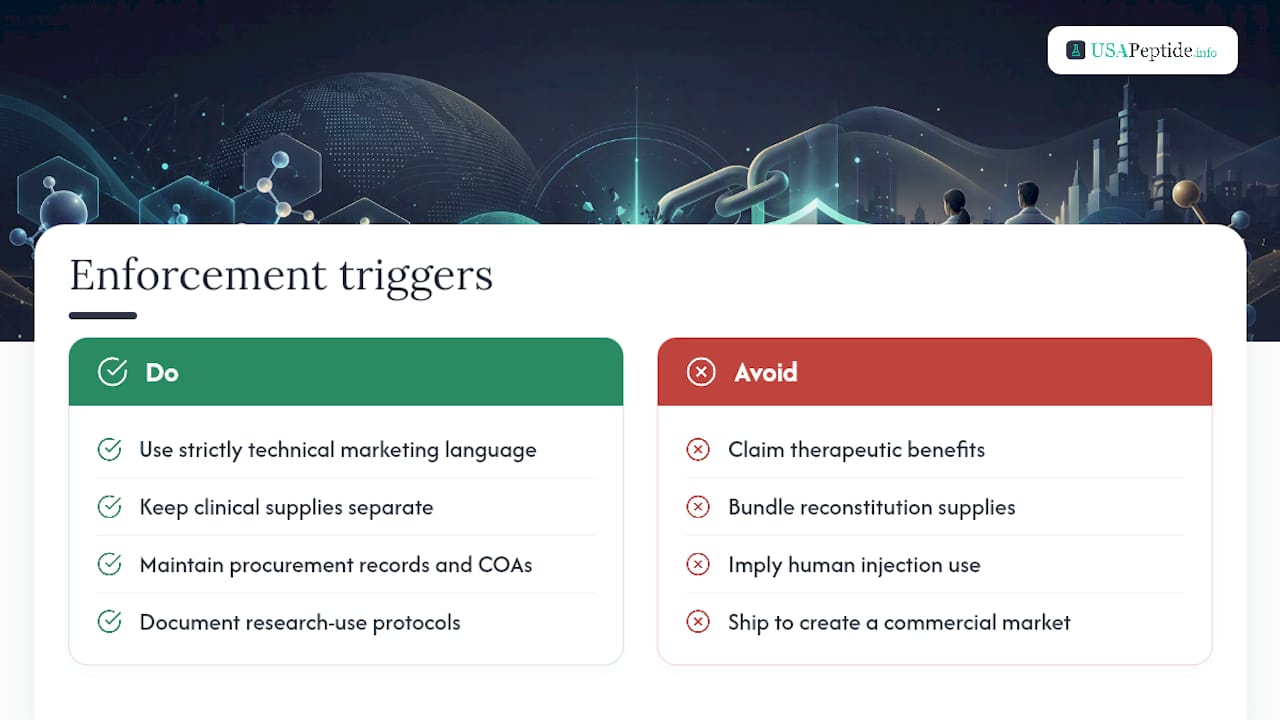
The FDA's March 2026 warning letter to Gram Peptides cited the company for marketing unapproved new drugs under section 505(a) of the FD&C Act. The letter's key finding: RUO labeling didn't protect the company because its marketing, including language suggesting therapeutic benefit and product bundling that implied injection for human use, contradicted the label. The FDA treats marketing conduct as the controlling evidence, not the disclaimer printed on a vial.
The pattern regulators watch for: therapeutic language (weight loss, joint repair, anti-aging), bundled reconstitution supplies that imply injection, and interstate shipping records that establish a commercial human-use market rather than a laboratory supply chain.
Enforcement doesn't stop at warning letters. Depending on severity, agencies have pursued product seizures, payment processor and merchant-account terminations, and state medical board actions against prescribers. U.S. Customs and Border Protection also intercepts shipments flagged for mislabeling or undeclared contents at the import stage.
Mitigation is straightforward in principle: keep marketing language strictly technical, never bundle clinical-use supplies with research materials, and maintain a documented procurement trail, including COAs, that supports a genuine research use case if ever questioned.
The Compliance Playbook: What Labs Should Document Right Now
A defensible research posture rests on paperwork as much as intent. Build these habits before an auditor, a partner institution, or a regulator ever asks.
Vendor due diligence. Require Certificates of Analysis from ISO 17025 accredited laboratories, not just the seller's in-house testing. Retain every procurement and shipment record, and avoid any supplier whose own marketing leans toward consumer or human-use language, since that exposure can attach to downstream buyers too.
Quality framework distinctions. Full cGMP compliance is the standard for drugs manufactured for human administration. For nonclinical research material, ISO 17025 accredited testing with a detailed COA, covering HPLC purity, method description, and chain-of-custody documentation, is generally the operationally relevant benchmark labs should verify.
Document control essentials:
- RUO labeling on every container and shipment record
- Material transfer agreements between institutions
- Chain-of-custody logs from receipt through storage and reconstitution
- Written SOPs for storage conditions and reconstitution procedures
- An adverse-event logging process, even for nonclinical work
Oversight triggers. Any project involving human biological samples, even indirectly, should route through Institutional Review Board or Institutional Biosafety Committee review before work begins. Legal counsel should review any protocol with a plausible human-use interpretation.
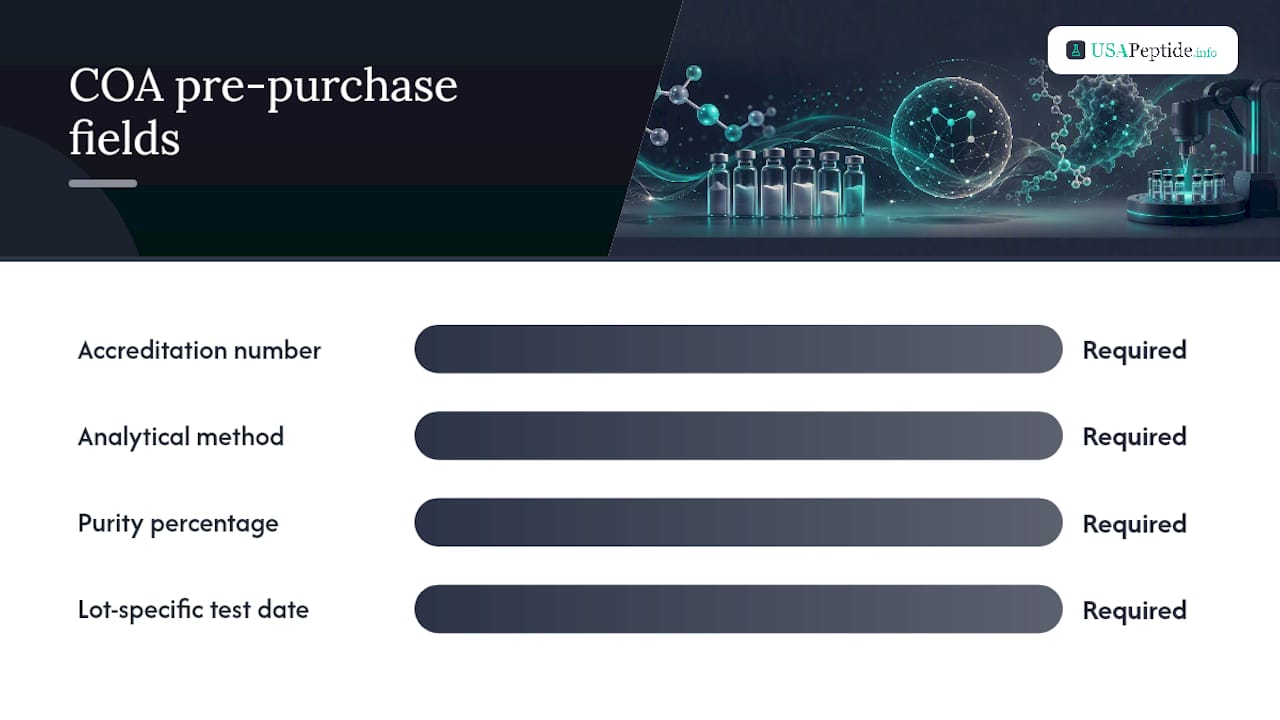
Pro Tip: Build a COA checklist that flags accreditation number, method (HPLC vs. mass spectrometry), purity percentage, and lot-specific testing dates before any purchase order is approved. A COA grading tool can help standardize that first-pass review across a lab's procurement team.
Timeline: What to Track Over the Next 12 to 18 Months
Regulatory movement here won't announce itself with a single press release. It shows up in procedural filings that most labs never think to monitor.
- Watch the Federal Register and FDA dockets for a proposed rule tied to the July 2026 PCAC recommendations; formal notice-and-comment rulemaking typically runs 12 months or longer before finalization.
- Track upcoming PCAC agendas for follow-up reviews, since committee membership and conflict-of-interest scrutiny may shift future votes.
- Monitor state pharmacy board advisories, which can move faster or slower than federal action and will ultimately determine real-world clinician access even after any federal rule change.
- Watch for new warning letters, which remain the clearest real-time signal of where enforcement lines actually sit.
An Editorial Perspective on Responsible Peptide Research
The gap between what the PCAC vote signaled and what actually changed operationally is where most confusion in this space lives. A recommendation is not a rule, and treating it as one, whether to justify looser sourcing practices or to overstate research legitimacy, misreads the process badly.
What gets underestimated is how much the burden of proof sits with documentation, not intention. A lab that genuinely restricts a peptide to nonclinical work but can't produce a clean COA trail, vendor history, and internal SOPs looks, on paper, indistinguishable from an operation the FDA would flag. Good intent without good records doesn't hold up under scrutiny.
USAPeptide's own view is straightforward: use the peptide database and dosage calculator as working tools inside an institutional framework, not as a substitute for legal review or IRB oversight where human elements exist. Responsible research and regulatory caution aren't in tension. They're the same discipline.
— USAPeptide Team
Where Researchers Find Verified Sourcing and COA Support
Documentation is the single biggest gap between labs that pass institutional review and labs that don't, and it's usually a sourcing problem rather than a science problem.
The Peptriva Research Peptide Resource Center exists for exactly this gap. It compiles vetted supplier references alongside the documentation researchers actually need: ISO 17025 accreditation details, current Certificates of Analysis, and purity data tied to specific lots rather than generic marketing sheets.

Researchers can also run any existing COA through the COA grading tool before finalizing a purchase order, a faster check than manually cross-referencing accreditation numbers and method disclosures line by line. For labs building or refreshing a peptide procurement standard, the recovery-focused peptide guide offers a working example of how sourcing documentation should read for commonly studied compounds. Distribution-side questions, particularly around chain-of-custody expectations during shipping, are covered well in this pharmaceutical distribution compliance overview. Qualified researchers evaluating institutional access should start with the Peptriva resource page and reach out directly for questions specific to their lab's procurement needs.
Primary Sources Worth Reading Directly
- FDA's PCAC meeting notice, the official record of July 2026 agenda items
- Gram Peptides warning letter, a real enforcement precedent
- FD&C Act full text for statutory definitions
- FDA bulk drug substances guidance explaining 503A criteria
This article is general information, not a substitute for advice from a qualified doctor. Consult a qualified healthcare professional about your own circumstances before acting on anything here.
Sources
- How the FDA Regulates Peptides | Johns Hopkins
- Gram Peptides - 721806 - 03/31/2026 | FDA
- Bulk drug substances used in compounding | FDA
- Pharmacy Compounding Advisory Committee meeting (July 23–24, 2026) | FDA