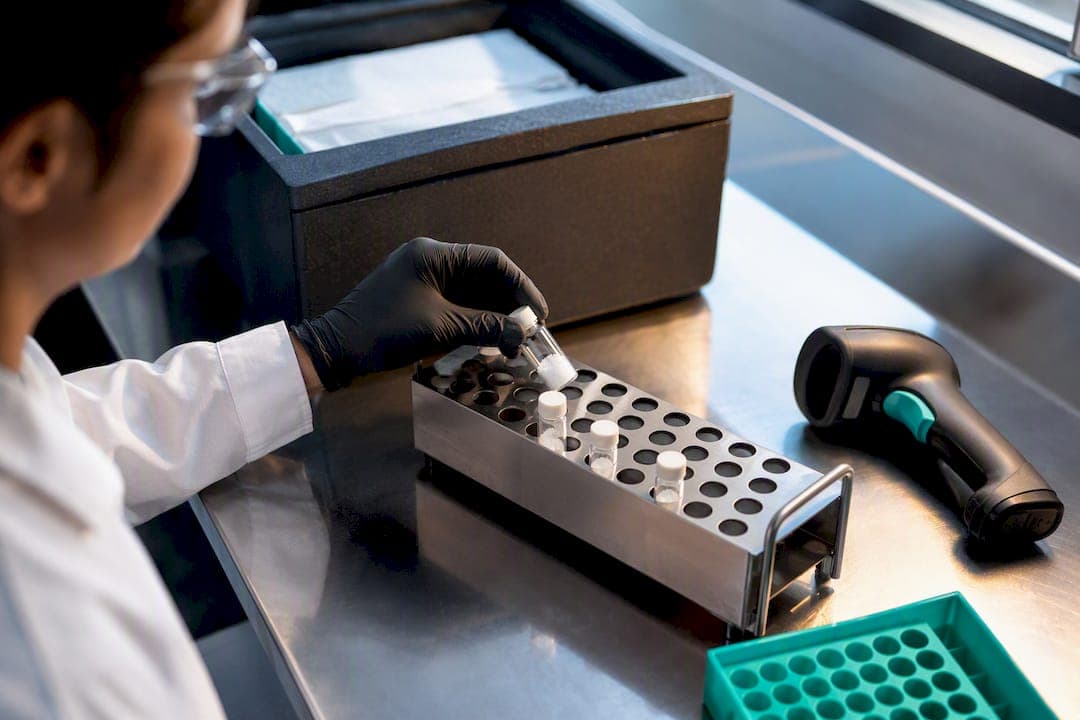
Require a lot-specific Certificate of Analysis showing HPLC purity and mass spectrometry identity, run by a named third-party lab (ISO 17025 accreditation preferred), plus documented cold-chain shipping. Price matters only after those conditions are met. Products labeled for research use should be sourced and handled accordingly, with documentation that lets another lab verify what you actually received.
TL;DR:
- Suppliers should provide a lot-specific COA with matching lot number, testing date, lab name, and validated analysis method to ensure verifiable purity.
- Independent ISO 17025-accredited labs and detailed analytical data, including chromatograms and mass spectrometry, are essential for confirming peptide identity and purity.
- A tier 1 testing panel, including HPLC, MS, and endotoxin or sterility tests, is required for peptides used in cell culture or animal research, especially for publication-quality work.
- Cold-chain shipping and careful labeling confirm sample integrity during transit, while proper storage and aliquoting extend peptide usability and prevent degradation.
- Thorough vetting involves checking supplier legitimacy, verifying lot-specific documentation, comparing prices, and requesting chromatograms before placing an order.
Table of Contents
- Peptide Sourcing Guide: A 6-Point Supplier Checklist
- How to Read a Certificate of Analysis for Peptides
- What Do HPLC, Mass Spec, and Endotoxin Tests Actually Prove?
- Matching Purity Thresholds to Your Experimental Use
- Spotting Red Flags: A 15-Minute Supplier Vet
- Packaging, Shipping, and Storage: Protecting Sample Integrity
- Building a Traceable Procurement Record
- How USAPeptide Supports Documentation-First Sourcing
- Common Peptide Synthesis Methods and Their Impact on Quality
- Regulatory Considerations and Compliance for Peptide Sourcing
- Lead Times and Typical Delivery Timelines for Peptide Orders
- Handling and Disposal Guidelines for Peptides
- Intellectual Property and Licensing Concerns Related to Peptide Use
- The Documentation-First Verdict on Peptide Sourcing
- Get Your Sourcing Documentation Verified Before You Order
- Sources
Peptide Sourcing Guide: A 6-Point Supplier Checklist
A supplier's website will always claim purity. The question is whether it can prove it, batch by batch. Applying a structured 6-point checklist before you place an order catches most quality problems before money changes hands.
- COA completeness — the Certificate of Analysis must be lot-specific, dated, name the testing method, and identify the lab that ran it. A generic "typical results" sheet is not a COA.
- Third-party accreditation — self-certified purity numbers from the seller's own lab carry far less weight than results from an ISO 17025-accredited independent facility.
- Analytical data on request — the supplier should be able to produce an HPLC chromatogram and MS identity report, not just a printed percentage.
- Endotoxin and sterility data — relevant when the peptide will touch cell culture or animal work.
- Cold-chain transparency — clear statements on packaging method (gel packs, dry ice) and expected transit conditions.
- Responsive, traceable service — a real return policy, a business address, and a support team that answers technical questions without stalling.
Pro Tip: Email a prospective supplier and ask for the raw chromatogram of the exact lot they'd ship you, not a stock PDF. How fast and how specifically they answer tells you more than their homepage ever will.
How to Read a Certificate of Analysis for Peptides
A COA is only useful if its fields actually tie back to the vial in your hand. Four elements do the real work: the lot number (must match the vial label exactly), the test date, the testing lab's name, and the method used for each result. A single purity percentage without a chromatogram is a claim, not evidence.
- Lot number: the strongest single indicator of verifiability. A COA without one matching the physical product cannot be trusted, no matter how clean the rest of the document looks.
- HPLC chromatogram: shows the actual peak shape and any shoulder peaks or co-eluting impurities a bare percentage hides.
- MS report: confirms the peptide's molecular weight matches the expected mass for that sequence, catching cases where a similarly sized but wrong compound was shipped.
- Missing data: if a supplier can't produce the underlying chromatogram or MS trace on request, treat that as a documentation gap, not a formality. Read a COA properly before you compare prices at all.
What Do HPLC, Mass Spec, and Endotoxin Tests Actually Prove?
Each analytical method answers a different question, and no single test covers all of them.
- HPLC (High-Performance Liquid Chromatography) measures chromatographic purity, the proportion of the sample that elutes as the main peak. A 99% HPLC purity claim without the actual trace tells you the number but not whether a suspicious shoulder peak got rounded away.
- Mass spectrometry confirms identity, verifying the molecule's mass matches the intended peptide sequence rather than a structurally similar impurity.
- LAL (endotoxin) and sterility testing matter specifically for cell culture and in vivo protocols, where bacterial byproducts can confound results even in an otherwise pure sample.
A Tier 1 test panel pairs HPLC and MS as a baseline, adding endotoxin and sterility testing for anything touching live cells or animals. HPLC percentage alone is genuinely insufficient for identity-sensitive work: an experienced analyst reading a raw chromatogram alongside matching MS data can spot co-eluting impurities that a headline purity number simply doesn't show.
Matching Purity Thresholds to Your Experimental Use
Procurement specs should follow the experiment, not the other way around. Recommended minimum purity scales with how much the result depends on molecular precision.
- Exploratory or screening assays: 95% HPLC purity is often adequate when the goal is a preliminary signal, not a defensible result.
- Biochemical and in vitro cell culture work: 98% purity plus endotoxin testing, since contaminants can distort dose response curves.
- In vivo studies: 98% or higher, with sterility and endotoxin data required, given the added variable of a living system.
- Publication-grade work: 99% purity with full lot-specific COA, chromatogram, and MS data, because peer reviewers and replication attempts will ask for exactly this documentation.
Accepting slightly lower purity for early-stage, non-critical screening is a reasonable tradeoff, as discussed in the Drug Repurposing for Rare Diseases: A Practical Guide. Carrying that same tolerance into in vivo or publication work is not.
Spotting Red Flags: A 15-Minute Supplier Vet
Most low-quality suppliers reveal themselves fast if you know where to look. A quick verification pass built around a handful of checks catches the majority of problems before you ever place an order.
- Check whether the product page links directly to a lot-specific COA, not a generic sample document.
- Search the named testing lab independently. A lab that has no public footprint or accreditation record is a warning sign.
- Confirm the lot number on the COA matches what the supplier says will ship.
- Compare the price against two or three other suppliers offering the same purity and testing tier. A price far below the pack usually means testing was skipped, not that a bargain was found.
- Verify basic business legitimacy: physical contact information and registration, not just a contact form.
A template COA is easy to spot once you've seen a real one: identical formatting across unrelated products, rounded purity numbers that never vary, or a lab name that doesn't turn up in an accreditation database are all signs the "testing" behind it is copy paste.
Pro Tip: Send one short email asking for the specific lot's chromatogram before you buy. A supplier with real documentation replies within a day with the actual file, not a boilerplate purity statement.
Packaging, Shipping, and Storage: Protecting Sample Integrity
Peptides degrade under heat and repeated freeze-thaw cycles, so transit conditions matter as much as the product itself. Anything shipped without cold-chain packaging in warm months is a legitimate reason to ask questions before ordering.
- Require cold-chain shipment (gel packs or dry ice, depending on distance and stability data) for temperature-sensitive peptides, especially in summer months.
- On arrival, confirm the vial label matches the packing slip's lot number, check that seals are intact, and verify the COA shipped alongside the product.
- Lyophilized (freeze-dried) peptides generally tolerate short-term room-temperature transit better than reconstituted solutions, which should go straight to the freezer or refrigerator per the supplier's storage guidance.
- Longer transit times and seasonal heat both raise the case for paying extra for expedited, insulated shipping rather than standard ground service.
Building a Traceable Procurement Record
Reproducibility starts with paperwork, not the bench. A minimal record for every peptide received should log the supplier name, product code, lot number, a link to the COA, the date received, and the storage conditions applied. Skipping any of these fields makes a result harder to defend later, whether to a reviewer or an internal audit.
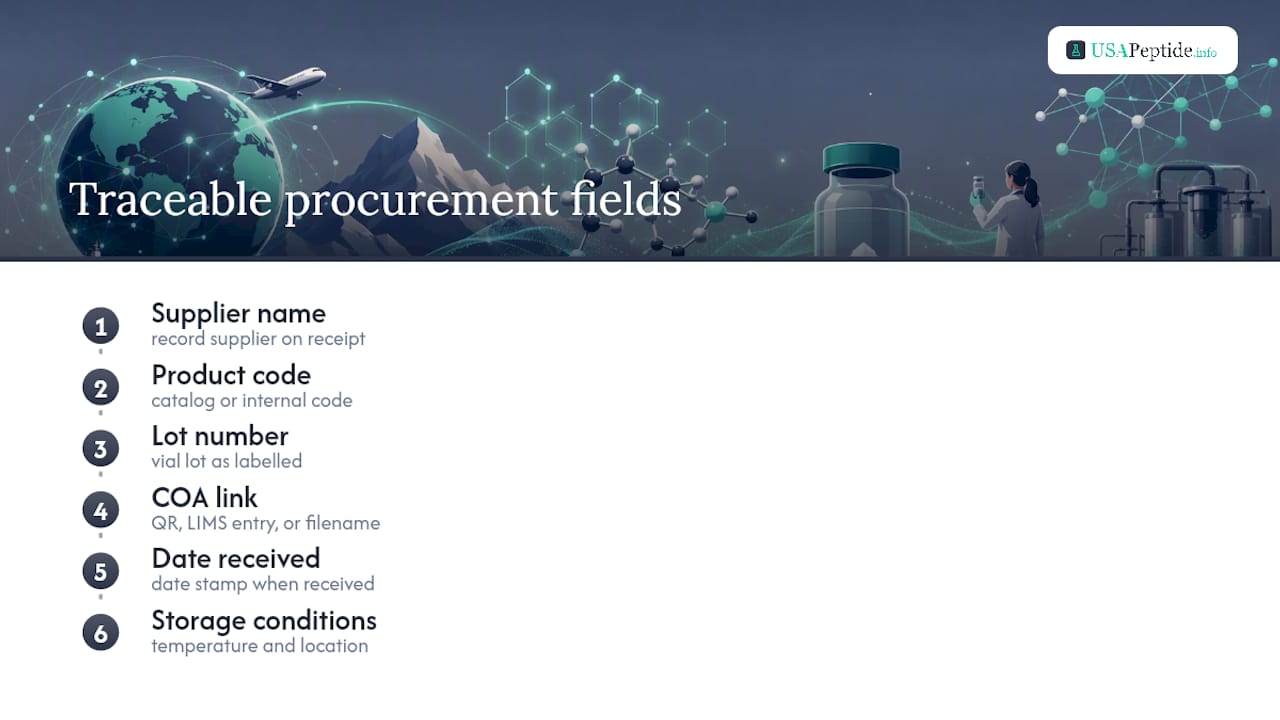
Linking COAs to physical vials through a QR code, a LIMS entry, or even a consistent file-naming convention (supplier, lot, date) prevents the common failure mode where a COA sits in an inbox disconnected from the vial it describes. A lot documentation checklist helps standardize this across a lab.
Retention policy matters too: keep COAs for the life of the associated data, and version control them if a supplier reissues a corrected document. This paper trail is what supports a publication's materials section or survives scrutiny during an audit.
How USAPeptide Supports Documentation-First Sourcing
Applying the six-point checklist and the 15-minute vet by hand, order after order, gets tedious fast. USAPeptide.info's COA check tool automates the part researchers find hardest: grading whether a submitted COA actually contains the fields, lab identity, and lot linkage the checklist demands.
The platform's peptide database pairs each compound's molecular profile with expected purity benchmarks, so a researcher can confirm a supplier's claimed results against a known reference before ordering. A dosage calculator rounds out the toolset for planning research use once material arrives. Together, these tools shorten the gap between "this COA looks fine" and "this COA is verifiably fine."
Common Peptide Synthesis Methods and Their Impact on Quality
Most research peptides are made through solid-phase peptide synthesis (SPPS), where amino acids are added one at a time to a resin-bound chain. Within SPPS, two chemistries dominate: Fmoc and Boc. Fmoc synthesis, which uses milder base-driven deprotection, has become the more common industrial approach because it avoids the highly corrosive hydrofluoric acid Boc chemistry requires at the cleavage step.
Synthesis method affects quality in ways that show up directly on a COA. Longer peptide sequences accumulate more opportunities for incomplete coupling reactions, producing truncated or deletion byproducts that a coarse purification step might miss. This is precisely why the chromatogram matters more than the printed purity number: a well-resolved HPLC trace with a single sharp peak indicates a clean synthesis and thorough purification, typically via reverse-phase HPLC, while a trace with shoulder peaks or a broad base suggests incomplete separation of byproducts.
Some suppliers cut costs by using shorter purification runs or less selective columns, which lowers cost per milligram but raises the risk of residual impurities that a single-number purity claim won't reveal. Peptides with cyclic structures or multiple disulfide bonds add further complexity, since improper folding or oxidation during synthesis can produce a product with the right mass but the wrong three-dimensional structure, something MS alone won't always catch but which functional assays eventually will.
Regulatory Considerations and Compliance for Peptide Sourcing
Research peptides sold in the United States are typically labeled "for laboratory research use only, not for human consumption." That label is not boilerplate. It defines the legal basis under which most of these compounds are sold and reflects the fact that they haven't gone through the FDA approval process required for clinical use.
Buyers should verify that a supplier's marketing matches that labeling. A vendor that implies a compounded, prescription-based, or 503A/503B pharmacy-sourced product while selling under a research-use label is misrepresenting its own regulatory status, a red flag worth treating seriously during vetting. Congressional activity around compounding and biologics regulation continues to evolve; recent legislative records on Congress show ongoing attention to this space, which is worth monitoring rather than treating as settled.
For a lab, compliance mostly means matching your institution's own research-use protocols and biosafety requirements to the supplier's documentation. That includes confirming the product wasn't marketed with therapeutic claims, keeping COAs and purchase records on file, and following your institution's material safety and IRB or IACUC guidance where animal or human-adjacent work is involved. None of this substitutes for legal counsel on a specific use case, but it does mean checking the label matches the marketing before the material matches your bench.
Lead Times and Typical Delivery Timelines for Peptide Orders
Standard research peptide orders from established suppliers typically ship within one to three business days of payment clearing, with delivery inside the continental U.S. adding another one to five days depending on the shipping tier chosen. Same-day shipping, where offered, applies to in-stock lots and orders placed before a specific cutoff time, not to custom syntheses.
Custom peptide synthesis is a different timeline entirely. A novel sequence not held in a supplier's standard catalog can take one to several weeks to synthesize, purify, and test, depending on chain length and purification difficulty. Longer or structurally complex peptides (cyclic, multiple disulfide bonds) tend toward the longer end of that range.
Cold-chain shipping requirements can add friction during summer months, when suppliers may batch dry-ice shipments to fewer days per week to manage costs and transit risk. If your protocol has a hard start date, confirm both the synthesis or stock status and the current shipping cadence before you count on a delivery window. Building a few days of buffer into procurement timing is cheaper than a delayed experiment.
Handling and Disposal Guidelines for Peptides
Most research peptides arrive lyophilized (freeze-dried) and stay stable at refrigerated or frozen temperatures for extended periods, but that stability changes the moment they're reconstituted. Once dissolved, a peptide solution generally has a much shorter usable window and should be stored per the supplier's specific stability data, usually refrigerated and used within days to a few weeks, not months.
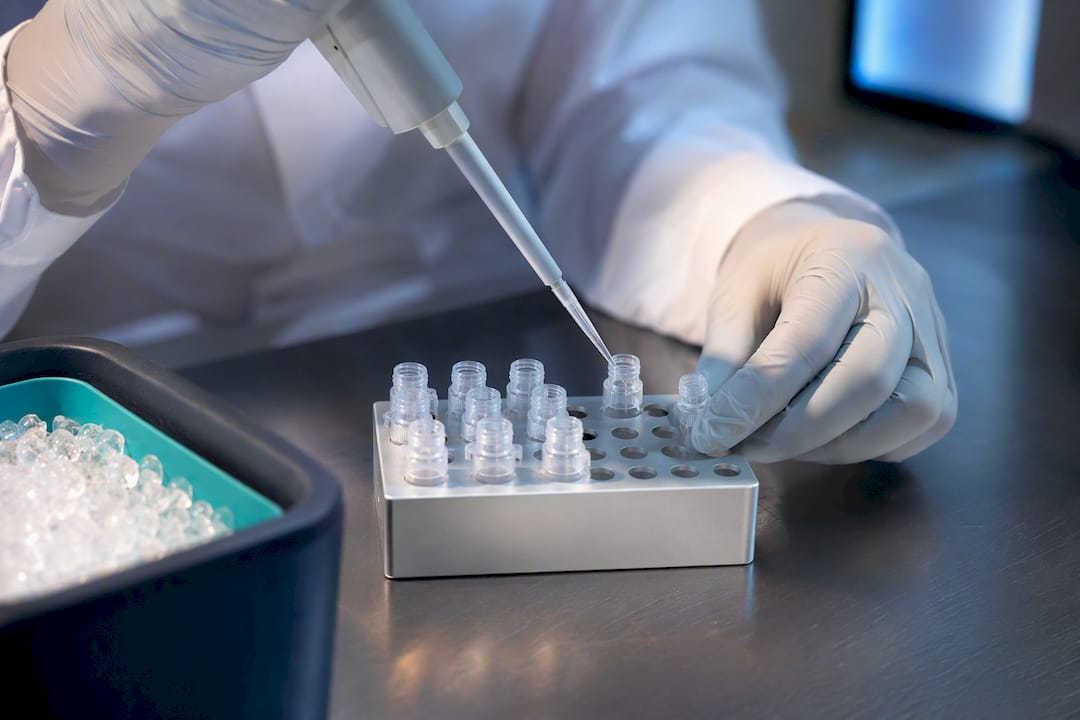
Repeated freeze-thaw cycles degrade peptide integrity, so aliquoting a stock solution into single-use portions immediately after reconstitution avoids that problem later. Basic lab hygiene applies throughout: gloves, a clean work surface, and standard sharps handling if syringes or needles are part of the workflow.
Disposal follows your institution's chemical and biological waste protocols rather than a peptide-specific rule. Small quantities of research peptides are generally treated as non-hazardous laboratory chemical waste, but expired or unused material should still go through your facility's designated chemical waste stream rather than a sink or standard trash, both to comply with local environmental regulations and to avoid any ambiguity in an audit. When in doubt, your institution's environmental health and safety office has the final say, not a supplier's packaging insert.
Intellectual Property and Licensing Concerns Related to Peptide Use
Peptide sequences themselves are often not proprietary. Well-studied research peptides like BPC-157 or TB-500 are widely published, and their base sequences appear in open scientific literature, meaning sourcing the compound itself typically raises no IP issue for standard research use.
Licensing concerns arise more often around specific formulations, delivery systems, or synthesis methods that a company has patented, and around branded or FDA-approved therapeutic peptides where a manufacturer holds exclusive commercial rights. Sourcing a research-grade version of a compound that has an approved pharmaceutical analog (semaglutide is the clearest current example) doesn't infringe on the manufacturer's patent as long as the material stays within legitimate research use and isn't marketed or sold as the approved drug itself.
Where this gets genuinely complicated is downstream: if your research leads to a novel finding, modification, or application involving a peptide, standard academic and institutional IP policies apply, and your institution's technology transfer office is the right resource, not general sourcing guidance. Sourcing documentation (the COA, lot records, supplier agreement) also matters here, since a clear paper trail of what was purchased and from whom supports any later IP disclosure your institution requires.
The Documentation-First Verdict on Peptide Sourcing
The conventional advice on peptide sourcing spends too much energy comparing prices and not enough time asking suppliers to prove anything. Price comparison is the easy part. Verifying that a purity claim survives contact with a real chromatogram and a real accredited lab is the part that actually protects an experiment, and it's the part most buyers skip because it takes an extra ten minutes.
The reader who benefits most from this playbook isn't the person hunting for the cheapest milligram price. It's the person who has already been burned once by a COA that didn't match the vial, or who is about to submit data for peer review and doesn't want a reviewer asking for documentation that was never generated. Prioritize the lot number match first, the named lab second, and price a distant third.
What's overrated in most sourcing discussions is catalog size. What's underrated is a supplier's willingness to send a raw chromatogram without hesitation. That single response, fast or slow, complete or evasive, tells you more about a vendor's actual quality control than anything on their homepage.
— USAPeptide Team
Get Your Sourcing Documentation Verified Before You Order
USAPeptide gives researchers something most sourcing guides can't: a way to check the actual paperwork before money moves, not just a checklist to apply on faith.
Once you've picked a candidate supplier using the six-point checklist above, run the COA itself through the COA check tool to grade whether the lot number, testing lab, and analytical data actually hold up. Pair that with the peptide database to confirm the compound's expected molecular profile matches what the supplier claims, and browse the Peptriva resource center if you want direct guidance connecting to vetted, ISO 17025-tested suppliers rather than starting your search cold. For labs weighing tissue-repair research specifically, the curated recovery peptide guide maps compounds to use cases so procurement specs match the experiment from the start.
Start by grading your next COA candidate. It takes less time than the vet workflow above and tells you immediately whether a supplier's documentation is worth trusting.
This article is general information, not a substitute for advice from a qualified doctor. Consult a qualified healthcare professional about your own circumstances before acting on anything here.
Sources
- How to Choose a Research Peptide Supplier: 6-Point Quality Checklist (2026)
- Peptide Sourcing - SSRP Institute
- Knowledge Guide: How to Research Peptide Suppliers and Spot Non-Pharmacy Sources