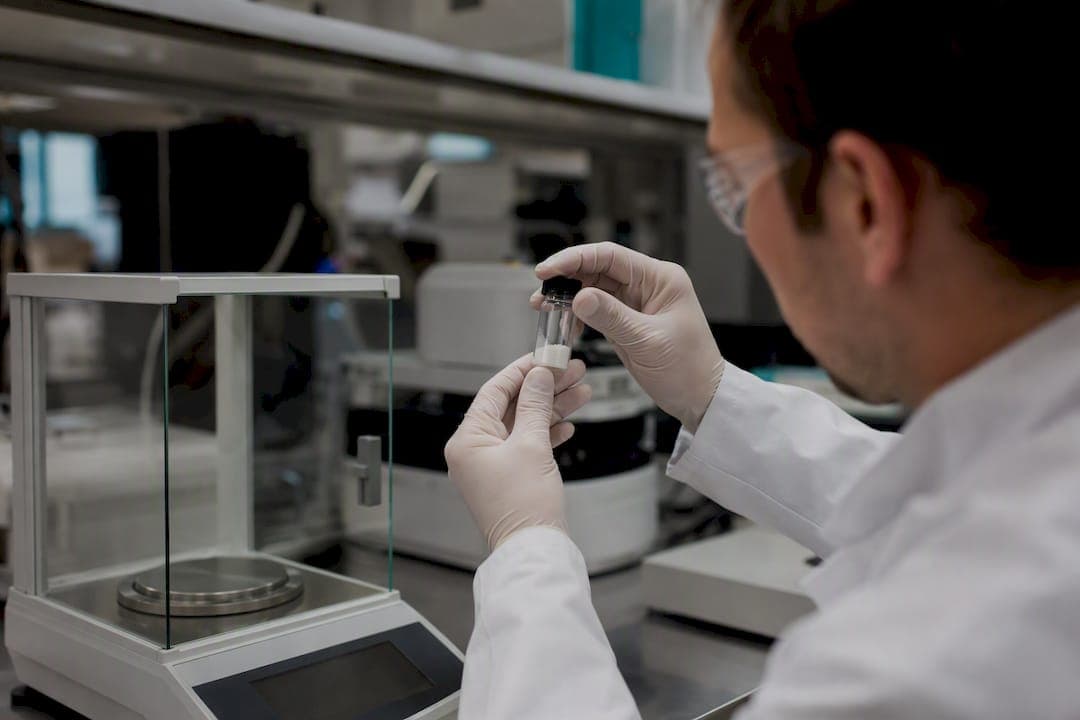
A trustworthy peptide COA lets you confirm lot identity, purity, and contamination status in about a minute. If the document is missing an HPLC chromatogram, a mass spectrum, or a lab accreditation statement, treat the lot as unverified until you get more data.
Run this triage before anything touches your bench:
- Lot or batch number on the COA matches the vial label exactly
- HPLC chromatogram image is present, not just a purity percentage
- Mass spectrum or deconvoluted mass table is included, not just a stated value
- Lab name is identified, with ISO 17025 or equivalent accreditation stated
- Analysis date and analyst name or signature appear on the document
Pro Tip: If any of these five items are missing, request the raw chromatogram file or the full MS spectrum before you accession the lot. A vendor that can't produce raw data on request usually never ran the test.
A COA without a matching lot number is not a certificate of anything specific. It's a template, and templates don't tell you what's actually in the vial.
Key Takeaways
A peptide COA is only trustworthy when its lot number matches the vial, its purity claim is backed by a visible HPLC chromatogram, and its identity claim is backed by a mass spectrum with stated method parameters.
| Point | Details |
|---|---|
| Lot match is non-negotiable | The COA's batch number must match the vial label exactly, or the document isn't evidence for that lot. |
| Demand raw data | Require the actual HPLC chromatogram and MS spectrum, not just summary purity and mass numbers. |
| Mass confirms weight, not sequence | Intact mass matching within tolerance doesn't rule out scrambled sequences; peptide mapping does. |
| Know your threshold | Research-grade work typically accepts ≥98% HPLC purity; GMP documentation is required for clinical or regulated use. |
| Use a grading tool | USAPeptide.info's COA check tool scores completeness and flags missing fields against these same criteria. |
Table of Contents
- How to Read a COA Field by Field
- What Does an HPLC Purity Number Actually Mean?
- What Does a Mass Spec Result Actually Confirm?
- How Do You Know When to Reject a COA?
- Research-Grade COA or GMP Documentation: Which Do You Need?
- How USAPeptide.info Helps You Verify a COA
- A Lab Manager's Note on Building COA Checks Into Your SOP
- Where to Get Help Verifying a Lot
- Sources
How to Read a COA Field by Field
Start with the batch or lot number. It has to match the sticker on your vial character for character. A Certificate of Analysis is inherently batch-specific, reporting empirical results from one production run. A Certificate of Compliance, by contrast, is a weaker document that often just states the product meets a specification, with no raw data behind it. If a vendor sends a CoC instead of a lot-linked COA, you don't have analytical evidence yet.
Next comes product identification: the sequence, theoretical molecular weight, molecular formula, and sometimes a CAS number. These fields tell you what the lab believes it tested. Compare the theoretical MW against whatever mass value shows up later in the mass spec section.
Administrative fields matter more than researchers often assume. Look for the date of analysis, the analyst's name, the lab's name and address, and an accreditation statement. A lab operating under ISO 17025 has been independently assessed for competence in the specific tests it's reporting, which is a meaningfully different claim than "in-house tested."
The analytical methods section is where the real evidence lives:
-
- HPLC purity, with method details (column, gradient, wavelength)
- LC–MS or MALDI for mass confirmation
- Peptide mapping via proteolytic digest plus MS/MS, when sequence confidence matters
- Endotoxin testing (LAL or recombinant factor C) for cell-culture-relevant lots
- Residual solvents by GC and water content by Karl Fischer titration
- Net peptide content, which accounts for water, salts, and counter-ions in the total mass
Raw data looks like an actual chromatogram graphic with peaks and a baseline, a mass spectrum or deconvoluted mass table, and stated method parameters: column type, gradient program, detector wavelength, and ionization technique. A complete COA includes all of this rather than summarizing it into a single purity number.
Pro Tip: Keep a running log of which vendors supply raw chromatogram files unprompted. It's one of the fastest ways to separate labs that actually run the analysis from labs that generate paperwork.
What Does an HPLC Purity Number Actually Mean?
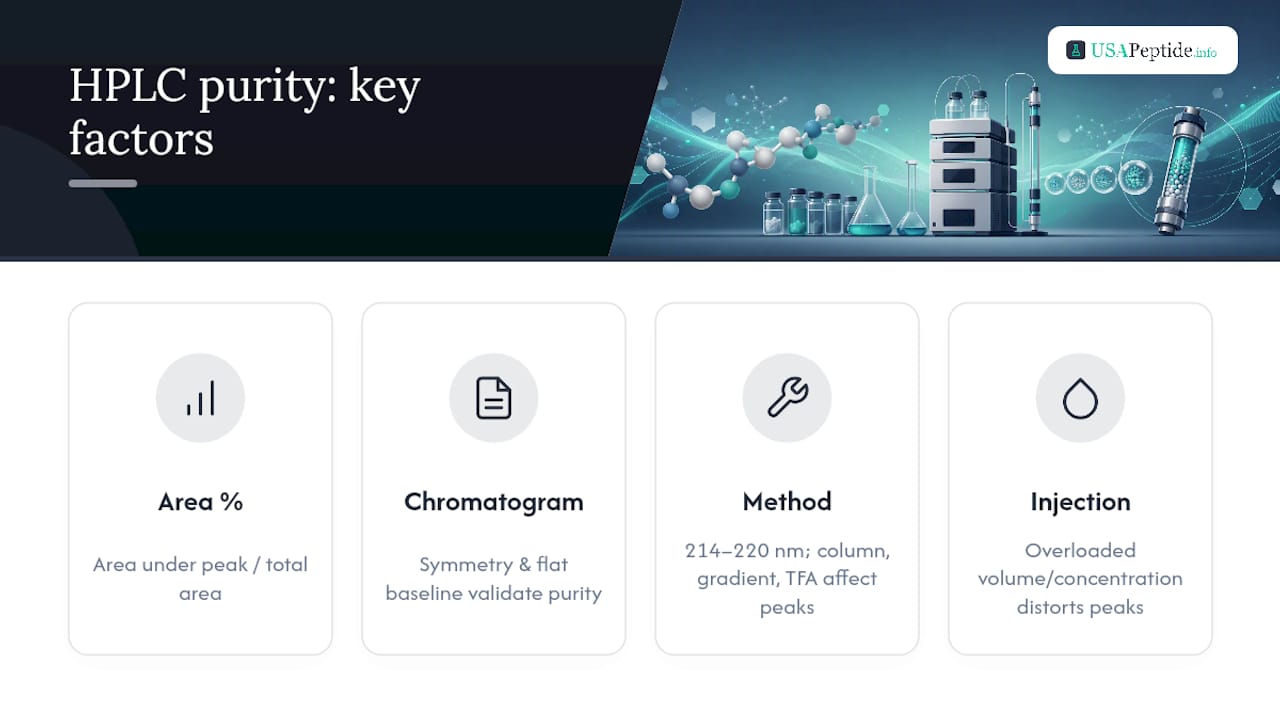
The percentage on a COA is almost always "% area," calculated by integrating the area under your peptide's peak and dividing by the total area of all peaks in the run. It's a proxy for purity, not a direct measurement of mass or identity, and it's only as good as the chromatogram behind it.
The graphic matters as much as the number. A sharp, symmetric peak sitting on a flat baseline supports the stated purity. Tailing, shoulder peaks, or co-eluting impurities near the main peak can inflate or obscure the real figure, and none of that shows up if the vendor gives you a number with no chromatogram attached.
Method details change how you should read the result. Detection at 214 to 220 nanometers is the standard for peptide bonds; a lab reporting at 254 or 280 nm is likely tuned for aromatic side chains, which can miss impurities lacking those groups. Column chemistry and gradient steepness also shift resolution, and TFA in the mobile phase can suppress or shift peaks in ways that flatter the result.
Each is a common way vendors distort what looks like rigorous data.
Pro Tip: Ask for the injection volume and concentration alongside the chromatogram. Overloaded injections distort peak shape and can make impurities disappear into the main peak.
What Does a Mass Spec Result Actually Confirm?
Intact-mass analysis by ESI or MALDI compares the observed mass against the theoretical mass for your sequence, typically accepting a match within about ±1 Da for ESI and ±2 Da for MALDI. A match here confirms the molecule weighs what it should.
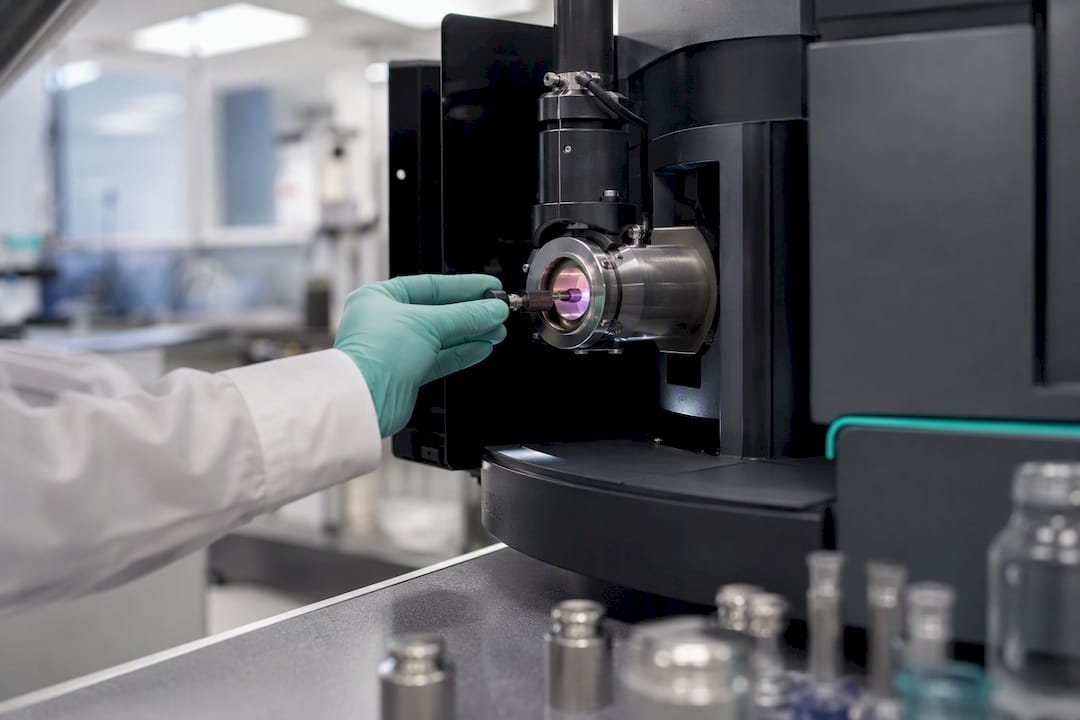
It does not confirm amino acid order, stereochemistry, or rule out isomers with an identical mass. Intact mass is necessary but not sufficient for full sequence confirmation. Two peptides with scrambled sequences but the same composition can produce the same mass reading.
Peptide mapping closes that gap. A proteolytic digest followed by MS/MS fragment analysis builds sequence coverage piece by piece, giving you actual evidence for amino acid order rather than an inference from total mass.
A mass spec number without a stated ionization method, charge state, or raw spectrum is a claim, not a confirmation. Ask which instrument ran it and whether the spectrum is available.
Check three things on any MS report: the ionization method named, observed m/z alongside the deconvoluted mass, and whether charge states are disclosed.
How Do You Know When to Reject a COA?
Treat these as immediate disqualifiers: no lot number, no chromatogram or spectrum, an unnamed or non-accredited lab, exact round-number purity, or a COA that's identical across multiple different batches.
Run verification in this order:
- Match the lot number on the COA against the vial label.
- Confirm identity through the mass spec section.
- Confirm purity through HPLC purity plus the chromatogram itself.
- Check contaminant data: endotoxin levels and residual solvents.
- Confirm the lab's accreditation status and the analysis date.
- If a step fails, request the full raw chromatogram and MS files along with method parameters before proceeding.
- If the vendor can't produce raw data within a reasonable window, ask for third-party retesting.
- Quarantine the lot, log every vendor communication with dates, and set a clear internal rejection threshold your team applies consistently.
A missing chromatogram is not an oversight worth working around. It's the one piece of evidence you can't reconstruct after the fact.
Research-Grade COA or GMP Documentation: Which Do You Need?
A lot-specific COA with an HPLC chromatogram, MS-confirmed identity, and purity at or above the typical research threshold of 98% is usually sufficient for in vitro and bench research. Endotoxin limits should match your application; cell-culture work commonly targets below 1 EU/mg.
GMP documentation becomes necessary once work moves toward clinical relevance, regulated manufacturing, or anything requiring full process validation and traceable batch records.
- In vitro cell-culture assay: research-grade COA with endotoxin under 1 EU/mg is generally adequate.
- Injectable or in vivo studies with regulatory implications: GMP or pharmacy-grade documentation is required, not a standard research COA.
- Anything feeding into a publication with reproducibility claims: keep the full raw data package on file regardless of grade.
How USAPeptide.info Helps You Verify a COA
The COA check tool walks through the same lot match, chromatogram, and MS checks covered here, scoring completeness so you're not doing it from memory every time. The peptide glossary defines the acronyms you'll hit on real documents, from LAL to Karl Fischer titration.
- COA grading and completeness scoring
- Definitions for HPLC, LC–MS, peptide mapping, and related terms
- Product profiles showing what a properly documented COA looks like
Pro Tip: Run a suspicious COA through the grading tool before you email the vendor. It's faster to know exactly which field is missing before you ask them to fill it in.
A Lab Manager's Note on Building COA Checks Into Your SOP
The lots that cause problems are usually the ones nobody logged properly at intake. A minimal SOP works: record the lot ID, attach the COA PDF directly to the inventory entry, and quarantine the material until someone actually reviews the document.
Pro Tip: Keep a 1 to 2 mL retention sample from every lot you accept. If a result looks off three weeks later, you'll have material on hand to send for third-party verification instead of arguing with a vendor over a document.
Document every vendor exchange, and set a firm threshold for when a lot gets escalated to rejection rather than a follow-up email.
Where to Get Help Verifying a Lot
If a COA leaves you with more questions than answers, you don't need to sort it out alone. There are other routes: emailing the vendor directly, or paying out of pocket for outside lab testing on your own schedule.

USAPeptide.info gives you a faster path: the COA check tool grades completeness against the same criteria covered in this walkthrough, so you get a structured answer instead of guessing at what a vendor's PDF is missing. The site also connects researchers to ISO 17025-accredited supply partners with verified, lot-linked documentation already on file, cutting out the back-and-forth of chasing raw data from an unresponsive vendor. If you're starting from scratch rather than checking an existing lot, the research peptide reference hub is the place to browse verified product profiles and their COA documentation before you order.
Sources
- How to Read a Certificate of Analysis (COA) for Research Peptides
- Mass spectrometry limitations and peptide mapping (peer-reviewed discussion)
Verify lab accreditation directly against ISO 17025 status, and request independent third-party testing whenever a vendor's documentation stays incomplete after you've asked.
This article is general information, not a substitute for advice from a qualified doctor. Consult a qualified healthcare professional about your own circumstances before acting on anything here.