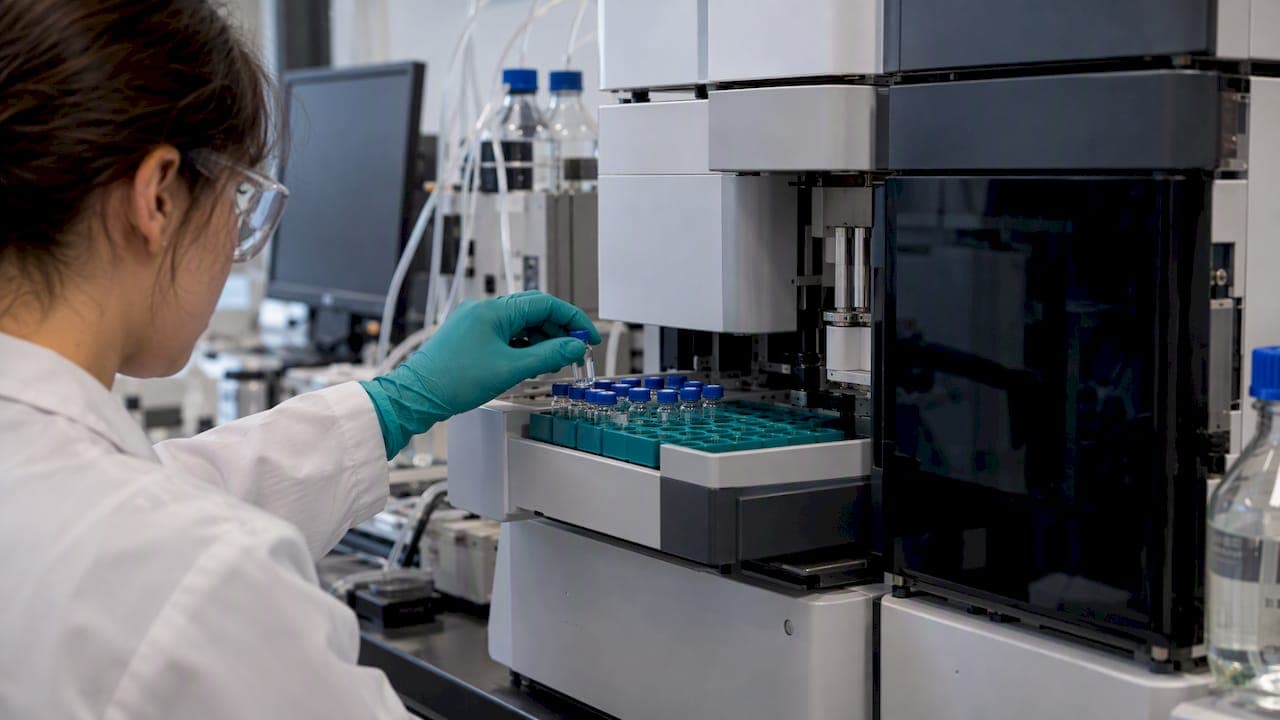
A peptide impurity profile is the full set of detectable sequence variants and chemical degradation products present alongside the intended compound, and reliable characterization requires a stability-indicating RP-LC method paired with orthogonal LC-MS/MS confirmation. An HPLC area percent alone tells us how clean a chromatogram looks under one set of conditions, not what is actually present in the vial. Treating that single number as a complete purity measure is one of the most common misreadings in peptide quality assessment.
TL;DR:
- HPLC area percent measures relative UV peak area, not peptide mass; use net peptide content corrected for water and counterions for dosing calculations.
- Pair reverse phase chromatography with mass spectrometry for intact mass, then use tandem mass spectrometry or orthogonal separation when coelution or isobaric variants remain.
- Request the chromatogram, method conditions, intact mass, moisture and counterion correction, lot number, and test date; a bare purity percentage cannot support verification.
- Validate that the method distinguishes degradants from the parent using forced degradation samples, with detection limits below the applicable specification.
- Set impurity limits according to intended use, because research grade and GMP grade materials follow different specification expectations, with no universal cutoff.
Table of Contents
- What Are the Main Types of Peptide Impurities?
- How Do RP-HPLC, LC-MS, and MS/MS Work Together?
- How Should You Read a COA and Set Impurity Limits?
- Building a Stability-Indicating Method: Development and Validation
- What Does a Practical Impurity-Profiling Workflow Look Like?
- How USAPeptide.info Supports Rigorous Impurity Assessment
- A Note on Reproducibility and Documentation
- Where to Find Verified COAs and Reference Materials
- FAQ
- Sources
What Are the Main Types of Peptide Impurities?
Impurities in synthetic peptides fall into two broad families: process-related and degradation-related. Process-related impurities originate during synthesis itself, while degradation products form afterward, during storage, handling, or reconstitution. Recognizing which family a given species belongs to changes how we test for it and how we read a certificate of analysis.
Process-related impurities tend to cluster around a handful of mechanisms tied to solid-phase synthesis chemistry. Deletion and truncation sequences occur when a coupling step fails and the chain continues without that residue, producing peptides shorter than the target. Insertion variants add an extra residue through double coupling or reagent carryover. Capped truncates form when a failed coupling site gets acetylated or otherwise blocked, which can make the truncate chromatographically similar to impurities from unrelated pathways. Residual reagents and solvents, including trifluoroacetic acid, acetonitrile, and coupling agents, round out the process-related category and are typically addressed separately from sequence-level testing.
Degradation products form after synthesis is complete, often during storage or in solution, and their presence or absence says a great deal about how a lot has been handled.
- Oxidation affects methionine, cysteine, and tryptophan residues and shifts mass by small, often diagnostic increments.
- Deamidation converts asparagine or glutamine residues to aspartate or glutamate, altering charge and retention time.
- Hydrolysis cleaves peptide bonds, generating fragments that can be isobaric with unrelated truncates.
- Disulfide exchange scrambles cysteine pairing in multi-cysteine peptides, creating isomers with nearly identical mass.
- Aggregation produces dimers and higher-order species that may elute near the main peak or stay on the column entirely.
Isobaric and isomeric variants deserve particular caution because two species can share the same monoisotopic mass while differing completely in sequence or structure, a scenario mass detection alone cannot resolve. Peptide length and the presence of modifications such as acylation or PEGylation also shift impurity risk and chromatographic behavior, since longer or heavily modified sequences generally carry more potential failure points per synthesis cycle.
How Do RP-HPLC, LC-MS, and MS/MS Work Together?
No single method answers every question a peptide impurity profile raises, which is why a layered approach has become standard practice in peptide purity analysis.
Reverse-phase HPLC or UPLC with UV detection remains the workhorse for separation and quantitation. The area percent it reports describes the relative size of peaks under specific UV absorbance and gradient conditions, not the absolute mass of peptide present. Two problems limit what that number can tell us on its own: co-elution, where an impurity hides directly under the main peak, and detector response, since not every impurity absorbs UV light the same way the parent peptide does. The shape of the chromatogram trace itself, including shoulders, tailing, and asymmetry, often carries more diagnostic value than the printed percentage.
LC-MS and high-resolution mass spectrometry add a dimension HPLC cannot provide: confirmation of molecular identity through mass. HRMS allows adduct detection and charge-state deconvolution, which is essential for confirming the intact mass of the intended sequence and spotting mass shifts consistent with oxidation, deamidation, or hydrolysis. Its limitation is quantitation: ionization efficiency varies between species, so MS intensity does not translate cleanly into relative abundance, and isobaric species still require additional separation to distinguish.
MS/MS and peptide mapping go a step further by fragmenting the molecule and localizing exactly where a modification sits within the sequence, turning "something changed the mass by 16 daltons" into "methionine at position 4 is oxidized." Orthogonal separations, including ion-exchange chromatography and capillary zone electrophoresis, along with chiral methods for detecting stereochemical inversion, fill in gaps that reverse-phase chemistry alone cannot resolve.

A method sensitivity target near a low area percentage is commonly used in pharmacopeial contexts for detecting low-level impurities, which means a validated method needs a limit of quantitation that comfortably spans the specification limit it is meant to enforce, according to general pharmacopeial guidance referenced in peptide reference standard literature.
Confidence in an identification should be reported in tiers rather than treated as binary. A tentative identification rests on retention time and mass match alone. A confirmed identification adds MS/MS fragmentation consistent with the proposed structure. A definitive identification requires co-elution with an authentic reference standard under the same chromatographic conditions, which remains the strongest evidence available short of total synthesis and independent characterization.
How Should You Read a COA and Set Impurity Limits?
A certificate of analysis is only as useful as the detail behind it, and a research team evaluating a COA should treat it as a starting point for verification rather than a final answer.
- Chromatogram and method details. The COA should include the actual trace, not just a summary number, along with column type, gradient, and detection wavelength.
- Mass data. Intact mass confirmation by LC-MS or HRMS should accompany the purity figure, ideally with adduct and charge-state information.
- Moisture and counter-ion content. Net peptide content differs from HPLC area percent because water, acetate, or trifluoroacetate salts contribute to total mass without being peptide.
- Residual solvents and endotoxin. These matter most for in vivo research applications and are frequently tested and reported separately.
- Lot number, test date, and lab accreditation. Traceability lets a lab match results to a specific synthesis run and verify the testing facility's credentials.
Net peptide content, not HPLC area percent, is what should drive dosing and mass calculations: a vial reporting 95% HPLC purity but only 80% net peptide content by mass balance means roughly one-fifth of the weighed material is water, counter-ion, or other non-peptide mass, a distinction that USP-aligned reference standard methodology addresses directly through mass-balance correction.
Research-grade impurity thresholds are typically set case-by-case based on intended use rather than a single universal cutoff, and GMP-grade material carries tighter, more extensively validated specifications than research-use compounds. When a reference standard is unavailable for a given impurity, the reasonable request to a supplier is a mass-balance breakdown and a description of the orthogonal methods used to assign purity, rather than a bare percentage.
Pro Tip: Before accepting a COA at face value, check whether the test date, lot number, and method details line up; a certificate missing any of the three warrants a follow-up request to the supplier.

Building a Stability-Indicating Method: Development and Validation
Method development for impurity profiling starts with an Analytical Target Profile that defines what the method needs to detect, at what sensitivity, and under what degradation conditions, scoped specifically to the peptide's known or suspected failure pathways.
Forcing degradation this way reveals which pathways actually dominate for a given sequence, information that guides where analytical attention should concentrate.
Validation according to ICH Q2 guidance covers specificity, limit of detection, limit of quantitation, linearity, precision, and accuracy, and a method intended for impurity work must also demonstrate that it is stability-indicating, meaning it can distinguish degradation products from the parent compound without interference.
- Confirm specificity by showing the method separates known degradants from the main peak.
- Establish LOD and LOQ low enough to detect impurities near the specification limit.
- Demonstrate linearity and precision across the expected concentration range.
- Prove stability-indicating capacity using the forced-degradation sample set.
| Validation parameter | What it demonstrates |
|---|---|
| Specificity | Degradants resolve from the main peak and from each other |
| LOD/LOQ | Sensitivity reaches below the specification limit |
| Linearity | Response is proportional across the working range |
| Precision and accuracy | Repeated measurements agree with expected values |
When co-elution appears during development, the usual levers are gradient slope, ion-pair concentration, column chemistry, column temperature, and organic solvent composition, often adjusted in combination rather than one at a time, and sometimes resolved only by adding an orthogonal separation technique.
What Does a Practical Impurity-Profiling Workflow Look Like?
A consistent lab workflow reduces the chance that an impurity goes undetected simply because of how a sample was handled.
- Prepare samples carefully. Use solvents and concentrations appropriate to the peptide's solubility, and consider blocking agents to prevent adsorption losses to vial surfaces, particularly for hydrophobic sequences.
- Track reconstituted stability. Reconstituted peptides degrade at different rates depending on buffer and temperature, and a defined verification window helps catch early degradation before it affects results.
- Run controls alongside samples. A process standard, an authentic reference peptide, spike-and-recovery checks, and system-suitability injections confirm the method is performing as validated on the day of testing.
- Apply consistent integration and reporting rules. Fixed thresholds for peak integration, consistent rounding, and documented uncertainty keep results comparable across runs and lots.
- Escalate when results are ambiguous. An unresolved shoulder peak or an unexpected mass shift is the signal to request batch-specific orthogonal testing rather than accepting a single chromatogram as final.
Pro Tip: Storage conditions influence which degradation pathways dominate, so matching storage temperature to the peptide's known stability profile reduces the chance of degradation artifacts complicating an impurity profile.
How USAPeptide.info Supports Rigorous Impurity Assessment
A COA grading tool can flag gaps such as missing mass data, absent chromatogram traces, or incomplete method details on a supplier's certificate. Alongside a peptide database and reference-standard guidance, a tool may give researchers a structured way to check whether a COA supports the experiment they are planning. References to ISO 17025-accredited testing can be maintained throughout materials, and it is important to be direct about the limits of any single document: when a COA lacks mass confirmation or orthogonal evidence, the next step is third-party testing, not assumption.
A Note on Reproducibility and Documentation
Reproducibility in peptide research depends on documentation as much as on chemistry. A single HPLC percentage, however clean it looks, cannot substitute for mass confirmation, and it certainly cannot predict how a peptide will behave in a biological assay. We encourage keeping full analytical traces, not just summary values, and treating any COA that omits method detail as incomplete until that detail is supplied.
— USAPeptide Team
Where to Find Verified COAs and Reference Materials
We maintain a peptide database built around documented quality assurance, including compounds tested to ≥99% HPLC purity through ISO 17025-accredited laboratory partnerships, giving researchers a direct path to verified material instead of starting impurity review from scratch.

- Our COA grading tool flags missing chromatogram traces, absent mass data, or incomplete method details before a sample reaches the bench.
- Our reference-standard request process connects researchers to accredited lab partnerships for compounds that need additional orthogonal confirmation.
- For background on how research-use classification intersects with COA expectations, see this explainer on research-use-only peptide classification.
Browse the full peptide catalog to compare documented purity data against what your protocol requires.
This article is general information, not a substitute for advice from a qualified doctor. Consult a qualified healthcare professional about your own circumstances before acting on anything here.
FAQ
What is the acceptable purity for peptides?
Acceptable purity depends on intended use rather than one fixed number, since research-grade and GMP-grade material carry different specification requirements.
Is 98% purity good for peptides?
Reviewing the accompanying mass data and moisture or counter-ion correction gives a fuller picture than the percentage alone.
What shouldn't you mix with peptides?
Peptides are sensitive to incompatible solvents, extreme pH, and bacteriostatic agents that were not validated for the specific sequence, since these can accelerate hydrolysis, aggregation, or oxidation. Reconstitution should follow the method documented for that peptide's known stability profile rather than a generic protocol.
How to tell if peptides are pure?
Purity assessment requires a stability-indicating HPLC method combined with LC-MS confirmation of intact mass, since UV area percent alone cannot rule out co-eluting impurities. Reviewing the chromatogram trace itself, not just the summary number, along with mass data, gives the most reliable picture available short of full orthogonal testing.
Sources
- Characterization and reference standard approaches for peptide materials (PMC review)
- ICH Q2 guideline (analytical method validation)