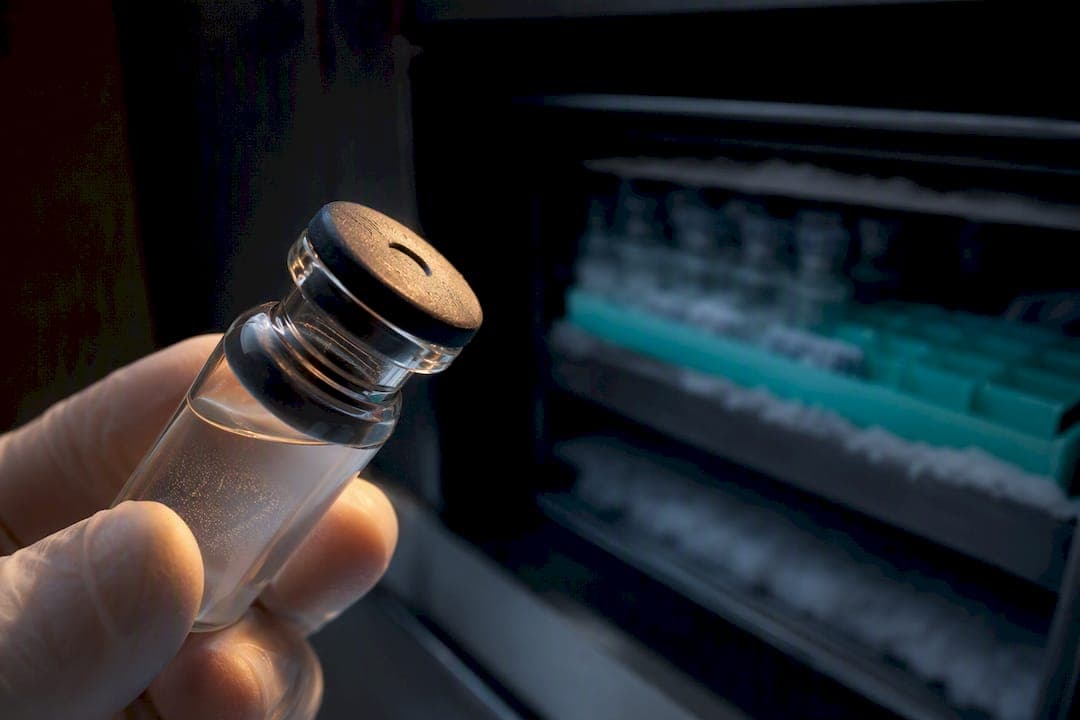
Lyophilized peptide is stable for months to years at proper freezer temperatures, but reconstitution starts a clock that solvent choice, temperature, and handling determine. A bacteriostatic-water solution kept at 2–8°C is commonly treated as usable for about four weeks, sterile-water preparations for far less, and frozen single-use aliquots extend that window at the cost of freeze-thaw risk. Solvent selection, storage temperature, and aliquoting are the three levers that actually control how long a reconstituted peptide stays scientifically usable.
TL;DR:
- Reconstituted peptides typically remain stable for a few weeks at 2–8°C, with frozen aliquots extending usability but risking freeze-thaw damage.
- Peptide degradation after reconstitution is driven by hydrolysis, oxidation, deamidation, and aggregation, all affected by sequence, pH, and temperature.
- Storing lyophilized vials at -20°C in sealed, inert packaging preserves high purity for months to years, while exposing open vials to moisture shortens shelf life.
- The FDA’s 28-day storage guideline for multi-dose vials is conservative; some sequences may stay stable beyond this period if conditions are optimal.
- Using the correct solvent, buffering pH to 3–6, aliquoting immediately, and minimizing freeze-thaw cycles are essential for maintaining peptide integrity.
Table of Contents
- Why dry and dissolved peptides age at different speeds
- Storing lyophilized vials: temperature, packaging, and shelf life expectations
- How long reconstituted peptides actually last
- Choosing a solvent, buffer, and pH to slow degradation
- Aliquoting and freeze-thaw discipline that actually protects your samples
- Spotting degradation before it wrecks an experiment
- Checking shipments and protecting the cold chain
- A step-by-step SOP from receipt to disposal
- Using USAPeptide's tools to enforce the SOP in practice
- A conservative lab's honest take on reconstituted peptide life
- Tools that make the storage SOP easier to follow
- Where this guidance comes from
- Sources
Why dry and dissolved peptides age at different speeds
A lyophilized peptide sits inside what chemists call a glassy matrix: a low-moisture, low-mobility solid where molecules barely move. That immobility is what makes freeze-dried powder so forgiving. Water is the reactant that drives most peptide degradation, and a lyophilized cake has almost none of it available for chemistry to happen.
Reconstitution changes that instantly. Dissolving the peptide in water or buffer gives every degradation pathway the mobility it needs to proceed, and ChemVerify's overview of reconstitution chemistry identifies four dominant routes once a peptide is in solution:
- Hydrolysis, where the peptide backbone or side chains react with water and break apart.
- Deamidation, especially at asparagine-glycine (Asn-Gly) motifs, which are notoriously reactive.
- Oxidation, which targets methionine and cysteine residues first.
- Aggregation, where peptides clump together, often accelerated at high concentration or with hydrophobic surfaces nearby.
The exact rate depends on the sequence you're working with, the pH of the solution, and the temperature it's held at. A peptide with no Met, Cys, or Asn-Gly pairing will typically outlast one riddled with them.
Storing lyophilized vials: temperature, packaging, and shelf life expectations
Unopened lyophilized vials belong in the freezer, not the refrigerator, for anything beyond short-term use. Standard guidance calls for freezing at typical freezer temperatures as the working storage standard, with lower temperatures reserved for long-term archival stock or particularly fragile sequences. Manufacturer and lab guidance on lyophilized storage confirms that peptides held at -20°C retain high purity for months to years, a sharp contrast to the days-to-weeks window that applies once the same peptide is dissolved.
Packaging matters almost as much as temperature. Sealed vials with desiccant packs and inert headspace (nitrogen or argon, when the vendor provides it) hold up far better than vials that have already been punctured or exposed to ambient air. Once a vial is opened, its stability clock starts moving even if the powder itself is untouched, since atmospheric moisture begins working its way in.
Transit is the variable labs most often overlook. A vial that spends 48 hours at ambient temperature during shipping doesn't reset once it lands in a freezer. It's already lost part of its usable life before the researcher opens the box.
- Keep unopened vials at -20°C for routine work.
- Reserve -80°C for archival or long-interval storage.
- Treat any vial with visible desiccant discoloration or headspace loss as compromised.
Pro Tip: Log the date a shipment arrives and the date it's placed in proper cold storage separately. That gap, not the vial's "manufacture date," is what actually predicts how much shelf life the powder has left.
How long reconstituted peptides actually last
Once dissolved, most peptides run on a timeline measured in days or weeks, not months. Refrigeration slows chemistry down without stopping it, and freezing an aliquot buys real time at the cost of a freeze-thaw hit.
Practical ranges researchers commonly work with:
- Hours at room temperature generally safe for immediate use, but not for storage.
- A few weeks refrigerated (2–8°C) as the working window for most bacteriostatic-water preparations, varying by sequence.
- Months frozen in single-use aliquots can be workable, though verification is warranted before trusting older aliquots.
- Longer-term freezing requires confirmation the specific sequence tolerates it.
By the numbers: FDA multi-dose vial labeling specifies a maximum in-use period of 28 days after first puncture for multi-dose vials, a figure widely adopted as a practical reference across peptide research.
That 28-day figure isn't a universal chemical half-life. It reflects preservative activity in bacteriostatic water (specifically benzyl alcohol) and a conservative regulatory buffer, not a hard wall where degradation suddenly accelerates. Some sequences remain analytically intact well past that point; others show measurable drift earlier. Lab-focused stability data report median half-lives around 42 days at 4°C in some studies, with wide variation driven by sequence and solvent choice. Treat 28 days as the conservative default, then adjust based on what you actually know about the peptide in front of you.
Choosing a solvent, buffer, and pH to slow degradation
Solvent choice is the single biggest lever a researcher controls at the moment of reconstitution. Bacteriostatic water versus sterile water is the first fork in the road: bacteriostatic water contains benzyl alcohol, which supports repeated multi-dose withdrawals and underlies that common 28-day window. Sterile water has no preservative, which means it's a single-use solution, full stop, regardless of how it's stored afterward.
pH is the second lever, and arguably the more powerful one chemically. A pharmaceutics review of aqueous peptide stability found that buffering solutions to pH 3–6 slows deamidation and oxidation for many sequences, since both reactions are pH-sensitive.
- Bacteriostatic water: supports multi-dose use, roughly 28 to 30 days refrigerated.
- Sterile water: single-use only, no preservative buffer against microbial growth.
- Buffered solutions (pH 3–6): often extend chemical stability for deamidation-prone sequences.
- Antioxidants, degassing, and co-solvents: can help but need vehicle controls before you trust the result.
Aliquoting and freeze-thaw discipline that actually protects your samples
Aliquoting immediately after reconstitution is the cheapest insurance available in a peptide lab. GenScript's peptide storage guidance recommends splitting a reconstituted batch into single-use volumes the moment it's mixed, rather than drawing repeatedly from one working vial.
- Reconstitute the full vial, then immediately divide it into single-use aliquots sized for one experiment or assay run.
- Freeze aliquots you won't use within the refrigerated window, ideally at -20°C, and thaw only the volume needed.
- Never refreeze a thawed aliquot. Each freeze-thaw cycle accumulates measurable damage, and a peptide that survives one cycle cleanly may not survive three.
- Use low-binding microcentrifuge tubes to cut adsorption losses, minimize headspace to limit oxidation exposure, and label every tube with date, concentration, and solvent.
Pro Tip: If you're working at low experimental concentrations, prepare a higher-concentration frozen stock and dilute immediately before use. Adsorption to tube walls can claim a disproportionate share of a dilute peptide's total mass, and that loss is easy to mistake for chemical degradation when it's really just surface binding.
Spotting degradation before it wrecks an experiment
Visual inspection catches only the late stages of decay. Cloudiness or turbidity usually points to aggregation. A color shift, especially yellowing, often signals oxidation. Visible particulates mean the sample should be discarded outright, not filtered and reused.
- Cloudy or turbid solution: likely aggregation, discard or verify before use.
- Color change (yellowing, darkening): possible oxidation, flag for analytical check.
- Particulates or precipitate: discard, do not attempt to filter and continue.
Peptide storage guides note that a solution can look perfectly clear while already carrying meaningful degradation. Run HPLC or mass spectrometry whenever an assay is high-stakes, a batch behaves unexpectedly against historical controls, or storage has run long enough that visual clarity alone isn't a credible guarantee.
Checking shipments and protecting the cold chain
Damage often happens before a peptide ever reaches the bench. Inspect every incoming shipment before it goes into storage:
- Check the outer packaging for signs of thermal exposure, including softened gel packs or condensation.
- Read any included temperature logger before assuming the shipment stayed within range.
- Verify desiccant packs are still intact and haven't discolored.
- Cross-check the Certificate of Analysis against the batch you received.
Flag or reject any shipment with clear evidence of a thermal excursion, and contact the supplier before using the material in a controlled study. For outbound or longer routes, insulated shippers with gel or phase-change packs plus a temperature logger are the standard mitigation, particularly across multi-day transit.
A step-by-step SOP from receipt to disposal
A written checklist removes guesswork and gives every batch a documented trail. This is the sequence a research lab can adopt directly:
- Receive and inspect the shipment for thermal damage and packaging integrity.
- Equilibrate unopened vials to room temperature briefly before opening, avoiding condensation inside the vial.
- Log the COA against the batch number and purity data.
- Reconstitute with a documented solvent, volume, and final concentration.
- Aliquot immediately into single-use volumes.
- Label and store each aliquot with date, solvent, concentration, operator initials, and storage temperature.
- Log use and calculated expiry for every withdrawal.
- Dispose of expired or suspect material per lab protocol.
| SOP step | What to record |
|---|---|
| Reconstitution | Date, solvent type, final concentration |
| Aliquoting | Volume per tube, operator initials |
| Storage | Temperature, freezer/fridge ID, expiry date |
| Verification | HPLC/MS date and result, if performed |
Run HPLC or MS verification whenever an aliquot is approaching its calculated expiry and the result matters for a downstream conclusion, and document that check alongside the batch record rather than treating it as a one-off side test to ensure quality using reliable protein markers from ABMIUM.
Using USAPeptide's tools to enforce the SOP in practice
The SOP above only works if the numbers feeding it are correct, which is where verification tools earn their place in the workflow.
- The COA grading tool flags stability-relevant details on a Certificate of Analysis, including residual solvent levels and water content, both of which shorten effective shelf life if they're out of range.
- The reconstitution and aliquot calculator removes guesswork from volume and concentration math at the exact step where dosing and dilution errors tend to happen.
- The peptide storage temperature reference gives sequence-level guidance rather than a single blanket rule.
Pair those tools with periodic HPLC verification whenever an experiment's outcome depends on knowing the actual, not assumed, concentration in a vial.
A conservative lab's honest take on reconstituted peptide life
Assume 28 days for a refrigerated bacteriostatic vial unless you have data proving otherwise for your specific sequence. Aliquot before freezing, never after thawing. Repeated freeze-thaw cycles, storing dilute working solutions, and trusting a clear-looking vial are the three mistakes that quietly ruin the most data. When a result actually matters, verify the sample. Clarity is not proof.
— USAPeptide Team
Tools that make the storage SOP easier to follow
Researchers can use verification tools that allow checking a Certificate of Analysis directly, calculating exact aliquot volumes, and referencing sequence-level storage temperatures to improve accuracy compared to estimating shelf life from memory or a vendor's generic label.
The COA grading tool reads a Certificate of Analysis for the residual solvent and water content figures that predict how a given batch will actually behave in solution, catching problems before they show up as a failed assay weeks later. The reconstitution and aliquot calculator handles the volume math so aliquot sizes match your actual usage pattern instead of a rough guess. For labs building out a full SOP, the Peptriva Research Peptide Resource Center collects templates, reference charts, and sourcing guidance in one hub. Starting the verification process with the incoming shipment's Certificate of Analysis before freezer storage is recommended.
Where this guidance comes from
The timelines, mechanisms, and storage recommendations in this article draw on a small set of sources worth reading directly if you're building a lab-wide SOP.
- A pharmaceutics review of aqueous peptide stability for degradation mechanisms and stabilization strategies.
- GenScript's storage and handling guidelines for aliquoting and labware recommendations.
- ChemVerify and Global Bioanalytical for mechanistic and timeline context.
Sources
- Pharmaceutics review article on peptide stability in aqueous solutions
- Peptide reconstitution for research — solvent selection, concentration, stability
- Peptide stability after reconstitution — ChemVerify