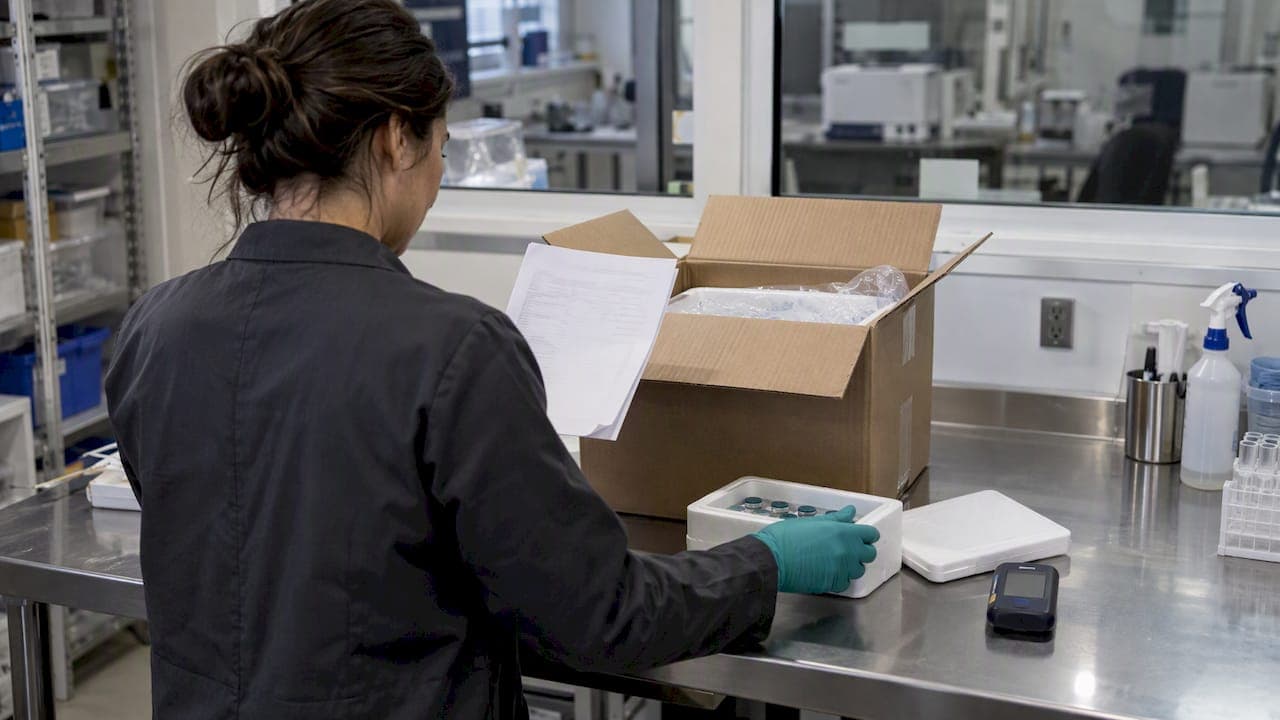
For research peptides, chain of custody means a continuous, auditable link from supplier batch to every in-lab aliquot. We confirm this on receipt by matching the vial and lot number to a batch-specific Certificate of Analysis and logging that match as a custody event. From there, the next step is verifying the COA itself against the physical sample.
TL;DR:
- Mismatched lot numbers between the vial, COA, and purchase order undermine the chain of custody and require immediate reconciliation.
- Temperature excursions need to be logged and evaluated; partial melting or visible signs are insufficient without logger data confirming full transit conditions.
- Independent identity testing is necessary if the COA lacks full analytical method disclosure, shows signs of degradation, or if temperature control was compromised during transit.
- Proper aliquoting practices require recording parent lot numbers for each child vial and restricting relabeling to authorized personnel.
- Retaining logger files and COA PDFs alongside custody logs for the full research duration supports audit readiness and traceability.
Table of Contents
- Core components of a defensible peptide chain of custody
- Step-by-step COA and batch-identity verification on receipt
- Cold chain and packaging: interpreting logger data and packaging signals
- Receiving SOP: aliquoting, relabeling, storage, and custody log best practices
- Common gaps that break the chain and rules for escalation or independent testing
- Practical custody-event checklist and COA grading reminders
- Regulatory compliance and standards governing chain of custody for peptides
- Audit trails and documentation best practices for forensic or legal integrity
- Roles and responsibilities of personnel in maintaining chain of custody
- Methods for electronic chain of custody tracking and software solutions
- Three quick wins for tighter peptide custody
- How USAPeptide supports chain-of-custody checks and COA grading
- FAQ
- Sources
Core components of a defensible peptide chain of custody
A defensible custody system rests on three categories of information: identifiers, events, and source documents. Unique identifiers link a physical vial to its paperwork: the vial ID, the supplier lot number, the purchase order, and the Certificate of Analysis that corresponds to that specific lot, not just that peptide. Custody events mark every point where control of the material changes: receipt, first opening, aliquoting, internal transfer between researchers or freezers, and eventual disposal.
Each event needs documentation pulled from a specific source:
- Shipment manifest: confirms what was sent, in what quantity, and from where.
- Temperature logger export: shows the thermal history during transit.
- COA PDF: verifies identity, purity, and the analytical method used.
- Internal custody log: ties the physical vial to every person who handled it and when.
Missing any one of these breaks the audit trail, even if the other three look complete.
Step-by-step COA and batch-identity verification on receipt
A Certificate of Analysis is only useful if it matches the vial in front of you, not just the peptide name on the label. Work through these checks in order:
- Confirm the peptide identity and sequence listed on the COA matches the product ordered.
- Match the lot number printed on the vial to the lot number printed on the COA header, not just the product SKU.
- Check the analytical methods used: a credible COA for a research peptide discloses HPLC purity and, ideally, mass spectrometry confirmation of identity, since MS specificity catches degradation products that UV detection alone can miss, as analytical method validation for intact peptides demonstrates for therapeutic peptide identification.
- Review the purity claim and acceptance criteria rather than accepting a single percentage figure without context.
- Reconcile the full paper trail: physical vial lot, COA lot, purchase order number, and shipment manifest should all agree before the material enters inventory.
Pro Tip: Keep a running reconciliation log in a spreadsheet or LIMS where each row requires all four identifiers to match before a lot is marked "released for use."
If a COA lacks a lot number, omits the analytical method, or lists purity without a method reference, that is grounds to request a batch-specific third-party retest or reject the lot outright before it reaches the bench. Our COA grading tool walks through exactly these fields for labs that want a structured second check, and a step-by-step COA reading guide covers the same fields in more depth.
Cold chain and packaging: interpreting logger data and packaging signals
Packaging tells you what the shipper intended; logger data tells you what actually happened. Dry ice, wet ice, and phase-change gel packs each imply a different target temperature range, and the coolant type on the packing slip should match the storage condition the peptide requires.
- Dry ice signals an intended deep-frozen transit, appropriate for long-term stability needs.
- Wet ice or gel packs signal a refrigerated, not frozen, transit window.
- Phase-change packs are engineered to hold a narrower band for longer durations than standard ice.
A temperature data logger, not the packaging itself, is the only reliable evidence of what the peptide actually experienced in transit. A validated LC-MS/MS method with a lower limit of quantitation of 0.50 nanograms per milliliter demonstrates how sensitive trace-level confirmation can be, which is the kind of resolution available if a shipment's integrity is ever in question. Log the logger's full export, note any excursion above threshold and its duration, and retain that file alongside the COA. A cold exterior or a partially melted gel pack is not evidence of integrity on its own: only the logger record confirms whether the material stayed within range for the full transit window.
Receiving SOP: aliquoting, relabeling, storage, and custody log best practices
The moment a shipment is opened, custody risk shifts from the carrier to the lab. A clear receiving SOP keeps that handoff traceable.
- Perform acceptance checks immediately: inspect packaging integrity, confirm logger status, and have the receiving researcher sign and date the custody log before storage.
- Aliquot with a parent-child structure: every child aliquot gets its own ID but must reference the parent vial's lot number in a LIMS field or paper log, never a standalone label with no lineage.
- Store peptides according to their form: dry peptide is generally stable at room temperature for short periods, but long-term storage calls for -20°C, while reconstituted solutions are sensitive to repeated freeze-thaw cycles and adsorption onto container walls.
- Restrict relabeling to authorized personnel, and never relabel a vial without recording the original lot number permanently in the log first.
Pro Tip: Treat every aliquot like a new custody event, not a housekeeping task: a five-second log entry at the bench prevents hours of reconciliation later.
Container choice matters too: peptides in solution can adsorb to glass or plastic surfaces at low concentrations, so storage container guidance is worth consulting before choosing a vial type for dilute working solutions. Our storage temperature reference and reconstitution stability SOP cover these decisions in more detail.
Common gaps that break the chain and rules for escalation or independent testing
Most custody failures are not dramatic. They are small omissions that compound.
- Missing or mismatched lot numbers between the vial, COA, and purchase order.
- Undocumented aliquots: child vials with no reference to a parent lot.
- Temperature excursions with no corrective log entry explaining what happened and what was done about it.
- Relabeling without a recorded original lot, which severs the link to the original COA entirely.
Decision rules should be simple enough to apply under time pressure. A brief excursion within a tight margin and a short duration may warrant quarantine and a documented review rather than automatic rejection; a longer or more severe excursion, especially with no corrective log, should trigger quarantine by default until identity and purity are reconfirmed. Independent identity testing by mass spectrometry is warranted when the COA's method disclosure is weak or when degradation is suspected, since MS resolves coeluting degradation products that UV-based purity numbers alone cannot. Request the raw chromatogram and method parameters from any third-party lab you commission, not just a summary report.
Practical custody-event checklist and COA grading reminders
A custody-event record only needs a handful of fields to be useful, but every event should capture them without exception.
- Vial or aliquot ID tied to its parent lot number.
- Timestamp for the event, not just the date.
- Handler name or initials, recorded at the time of the event, not after.
- Location where the material was stored or moved to.
- Reason for transfer, even a brief one, for anything other than storage.
| COA field | Why it matters | Red flag if missing |
|---|---|---|
| Lot number | Links COA to physical vial | No lot reconciliation possible |
| Analytical method (HPLC/MS) | Confirms how purity was measured | Purity number with no method is unverifiable |
| Purity result with criteria | States pass/fail basis | Bare percentage with no acceptance threshold |
| Signature or lab identifier | Confirms accountability for the result | Anonymous or unsigned report |
Keep logger files and COA PDFs in the same record system as the custody log itself, ideally for the full life of the research project, so a reviewer can reconstruct the full chain from a single reference number. Our peptide sourcing checklist outlines a compact six-point version of this review for labs building their own intake procedure.
Regulatory compliance and standards governing chain of custody for peptides
Research-grade peptides occupy a different regulatory space than approved pharmaceuticals, and that distinction shapes what "compliance" means in practice. There is no single federal chain-of-custody statute written specifically for research peptides sold for laboratory use, so labs generally borrow documentation standards from adjacent, better-defined frameworks: forensic and clinical chain-of-custody practice, good laboratory practice principles, and institutional biosafety or research integrity policies set by the lab's own institution or funding body.
The forensic model is the most rigorous reference point available. Chain-of-custody documentation in forensic and clinical settings requires a signed, dated, timestamped record for every transfer of possession, specifically so that evidence integrity can be proven later if the material or its results are challenged. Applying that same discipline to a research peptide shipment, documented transfer at receipt, at aliquoting, and at disposal, gives a lab a defensible record even though no regulator is mandating the exact form.
Where peptides are used in studies feeding into publications, grant reporting, or any downstream regulatory submission, institutional review boards and funding agencies often expect documentation that traces results back to a verified, identity-confirmed source material. A COA alone does not satisfy that expectation: it reflects the supplier's test of a submitted sample, not an ongoing guarantee about every vial in a shipment. Lot-specific reconciliation at the point of use is what actually closes that gap, and it is the researcher's own responsibility, not the supplier's, to generate and retain it.

Audit trails and documentation best practices for forensic or legal integrity
An audit trail is only as strong as its weakest recorded event, and the weakest point in most peptide workflows is the gap between receipt and first use. Building a trail that would hold up under outside scrutiny, whether a journal reviewer, an institutional audit, or a legal inquiry, means documenting continuity rather than snapshots.
Every custody event needs a signature or verifiable handler identifier, a timestamp rather than just a date, and a clear statement of what changed, consistent with the documentation standard that forensic chain-of-custody practice requires for every transfer of possession. Storing these records in a format that cannot be silently edited after the fact, whether a bound logbook, a version-controlled spreadsheet, or a LIMS with change tracking, matters more than the specific tool chosen.
Retention is the other half of audit readiness. A COA, a temperature logger export, and a custody log entry are each individually weak evidence; together, cross-referenced by lot number, they form a record that can answer "where was this material and who touched it" for any point in its lifecycle. Labs should decide retention periods based on their own institutional policy and the expected lifespan of any resulting publication or report, but a practical minimum is to retain records for as long as the data derived from that material remains in active use. Clinical laboratory practice offers a useful model here: documenting signatures, dates, and custody changes at every handoff is what makes a sample record audit ready, and the same discipline transfers directly to a peptide receiving log.
Roles and responsibilities of personnel in maintaining chain of custody
Custody integrity depends on clearly assigned responsibility at each stage, not on a single compliance officer checking everything after the fact. The researcher who signs for a shipment at receipt is responsible for the acceptance checks: confirming packaging integrity, pulling the logger data, and verifying the COA lot against the physical vial before the material is logged as accepted.
Whoever performs aliquoting or dilution is responsible for maintaining the parent-child link at that moment, not after the fact from memory. This is also where relabeling authority should be restricted: allowing any lab member to relabel a vial without a recorded reason creates an easy point of failure, so most labs are better served by designating a small number of authorized personnel for that specific task.
A lab manager or principal investigator typically owns the retention policy and the periodic review of custody logs for gaps, missing signatures, or unresolved temperature excursions. That review does not need to be constant, but it does need to be scheduled rather than reactive, since gaps found months later are far harder to correct than gaps caught at the next log review. Clear role assignment also matters for disposal: whoever removes a vial from active inventory should log that event with the same rigor as receipt, closing the chain rather than letting the record simply stop.
Methods for electronic chain of custody tracking and software solutions
Paper logs work for small labs with low sample volume, but they scale poorly once a lab is running multiple peptide projects with overlapping aliquots. A laboratory information management system, commonly called a LIMS, is the most common electronic solution, and the ones best suited to custody tracking let a lab design custom fields rather than forcing data into a generic sample-tracking template.
The fields that matter most for peptide custody are the same ones a paper log needs: parent lot ID, child vial ID, handler identifier, timestamp, storage location, and a link or attachment field for the temperature logger file and the COA PDF. A LIMS that supports file attachments directly on a custody record keeps the COA and logger export physically tied to the event they document, rather than stored separately where the link can be lost.

Spreadsheet-based tracking, while less robust than a dedicated LIMS, can work for smaller labs if it enforces the same discipline: locked historical rows, mandatory fields before a new row is accepted, and a single source of truth rather than parallel copies on different machines. Whatever system a lab chooses, the test is the same: can a reviewer, given only a lot number, reconstruct every custody event for that material without asking a researcher to recall details from memory.
Three quick wins for tighter peptide custody
Most labs do not need a new system, just three small changes: log every aliquot's parent lot at the moment of splitting, require a signature and timestamp on receipt before storage, and retain logger files next to the COA rather than in a separate folder. None of this slows bench work meaningfully, and it is what makes results reproducible when a reviewer or collaborator asks where the material came from. When a COA's method disclosure looks thin, our COA grading tool is a quick way to check before the vial goes into inventory.
— USAPeptide Team
How USAPeptide supports chain-of-custody checks and COA grading
We built our reference platform around the same verification habits this guide describes, because a defensible custody record starts with a trustworthy source document. A COA grading tool can check a submitted Certificate of Analysis for the fields that matter: lot number, analytical method, purity criteria, and signature, flagging gaps that would otherwise surface only during an audit. Alongside it, a peptide database gives molecular profiles and mechanism summaries for compounds across categories including GLP-1 & Metabolic Peptides, Tissue & Connective Repair, and Growth Hormone Peptides, and a dosage calculator supports research-dosing planning once identity and purity are confirmed.
For labs sourcing ISO 17025-accredited, high-purity compounds, these tools can work alongside the receiving SOP outlined above:
- Run a new COA through our COA grading tool before marking a lot as accepted.
- Cross-check molecular identity and expected purity against our peptide database entries.
- Use our dosage calculator once a lot has passed custody verification.
Start at our main reference platform to review compound data and COA standards before your next shipment arrives.
FAQ
What is chain of custody for research peptides?
Chain of custody for research peptides is a continuous, documented record linking a supplier's batch to every subsequent handling event: receipt, aliquoting, transfer, and disposal. Each event requires a signature, a timestamp, and enough detail to reconstruct who had the material and when, consistent with the documentation standard used in forensic chain-of-custody practice.
How do I verify a peptide COA matches the physical vial?
Match the lot number printed on the vial to the lot number on the COA header, not just the product name, then confirm the purchase order and shipment manifest reference the same lot. A COA that lacks a lot number or analytical method disclosure should prompt a batch-specific retest before the material is used.
What temperature should peptides be stored at?
Dry peptide is generally stable at room temperature for short periods, but long-term storage calls for -20°C, while reconstituted solutions are sensitive to repeated freeze-thaw cycles and should avoid unnecessary temperature swings. Container choice also affects stability, since dilute solutions can adsorb onto vial surfaces.
What are the most common chain-of-custody failures in peptide labs?
The most common gaps are mismatched or missing lot numbers between the vial and COA, undocumented aliquots with no parent lot reference, and temperature excursions with no corrective log entry. Each of these breaks the audit trail even when the rest of the record looks complete.
When should a lab order independent identity or purity testing?
Independent testing by mass spectrometry or HPLC is warranted when a COA's method disclosure is weak, when degradation is suspected, or after an undocumented or unresolved temperature excursion. Request the raw chromatogram and method parameters from the testing lab rather than a summary result alone.
Sources
- Chain of Custody - StatPearls - NCBI Bookshelf
- Peptide handling, dissolution & storage - NIBSC
- Method for identification and quantification of intact teduglutide peptide using (RP)UHPLC-UV-(HESI/ORBITRAP)MS - Analytical Methods
- Highly sensitive single LC‑MS/MS method for cleaning validation of synthetic peptides using Shimadzu LCMS-8060