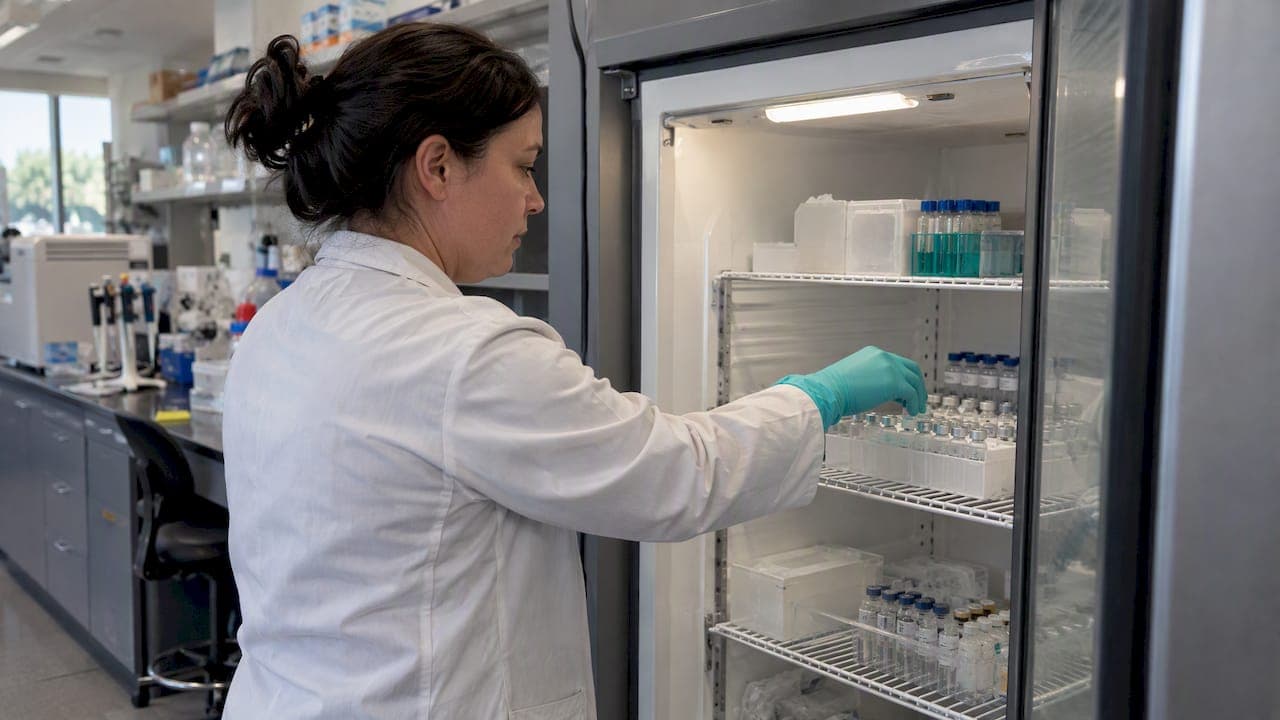
Semaglutide shows pH- and temperature-dependent chemical and physical instability. Researchers should control pH, buffer strength, and ionic strength during handling, and confirm batch integrity with a validated stability-indicating RP-HPLC or UPLC method paired with an orthogonal aggregation assay. The peptide is comparatively stable under strict cold storage with limited room-temperature excursions, and in-use timelines should follow published pen and cartridge data rather than general assumptions about peptide shelf life.
TL;DR:
- Semaglutide's stability is highly pH-dependent, with better preservation at pH above 7.0 and rapid degradation near its isoelectric point around pH 5.4, especially in phosphate buffers.
- Temperature effects differ between solid and solution states, with accelerated thermal studies useful for predicting long-term stability and highlighting phase transitions during storage.
- Aggregation risks increase near pH 8 through micellar formation or at low pH via fibril development, requiring specialized detection methods like fluorescence and spectroscopy.
- Validated stability-indicating HPLC or UPLC methods combined with orthogonal assays are essential for accurate degradation assessment and must follow ICH validation standards.
- In-use stability data show semaglutide can remain within specifications for up to 8 months refrigerated or 56 days at room temperature, allowing some flexibility in handling protocols.
Table of Contents
- How pH and buffer composition affect chemical stability and solubility
- Temperature and solid-state vs. solution stability
- Physical instability: aggregation pathways, detection, and formulation mitigations
- Stability-indicating assays and method validation for semaglutide
- Storage, handling, and beyond-use dating for research samples
- Formulation and QC recommendations for stability study design
- How USAPeptide supports semaglutide stability work
- Common lab mistakes and research gaps worth watching
- Practical next steps with USAPeptide resources
- Sources
- FAQ
How pH and buffer composition affect chemical stability and solubility
Semaglutide's degradation rate depends heavily on pH and buffer identity rather than temperature alone. A preformulation stability study found the peptide relatively stable at pH 1.2, with less than 32% degradation over 28 days, while samples held in acetate buffers at pH 4.5 to 5.5, near semaglutide's isoelectric point of approximately 5.4, degraded far faster. Phosphate buffers produced the most severe result: some conditions at pH 6 to 7 showed nearly complete degradation within 7 days. That finding runs counter to the common assumption that near-neutral pH is automatically safer for peptide formulations.
Buffer molarity and ionic strength also shift degradation kinetics and aggregation propensity, independent of pH value alone. Higher ionic strength environments can accelerate self-association in some conditions, compounding chemical instability with physical instability.
Formulation-stage takeaways from the available data include:
- Favor finished parenteral formulations with a pH above 7.0, consistent with preformulation recommendations.
- Avoid phosphate buffer systems where possible, given the sharp degradation observed in that chemistry.
- Treat the pH window around the isoelectric point, roughly pH 4.5 to 5.5, as a high-risk zone requiring tighter monitoring.
- Characterize buffer strength and ionic strength as separate variables in any stability protocol, not as a single "pH" parameter.
Temperature and solid-state vs. solution stability
Thermal stress affects semaglutide differently depending on whether the peptide sits in solution or in a solid or lyophilized state. Accelerated studies generally show short-term tolerance to elevated temperatures, with degradation becoming progressive rather than immediate as exposure time extends. This pattern supports using accelerated thermal data as a predictive tool rather than a pass/fail cutoff.
Solid-state and glassy-state observations point to phase transitions and secondary-structure shifts that can occur without obvious visual change, which matters for lyophilized research material stored at room temperature for extended periods.
Practical applications of accelerated data include:
- Use short-duration, elevated-temperature runs to flag degradation trends before committing to long-term studies.
- Treat solid-state and solution-state material as distinct stability questions requiring separate test matrices.
- Set transport controls, such as insulated shipping with temperature logging, based on the most conservative accelerated result rather than average performance.
Physical instability: aggregation pathways, detection, and formulation mitigations
Semaglutide aggregates through distinct, pH-dependent pathways rather than a single degradation mechanism. Research on fibrillar and micellar aggregation shows micellar and oligomeric assemblies forming near pH 8, while low pH conditions around pH 2.4 drive beta-sheet fibril formation. Fibrillation can develop gradually over periods of weeks, producing clear beta-sheet signatures. A critical aggregation concentration on the order of low 10 to the negative fourth weight percent was identified in that work, meaning aggregation risk is tied closely to formulation concentration, not just storage time.
Detecting these pathways requires more than a visual check. A practical analytical sequence:
- Screen with thioflavin T fluorescence to flag early amyloid-like aggregation.
- Confirm secondary-structure changes with circular dichroism spectroscopy.
- Use small-angle X-ray scattering or cryo-electron microscopy to resolve particle morphology.
- Run particle counting as an orthogonal check against the spectroscopic data.
Formulation mitigations include adjusting excipient selection, tuning ionic strength and buffer composition to avoid the pH ranges linked to self-assembly, and accounting for how lipidation influences aggregation behavior during manufacturing and storage.
Pro Tip: Run aggregation assays on concentrated stock solutions before dilution, since concentration-dependent self-assembly can mask itself once samples are diluted for testing.

Stability-indicating assays and method validation for semaglutide
A validated stability-indicating method is the backbone of any semaglutide stability program. A multimodal HPLC approach developed for semaglutide and tirzepatide reports linearity near R² of 0.999, limits of detection and quantitation in the low nanogram to microgram per milliliter range, and reproducibility with percent relative standard deviation at or below 1.3 in an associated application note. RP-HPLC and UPLC with UV or diode-array detection separate degradants from the parent peptide, while LC-MS adds identity confirmation for unknown degradation products.
A forced-degradation checklist for method development should include:
- Acid, base, and neutral hydrolysis conditions run in parallel.
- Oxidative stress using hydrogen peroxide to probe methionine and other oxidation-sensitive residues.
- Photolytic exposure under ICH-recommended light conditions.
- Thermal stress at multiple elevated temperatures and durations.
Validation should follow ICH Q2(R1) expectations for specificity, accuracy, precision, linearity, robustness, and defined limits of detection and quantitation.
Storage, handling, and beyond-use dating for research samples
Cold storage remains the default baseline for semaglutide, but in-use data shows some tolerance for room-temperature periods. A simulated-use study on semaglutide injection at 5 mg/mL found samples remained within specification for up to 8 months at 2 to 8 degrees Celsius, and for 56 days at 15 to 30 degrees Celsius, even under worst-case simulated needle punctures.
Those figures from the in-use stability study suggest research teams have more flexibility for short room-temperature handling windows than conservative lab practice often assumes, provided the formulation matches the tested product.
For reconstituted or aliquoted research samples, apply time limits consistent with that data rather than open-ended storage assumptions, and document storage temperature at every handling step. Disposition triggers worth building into a protocol:
- Visible turbidity, precipitation, or color change, which signals advanced aggregation.
- Assay results falling outside the predefined potency or degradant threshold.
- Particulate counts exceeding the method's acceptance criteria.
Formulation and QC recommendations for stability study design
A defensible stability program combines accelerated testing, long-term testing, and a forced-degradation matrix rather than relying on any one study type alone. Essential elements:
- Run accelerated stability at multiple elevated temperatures to model degradation trends over compressed timelines.
- Maintain long-term stability samples under label storage conditions for direct shelf-life confirmation.
- Build a forced-degradation matrix covering acid, base, oxidative, photolytic, and thermal stress, each analyzed by the validated stability-indicating method.
- Pair chemical assay data with an aggregation assay, since potency loss and physical aggregation do not always track together.
- Include orthogonal confirmation, such as LC-MS alongside RP-HPLC, before treating a degradant identification as final.
Set decision thresholds in advance: define acceptable percent degradation, acceptable aggregate levels, and minimum potency retention before testing begins, and use consistent sample sizes with proper controls so results hold up to regulatory-quality scrutiny.
How USAPeptide supports semaglutide stability work
A peptide reference platform can assist researchers in verifying incoming material before it enters a stability study. The semaglutide molecular profile page gives purity data and COA examples that pair directly with the method validation approaches described above.
Available tools may include a COA grading tool to assess supplier documentation standards, peptide databases with molecular profiles for cross-checking formulation and purity claims, and contextual information on ISO 17025 testing and HPLC purity data to aid comparison of vendor claims with independent benchmarks.
Such resources can be integrated into method validation and stability workflows as an additional verification step supplementing practical research protocols and dosing references.
Common lab mistakes and research gaps worth watching
Visual inspection catches late-stage aggregation, such as turbidity or precipitation, but misses early chemical degradation and oligomerization entirely. Buffer ionic strength and container closure interactions are frequently underweighted variables in stability protocols. Long-term solid-state stability and the correlation between aggregation extent and potency loss remain areas where more published data would sharpen current practice.
— USAPeptide Team
Practical next steps with USAPeptide resources
Sourcing semaglutide for stability work is facilitated when purity data can be verified prior to laboratory use. Research-grade compounds with documented Certificates of Analysis that are ISO 17025-accredited provide confidence that purity claims can be checked rather than assumed.

A few steps to apply this directly:
- Run any incoming semaglutide COA through the grading tool before starting a stability study.
- Review the semaglutide research reference for method-validation context relevant to your protocol.
- Consult the reconstitution stability SOP for practical beyond-use dating guidance.
Browse the peptide research catalog for ISO 17025-tested GLP-1 and metabolic peptide material to support your next study.
This article is general information, not a substitute for advice from a qualified doctor. Consult a qualified healthcare professional about your own circumstances before acting on anything here.
Sources
- Influence of Buffering Capacity, pH, and Temperature on the Stability of Semaglutide: A Preformulation Study
- Fibrillar and micellar aggregation of semaglutide and formation of a chiral‑imprinted glass
- A multimodal HPLC stability indicating approach for the estimation of Semaglutide and Tirzepatide in bulk, pharmaceutical dosage forms, and rat plasma
- In-use Stability of Semaglutide Injection 15mg/3mL (5mg/mL) In-use Storage Conditions, Study Design, Study Outcome and Labelling Recommendations
FAQ
Does semaglutide expire if refrigerated?
Refrigerated semaglutide does degrade over time, though far more slowly than at room temperature. An in-use stability study found samples stayed within specification for up to 8 months at 2 to 8 degrees Celsius, which still represents a defined endpoint rather than indefinite stability.
Can I use six-month-old semaglutide?
Semaglutide stored continuously at 2 to 8 degrees Celsius for six months falls within the window supported by in-use stability data, which found specification compliance for up to 8 months under refrigeration. Material that experienced temperature excursions or inconsistent storage should be reassessed with a stability-indicating assay before use.
Can taking expired semaglutide make you sick?
Degraded semaglutide may lose potency or form aggregates rather than becoming acutely dangerous in most cases, but using material beyond its tested stability window removes any assurance of correct dosing or purity. Anyone with questions about a specific product's safety for human use should consult a qualified healthcare professional rather than relying on general stability research.
Why discard semaglutide after 28 days?
The 28-day disposal guidance common on commercial product labeling reflects a conservative in-use period set for patient-use pens, separate from the longer research-use in-use data discussed above. Research teams working from different formulations or concentrations should rely on stability testing specific to their own sample rather than assuming the 28-day figure applies universally.
What analytical methods best detect semaglutide degradation?
A validated stability-indicating RP-HPLC or UPLC method, as described in a multimodal HPLC approach for semaglutide and tirzepatide, remains the standard for detecting chemical degradation. Pairing it with an orthogonal aggregation assay, such as thioflavin T fluorescence or circular dichroism, catches physical instability that chromatography alone can miss.