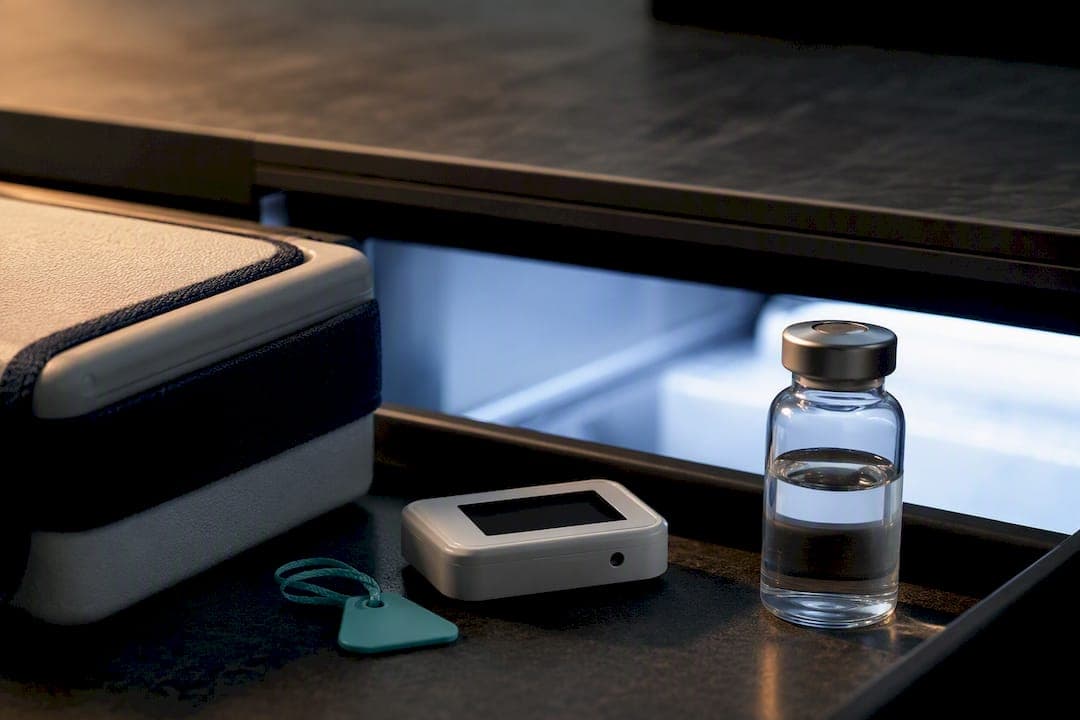
Lyophilized research-grade tirzepatide holds its potency best at 2 to 8°C for short-term work, or at minus 20°C or below for long-term storage, provided moisture stays low. Once reconstituted, treat the solution as refrigerator-only: keep it at 2 to 8°C and cap the beyond-use window at a conservative 28 days, never in the freezer. Oxidation and deamidation are the dominant threats, so every handling decision should minimize exposure to oxygen, light, and temperature swings, a standard approach is applied when evaluating supplier data.
TL;DR:
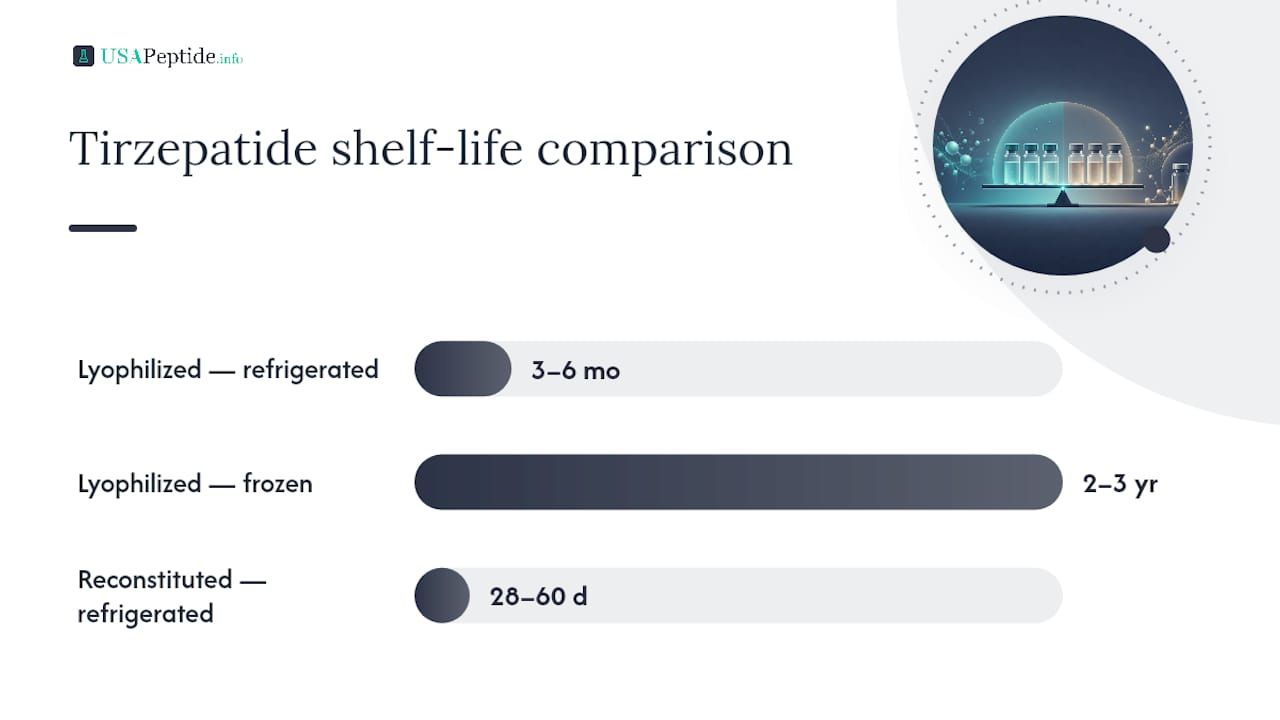
- Lyophilized tirzepatide should be stored at 2 to 8°C for 3 to 6 months or frozen at minus 20°C for up to 3 years, assuming low humidity and proper handling.
- Reconstituted tirzepatide must stay refrigerated at 2 to 8°C and cannot be frozen, with a conservative beyond-use date of 28 days unless verified by lot-specific stability data.
- Oxidation and deamidation are the main degradation pathways, with oxidation affecting tryptophan residues and deamidation targeting glutamine 19, both accelerated by heat, light, and pH changes.
- Handling practices such as minimizing oxygen exposure, aliquoting into single-use vials, and avoiding repeated septum punctures reduce degradation risks during use.
- Confirm lot quality through Certificates of Analysis checking purity, identity, moisture, and lab accreditation before extending storage beyond default periods.
Table of Contents
- What Are the Correct Tirzepatide Storage Conditions?
- Which Degradation Pathways Threaten Tirzepatide Samples?
- How Should You Reconstitute and Handle Tirzepatide Safely?
- What Analytical Methods Confirm Tirzepatide Stability?
- What Should a Certificate of Analysis Confirm Before You Trust a Lot?
- Common Pitfalls in Lab Handling of Reconstituted Peptide
- Verify Your Lot Before You Extend Any Beyond-Use Date
- Sources
- FAQ
What Are the Correct Tirzepatide Storage Conditions?
Lyophilized tirzepatide powder is the more forgiving form. Refrigerated at 2 to 8°C (36 to 46°F), it typically holds for 3 to 6 months before quality checks become advisable. Frozen at minus 20°C or colder, general peptide-storage practice puts lyophilized material in the 2 to 3 year range for retained stability, assuming the vial was never exposed to significant humidity during that stretch.
Reconstituted tirzepatide is a different animal entirely. It must stay refrigerated at 2 to 8°C and never enter a freezer. Ice crystal formation disrupts peptide bonds and secondary structure in ways that lyophilized powder simply doesn't experience. Practitioner and compounding guidance converges on a conservative 28-day beyond-use date (BUD) for refrigerated reconstituted material, extending to a range as wide as 28 to 60 days only when a lab has lot-specific stability data in hand. That 28-day figure, worth noting, traces back to sterility-focused compounding standards rather than proof of chemical stability. Treat it as a sterility default, not a chemistry result, unless your own analytical work says otherwise.
Practical controls that reduce risk during that window:
- Reconstitute single vials rather than pooling stock, and aliquot immediately into use-ready volumes.
- Label every vial with the reconstitution date and the calculated discard date, not just the lot number.
- Avoid repeated needle punctures into the same septum; each entry raises contamination odds and introduces air.
- Log any temperature excursion, no matter how brief, and flag that vial for exclusion from critical assays.
| Form | Recommended condition | Practical shelf-life window |
|---|---|---|
| Lyophilized powder | 2 to 8°C | 3 to 6 months |
| Lyophilized powder | ≤ minus 20°C | Up to 2 to 3 years |
| Reconstituted solution | 2 to 8°C | 28 days (conservative); up to 60 with verified data |
| Reconstituted solution | Frozen | Not recommended |
Pro Tip: Keep a running excursion log on the outside of the fridge or freezer, not buried in a binder. A vial that spent even 20 minutes at room temperature during a power blip is a different reagent than one that never left the cold chain, and your data should reflect that.
For a broader reference on cold-chain handling across other research peptides, USAPeptide's peptide storage temperature guide covers the general principles that apply here.
Which Degradation Pathways Threaten Tirzepatide Samples?
Tirzepatide degrades primarily through five mechanisms, and each leaves a distinct fingerprint in your data. Understanding where they occur on the molecule determines how you store it and how you interpret an unexpected peak in your chromatogram.
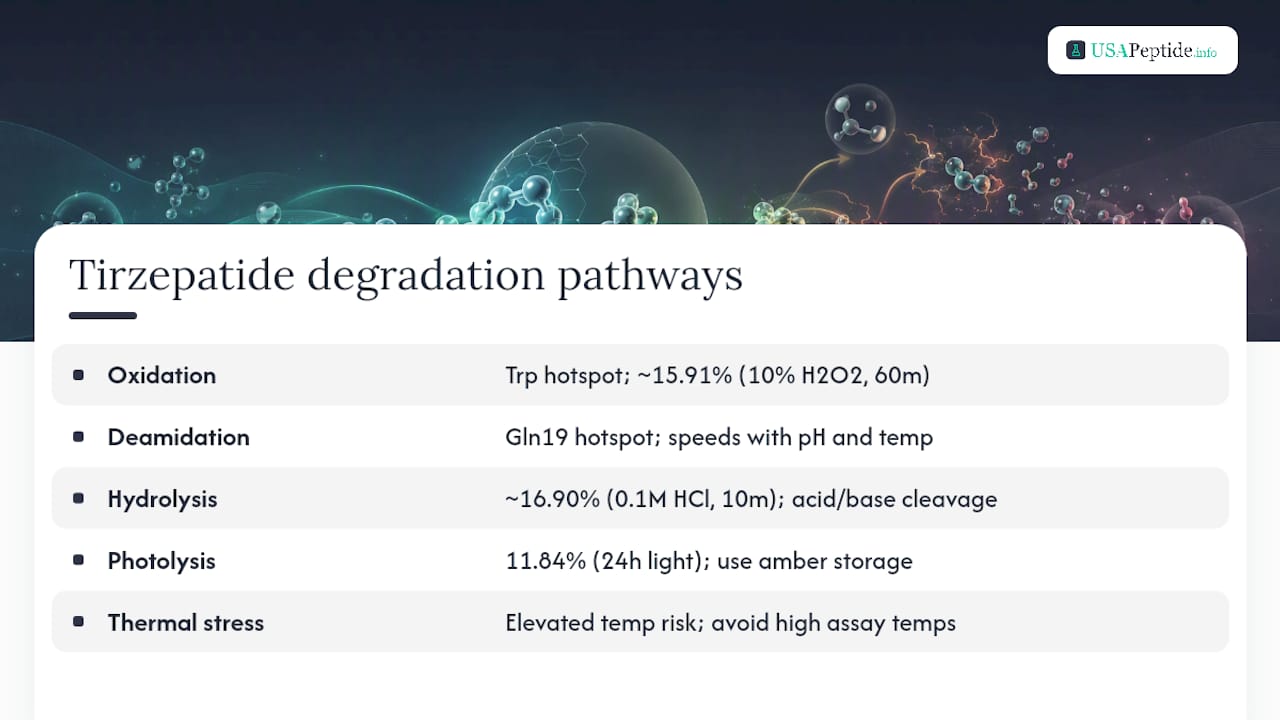
Oxidation is the pathway most labs underestimate. It tends to strike tryptophan residues first, and forced-degradation work using 10% hydrogen peroxide at 25°C for 60 minutes produced roughly 15.91% degradation in one HPLC study, a substantial loss for a single hour of oxidative stress. Minimizing headspace and oxygen contact matters more than most protocols acknowledge; antioxidant additives should only enter a protocol after validation, not as a default fix.
Deamidation concentrates at glutamine residues, with glutamine 19 identified as a specific hotspot in high-resolution mass spectrometry work. This reaction accelerates with both rising pH and rising temperature, which is exactly why refrigerated, pH-controlled storage does double duty against two separate mechanisms at once.
Hydrolysis shows up hardest under strong acid or base conditions. The same forced-degradation dataset recorded about 16.90% degradation from a mild 0.1 M HCl exposure for just 10 minutes, a figure that should make anyone rethink casual pH adjustments during reconstitution.
Photolysis and thermal stress round out the list. The same study measured 11.84% degradation after 24 hours of direct light exposure. Amber storage and avoiding elevated assay temperatures address both risks without adding cost or complexity to a protocol.
How Should You Reconstitute and Handle Tirzepatide Safely?
Solvent choice depends entirely on downstream use. For biological assay contexts where multi-dose access is needed, bacteriostatic water is the more common choice, since its preservative content limits microbial growth across repeated draws.
Follow this sequence to limit degradation risk during and after reconstitution:
- Confirm the solvent matches your downstream method, analytical versus biological use call for different choices.
- Reconstitute gently, avoiding vigorous shaking that introduces air and mechanical stress into the solution.
- Record the resulting pH. Slightly acidic conditions tend to favor different degradation chemistry than neutral pH, so knowing your starting point matters for interpreting later results.
- Aliquot immediately into amber or low-protein-binding vials sized for single-use assay runs, minimizing headspace in each one.
- For any aliquot intended for longer storage, consider an inert gas overlay to displace oxygen before sealing.
- Document the reconstitution event in the batch record: date, solvent lot, resulting pH, and operator.
Sterile, endotoxin-free solvents aren't just a contamination safeguard. Endotoxin and microbial byproducts can catalyze degradation reactions that have nothing to do with temperature, which makes solvent quality a stability variable in its own right, not merely a sterility one.
Pro Tip: If a vial is accidentally frozen, don't assume it's ruined, but don't assume it's fine either. Flag it, exclude it from any assay where potency precision matters, and run a confirmatory HPLC check before deciding whether to discard it.
What Analytical Methods Confirm Tirzepatide Stability?
Forced-degradation testing is how you generate the evidence that supports (or denies) an extended beyond-use date. ICH-aligned panels typically expose samples to acidic hydrolysis (dilute HCl), basic hydrolysis (dilute NaOH), oxidative stress (hydrogen peroxide), photolysis, and thermal stress, each run separately so degradants can be attributed to a specific mechanism.
Reagent concentration matters more than intuition suggests. One validated HPLC method found that 0.1 M HCl and NaOH produced adequate, measurable degradation without the precipitation and denaturation that 1 M concentrations caused. Mild stress that degrades cleanly beats aggressive stress that just destroys the sample.
On the mass spectrometry side, high-resolution instruments like the Xevo G3 QTof, paired with UNIFI software, localize exactly where oxidation and deamidation occur. That application note tracked oxidative stress over extended timepoints and distinguished single, double, and triple oxidation species while confirming deamidation at Q19, resolution no HPLC method alone can deliver.
Working solution stability also deserves a mention: the same study found deionized water solutions held steady for 24 hours at room temperature and up to a week refrigerated, with RSD under 2%, a useful benchmark for assay-day planning.
| Method | What it confirms | Typical use |
|---|---|---|
| Stability-indicating HPLC | Percent degradation under stress | Screening, quantitation |
| High-resolution MS (QTof + peptide mapping) | Site-specific modification | Impurity identity, mechanism |
| Forced-degradation panel | Which pathway dominates | BUD justification |
What Should a Certificate of Analysis Confirm Before You Trust a Lot?
A usable Certificate of Analysis needs to state HPLC purity, mass spec identity confirmation, moisture content, residual solvents, endotoxin levels, batch date, and the identity of the testing laboratory. Moisture matters more than most researchers realize: lyophilized peptides typically run 2 to 8% moisture content, and anything meaningfully above that range signals incomplete lyophilization and a shorter effective shelf life regardless of what the label date says.
Give real weight to ISO 17025 accreditation on the testing lab itself, not just the supplier's own claims. Third-party verification under that standard is what separates a credible purity figure from a marketing number. Supplier-provided stability data can justify a longer BUD than the conservative defaults above, but only after your own lab spot-checks that claim against a sample of the actual lot in hand, not the vendor's reference batch. Attach every COA to its batch record, log each reconstitution event against it, and keep your own stability test results filed alongside, that paper trail is what an audit actually asks for.
Common Pitfalls in Lab Handling of Reconstituted Peptide
Most stability failures in a research setting aren't chemistry problems, they're workflow problems. Pooling vials instead of single-use aliquoting, weak labeling, and skipping COA spot checks account for the majority of the discrepancies we hear about. Extending a reconstituted BUD past 28 days without lot-specific data and an internal verification plan is the single riskiest habit a lab can develop. A verified supplier paired with a COA-grading routine closes most of that gap before it starts.
— USAPeptide Team
Verify Your Lot Before You Extend Any Beyond-Use Date
This resource exists so labs don't have to guess at lot quality before committing to an extended refrigerated window. Rather than taking a supplier's shelf-life claim at face value, run the actual Certificate of Analysis through our COA grading tool to check purity, identity, and testing-lab credentials against the standards this article covers.

Our tirzepatide molecular profile pulls together identity data and COA benchmarks specific to this peptide, useful groundwork before you decide whether a supplier's 60-day claim actually holds up for your lot. If you're sourcing from an ISO 17025 verified vendor, the Peptriva resource center lists compounds with the documentation already structured for lab review, so purity and identity checks take minutes instead of a back-and-forth email chain with a supplier. Before your next order ships, pull the COA and grade it. It's the fastest way to know whether a 28-day default is conservative for your material, or exactly right.
FAQ
How Long Does Reconstituted Tirzepatide Last Refrigerated?
A conservative 28-day beyond-use date at 2 to 8°C is standard practice, extending to 28 to 60 days only with lot-specific stability data confirming it.
Can You Freeze Reconstituted Tirzepatide?
No. Freezing reconstituted solution risks ice-crystal damage to the peptide structure; freezing is only appropriate for lyophilized powder at minus 20°C or below.
What Causes Most Tirzepatide Degradation in Storage?
Oxidation at tryptophan and deamidation at glutamine 19 are the two dominant pathways, both accelerated by heat, light, and elevated pH.
How Do You Know if a Tirzepatide Sample Has Degraded?
Cloudiness, discoloration, or a new peak on stability-indicating HPLC are the clearest signals; any confirmed excursion or unexplained chromatographic shift warrants discard.