
Tirzepatide is a synthetic 39-amino-acid peptide that acts as a dual agonist at the GIP receptor (GIPR) and GLP-1 receptor (GLP-1R), with an imbalanced affinity profile favoring GIPR and a biased GLP-1R signaling pattern that preferentially activates cAMP over β-arrestin recruitment. A C20 fatty diacid moiety enables reversible albumin binding, extending its half-life to roughly five days and supporting once-weekly dosing. The downstream physiological consequences include glucose-dependent insulin secretion, glucagon suppression, central appetite reduction, and altered adipocyte lipid handling.
TL;DR:
- Tirzepatide's albumin binding extends its half-life to about five days, enabling once-weekly injections and influencing its distribution and clearance.
- Its receptor activity is imbalanced, with high affinity for GIPR and lower affinity for GLP-1R, paired with a bias towards cAMP signaling over β-arrestin.
- Dose-dependent weight loss and glycemic improvements suggest receptor engagement continues to increase with higher doses, supporting a graded response.
- The drug's gastrointestinal side effects mainly occur during dose escalation, and the compound takes around 30 days to clear after stopping.
- Current evidence for cardiovascular and beta-cell durability benefits is promising but remains preliminary, relying on secondary outcomes and short-term studies.
Table of Contents
- Molecular Structure and Design of Tirzepatide
- Receptor Pharmacology: GIPR and GLP-1R Binding and Biased Agonism
- Pharmacokinetics and Dosing: Population PK, Half-Life, and Practical Implications
- Cellular and Tissue Mechanisms: Pancreas, Adipose Tissue, and the Central Nervous System
- Systemic Effects and Biomarkers: Glycemic Control, Weight Loss, and Cardiorenal Signals
- Safety, Tolerability, and Dose Escalation Cautions
- Evidence Base: Clinical Trials, PK Studies, and Preclinical Models
- Assay Quality and COA Verification for Tirzepatide Research
- Downstream Signaling Beyond cAMP: MAPK and PI3K Pathway Engagement
- How Tirzepatide's Mechanism Differs From Other GLP-1 Agonists
- Beta-Cell Proliferation and Survival Mechanisms
- Gastrointestinal Motility Effects
- Cardiovascular Physiology and Mechanistic Basis for Potential Benefits
- The USAPeptide Team's Take on Tirzepatide's Mechanism
- Sources
Molecular Structure and Design of Tirzepatide
Tirzepatide's backbone is a 39-amino-acid peptide engineered from the native GIP sequence, modified to also engage GLP-1R. This dual-receptor scaffold is what separates it mechanistically from single-receptor incretin mimetics, and it's the reason researchers often describe tirzepatide as a "twincretin" rather than a conventional GLP-1 analog. The peptide backbone alone, however, would clear the body within hours. What makes tirzepatide pharmacologically viable as a once-weekly compound is a second structural feature attached to the peptide chain: a C20 fatty diacid moiety.
This fatty diacid isn't decorative. It gives the molecule a strong, reversible, noncovalent binding affinity for human serum albumin, the most abundant protein in plasma. Once bound, tirzepatide behaves less like a free-floating peptide vulnerable to enzymatic degradation and renal filtration, and more like a passenger riding along with albumin's own long circulating half-life. The population pharmacokinetics of tirzepatide confirm this albumin-mediated protection is central to the drug's exposure profile, allowing researchers to model tissue distribution using allometric scaling tied to body size rather than needing separate PK models for each demographic subgroup.
The albumin interaction accomplishes two things simultaneously. First, it sequesters the peptide from circulating proteases that would otherwise cleave the amide backbone. Second, it slows glomerular filtration, since albumin-bound complexes are too large to pass efficiently through the kidney's filtration barrier. Structural analyses summarized in StatPearls describe this fatty-acid conjugation strategy as functionally analogous to approaches used in other long-acting incretin peptides, though tirzepatide's specific C20 diacid chemistry and dual-receptor targeting remain distinct.
Metabolically, tirzepatide's clearance follows a few parallel pathways once it eventually dissociates from albumin:
- Proteolytic cleavage of the peptide backbone by circulating and tissue peptidases, similar to how the body degrades endogenous incretins.
- Beta-oxidation of the fatty diacid side chain, the same catabolic pathway the body uses for dietary fatty acids.
- Amide hydrolysis at specific bond sites, contributing to the terminal breakdown products that appear in metabolite studies.
For researchers designing assays, this matters practically. Detection strategies that rely on intact-peptide immunoassays may miss circulating metabolites, and tissue distribution studies should account for the fact that a meaningful fraction of measured drug at any timepoint is albumin-bound rather than freely diffusible. That distinction affects how you interpret both plasma concentration curves and any attempt to correlate tissue-level exposure with receptor occupancy. A detailed molecular profile of tirzepatide lays out the sequence-level detail useful for researchers designing binding or metabolite-tracking experiments.
Receptor Pharmacology: GIPR and GLP-1R Binding and Biased Agonism
Tirzepatide does not engage its two receptor targets equally, and that asymmetry is arguably the most mechanistically interesting feature of the molecule. At GIPR, tirzepatide's binding affinity and potency approach those of native, endogenous GIP. At GLP-1R, however, its affinity and potency are markedly lower than native GLP-1, sometimes described in the literature as an "imbalanced" agonist profile weighted heavily toward the GIP receptor.
That imbalance would be a minor pharmacological footnote if it weren't paired with a second, more consequential property: biased signaling at GLP-1R. Receptor pharmacologists distinguish between two major downstream pathways activated when a ligand binds GLP-1R. One is the classic Gs protein cascade that raises intracellular cyclic AMP (cAMP), driving the acute insulinotropic and metabolic effects associated with incretin activity. The other is β-arrestin recruitment, a pathway more closely tied to receptor desensitization and internalization. A narrative review on tirzepatide's mechanism of action documents that tirzepatide preferentially activates the cAMP arm while recruiting comparatively less β-arrestin than native GLP-1 or several other GLP-1R agonists tested head-to-head in vitro.
Statistic Callout: In vitro signaling assays cited in mechanistic reviews show tirzepatide produces GIPR activation comparable to native GIP, while its GLP-1R potency sits well below native GLP-1, yet its bias ratio favors cAMP signaling over β-arrestin recruitment relative to balanced GLP-1R agonists.
Why would a receptor agonist "want" to avoid β-arrestin recruitment? Because β-arrestin binding typically triggers receptor internalization and, over repeated dosing, desensitization. A ligand that favors cAMP while sparing β-arrestin theoretically preserves surface receptor density longer, sustaining signaling capacity across a dosing interval rather than triggering rapid tachyphylaxis. This is a plausible, mechanistically coherent explanation for why tirzepatide's insulinotropic and metabolic effects hold up well across a weekly dosing cycle, but it remains a hypothesis under active investigation rather than settled clinical fact.
Several downstream consequences follow from this biased profile, at least in preclinical and early mechanistic human data:
- Reduced receptor internalization may sustain intracellular signaling longer per dosing interval than balanced agonists.
- Preserved surface receptor expression could support consistent insulinotropic responses across repeated dosing cycles.
- The cAMP-dominant profile aligns with enhanced insulin secretion measures observed in mechanism studies comparing tirzepatide to other incretin therapies.
That last point has direct clinical-mechanism support. A 28-week hyperglycemic clamp study comparing tirzepatide 15 mg against semaglutide 1.0 mg found greater improvements in insulin secretion measures with tirzepatide, consistent with the biased-signaling hypothesis, though clamp studies isolate insulin secretion dynamics under controlled glucose conditions rather than replicating free-living metabolic behavior.
The translational caveat here deserves emphasis. Most of the receptor-binding and bias data come from transfected cell lines and heterologous expression systems, not native human islet or hypothalamic tissue. Bias factors measured in HEK293 or CHO cell assays don't always predict receptor behavior in the actual physiological context of a pancreatic beta cell or a hypothalamic neuron, where scaffolding proteins, receptor density, and local signaling architecture differ substantially. Researchers should treat "biased agonism explains tirzepatide's efficacy" as a strong working hypothesis with converging lines of preclinical support, not as a fully closed mechanistic loop.
Pharmacokinetics and Dosing: Population PK, Half-Life, and Practical Implications
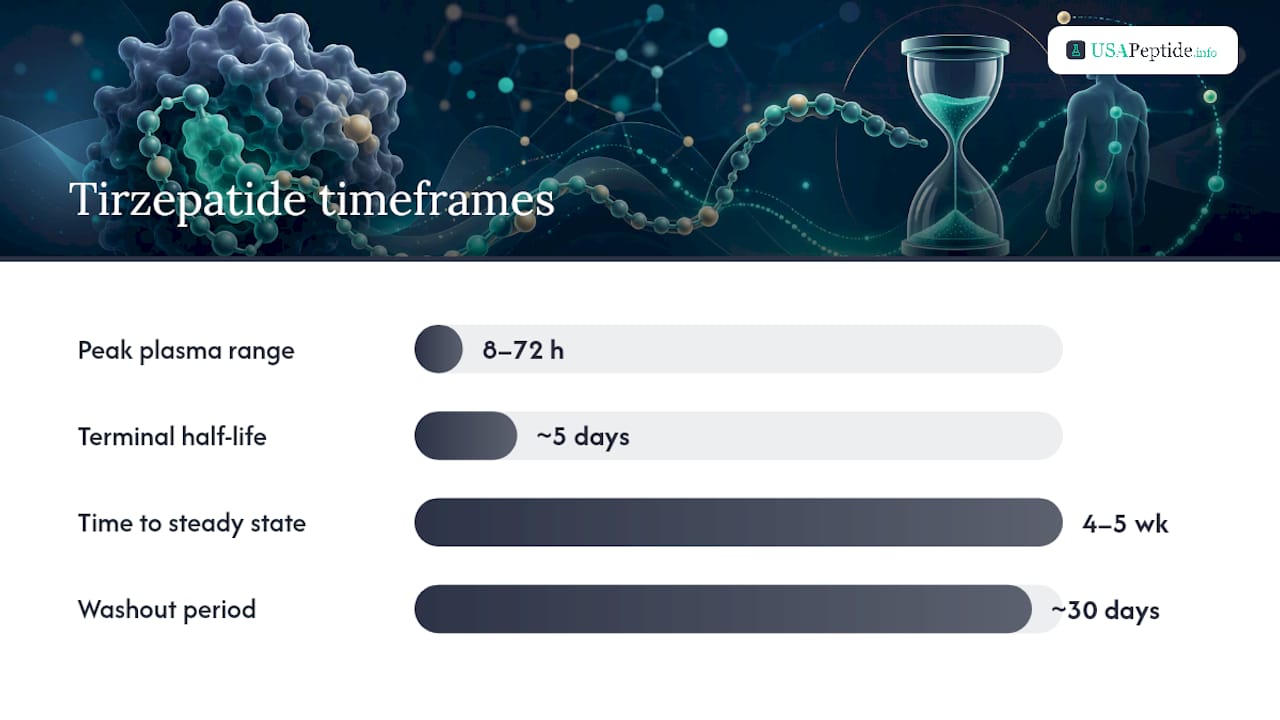
Tirzepatide's disposition follows a two-compartment pharmacokinetic model with first-order absorption after subcutaneous injection and first-order elimination, according to a population pharmacokinetic analysis that pooled data across 19 separate studies. The model estimated a median terminal half-life of approximately five days, which is the structural basis for the drug's once-weekly dosing interval. Peak plasma concentrations typically occur 8 to 72 hours post-injection, and steady-state exposure is generally reached after four to five weekly doses, consistent with a compound whose accumulation follows straightforward first-order kinetics.
The same population PK model applied allometric scaling, adjusting exposure estimates by body size using established scaling exponents rather than treating every patient's weight as an independent, unexplained source of variability. That analysis found body-weight-related differences in exposure were adequately captured by the allometric framework, and covariate analysis did not identify a need for routine dose adjustments based on age, sex, renal function, or race. This is a meaningfully different finding from PK studies of some other biologics, where demographic subgroups sometimes require distinct titration approaches.
Key pharmacokinetic and dosing features researchers should track:
- Half-life: approximately 5 days, driven primarily by albumin-mediated protection against renal clearance and proteolysis.
- Steady state: typically achieved after 4 to 5 weekly doses given the compound's elimination kinetics.
- Dose escalation: approved regimens typically start at a low subtherapeutic dose and increase every 4 weeks, a schedule designed around gastrointestinal tolerability rather than any PK requirement for gradual receptor engagement.
- Washout period: approximately 30 days after the final dose, reflecting roughly six half-lives, which is the standard threshold pharmacologists use to consider a compound functionally cleared.
- No routine demographic adjustment: population PK covariate analysis did not support dose changes based on common demographic variables.
The dose-escalation schedule is worth unpacking mechanistically because it's often misunderstood as a pharmacokinetic necessity when it's really a tolerability strategy. Because GLP-1R activation in the gut slows gastric emptying and GIPR/GLP-1R co-activation in the CNS suppresses appetite, starting at full dose produces gastrointestinal adverse effects in a large share of patients. Titrating upward over weeks allows some degree of physiological adaptation, even though the receptor pharmacology itself doesn't change.
Discontinuation deserves specific mechanistic attention, and this is an area where manufacturer guidance is unambiguous. Because the drug's clearance depends on that roughly five-day half-life, Lilly's own guidance states tirzepatide should be undetectable in the body within about 30 days of the last dose. That washout window matters for researchers designing crossover studies, for clinicians managing a planned discontinuation, and for anyone interpreting biomarker changes that might persist for weeks after dosing stops rather than reversing immediately. Abrupt unsupervised cessation isn't dangerous in the way stopping certain hormone therapies can be, but the gradual decline in glucagon suppression and appetite modulation over that washout period is worth accounting for in any study design that assumes an immediate drug-free baseline.
Cellular and Tissue Mechanisms: Pancreas, Adipose Tissue, and the Central Nervous System
Dual GIP/GLP-1 agonism doesn't produce a single unified cellular effect. It produces distinct, tissue-specific responses that happen to converge on similar metabolic outcomes. Understanding each tissue compartment separately clarifies why tirzepatide's effects look different from a GLP-1-selective agonist even though both classes lower blood glucose and reduce body weight.
1. Pancreatic islet effects. In pancreatic beta cells, GIPR and GLP-1R co-activation amplifies glucose-stimulated insulin secretion through the classic incretin mechanism: receptor activation raises intracellular cAMP, which potentiates calcium-dependent insulin exocytosis specifically when glucose levels are elevated. This glucose dependency is the mechanistic reason incretin-based therapies carry a lower intrinsic hypoglycemia risk than insulin secretagogues that act independently of ambient glucose. Mechanism studies report improvements in both first-phase and second-phase insulin secretion, along with gains in disposition index, a composite measure that accounts for both insulin secretion and insulin sensitivity together.
2. Glucagon suppression. Tirzepatide reduces glucagon secretion from pancreatic alpha cells in a glucose-dependent manner, which lowers hepatic glucose output and blunts postprandial glucose excursions. This alpha-cell effect works in tandem with the beta-cell insulinotropic action rather than independently, since suppressed glucagon reduces the glucose load that insulin then has to manage.
3. Adipocyte GIPR signaling. This is where tirzepatide's mechanism diverges most clearly from GLP-1-selective drugs, because adipocytes express GIPR but not meaningful levels of GLP-1R. GIPR activation on adipose tissue is associated with changes in lipid storage dynamics, shifts in adiponectin secretion, and downstream improvements in insulin sensitivity at the tissue level. Insight into dual incretin pharmacology frames this division of labor plainly: GIP signaling contributes more to adipose metabolism and insulin sensitivity, while GLP-1 signaling contributes more heavily to anorectic, appetite-suppressing effects. The two receptor systems appear to work complementary jobs rather than redundant ones.
4. Central nervous system access and appetite circuits. Peptide access to the brain is normally restricted by the blood-brain barrier, but circumventricular organs, including the area postrema and the arcuate nucleus region near the median eminence, sit outside that barrier and allow circulating peptides like tirzepatide direct access to appetite-regulating neural circuits. Preclinical distribution studies using fluorescent tracers have demonstrated tirzepatide reaching these regions in rodent models. More strikingly, a six-week human fMRI study found reduced brain activation in response to high-fat, high-sugar food cues after tirzepatide treatment, providing early functional imaging evidence that the drug's appetite-suppressing effect involves direct central engagement rather than being a secondary consequence of gastrointestinal discomfort alone.

Pro Tip: If you're designing a mechanistic study to isolate central versus peripheral appetite effects, pair a GI motility marker (like gastric emptying scintigraphy) with a food-cue fMRI protocol in the same cohort. Studies that measure only one or the other tend to overattribute appetite suppression to whichever pathway they happened to study.
Preclinical rodent models have also explored whether GIPR agonism, despite its lower receptor density in the CNS compared to GLP-1R, plays a role in blunting nausea-related tolerance issues sometimes seen with high-potency GLP-1R-only agonists. The evidence here remains preliminary but suggests GIPR co-activation may modulate the CNS's adaptive response to sustained GLP-1R stimulation, an active area of ongoing mechanistic investigation rather than a settled finding.
Systemic Effects and Biomarkers: Glycemic Control, Weight Loss, and Cardiorenal Signals
The cellular mechanisms above translate into measurable systemic outcomes that mechanistic researchers use as biomarkers for target engagement. Glycemic control readouts and weight change are the two most consistently reported, but lipid, blood pressure, and renal biomarkers have also drawn attention in post hoc trial analyses.
In glycemic trials, a meaningful proportion of participants achieved near-normal HbA1c values, reflecting the combined effect of enhanced insulin secretion and glucagon suppression described in the previous section. Statistic Callout: In obesity trials within the SURMOUNT program, participants receiving higher-dose tirzepatide (10 to 15 mg) lost between roughly 16% and 22% of body weight over 72 weeks, with the magnitude of weight loss showing clear dose dependency across the studied range.
That dose dependency itself is mechanistically informative. If weight loss were driven purely by an on/off appetite switch, you'd expect a plateau effect once the receptor was saturated at lower doses. Instead, the graded response across 5 mg, 10 mg, and 15 mg doses suggests a system where increasing receptor occupancy, or increasing the duration of sustained cAMP-biased signaling, continues to produce incremental physiological effect. This is consistent with the biased-agonism hypothesis discussed earlier, where preserved receptor surface expression allows for a more dose-responsive relationship than a rapidly desensitizing pathway would permit.
Beyond glucose and weight, post hoc analyses of trial data have reported several secondary biomarker shifts:
- Reductions in triglycerides and modest favorable shifts in LDL and HDL cholesterol, plausibly linked to the adipocyte lipid-handling effects described in the tissue mechanisms section.
- Small reductions in systolic blood pressure, observed across dose groups, though the precise mechanistic pathway (weight loss versus a direct vascular effect) remains under study.
- Changes in select renal biomarkers, including markers of albuminuria in some analyses, that researchers are still working to disentangle from the confounding effect of concurrent weight loss and improved glycemic control.
The honest caveat for this section is that most cardiovascular and renal signals to date come from secondary or post hoc analyses of trials designed primarily around glycemic and weight endpoints, not from dedicated cardiovascular or renal outcome trials. That distinction matters for how confidently you can attribute causality. A biomarker shift observed as a secondary finding in a glycemic trial is a legitimate hypothesis generator, but it isn't equivalent evidence to a purpose-built outcomes trial with cardiovascular or renal events as the primary endpoint. Long-term data addressing those harder outcomes remains an open area, and researchers should treat current cardiorenal signals as mechanistically plausible rather than definitively established.
For researchers building comparative frameworks around metabolic peptide research, a category overview of GLP-1, GIP, and related metabolic peptides contextualizes how tirzepatide's biomarker profile compares against other compounds in active study.
Safety, Tolerability, and Dose Escalation Cautions
Gastrointestinal adverse events, primarily nausea, diarrhea, and decreased appetite, are the most consistently reported tolerability issue with tirzepatide, and they cluster heavily around the early titration period. A clinical tolerability review links the incidence and severity of these GI effects directly to the dose-escalation phase, noting that symptoms typically attenuate over subsequent weeks as patients continue at a stable dose. This pattern fits the underlying mechanism: gastric emptying delay and central appetite suppression are strongest early in exposure to a new dose level, before whatever adaptive processes occur have had time to develop.
Manufacturer guidance discourages abrupt, unsupervised discontinuation, largely because of the extended washout period discussed earlier. Since tirzepatide takes roughly 30 days to clear the body after the last dose, stopping treatment without a monitoring plan can leave glycemic and appetite effects fading unpredictably over weeks rather than resolving on a clean timeline, which complicates both clinical management and research designs that assume a sharp washout.
Rarer but more serious safety signals reported in trial data include acute pancreatitis, gallbladder-related events, and, in rodent studies, thyroid C-cell tumors, though the human relevance of that last finding remains unresolved and is generally treated as a class-labeling precaution for GLP-1-based therapies rather than an established human risk based on current evidence.
A practical monitoring checklist for researchers and clinicians working with tirzepatide:
- Track GI symptom severity against the specific week of the titration schedule, not just cumulative dose.
- Monitor for signs of pancreatitis (persistent abdominal pain) at any point in the dosing schedule, not only during escalation.
- Document time since last dose carefully in any discontinuation-related data, given the roughly 30-day washout window.
- Screen for personal or family history of medullary thyroid carcinoma or MEN 2 syndrome before initiating research or clinical use, per standard incretin-class precautions.
Evidence Base: Clinical Trials, PK Studies, and Preclinical Models
Not every mechanistic claim about tirzepatide rests on the same tier of evidence, and researchers evaluating the literature should keep that hierarchy explicit. Some claims, like the roughly five-day half-life and the two-compartment PK model, come directly from a rigorously designed population pharmacokinetic analysis that pooled data across 19 studies using validated allometric scaling methods. That's about as solid a pharmacokinetic evidence base as exists for this compound.
Other claims sit on a different foundation. The insulin secretion advantage over semaglutide comes from a single 28-week hyperglycemic clamp study, a well-controlled phase 1 mechanism trial, but still one study rather than a replicated body of work. Weight loss magnitudes and glycemic outcomes, by contrast, draw on the full SURPASS and SURMOUNT phase 2/3 clinical trial programs, giving those figures a much broader evidentiary base across thousands of participants.
The biased-agonism and receptor-affinity data occupy the least clinically validated tier. Much of that evidence comes from in vitro signaling assays in transfected cell lines, not native human tissue, and the CNS distribution data supporting direct appetite-circuit engagement comes primarily from rodent tracer studies plus a single small human fMRI study over six weeks.
Key evidentiary distinctions worth tracking:
- Strongest evidence tier: population PK modeling and phase 2/3 glycemic and weight-loss outcomes from the SURPASS and SURMOUNT trial programs.
- Moderate evidence tier: phase 1 mechanism studies like the hyperglycemic clamp trial, which are well-controlled but limited in sample size and duration.
- Preliminary evidence tier: receptor bias assays in heterologous cell systems and rodent CNS distribution studies, both mechanistically informative but not yet fully validated in native human tissue.
Translational caveats compound across these tiers. Species differences between rodent models and humans affect how confidently CNS distribution findings translate. Surrogate biomarkers like disposition index or fMRI activation patterns are useful mechanistic proxies but aren't identical to hard clinical endpoints. And trial endpoint heterogeneity across the SURPASS (diabetes-focused) and SURMOUNT (obesity-focused) programs means cross-study comparisons require care about population differences. Future mechanistic trials that pair receptor-occupancy imaging with clinical outcome tracking in the same cohort would meaningfully close some of these gaps. Recent peptide research updates track emerging studies as this evidence base continues to develop.
Assay Quality and COA Verification for Tirzepatide Research
Mechanistic research on tirzepatide is only as reliable as the compound purity behind it. Contaminants and degradation products can confound receptor-binding and signaling assays in ways that are easy to misattribute to biological variability rather than material quality. Researchers evaluating a Certificate of Analysis should check several specific items before trusting a batch for signaling or PK work:
- HPLC purity ≥99%, since impurities below that threshold can introduce off-target receptor activity that muddies cAMP or β-arrestin signaling readouts.
- ISO 17025 accreditation of the testing laboratory, which confirms the analytical methods generating the COA meet recognized international competency standards.
- Mass spectrometry confirmation of identity, not just purity, to rule out sequence errors or truncated peptide fragments.
- Batch-specific documentation, since a COA tied to a generic product listing rather than the specific lot in hand tells you nothing about what's actually in the vial.
Impurities in the low single-digit percentage range can meaningfully skew a dose-response curve in a signaling assay, particularly when the contaminant is a truncated or oxidized peptide fragment with partial receptor activity of its own. Any mechanistic study reporting tirzepatide results should include the COA reference, storage conditions (typically lyophilized and refrigerated, with reconstituted solution requiring cold storage and limited use windows), and a note on assay validation steps taken to rule out confounding.
USAPeptide's COA verification tool helps researchers cross-check whether a supplied Certificate of Analysis reflects legitimate testing methodology rather than a boilerplate document, and the tirzepatide molecular profile page consolidates structural and mechanism data alongside sourcing guidance for lab-grade material.
Downstream Signaling Beyond cAMP: MAPK and PI3K Pathway Engagement
The cAMP versus β-arrestin framework captures the headline story of tirzepatide's receptor bias, but it isn't the entire signaling picture. Both GIPR and GLP-1R, once activated, can engage additional intracellular cascades that shape the cell's full response beyond acute insulin secretion.
Mitogen-activated protein kinase (MAPK) signaling, particularly the ERK1/2 branch, is activated downstream of cAMP-dependent protein kinase A activity in beta cells, and this pathway is implicated in longer-term cellular adaptations, including gene transcription changes tied to beta-cell proliferation and survival rather than acute insulin exocytosis. Phosphoinositide 3-kinase (PI3K) signaling, meanwhile, intersects with insulin receptor substrate pathways and contributes to metabolic effects in peripheral tissue, including some of the insulin-sensitizing effects observed in adipocytes following GIPR activation.
These secondary pathways matter because they help explain effects that operate on a different timescale than acute glucose handling. Acute insulin secretion happens in minutes through the cAMP/PKA axis. Beta-cell survival and adipocyte remodeling operate over days to weeks, and MAPK/PI3K engagement is the more plausible mechanistic bridge for those slower changes. Most of this evidence comes from broader incretin receptor signaling research rather than tirzepatide-specific pathway mapping, so researchers should treat MAPK and PI3K involvement as a reasonable extrapolation from GIPR/GLP-1R biology generally, applied to tirzepatide specifically, rather than a fully mapped tirzepatide-exclusive signaling diagram.
How Tirzepatide's Mechanism Differs From Other GLP-1 Agonists
The core distinction is receptor scope. Selective GLP-1R agonists engage a single target, and their metabolic effects flow entirely through GLP-1R-mediated insulin secretion, glucagon suppression, gastric emptying delay, and central appetite signaling. USAPeptide's semaglutide profile covers that single-receptor pharmacology in detail for comparison.
Tirzepatide adds GIPR engagement on top of that GLP-1R activity, and the affinity balance runs opposite to what you might expect: it binds GIPR with near-native potency while its GLP-1R potency lags behind native GLP-1. That means a meaningful share of tirzepatide's total metabolic signal comes through a receptor that selective GLP-1 drugs never touch at all, particularly the adipocyte-level lipid metabolism and insulin sensitivity effects tied to GIPR.
The biased signaling profile adds a second layer of difference. Even restricting comparison to GLP-1R activity alone, tirzepatide's cAMP-favoring, β-arrestin-sparing signaling pattern differs from the more balanced signaling seen with several other GLP-1R agonists. Whether that bias translates into meaningfully different clinical durability, beyond what dosing frequency alone would predict, is still being worked out mechanistically, but it's a real pharmacological distinction at the receptor level, not just a marketing distinction between drug classes.
Beta-Cell Proliferation and Survival Mechanisms
Beyond acute insulin secretion, incretin receptor activation influences whether pancreatic beta cells survive and replicate over time, a mechanism with obvious relevance for anyone studying diabetes progression rather than just acute glycemic control. GLP-1R activation has long been associated in preclinical rodent models with reduced beta-cell apoptosis and, in some models, modest proliferative signals, largely mediated through the cAMP/PKA and downstream MAPK pathways described above.
Tirzepatide's dual receptor engagement raises the mechanistic question of whether GIPR co-activation adds an independent beta-cell survival signal on top of GLP-1R's contribution. GIPR is expressed on beta cells alongside GLP-1R, and GIP signaling has its own history in the preclinical literature of supporting beta-cell function, separate from its adipose tissue effects. The 28-week hyperglycemic clamp study's finding of enhanced insulin secretion measures with tirzepatide relative to semaglutide is consistent with, though not direct proof of, a beta-cell functional advantage tied to combined receptor engagement.
Direct human histological evidence for beta-cell mass changes with tirzepatide specifically doesn't exist, for the practical reason that pancreatic tissue sampling in living patients isn't standard research practice. What exists instead is a converging set of functional proxies, disposition index improvements, sustained insulin secretion across the dosing interval, and preclinical rodent survival data for the broader incretin receptor class, that together support a plausible beta-cell preservation mechanism without constituting direct confirmation.
Gastrointestinal Motility Effects
Delayed gastric emptying is one of the most direct and mechanistically well-understood effects of GLP-1R activation, and tirzepatide inherits this effect through its GLP-1R agonist activity. GLP-1R is expressed on vagal afferent neurons and within the enteric nervous system, and its activation slows the rate at which stomach contents empty into the small intestine.
This delay contributes to satiety through two separate pathways worth distinguishing. Prolonged gastric distension itself signals fullness through mechanoreceptors, while slowed nutrient delivery to the small intestine also blunts the postprandial glucose spike, reinforcing the glycemic benefits described in the pancreatic mechanism section. It's worth noting this GI motility effect is mechanistically separate from the central appetite suppression demonstrated in the fMRI food-cue studies discussed earlier. Delayed gastric emptying and reduced hypothalamic activation to food cues appear to be two distinct, complementary mechanisms rather than one causing the other, which is part of why appetite suppression research increasingly measures both pathways independently rather than assuming GI effects fully explain reduced food intake.
The same motility slowing is also the leading mechanistic explanation for the nausea and early satiety reported during dose escalation, tying this section directly back to the tolerability pattern discussed in the safety section.
Cardiovascular Physiology and Mechanistic Basis for Potential Benefits
Tirzepatide's cardiovascular mechanistic story is built on indirect pathways rather than a demonstrated direct cardioprotective receptor effect, and that distinction matters for how researchers should frame current evidence. Weight loss itself reduces cardiovascular risk factors independent of any drug-specific mechanism, and given the magnitude of weight reduction reported in the SURMOUNT program, a substantial share of any observed cardiovascular biomarker improvement plausibly runs through that pathway alone.
Beyond weight-mediated effects, GLP-1R is expressed in cardiac tissue and vascular endothelium, and GLP-1R agonism as a class has been associated with modest reductions in blood pressure and improvements in lipid profiles in trial data, mechanisms that likely extend to tirzepatide given its GLP-1R activity, though the magnitude may differ given its biased signaling profile. The adiponectin-related shifts tied to adipocyte GIPR activation offer a second plausible pathway, since adiponectin has documented anti-inflammatory and vascular-protective associations in the broader metabolic literature.
What's genuinely missing is a dedicated cardiovascular outcomes trial with hard endpoints, myocardial infarction, stroke, or cardiovascular death, as the primary measure specifically for tirzepatide. Until that data matures, cardiovascular benefit remains a mechanistically coherent hypothesis supported by biomarker signals and class-level precedent, not an established outcome.
Researchers building broader translational and recovery-focused study protocols alongside metabolic peptide work may find the recovery and tissue-repair peptide category guide useful for cross-referencing complementary mechanistic frameworks.
The USAPeptide Team's Take on Tirzepatide's Mechanism
What stands out most across the mechanistic literature is how much of tirzepatide's clinical profile traces back to two structural decisions: the imbalanced GIPR/GLP-1R affinity and the biased cAMP-favoring signaling at GLP-1R. Neither is accidental, and neither is fully explained yet. The dose-dependent weight loss data suggests receptor engagement scales more linearly than a simple on/off appetite switch would predict, which should push researchers toward finer-grained dose-response study designs rather than binary comparisons. The biggest open gap isn't glycemic or weight mechanism, both are well characterized. It's the cardiorenal and beta-cell durability questions, where current evidence is mechanistically plausible but still resting on secondary endpoints and short observation windows relative to the chronic disease timelines these questions actually require.
— USAPeptide Team
This article is general information, not a substitute for advice from a qualified doctor. Consult a qualified healthcare professional about your own circumstances before acting on anything here.
Sources
- Population pharmacokinetics of the GIP/GLP receptor agonist tirzepatide - PMC
- Tirzepatide - StatPearls
- How long will Mounjaro® (tirzepatide) be in the body after the last dose?