
Research peptides can be legally purchased and used in the United States, but only within tight conditions: the material must be classified correctly under FDA rules, sold and used for genuine non-human research, and never presented in a way that signals human use. "Research use only" labeling alone does not protect a seller or a buyer. Legality turns on FDA classification, compounding law, and the "intended use" test set out in 21 CFR 201.128, which examines labeling, marketing, and how a product is actually sold, not just what the box says.
TL;DR:
- The legality of research peptides depends on FDA classification, intended use, and how products are marketed and presented, not just labeling disclaimers.
- Enforcement actions mainly target the full commercial presentation, including bundled supplies and disease claims, rather than the peptides themselves.
- Most peptides fall into three categories: FDA-approved drugs for specific conditions, compoundable substances with proper licensing, or research-use-only materials used for legitimate lab research.
- Proper documentation, supplier verification, and understanding state as well as federal rules are essential for maintaining legal compliance and avoiding enforcement escalation.
- Regulators increasingly assess the overall commercial context, making ongoing compliance efforts and precise record-keeping critical for lawful research activities.
Table of Contents
- Understanding Research Peptide Legality Under Federal Law
- What Do 2026 FDA Warning Letters Reveal About Enforcement?
- The Three Legal Categories Every Peptide Falls Into
- How Do 503A and 503B Compounding Rules Actually Work?
- Compliance Checklist Every Lab Should Follow Before Buying
- Why State Rules Matter Alongside Federal Law
- What Happens When Vendors or Buyers Cross the Line?
- How USAPeptide.info Supports Compliant Research Sourcing
- A Straight Answer on Where the Real Risk Sits
- Sources
- FAQ
Understanding Research Peptide Legality Under Federal Law
The Federal Food, Drug, and Cosmetic Act (FD&C Act) is the statute that decides most of what matters here. Under Section 505(a), any new drug requires FDA approval before it can be introduced into interstate commerce, and a peptide marketed or sold for treating, preventing, or altering a human condition qualifies as a drug regardless of what its label claims. Sections 301 and 331 of the Act make it unlawful to introduce misbranded or unapproved new drugs into commerce, and this is the hook FDA uses against most peptide sellers, not some peptide-specific statute that doesn't exist.
The determining question is intent, and 21 CFR 201.128 spells out how FDA finds it. Intended use is judged objectively, through labeling claims, advertising, website copy, and "the circumstances that the article is, with the knowledge of such persons or their representatives, offered and used for a purpose for which it is neither labeled nor advertised." In plain terms: a seller cannot slap "not for human consumption" on a vial and then sell it bundled with syringes, bacteriostatic water, and a dosing chart. The overall commercial presentation controls, not the disclaimer.
A smaller subset of research materials intersects with the Controlled Substances Act. Peptides are not commonly scheduled substances, but any compound with structural or pharmacological overlap with a controlled substance may require a Schedule I researcher registration and an Investigational New Drug (IND) application before human-subject work can proceed. This is a narrow lane and mostly irrelevant to typical peptide research, but it is worth checking against DEA schedules before assuming a novel compound is unregulated.
For laboratories doing their own risk assessment, the primary sources are non-negotiable:
- The FD&C Act itself, particularly Sections 505, 301, and 331, for the drug-approval and misbranding framework.
- 21 CFR 201.128 for the full text of the intended-use standard.
- FDA guidance documents and the Federal Register for current interpretations and proposed rule changes.
- DEA scheduling lists, checked against any compound with stimulant, opioid, or hallucinogenic structural analogs.
None of these sources are optional reading for a compliance officer. Vendor marketing copy, forum consensus, and competitor websites are not legal authority, and treating them as such is how labs end up exposed.
What Do 2026 FDA Warning Letters Reveal About Enforcement?
FDA's enforcement activity in 2026 offers the clearest real-world picture of how the "intended use" test actually gets applied, and the pattern is consistent across nearly every letter issued this year. Regulators are not primarily objecting to the peptide molecules themselves. They are objecting to the full commercial package surrounding them.
A string of warning letters issued in August 2026 illustrates the point. FDA's letter to NuScience Peptides cited labeling and bundled accessory supplies as direct evidence of intended human use, despite RUO disclaimers on the products themselves. Around the same date, FDA's letters to Peak Performance Peptides and Peptide Partners flagged the same category of evidence: bacteriostatic water sold alongside peptide vials, dosing calculators hosted on the same site, and syringes marketed as companion products. Earlier in the year, FDA reviewed Gram Peptides and concluded that products including retatrutide were unapproved new drugs, again based on the site's overall presentation rather than any single claim.
The recurring evidence categories FDA cites include:
- Reconstitution instructions or bacteriostatic water sold as an accessory item.
- Dosing calculators or "recommended dose" charts hosted on the same domain as the product listing.
- Disease or condition claims anywhere on the site, in customer reviews, or in linked blog content.
- Syringes, needles, or injection supplies marketed as companion purchases.
Statistic Callout: Every major peptide-related warning letter FDA issued in August 2026 named bundled reconstitution or injection supplies as part of its evidence for unapproved new drug status, according to the NuScience Peptides letter and the related enforcement actions issued that month.
FDA's own language across these letters describes a "net impression" standard: regulators weigh labeling, accessory sales, site content, and customer-facing materials together, then ask what a reasonable buyer would conclude the product is for. A vendor can print "research use only" on every label and still lose that argument if the rest of the storefront reads like a peptide-therapy shop.
The Three Legal Categories Every Peptide Falls Into
Every peptide a lab might source falls into one of three legal buckets, and knowing which bucket applies is the single most useful classification exercise a compliance officer can run.
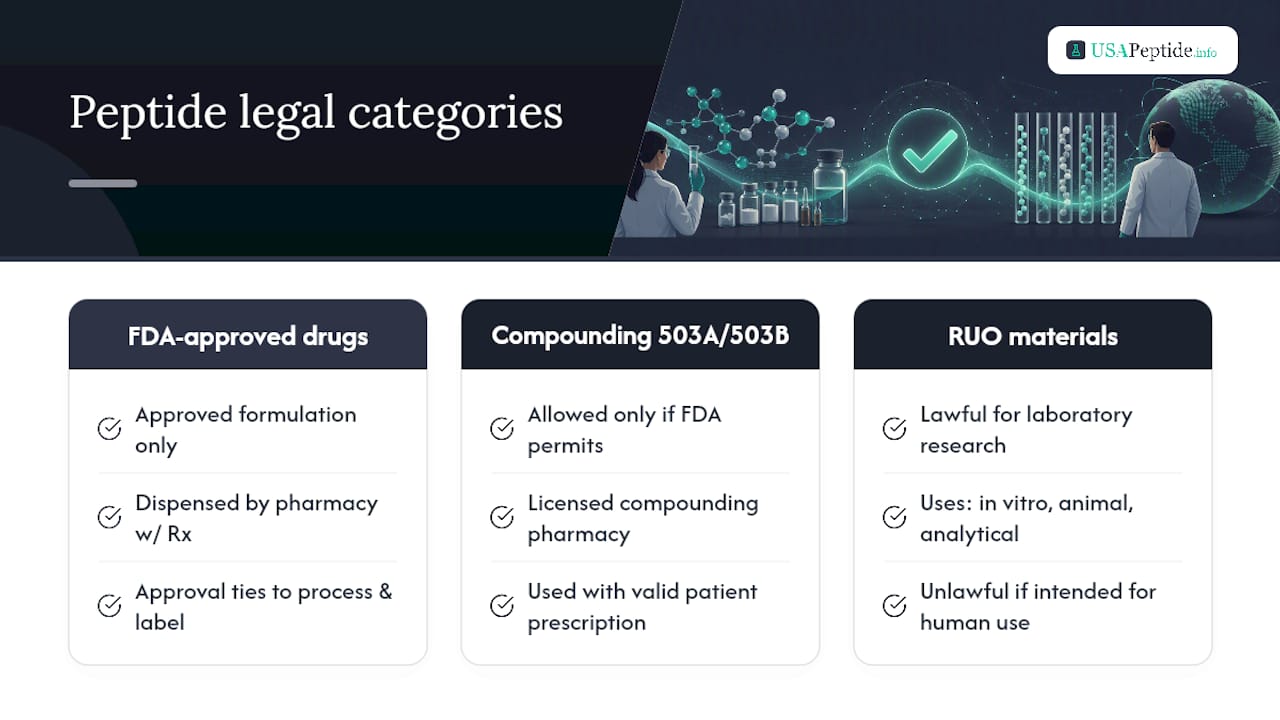
FDA-approved drugs. A small number of peptides, semaglutide and tirzepatide among them, have FDA-approved formulations for specific human indications. Only the approved formulation, dispensed through the approved channel (a pharmacy dispensing under a valid prescription), is lawful for human use. A chemically identical peptide sold as a research-grade vial from a different manufacturer is not the approved drug, even if the molecule is the same, because approval attaches to the specific manufacturing process and labeling, not the compound in the abstract. The distinction between an approved drug and a research-grade version of the same molecule is worth understanding in detail before comparing peptide research options.
Compoundable substances. Some bulk peptides can lawfully be used by licensed compounding pharmacies under Sections 503A or 503B of the FD&C Act, but only when FDA has evaluated and permitted that specific substance for compounding use, and only for patients with a valid prescription addressing a legitimate clinical need that an approved drug does not meet.
Research-use-only materials. RUO peptides are lawful to sell and possess when actually used for legitimate laboratory research, such as in vitro assays, animal studies, or analytical method development. RUO sales become unlawful the moment the seller's presentation, labeling, or accessory bundling signals that the buyer is expected to use the material in a human body.
How Do 503A and 503B Compounding Rules Actually Work?
Compounding law gets treated as a workaround by parts of the peptide market, and it is worth being precise about why it is not one. A bulk substance can be used in 503A or 503B compounding only through one of three narrow pathways: it appears on FDA's approved bulks list for that section, it is a component of an FDA-approved drug used consistently with that approval, or it meets the United States Pharmacopeia (USP) or National Formulary monograph requirements where one exists. Absent one of those three conditions, a compounding pharmacy cannot lawfully use the substance, regardless of how it is labeled or sourced.
FDA's bulk drug substances guidance lays out the evaluation criteria the agency applies before adding anything to the 503A list: clinical need, safety data, and whether an FDA-approved alternative already addresses the same use. The agency is actively working through a substantial list of peptides against these criteria as of 2026, and that review is substance-specific, not a blanket approval for "peptides" as a category.
The Pharmacy Compounding Advisory Committee (PCAC) held meetings in July 2026 to evaluate specific peptides for potential inclusion on the 503A bulks list. The meeting materials show the committee distinguishing between chemical forms of the same peptide, free base versus acetate salt, for instance, treating them as separate questions with separate evidence requirements. A favorable advisory vote on one salt form does not extend automatic clearance to another, and an advisory recommendation is not itself a final agency rule. The full regulatory rundown on which peptides PCAC has reviewed is worth bookmarking if your lab tracks this evaluation process closely.
For a laboratory, the operational takeaway is straightforward:
- Never assume a compounding pharmacy can legally supply a peptide just because it appears in PCAC discussion materials.
- Ask the pharmacy directly which section (503A or 503B) and which specific chemical form covers the product you are requesting.
- Request documentation showing the substance's current bulks-list status before treating any compounded peptide as a routine, low-risk purchase.
Compliance Checklist Every Lab Should Follow Before Buying
A defensible research posture comes down to documentation that shows, in writing, that the peptide is being used for legitimate non-human or bona fide laboratory research. Regulators are not looking for perfection; they are looking for a paper trail that contradicts any claim of human-use intent.
- Document the research protocol first. Write a protocol describing the study objective, methodology, and species or system involved, and route it through your institution's IACUC, IBC, or IRB where applicable, even for non-animal, non-human work.
- Verify the supplier before the first purchase. Request a Certificate of Analysis showing identity and purity testing, and confirm the testing lab holds ISO 17025 accreditation. A COA without an accredited lab behind it is closer to a marketing sheet than a quality document.
- Preserve chain-of-custody records. Keep lot numbers, invoices, and shipping records tied to each protocol, so any given vial can be traced back to a specific research use.
- Control your content, not just your storage. Keep protocol documents, lab notebooks, and internal communications entirely separate from any consumer-facing materials. Never generate or retain dosing charts, reconstitution instructions, or injection guidance written for human administration.
- Set an escalation path in advance. Identify which compliance officer or outside counsel gets contacted the moment a regulator reaches out, before it happens, not after.
Pro Tip: Run a "storefront test" on your own supplier before ordering: if their website reads like a human-dosing guide rather than a laboratory catalog, treat that as a red flag regardless of what the product label says. FDA's own warning letters use exactly that comparison.
Following a structured peptide sourcing checklist at intake, rather than reacting after a shipment arrives, is the difference between a lab with a clean compliance file and one improvising an explanation months later.
Why State Rules Matter Alongside Federal Law
Federal law sets the floor, but individual states layer additional rules on top of it, particularly through pharmacy practice acts and medical board regulations, and these vary enough that a peptide treated as routine in one state can trigger board scrutiny in another. State pharmacy boards often issue their own compounding restrictions that go beyond FDA's 503A framework, and state medical boards sometimes publish interpretive opinions specifically addressing peptide prescribing that have no federal equivalent.
A repeatable check before any interstate purchase should include:
- The state pharmacy board's current compounding policy statements or restricted-substance lists.
- The state medical board's interpretive guidance on peptide prescribing, if any exists.
- The state attorney general's office for any active enforcement advisories naming peptide vendors.
- Cross-referencing shipping destination rules if your lab receives materials across state lines.
Coordinate this check with institutional counsel before finalizing any purchase that crosses state boundaries, especially for a lab operating under a university or hospital system with its own compliance office. A supplier that is fully compliant with federal rules can still put your institution at odds with a state-specific restriction that federal guidance never addresses.
What Happens When Vendors or Buyers Cross the Line?
FDA enforcement escalates in a fairly predictable sequence, and understanding where a given violation sits in that sequence helps a lab gauge real exposure rather than guessing.
Warning letters are the first and most common step, demanding corrective action within a set timeframe. Failure to respond, or continued sales after a warning letter, can lead to product seizures, injunctions barring further distribution, and in the most serious cases, criminal referral to the Department of Justice for knowing and willful violations. Statistic Callout: Peptide warning letters FDA issued in 2026 named specific corrective steps, primarily removing disease claims, discontinuing accessory bundling, and pulling dosing calculators, giving vendors a narrow window to comply before further action follows, as shown in the Peptide Partners letter.
Escalation tends to follow specific triggers: explicit human-use claims anywhere in marketing, repeat violations after a prior warning, interstate distribution at scale, or accessory bundling that makes human-use intent hard to dispute. A single ambiguous product photo is unlikely to trigger action on its own; a pattern across labeling, accessories, and site copy is what moves a case forward.
If your lab or a supplier you use receives any regulatory contact, the immediate steps are the same regardless of severity: preserve all records exactly as they exist, notify institutional counsel before responding to any inquiry, and avoid altering website content or product listings until counsel has reviewed the situation. Deleting or editing materials after a regulator has already flagged them can look like an admission, even when the underlying research use was entirely legitimate.
How USAPeptide.info Supports Compliant Research Sourcing
Verifying a supplier's paperwork is often the hardest part of staying compliant, and this is a key focus in research peptide sourcing resources. The COA grading tool evaluates whether a Certificate of Analysis reflects genuine ISO 17025 testing or reads like a template document with no real lab behind it, which matters given how often FDA letters point to identity and purity gaps as a red flag.

Peptide databases provide molecular profiles and mechanism-of-action summaries for compounds such as BPC-157 and Semaglutide, helping protocol documentation reference scientific data rather than vendor marketing materials, as detailed in innovative therapies with nanomedicine cancer. The peptide sourcing checklist walks through the same supplier-verification steps covered above, in a format built for repeat use during procurement. These resources do not provide legal advice and cannot substitute review by institutional counsel, but can assist labs in documenting supplier legitimacy before purchases. Start by reviewing a compound's molecular profile and COA grade on the Usapeptide before your next procurement cycle.
A Straight Answer on Where the Real Risk Sits
Most of the confusion around research peptide legality comes from treating "not FDA-approved" and "illegal" as the same thing. They are not. Plenty of legitimate research materials are unapproved as drugs and entirely lawful to possess and use, provided the research is real and the presentation matches it. The actual risk sits almost entirely in distribution, labeling, and sale, not in a lab's internal, well-documented use of an RUO compound.
What the 2026 enforcement pattern makes clear is that regulators are getting more sophisticated about reading commercial context as a whole rather than parsing individual disclaimers. That is a reasonable shift, and institutions that already keep clean protocols, COAs, and chain-of-custody records have little to fear from it. The gap is mostly at smaller, less formal operations that never built that documentation habit in the first place.
Regulatory guidance in this space will keep moving. The PCAC's substance-by-substance review process alone guarantees that the compounding landscape looks different in a year than it does today. Labs that treat compliance as a one-time checklist item rather than an ongoing monitoring task are the ones that get caught flat-footed. USAPeptide.info will keep updating its guidance as FDA rules change, and any lab serious about long-term research work should build the same habit of periodic review into its own compliance calendar.
— USAPeptide Team
This article is general information, not a substitute for advice from a qualified lawyer. Consult a qualified legal professional about your own circumstances before acting on anything here.
Sources
- NuScience Peptides LLC - 733652 - 08/24/2026 | FDA
- 21 CFR § 201.128 - Meaning of “intended uses”. | LII / Legal Information Institute
FAQ
Where Can I Buy Research Peptides Online in the USA?
Legitimate research peptides are available through suppliers who provide verified Certificates of Analysis backed by ISO 17025-accredited testing labs, with no human-dosing instructions or bundled injection supplies. USAPeptide.info's database links to vetted, research-grade compound suppliers vetted against these standards.
What Are the Current Restrictions on Peptides in the United States?
Restrictions depend on the peptide's legal category: FDA-approved drugs require prescription dispensing through approved channels, compoundable substances require 503A or 503B eligibility under criteria FDA is still actively evaluating, and RUO materials must be sold and used strictly for non-human research. The controlling legal test for all three is the "intended use" standard in 21 CFR 201.128.
What Happens if You Get Caught With Peptides?
Enforcement targets sellers and distributors far more often than researchers with documented, legitimate lab use, and typically starts with an FDA warning letter demanding corrective action. Repeat violations, explicit human-use marketing, or interstate distribution can escalate to seizures, injunctions, or criminal referral, as seen in FDA's 2026 warning letters against several peptide vendors.
What Peptides Are Fully Legal?
No peptide is "fully legal" in every context; legality depends on the formulation, the seller's presentation, and the intended use, not the molecule alone. A handful of peptides, including semaglutide and tirzepatide, have FDA-approved formulations for specific human indications, while the same molecules sold as unapproved research-grade vials fall under a completely different legal category.