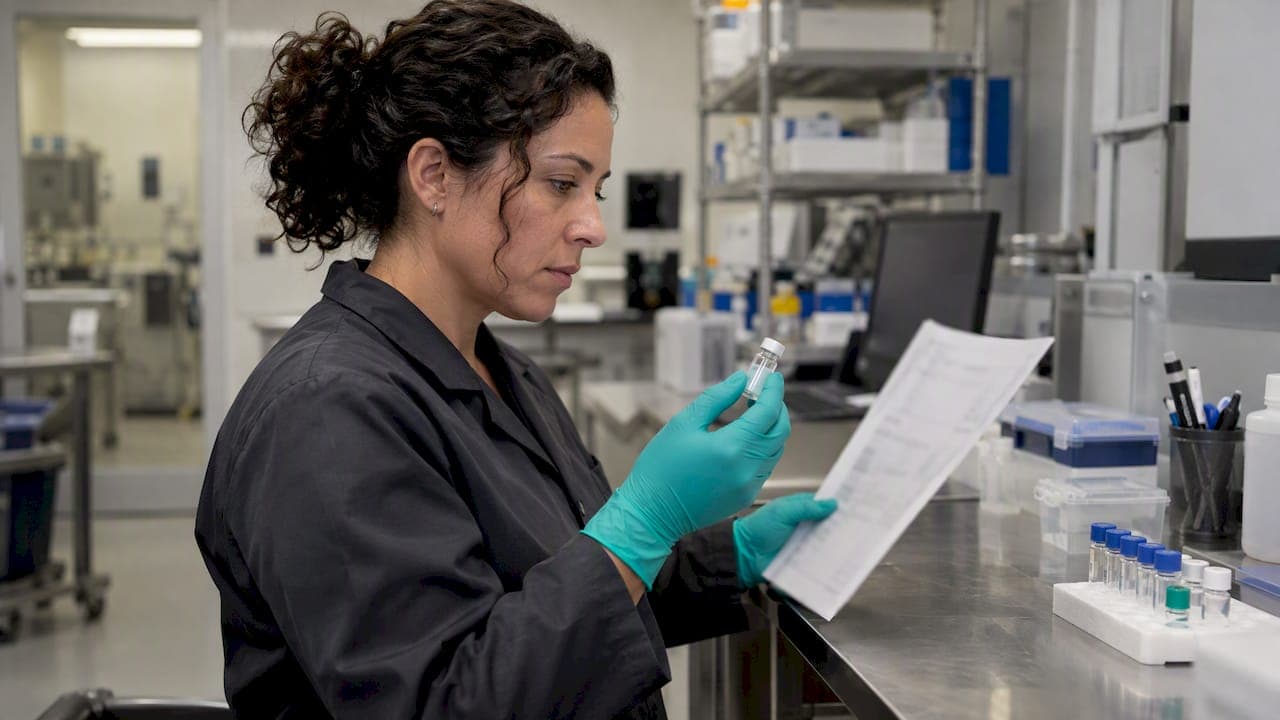
Research grade peptides are synthetic compounds manufactured and sold strictly for laboratory use, not for human consumption, and they should carry a per-lot Certificate of Analysis showing identity confirmation by mass spectrometry, an HPLC purity assay, and endotoxin or sterility data when the application calls for it. Before ordering, a lab's first action should be verifying that lot's COA against the issuing laboratory's accreditation. Anything less turns a research reagent into a guess.
TL;DR:
- A research-grade peptide should have a Certificate of Analysis confirming identity via mass spectrometry, with independent lab accreditation to ensure reliability.
- Validated LC-HRMS testing can detect impurities below 0.1%, which is necessary for reproducibility in sensitive assays.
- Suppliers must provide detailed impurity profiles, residual solvent data, and confirmatory spectra to verify product quality beyond a simple purity percentage.
- In vivo use requires endotoxin testing and sterility documentation, and peptides must be stored and reconstituted following manufacturer instructions to maintain integrity.
- The FDA enforces that research-grade peptides are strictly for laboratory use, and labs should evaluate COA credibility and avoid human applications with these compounds.
Table of Contents
- What "research-grade peptide" actually means
- Quality metrics and the analytical tests that back them
- How to evaluate a supplier's Certificate of Analysis
- Ordering, storage, and the legal line labs cannot cross
- How USAPeptide.info's tools support lot verification
- Where the field still gets reproducibility wrong
- Start a lot review with USAPeptide.info's grading tools
- FAQ
- Sources
What "research-grade peptide" actually means
The term describes a peptide synthesized for use in laboratory experiments: cell culture, biochemical assays, and preclinical animal work conducted under appropriate institutional oversight. It does not describe a peptide approved, tested, or labeled for use in humans. That distinction shapes everything else about how the product is documented and handled.
A research-grade compound ships with a Certificate of Analysis: a lot-specific document reporting identity, purity, and sometimes residual solvent or water content. A clinical or GMP-grade peptide intended for drug development comes with something far more extensive: validated batch manufacturing records, forced-degradation and stability data, process validation, and impurity characterization that meets ICH Q6B-style expectations for biologics and peptide drug products, as FDA guidance on peptide drug products describes. The guidance treats peptides as complex molecules with immunogenicity and stability concerns that go well beyond a simple purity number, which is one reason the gap between research-grade documentation and clinical-grade documentation is so wide.
Research-grade material is appropriate for basic in vitro work and exploratory animal studies, provided the lab independently confirms endotoxin levels and sterility where the protocol requires them. It is not appropriate for human use of any kind, including self-administration, and it is not a substitute for material produced under a regulated toxicology or GLP program.
Purity and impurity profile are related but distinct ideas, and conflating them is a common source of confusion. A peer-reviewed review of peptide reference standards describes how a mass-balance approach, assigning purity by accounting for water content, residual solvents, counter-ions, and related substances, combined with multi-lab testing, produces a far more defensible purity value than a single chromatographic percentage. For a lab trying to reproduce results across lots, the impurity profile often explains variability that a purity percentage alone cannot.

Quality metrics and the analytical tests that back them
A credible research-grade peptide is defined less by a single purity number than by the battery of tests that produced it. Each method answers a different question, and a lab evaluating a product should know what each one can and cannot tell them.
- HPLC assay reports the relative amount of the target peptide against related impurities in the same chromatographic run, typically expressed as an area-percent purity.
- LC-HRMS confirms molecular identity by mass and can resolve low-level impurities that co-elute or escape detection by UV absorbance alone.
- Peptide mapping with MS/MS fragments the molecule to confirm its amino acid sequence, catching deletion or substitution sequences that an intact-mass measurement might miss.
- Endotoxin testing, usually by the Limulus amebocyte lysate (LAL) method, and sterility testing apply specifically to material intended for in vivo or cell-based work where contamination would confound results.
Method validation matters as much as the result itself. A COA worth trusting states the analytical method used, reports the limit of quantification and limit of detection, and shows evidence of calibration against a reference standard rather than an uncharacterized internal control. A review of LC-HRMS methods for peptide quality control shows that validated methods, built to ICH Q2 standards for linearity, precision, and specificity, can detect and quantify peptide-related impurities at levels below 0.1%. That sensitivity is what allows a lab to tell the difference between a genuinely high-purity lot and one whose impurities simply fell below a less rigorous method's detection floor.
Validated LC-HRMS methods can resolve peptide impurities below 0.1%, a sensitivity that matters because impurities at that level can still affect an assay's reproducibility. A HPLC-only COA with no mass spectrometry backup cannot make that claim, and a lab relying on one should treat the purity figure as provisional rather than definitive.
Orthogonal confirmation adds another layer of confidence. Stable-isotope-labeled internal standards, of the kind used in quantifier products such as the SIL adalimumab signature peptide quantifier, illustrate how analytical labs cross-check peptide identity and concentration against a known reference rather than relying on a single chromatographic trace. Residual solvent testing and water content determination round out a complete analytical package, since both affect the mass-balance purity calculation and, over time, the compound's stability in storage. A technical overview of residual solvent testing in peptide products walks through acceptable limits and how they factor into a COA's overall credibility.
Sterility and endotoxin data belong in this conversation specifically when the research involves live animals, cell-based assays sensitive to contamination, or any application where an immune response could confound the result. A review of analytical and stability testing for peptides and proteins recommends ICH Q6B-aligned strategies covering identity, purity, and stability together, since these three dimensions interact: a peptide that degrades on storage will show a drifting purity value and, eventually, a changing impurity profile.
How to evaluate a supplier's Certificate of Analysis
A COA is only as useful as a researcher's ability to read it critically. The following checklist reflects what a complete, trustworthy document should contain, and what its absence should signal.
- Confirm identity by mass spectrometry, not retention time alone; a HPLC peak at the expected time does not prove the molecule is correct.
- Check the HPLC assay method and chromatogram, looking for a stated column, mobile phase, and wavelength rather than a bare percentage.
- Review the impurity table for named or structurally characterized impurities with individual limits, not a single "total impurities" line.
- Verify residual solvent and water content are reported, since both factor into the overall purity calculation and long-term stability.
- Look for endotoxin and sterility data when the peptide is intended for in vivo or cell-based work.
- Match the lot number and manufacture date on the COA to the vial received; a mismatched or missing lot number is disqualifying on its own.
- Identify the issuing laboratory and confirm it holds ISO 17025 accreditation, the standard that governs testing laboratory competence.
Supplier credibility extends beyond the COA itself. A lab can reasonably ask for raw spectra rather than summarized reports, the analytical method's standard operating procedure, and documentation of the testing lab's ISO 17025 scope. A supplier unwilling to provide any of these is signaling something about the rest of their quality program. A stepwise COA checklist and sourcing workflow built around these same categories can help a lab standardize how it triages new vendors.
Certain patterns are worth treating as red flags: test methods described only as "in-house" with no parameters, impurity data reported as a single aggregate number, marketing language that references dosing for human outcomes, or a COA that reuses the same chromatogram image across multiple product listings. None of these automatically disqualifies a supplier, but each should trigger a request for more documentation before an order proceeds.
Pro Tip: Request the raw LC-HRMS spectrum alongside the summary COA. A clean-looking purity percentage can still hide a co-eluting impurity that only a mass spectrum will reveal.
A simple decision framework keeps this consistent across a lab: accept the lot when identity, purity method, impurity table, and accreditation are all present and internally consistent; request more data when one element is missing but the supplier is responsive; reject the lot when the COA cannot be tied to the physical vial or when the supplier cannot produce a method description on request. A practical lab guide to reading a COA walks through this same triage in more detail for labs building the habit into routine intake.
Ordering, storage, and the legal line labs cannot cross
Catalog peptides ship faster than custom synthesis, often same-day for in-stock lots, but a lab should confirm batch traceability regardless of how quickly an order moves. Custom synthesis trades speed for specification control, useful when a study requires a modified sequence, a specific isotope label, or a purity grade above a catalog default. Either way, the lot number on the shipping documentation should match the COA on file before the material enters a freezer.
- Store lyophilized peptides at the temperature the COA specifies, typically frozen and protected from light and moisture until reconstitution.
- Reconstitute with the solvent the manufacturer recommends, since an incompatible solvent can cause aggregation or degrade the peptide before an assay even begins.
- Minimize freeze-thaw cycles after reconstitution, since repeated cycling is a common source of activity loss in peptide stocks.
- Document reconstitution date and conditions alongside the lot number so a drifting result can be traced back to storage rather than to the compound itself.
For any in vivo application, endotoxin limits and sterility documentation are not optional extras. A study that introduces a contaminated peptide into an animal model risks confounding the very outcome the study is designed to measure, and the supporting documentation should be on file before the first animal is dosed.
The legal picture is specific and worth stating plainly. FDA warning letters issued between 2024 and 2026 show the Agency treating some vendors' "research-use-only" peptide sales as distribution of unapproved new drugs, specifically when labeling, marketing language, or context indicates the product is intended for human use. A separate warning letter reflects the same enforcement pattern. The governing principle is straightforward: research-grade peptides are manufactured and sold for laboratory research, not for human administration, and labs should never use them in human studies or route them to clinical application. A detailed explainer on U.S. peptide regulations covers how this classification affects what labs can purchase and how it should be documented.
How USAPeptide.info's tools support lot verification
A peptide reference platform functions as a reference and verification layer that sits alongside, rather than replaces, a lab's own analytical confirmation. A peptide database compiles molecular profiles and mechanism-of-action summaries for commonly studied compounds, and a COA grading tool assesses whether a submitted Certificate of Analysis contains the elements a credible document should: identity confirmation, a named analytical method, an itemized impurity table, and accreditation details for the issuing lab.
- The COA grader flags missing impurity identification or an unaccredited issuing lab, the two gaps most likely to undermine a purity claim.
- A dosage calculator supports research-dosing calculations based on compound and study parameters.
- Category pages organize compounds by research area, including metabolic and GLP-1 peptides, tissue repair peptides, and growth hormone secretagogues.
When a grader flags a missing impurity profile, the practical next step is requesting the raw chromatogram and method description directly from the supplier before the lot is logged into a study. Used this way, the platform becomes part of a lab's intake workflow rather than a one-time lookup, applied consistently across metabolic studies, tissue-repair research, and similar programs where lot-to-lot consistency affects reproducibility. The platform operates as a referral and informational platform; it does not replace a lab's own confirmatory testing.
Where the field still gets reproducibility wrong
Most discussions of peptide quality stop at the purity percentage, and that is the single most consistent blind spot in how labs evaluate vendors. Reproducibility failures attributed to biological variability often trace back to a lot that was never fully characterized.
Three practices would close most of that gap if labs adopted them routinely. First, request raw spectra rather than summary reports, since a summary can smooth over exactly the irregularity that matters. Second, confirm endotoxin testing exists for any lot headed into in vivo work, rather than assuming a catalog listing implies it. Third, log which lot number was used in which assay, so a result that later proves difficult to replicate can be traced to a specific batch rather than written off as noise. None of these require new instrumentation, only a habit of asking for documentation that should already exist.
— USAPeptide Team
Start a lot review with USAPeptide.info's grading tools
Verifying a Certificate of Analysis before an order ships, rather than after a disappointing assay, saves a lab both time and reagent cost. Usapeptide centralizes peptide reference data, a COA grading tool, and category pages built around specific research areas, including a guide to peptides used in fat loss research covering GLP-1 and related metabolic compounds.

Run a lot's COA through the grader before it reaches the bench, and treat any flagged gap as a reason to request more documentation from the supplier. The platform operates as a referral and informational resource: the confirmatory testing a study depends on still belongs to the lab running it.
FAQ
What does research grade peptide mean?
A research-grade peptide is a compound manufactured and sold for laboratory research only, such as in vitro assays and preclinical studies, not for human use. It typically ships with a Certificate of Analysis reporting identity and purity, though the depth of that documentation varies significantly by supplier.
What is the most trustworthy peptide company?
Trustworthiness in this market comes down to documentation, not reputation: a supplier that provides a per-lot COA with mass spectrometry identity confirmation, a named HPLC method, an itemized impurity table, and ISO 17025 accreditation for its testing lab offers a far stronger basis for confidence than one that does not. Researchers should evaluate each lot's paperwork directly rather than relying on a vendor's general reputation.
Is it illegal to purchase research grade peptides?
Research-grade peptides can be legally sold and purchased in the United States for laboratory research use, but FDA warning letters show the Agency has acted against vendors whose marketing or labeling suggests the products are intended for human use, treating that activity as distribution of an unapproved new drug. The legal line depends on intended use and labeling, not on the compound itself, so labs should purchase strictly for research purposes and never for human administration.
What is the difference between peptides and research-grade peptides?
"Peptide" describes the molecule itself, a short chain of amino acids, regardless of its intended application. "Research-grade peptide" describes a specific quality and documentation standard, including a per-lot COA and analytical testing, intended for laboratory use rather than clinical or human use.
Sources
- Clinical pharmacology considerations for peptide drug products (FDA guidance)
- Analytical approaches to peptide reference standards (PMC)