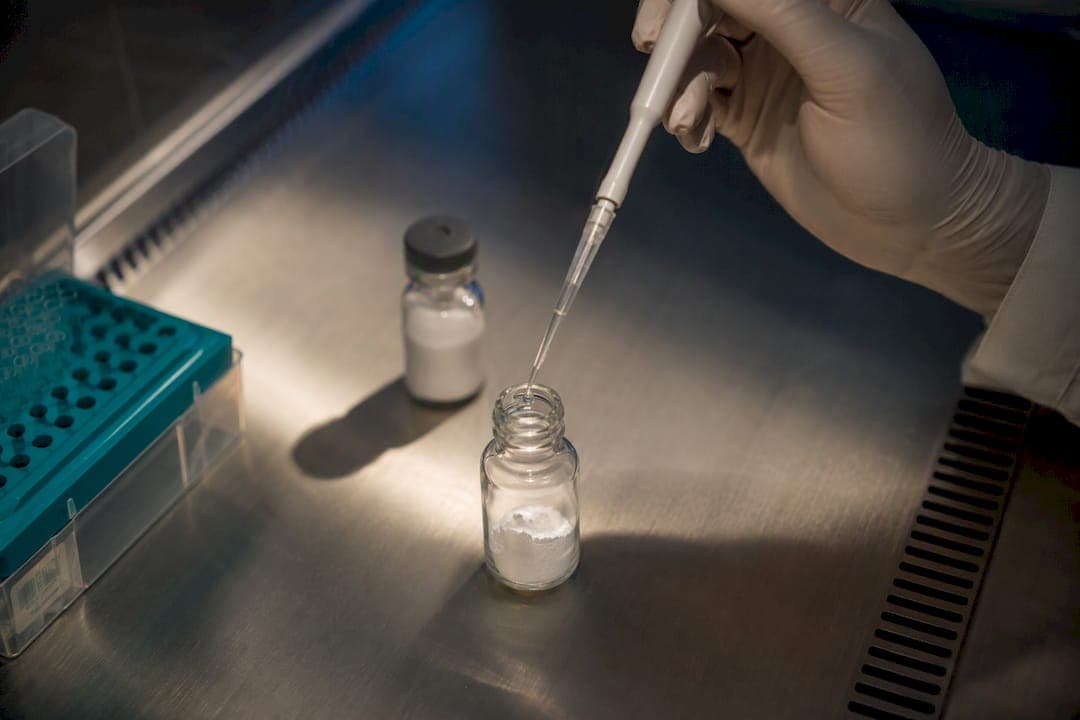
Start with sterile water or a mild aqueous buffer for most charged peptide sequences; it dissolves cleanly and keeps every downstream assay uncomplicated. Reserve dimethyl sulfoxide (DMSO) or another organic co-solvent for hydrophobic or neutral sequences that resist water, and always dilute stepwise rather than dumping solvent in all at once. Before you commit to either path, check what the peptide's charge and hydrophobicity actually predict, and plan for solvent carryover limits in whatever assay comes next.
TL;DR:
- Peptides with a net positive charge often dissolve best in water or dilute acetic acid, while negatively charged sequences may require ammonium hydroxide or bicarbonate solutions.
- Hydrophobic peptides over 15 residues or with multiple consecutive hydrophobic residues typically need organic co-solvents like DMSO or acetonitrile to wet thoroughly.
- Sequence-based predictions, such as charge and hydrophobicity, reliably guide initial solvent choices, but downstream assay compatibility determines overall success.
- Always test small amounts first, aid dissolution mechanically, and progressively dilute from concentrated organic stocks to prevent precipitation or degradation.
- Maintaining solvent carryover within assay-tolerant levels—ideally below 1% DMSO—prevents solvent-related interference with biological or analytical readouts.
Table of Contents
- Peptide Solubility Guide: Quick Rules for Choosing a Solvent
- How Do You Predict Peptide Solubility From Sequence Alone?
- What Is the Right Order of Steps for Dissolving a Peptide?
- Which Co-Solvents Work Best and How Do They Affect Assays?
- Why Is My Peptide Cloudy, Gelled, or Full of Precipitate?
- How Should You Store and Handle Reconstituted Peptide Stocks?
- How Do USAPeptide's Tools Support Better Solubility Decisions?
- Editorial Take: What Most Solubility Guides Get Wrong
- Sources
Peptide Solubility Guide: Quick Rules for Choosing a Solvent
A few rules of thumb settle most solvent decisions before you touch a vial.
- Net positive charge (basic residues like Lys, Arg dominate): start with water or dilute acetic acid (often 5 to 10%).
- Net negative charge (Asp, Glu dominate): try water first, then dilute ammonium bicarbonate or ammonium hydroxide if it resists.
- Neutral or hydrophobic-heavy sequence: skip straight to a small volume of DMSO, acetonitrile, or dimethylformamide (DMF), then dilute into aqueous buffer.
- Always test small first: dissolve a fraction of a milligram in a minimal volume before committing the full vial.
- Use gentle mechanical help: vortexing, brief sonication, or warming to 30 to 37°C speeds dissolution without degrading most sequences.
- Cap your organic solvent carryover before the solution ever reaches an assay plate.
These are starting points, not guarantees. The Synthetic Peptide Handling & Storage Protocol lays out this same escalation logic: water first, then acid or base by charge, then organic solvents only when aqueous options fail.
How Do You Predict Peptide Solubility From Sequence Alone?
Sequence tells you most of what you need to know before you open the vial. Count the ionizable residues (Lys, Arg, His for positive charge; Asp, Glu for negative) and estimate net charge at physiological pH. A peptide with three or more net charges per 10 residues usually dissolves readily in water. One with a roughly balanced charge, or none at all, is a candidate for organic solvent from the outset.
Hydrophobicity matters just as much. The GRAVY score (Grand Average of Hydropathy) averages the hydrophobicity value of every residue; a positive GRAVY score, flags a sequence prone to aggregation in water. Peptides over 15 residues with several consecutive hydrophobic residues (Leu, Ile, Val, Phe, Trp) behave more like small proteins than salts, and often need DMSO or acetonitrile just to wet the powder.
Terminal modifications shift the picture, too. Acetylation or amidation removes a charge site and nudges a peptide toward hydrophobic behavior, while phosphorylation adds a strongly negative group that usually improves water solubility. Backbone and side-chain packing, not just net charge, ultimately set the solubility ceiling, which is why two peptides with identical charge can behave very differently once concentrated.
- Estimate the isoelectric point (pI): the pH at which net charge hits zero.
- Aggregation risk peaks near the pI, since the molecule has the least electrostatic repulsion holding it apart in solution.
Solubility snapshot: Testing at acidic pH for basic peptides, or near-neutral to slightly basic pH for acidic peptides generally moves the solution safely away from the isoelectric point and toward maximum net charge, according to protocol references on pI-based solubility. Side-chain interactions, not backbone chemistry alone, drive most aggregation and phase-separation behavior in difficult sequences.
What Is the Right Order of Steps for Dissolving a Peptide?
A reliable dissolution protocol follows the same skeleton every time, adjusted only by what the sequence predicts.
- Check the Certificate of Analysis (COA) for purity, salt content, and residual solvent before you plan a stock concentration.
- Pick your first solvent using the charge and hydrophobicity rules above.
- Test a small aliquot first. Dissolve roughly 0.1 to 1 mg in a minimal volume (often 10 to 20% of your intended final volume) before committing the rest of the vial.
- Aid dissolution mechanically. Vortex briefly, sonicate for 1 to 2 minutes in a water bath, or warm gently to moderate temperatures. Avoid prolonged heat above body temperature; it risks degrading sensitive bonds.
- If aqueous attempts fail, dissolve in a small volume of concentrated DMSO first, then dilute into your working buffer. A concentrated organic stock dissolves faster and more completely than trying to force a large aqueous volume onto stubborn powder from the start.
- Filter through a sterile 0.22 micron membrane if the application demands sterility, then aliquot into single-use volumes and label with concentration, solvent, and date.
- Validate visually first. A clear, particulate-free solution suggests complete dissolution; run HPLC or mass spectrometry when the application requires confirmed concentration and purity.
Pro Tip: Prepare your DMSO stock at the highest practical concentration, then dilute down in stages. Diluting a concentrated stock in two or three steps prevents the localized precipitation that happens when organic solvent hits aqueous buffer too fast in one shot.
USAPeptide's reconstitution calculator can help you work backward from a target working concentration to the right stock volume before you start.
Which Co-Solvents Work Best and How Do They Affect Assays?
DMSO dissolves a wide range of hydrophobic peptides that water simply won't touch, but it carries a real chemical cost. It can oxidize cysteine and methionine residues over time, particularly in stocks stored above freezing or exposed to repeated freeze-thaw cycles. Reviews of DMSO's assay compatibility generally recommend keeping final DMSO concentration under roughly 1% for in vivo work and under about 5% for many cell-based assays, though sensitivity varies by cell type and readout.
- DMSO: best all-around hydrophobic solvent; oxidation risk for Cys/Met over time.
- Acetonitrile (ACN): volatile, HPLC-compatible, evaporates cleanly from fractions but not ideal for cell culture.
- DMF: similar solvating power to DMSO, less commonly assay-validated.
- Chaotropes (6 M urea, 6 M guanidine HCl): dissolve stubbornly aggregated peptides but must be removed by dialysis or desalting before most functional assays, per standard solubility guidelines.
Solubility snapshot: A peptide dissolved at high concentration in DMSO and diluted immediately before use minimizes both freeze-thaw stress and solvent exposure in the final assay well, a practice reinforced by handling protocols from Merck Millipore. If your downstream work involves live-cell assays, review the solvent tolerances across common cell-based assay formats before finalizing your carryover budget.
Why Is My Peptide Cloudy, Gelled, or Full of Precipitate?
Three failure modes look similar but need different fixes.
- Cloudiness right after dissolution: usually incomplete solubilization. Sonicate again, warm gently, or add a small increment of organic co-solvent.
- Gel formation: often self-assembly or aggregation, common in longer amphipathic sequences. Dilute further, add 0.01% Tween or another mild detergent, or shift pH away from the pI.
- Visible precipitate after storage: frequently oxidation or salt-buffer incompatibility. Check the stock's age and storage temperature before assuming the peptide itself has failed.
- Persistent aggregates: a brief exposure to a chaotrope such as 6 M urea can break them apart, but the chaotrope must come out again before any functional assay.
A clear, transparent solution is the simplest field test for complete dissolution; any haze or particulate means you are not done yet. If dilution and mild detergent don't resolve a stubborn gel, re-lyophilizing the material and starting the dissolution sequence over often works better than continuing to force a bad stock.
Pro Tip: Keep a small aliquot of your original lyophilized powder untouched. If a reconstituted stock degrades, you can go back to fresh material instead of troubleshooting a solution that may already be chemically compromised.
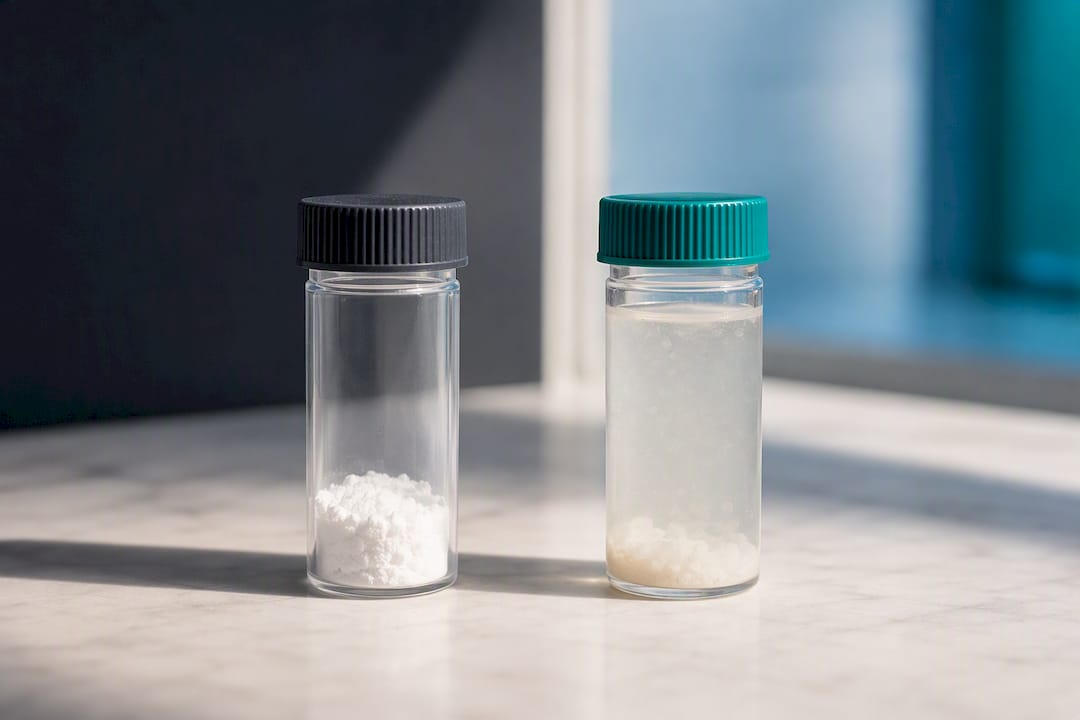
How Should You Store and Handle Reconstituted Peptide Stocks?
Lyophilized peptide keeps best at negative 20°C or colder, ideally under desiccation to block moisture uptake. Once reconstituted, aqueous stocks generally hold up for days at 2 to 8°C, while most researchers aliquot into single-use volumes and freeze the rest to avoid repeated freeze-thaw cycles.
- Store lyophilized powder at negative 20°C or below; check temperature-specific storage guidance for sequence-specific exceptions.
- Aliquot reconstituted stock immediately into the volumes you'll actually use.
- Cross-check your COA's residual solvent data against your assay's tolerance before finalizing storage plans, and consult residual solvent testing standards if the number looks high.
- Prepare fresh working dilutions the day of the experiment rather than storing diluted, low-concentration solutions for extended periods.
How Do USAPeptide's Tools Support Better Solubility Decisions?
A Certificate of Analysis tells you more than purity. Residual solvent figures on a COA hint at how the manufacturer processed the peptide, which affects how it behaves the first time you try to dissolve it. USAPeptide's COA grading tool checks a certificate's completeness and internal consistency, so you know whether the documentation backs up the purity claim before you plan a stock concentration around it.
The reconstitution calculator works alongside that COA data, letting you convert a target working concentration into the exact stock volume and solvent split you need. For sequence-specific terminology, from pI to GRAVY to chaotrope, the peptide research glossary fills in definitions without sending you hunting through a textbook mid-experiment.
Editorial Take: What Most Solubility Guides Get Wrong
Most guidance on this topic treats solvent selection as the whole problem. It isn't. The harder question is what happens after the peptide dissolves, whether your DMSO carryover survives contact with a cell assay, whether your chaotrope came out before you ran your binding study, whether your COA's residual solvent number actually matches what you're about to add on top of it.
Sequence-based prediction (charge, hydrophobicity, pI) gets you a reasonable first solvent choice most of the time. It does not get you a usable experiment. That only happens when the reconstitution plan accounts for the assay downstream from day one, not as an afterthought once the peptide is already in solution.
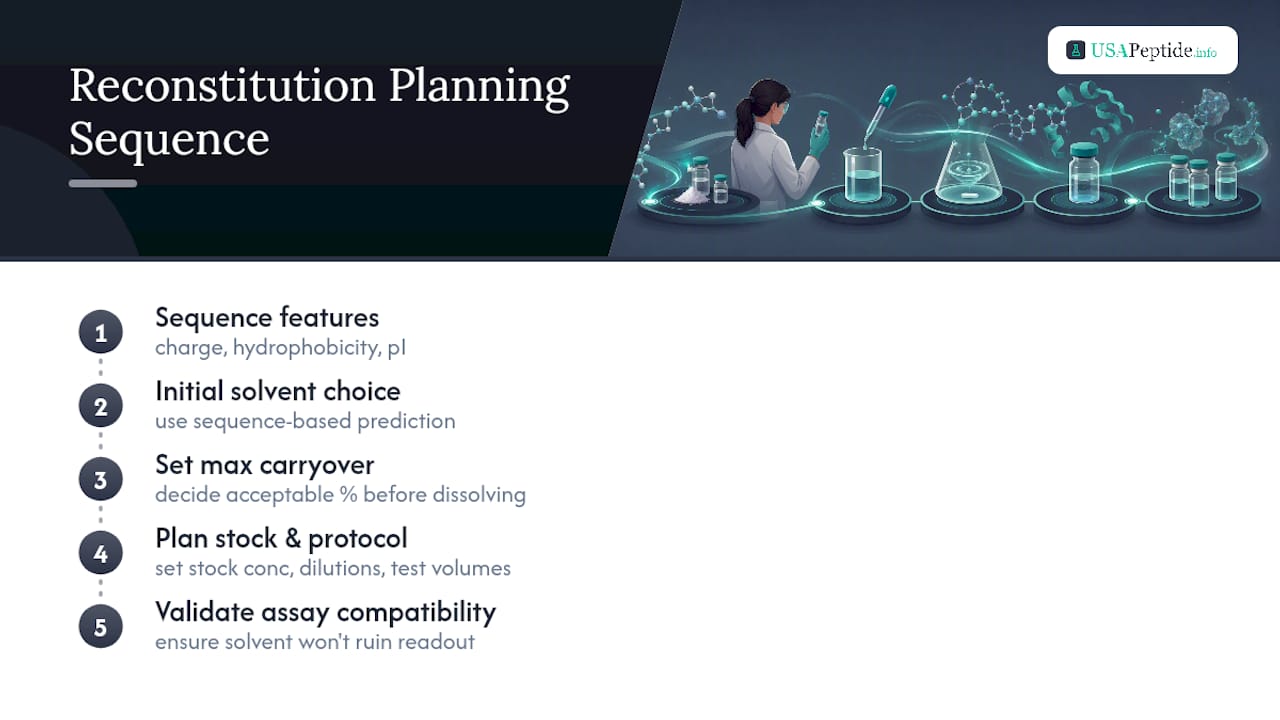
If there's one habit worth adopting over any single solvent rule, it's this: decide your maximum acceptable carryover percentage before you dissolve anything, not after. Work backward from that number to your stock concentration, and the rest of the protocol, small-test volumes, dilution steps, filtration, tends to fall into place on its own. Researchers who skip that step usually don't fail at dissolving the peptide. They fail three steps later, when the solvent that saved their peptide quietly ruins their readout.
For sourcing verified research-grade compounds with documented purity data to support this kind of planning, USAPeptide's Peptriva resource center is worth a look.
— USAPeptide Team
Sources
- Peptide Solubility Limits: Backbone and Side-Chain Interactions
- Synthetic Peptide Handling & Storage Protocol