
Peptide quality control must prove identity, quantify purity and net peptide content, and confirm contaminants sit at acceptable levels using validated, orthogonal methods tied to the material's intended use. A certificate that reports only an HPLC purity number, without mass balance, identity confirmation, or a validated method behind it, does not meet that standard. The governing references are USP reference standards, ICH Q2(R2), ICH Q14, and FDA guidance on analytical procedures.
TL;DR:
- Peptide quality control must include identity confirmation, purity assessment, and measurement of net peptide content through validated, orthogonal methods, not just purity percentages.
- HPLC purity numbers should be supported by mass-balance calculations and confirmed with techniques like MS or peptide mapping to accurately determine active peptide content.
- Analytical methods need ongoing validation and system suitability testing, with revalidation triggered by specific changes such as new equipment, reagents, or columns.
- Contaminant testing requires dedicated microbiological assays for sterility and endotoxin, which are not covered by chromatography or MS methods.
- Proper sample handling, documentation, and a complete workflow are critical for reliable QC results and ensuring lot comparability over time.
Table of Contents
- What Are the Critical Quality Attributes for Peptides?
- Which Analytical Methods Actually Confirm Peptide Quality?
- Why Doesn't HPLC Purity Equal Peptide Content?
- How Do You Validate an Analytical Method for Peptide QC?
- What Purity Threshold Should a Peptide Meet?
- What Contaminant Tests Does Peptide QC Require?
- How Does Sample Handling Affect QC Results?
- What Does a Complete QC Workflow Look Like?
- How USAPeptide Supports Defensible Peptide QC
- Getting the Priorities Right in Peptide QC
- Put These QC Practices to Work
- Sources
- FAQ
What Are the Critical Quality Attributes for Peptides?
Every peptide QC program rests on four measurable attributes, and conflating them is the most common analytical mistake in the field. Identity confirms the molecule is the correct sequence and mass, not just "a peptide that looks about right" on a chromatogram. Purity, typically expressed as HPLC UV area percent, measures how much of the detected material co-elutes with the main peak relative to impurities. Assay (or content) measures how much active peptide is actually present per unit mass, which is a different question than purity entirely. Net peptide content (NPC) accounts for water, counter-ions, and residual solvents that HPLC purity ignores completely.
These attributes serve different purposes depending on what the material is used for:
- Quantitative bioassays and dose-response work need accurate NPC, because a peptide that is 99% pure by HPLC but only 80% peptide by weight will throw off every concentration calculation downstream.
- Sequence-critical applications (receptor binding, structure-activity studies) need rigorous identity confirmation, ideally by mass spectrometry rather than retention time alone.
- Early screening and comparative studies can often tolerate a slightly lower purity threshold if the impurity profile is characterized and consistent across lots.
- API development and later-stage work demands tighter control on all four attributes simultaneously, since specifications tend to tighten as a peptide moves toward more rigorous use.
Prioritizing correctly means matching test rigor to consequence. The same impurity in a dose-critical study is not.
Which Analytical Methods Actually Confirm Peptide Quality?
No single instrument tells the whole story, and that is the central lesson of peptide analytics. Analytical HPLC with UV detection remains the workhorse for purity screening, but it only measures what elutes and absorbs in the chosen wavelength. System suitability testing (SST) and correct peak integration matter more than the number on the printout, because a mis-integrated shoulder peak can inflate apparent purity by several points without anyone noticing.
Intact-mass MS confirms the molecule's mass matches the expected sequence, which is a fast identity check but not a full structural proof. Peptide mapping via LC-MS/MS goes further, fragmenting the peptide and confirming the actual amino acid sequence, which catches deletion sequences, oxidation, and other synthesis artifacts that mass alone would miss.
Other techniques fill specific gaps:
- Amino acid analysis quantifies composition and helps cross-check assay results independent of chromatography.
- NMR and qNMR confirm structure and, in the quantitative form, can assign absolute purity without relying on a reference standard's UV response.
- Size-exclusion chromatography (SEC) detects aggregation and higher-order impurities that reverse-phase HPLC often misses.
A clean-looking chromatogram can still hide co-eluting impurities or compounds with a different detector response than the main peak, which is why analysts increasingly pair HPLC with LC-MS peak-purity checks rather than trusting the UV trace alone.
Pro Tip: Run LC-MS on any lot where the HPLC purity looks suspiciously perfect. A single sharp peak with no visible shoulders can still be masking a co-eluting impurity with weak UV absorbance.
Why Doesn't HPLC Purity Equal Peptide Content?
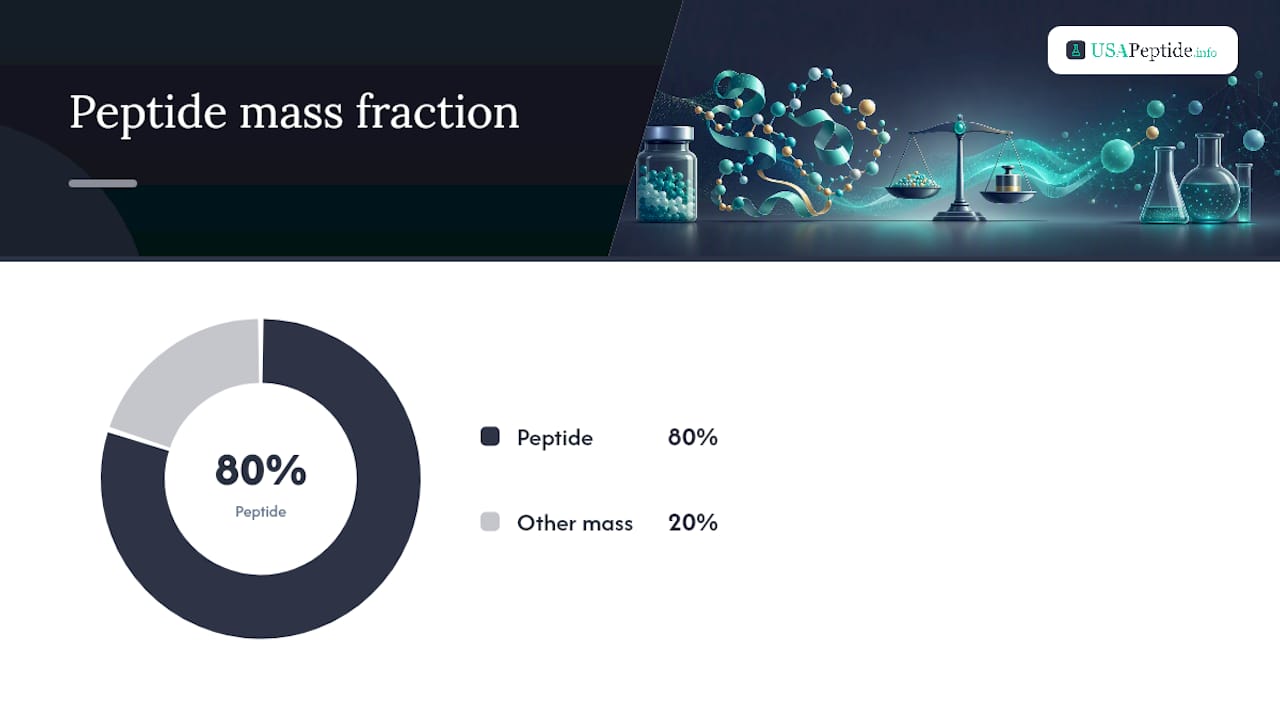
An HPLC report showing 98% purity tells you about the ratio of main peak to impurity peaks. It says nothing about how much of that vial's mass is actually peptide, versus water, acetate or trifluoroacetate counter-ions, and residual solvent from synthesis. This is the gap that trips up researchers converting a certificate's purity number directly into a molar concentration.
USP addresses this with a mass-balance approach: reference standard value assignment separates out detectable peptide-related impurities, counter-ion content, water, and residual solvents to arrive at an actual peptide mass fraction, rather than reporting HPLC area percent as if it were weight percent. A peptide salt can easily carry 10 to 20% of its mass as counter-ion and water, meaning a "98% pure" lyophilized powder might only be 80% peptide by weight once mass balance is applied. USP's reference standard documentation for synthetic peptide therapeutics lays out exactly how this calculation should work, and it should not automatically be read as 98% w/w active peptide.
Reference standards built on mass balance, rather than HPLC area alone, are what let two independent laboratories arrive at comparable content values for the same lot.
A practical orthogonal confirmation checklist looks like this:
- Run HPLC for purity and impurity profiling.
- Confirm identity with intact-mass MS or peptide mapping.
- Determine moisture content by Karl Fischer titration or loss-on-drying.
- Quantify residual solvents by GC.
- Calculate NPC from the combined data before assigning a working concentration.
Skipping the moisture and solvent steps is the single most common reason two labs report different concentrations for what is nominally the same peptide lot.
How Do You Validate an Analytical Method for Peptide QC?
Method validation exists to demonstrate a procedure is fit for its intended purpose, using predefined acceptance criteria and qualified instrumentation, according to FDA's guidance on analytical procedures and methods validation. ICH Q2(R2) spells out the specific characteristics a validation package needs to address:
- Specificity, confirming the method distinguishes the peptide from impurities, degradants, and matrix components.
- Accuracy, measured against a known reference or by recovery studies.
- Precision, covering repeatability and intermediate precision across analysts and days.
- Range, the interval over which the method has demonstrated accuracy and precision.
- Detection limit (LOD) and quantitation limit (LOQ), critical for trace impurity reporting.
- Robustness, testing sensitivity to small, deliberate changes in method parameters.
System suitability testing runs before every batch to confirm the method still performs as validated, using acceptance criteria like resolution, tailing factor, and column efficiency set during validation. Documentation should tie every acceptance criterion back to a specific validation experiment, not a generic pass/fail statement.
Validation is not a one-time event. ICH Q14 frames method development and lifecycle management as continuous, meaning labs should trend SST data over time, define triggers for revalidation (a new column lot, a reagent supplier change, an instrument replacement), and run change control on any method modification. A method that passed validation two years ago on a different HPLC column is not automatically still valid today.
What Purity Threshold Should a Peptide Meet?
Purity targets vary by application, with research and reference-grade material commonly targeting high purity levels as assessed by HPLC, while advanced-stage or pharmacopeial applications trend toward 99% or higher, with correspondingly tighter impurity reporting, identification, and qualification thresholds, as USP's analytical toolbox guidance on complex peptide therapeutics notes.
Setting a specification means answering three questions in order:
- What is the experimental endpoint, and how sensitive is it to a specific impurity class?
- Is there a pharmacopeial monograph or established regulatory precedent for this peptide class?
- What does historical batch data show as the achievable, reproducible purity range for this synthesis route?
A tighter specification than the process can reliably hit just generates false out-of-spec results and unnecessary investigations. A looser specification than the science justifies risks masking a real impurity trend. Reporting, identification, and qualification thresholds for impurities should be documented with the rationale behind them, not copied from an unrelated peptide's monograph because it was convenient.
What Contaminant Tests Does Peptide QC Require?
Chemical purity testing and microbiological safety testing are entirely separate disciplines, and this is where QC programs most often fall short. Standard contaminant assays include:
- Residual solvents by gas chromatography, checked against class-based exposure limits.
- Water content by Karl Fischer titration, feeding directly into the mass-balance calculation.
- Endotoxin by LAL or gel-clot assay, required wherever material will contact biological systems.
- Sterility testing, a distinct validated procedure for anything intended to be sterile.
- Host cell proteins (HCPs), quantified by mass spectrometry or immunoassay for recombinant-derived material.
HPLC and intact-mass MS confirm chemical identity and purity, but neither method can demonstrate sterility or endotoxin control; those require dedicated, validated microbiological assays run in parallel, not inferred from a chromatogram. For HCP quantitation, stable isotope-labeled (SIL) peptides and well-characterized analytical reference materials improve comparability between labs and let MS-based methods identify individual HCP species that immunoassays typically report only in aggregate. Detection sensitivity matters here: a method validated to detect HCPs at parts-per-million levels is not automatically adequate for a use case demanding parts-per-billion sensitivity. Learn more about residual solvent testing and compliance thresholds.
How Does Sample Handling Affect QC Results?
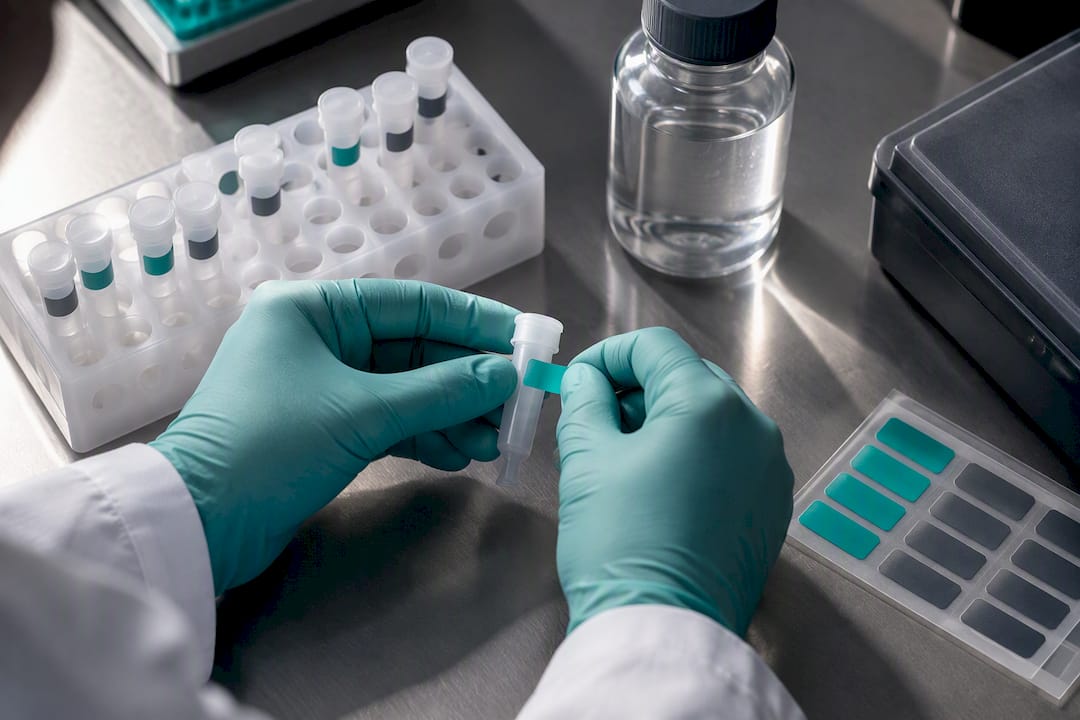
A COA reflects the tested lot at the time of testing, not the vial sitting in a freezer six months later, and comparability depends on documenting what happened in between.
- Record lot number, receipt condition, and date at intake.
- Log reconstitution solvent, final concentration basis, and preparation date.
- Note storage temperature and any freeze-thaw cycles the sample undergoes.
- Retain an aliquot from every lot for future investigation.
Moisture uptake and counter-ion shifts during storage can change apparent content even when the peptide itself is chemically stable, which is why lyophilized material in a properly sealed container closure holds up far better than powder exposed to ambient humidity. A moisture analyzer or Karl Fischer setup run periodically on stored stock catches this drift before it corrupts a study's dosing calculations. Retention samples should follow a defined timeline tied to the study duration, and a documented SOP for reconstituted stability verification removes guesswork when a result looks off months into a project.
Pro Tip: Label retained aliquots with reconstitution date and solvent, not just lot number. Six months later, "reconstituted in acetic acid on day one" is far more useful than a lot number alone.
What Does a Complete QC Workflow Look Like?
A defensible QC workflow runs in a fixed sequence:
- Define intended use and the CQAs that matter for it.
- Qualify raw materials and reference standards before synthesis begins.
- Control the synthesis and purification process itself.
- Run validated identity, purity, content, and contaminant tests.
- Review results against specification and release or reject the lot.
- Retain samples and archive the full documentation package.
That package should include the COA, validation reports, SST records, stability data, and any deviation logs. An out-of-spec result triggers a documented decision: retest under a justified protocol, open a full investigation, or reject the lot outright, never a silent re-run until the number looks acceptable.
How USAPeptide Supports Defensible Peptide QC
USAPeptide's COA grading tool helps labs check whether a vendor's certificate reflects real identity, purity, and mass-balance data rather than a bare purity percentage. Peptide databases and dosage calculators can support reference standard selection and interpretation of HPLC versus mass-balance reporting. Pair a COA check with the six-point sourcing checklist before treating any vendor certificate as final.
Getting the Priorities Right in Peptide QC
Screen every lot with HPLC first. Reserve LC-MS/MS and full orthogonal panels for critical lots or ambiguous results. Retention samples and documentation deliver the highest return of any control in the workflow.
— USAPeptide Team
Put These QC Practices to Work
A resource exists to consult when a vendor's certificate raises more questions than it answers. Instead of trusting a bare purity number, you can run it against USAPeptide's COA check tool to see whether identity, mass balance, and impurity data actually back up the claim. The peptide database and curated category pages, from GLP-1 and metabolic peptides to tissue and connective repair compounds, give labs a reference point for what a properly documented lot should look like before it ever reaches the bench. This tool does not replace in-house validation programs or independent testing. It complements both, giving you a practical first check before you commit a lot to a study. Start by running your next vendor certificate through the COA check and see how it holds up against a mass-balance read.
This article is general information, not a substitute for advice from a qualified doctor. Consult a qualified healthcare professional about your own circumstances before acting on anything here.
Sources
- Reference standards to support quality of synthetic peptide therapeutics (USP)
- FDA Analytical Procedures and Methods Validation for Drugs and Biologics
- ICH Q2(R2) Guideline (2023)
FAQ
Is 98% Purity Good for Peptides?
A 98% HPLC purity result is strong for most research applications, but it measures the ratio of main peak to impurities, not peptide content by weight. Once mass balance accounts for water, counter-ions, and residual solvents, the actual net peptide content can be meaningfully lower than 98%, which is why USP recommends mass-balance calculations alongside the HPLC number.
What Is the Difference Between Purity and Net Peptide Content?
Purity, measured by HPLC UV area percent, reflects how clean the chromatographic peak looks relative to impurities. Net peptide content measures the actual weight fraction of active peptide in the material after subtracting water, counter-ions, and residual solvents, and the two numbers can differ substantially for the same lot.
Why Isn't HPLC Alone Enough for Peptide Identity Confirmation?
HPLC retention time can be consistent with the expected peptide but cannot confirm sequence or molecular mass on its own. Mass spectrometry and peptide mapping provide the structural confirmation that HPLC alone cannot, which is why orthogonal identity testing is standard practice for anything beyond preliminary screening.
Does Peptide Purity Testing Confirm Sterility or Endotoxin Control?
No. Chemical purity and identity methods like HPLC and mass spectrometry cannot demonstrate sterility or endotoxin levels. Those require separate, validated microbiological assays such as LAL testing for endotoxin and dedicated sterility testing protocols.
How Often Should Analytical Methods Be Revalidated?
Revalidation is triggered by specific changes, such as a new column lot, reagent supplier switch, or instrument replacement, rather than running on a fixed calendar. ICH Q14's lifecycle management framework calls for ongoing trending of system suitability data to catch drift before it requires a full revalidation.