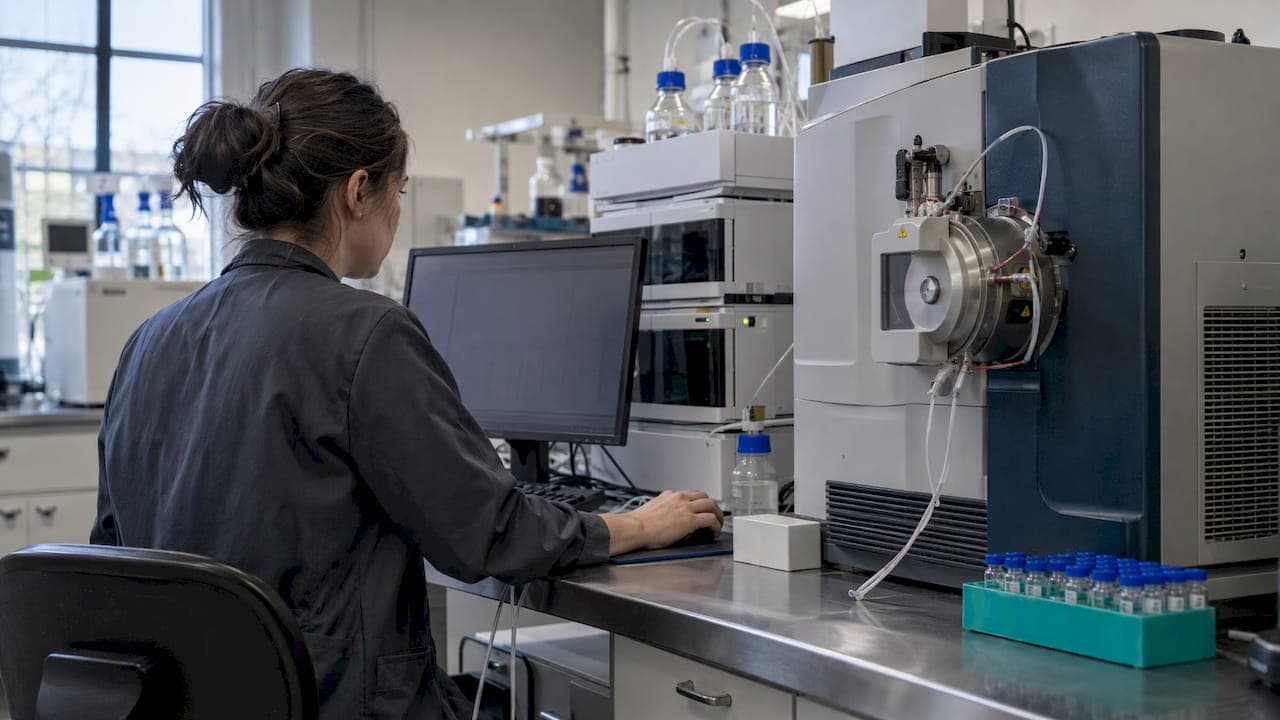
For scientific peptide work, we recommend verifying identity with molecular evidence through LC-MS/HRMS, paired with an orthogonal purity method and a report from an ISO 17025 accredited lab. Anything less leaves gaps that a reviewer, auditor, or downstream experiment can expose. The next step is simple: request raw mass spectra and method details before accepting any Certificate of Analysis at face value.
TL;DR:
- Verifying peptide identity requires primary mass analysis with mass delta tolerances of a few ppm and sequence confirmation through MS/MS fragmentation.
- Request raw spectrum images, lot numbers, and detailed method documentation to ensure the lab's reporting meets research-grade standards.
- Combining LC-MS with orthogonal techniques like HPLC purity, peptide mapping, or NMR strengthens the reliability of the identity claim.
- Accredited labs should clearly state method validation details, acceptance criteria, and raw data availability to be deemed capable of research-grade testing.
- Expect higher costs and longer timelines for comprehensive panels that include MS/MS, peptide mapping, or structural verification beyond simple mass checks.
- ✓Detailed molecular profiles
- ✓Verified identity and Certificates of Analysis
- ✓Peptide dosage calculator
- ✓COA grading tool
Table of Contents
- Quick checklist: identity testing essentials to request from a lab
- How each identity method works and when to use it
- Orthogonal testing: building a reliable identity argument
- How to read and interpret a COA and spot red flags
- Choosing a lab and submitting samples: accreditation, reporting, costs, and turnaround
- Costs, timelines, and realistic expectations
- How USAPeptide supports peptide identity verification
- Author perspective: pragmatic rules for lab grade peptide identity
- Where to go next for verified peptide materials
- FAQ
- Sources
Quick checklist: identity testing essentials to request from a lab
Before submitting a sample, researchers benefit from a short order template that specifies exactly what the lab must measure and report. Vague requests tend to produce vague Certificates of Analysis, which creates downstream problems when results need defending in a publication or audit.
The checklist below covers the analyses and documentation we recommend requesting at order time:
- Intact mass analysis by LC-MS or LC-MS/MS, with theoretical and observed mass reported side by side.
- MS/MS fragmentation data when sequence-level confirmation is needed, not just mass matching.
- HPLC purity chromatogram as an orthogonal, independent measurement of the same sample.
- Mass delta and tolerance stated in parts per million or Daltons, not just a pass or fail label.
- Instrument and method identification, including ionization mode and column type.
- Retention time and spectrum images, not summary text alone.
- Lot number, sample amount, and chain of custody notes tying the report to the physical material tested.
A lab that cannot produce these items on request is not equipped for research-grade identity work, regardless of how polished its summary report looks.
How each identity method works and when to use it
Peptide identity testing rests on a handful of core techniques, each with a different evidentiary role. Understanding what each method can and cannot prove helps researchers choose the right combination rather than over-relying on a single test.
LC-ESI-HRMS and LC-MS/MS form the backbone of modern identity verification. Liquid chromatography separates the peptide from synthesis byproducts and impurities, while electrospray ionization generates charge states that a high-resolution mass analyzer measures precisely. Deconvolution software converts the observed mass-to-charge ratios into a single monoisotopic mass, which is then compared to the theoretical mass calculated from the amino acid sequence. According to a mass spectrometry verification guide, modern HRMS instruments can resolve single-residue differences within a typical tolerance of 1 to 10 parts per million, which is tight enough to catch a single substituted amino acid. When sequence confirmation matters, MS/MS fragmentation breaks the peptide into smaller ions along the backbone, producing a ladder of fragments that maps back to the expected sequence. Coverage across that ladder, not just a single matching precursor mass, is what gives a report real evidentiary weight.
MALDI-TOF offers a faster, lower-cost screening option. It works well for confirming that a sample falls near an expected mass range, but its resolution and fragmentation capabilities are generally weaker than LC-MS/MS, so it is a poor substitute when sequence-level confirmation or detection of closely related impurities is required.
Peptide mapping serves a different purpose: it is a comparative fingerprint rather than a standalone mass check. The USP approach to peptide mapping involves enzymatic digestion of both the test sample and a reference standard, followed by chromatographic separation of the resulting fragments. Running the two side by side and comparing the fragment patterns can reveal single-residue changes that an intact mass measurement alone might miss, which makes mapping valuable when a reference standard is available.
NMR and amino acid analysis (AAA) round out the orthogonal toolkit. NMR provides detailed structural information independent of mass, while AAA confirms amino acid composition through a separate chemical pathway entirely. Both are more resource-intensive and are typically reserved for cases where mass spectrometry results are ambiguous or where a peptide's structure needs independent structural confirmation beyond mass and chromatography.
Ambiguous mass shifts are common and usually diagnosable. A delta of approximately +16 Daltons often points to oxidation, while a shift near +22 Daltons suggests a sodium adduct rather than a sequence error, according to the same mass spectrometry guide. Recognizing these patterns lets a lab distinguish a handling artifact from a genuine synthesis error without resorting to full re-sequencing.

Orthogonal testing: building a reliable identity argument
A single method, however precise, cannot carry an identity claim on its own. Orthogonality means combining techniques that fail in different ways, so an error in one is unlikely to be mirrored in the other. The classic pairing is LC-MS for molecular mass with HPLC for purity, since a mass match says nothing about co-eluting impurities and a clean chromatogram says nothing about molecular identity. A second common pairing adds NMR or peptide mapping when mass spectrometry results leave room for doubt, particularly with isobaric or near-isobaric variants that share a mass but differ in sequence, as noted in LC-MS identity guidance.
Practical acceptance criteria matter as much as the methods themselves. A defensible report typically specifies a mass tolerance in the single-digit to low double-digit ppm range, documents fragment coverage across the sequence when MS/MS is used, and notes co-injection results when a reference standard is run alongside the sample.
Pro Tip: A defensible identity statement names the methods, the tolerance used, and the specific acceptance criteria met, not just a final "Pass" verdict.

How to read and interpret a COA and spot red flags
A robust Certificate of Analysis walks through its mass row the same way every time: theoretical mass, observed mass, the delta between them, the instrument and method used, retention time, and an attached spectrum image. The FDA's guidance on analytical procedures and methods validation recommends that such data support identity, purity, and potency claims with documented validation characteristics like specificity, accuracy, and precision, not a bare conclusion.
Certain patterns in a COA should prompt a closer look:
- Missing spectrum images, where only a summary number appears instead of the raw chromatogram or mass spectrum.
- Identical COAs across different lot numbers, which is a strong sign of a template rather than per-lot testing.
- A simple "Pass" statement with no theoretical mass, observed mass, or tolerance stated anywhere.
- No instrument or method identification, leaving no way to assess whether the method was appropriate.
A well-documented COA should state method metadata and acceptance criteria rather than rely on a pass or fail label alone, per the same mass spectrometry verification guide, which is the single clearest signal of report quality we can point to without a specific numeric benchmark attached.
When a reported mass does deviate from theoretical, context matters more than panic. A consistent small shift across multiple lots from the same supplier often points to a systematic method issue rather than a one-off contamination event, and asking the lab for raw data resolves the question faster than re-testing blind.
Choosing a lab and submitting samples: accreditation, reporting, costs, and turnaround
Accreditation is the first filter, not the last. ISO 17025 accreditation evidences validated methods, documented competence, and traceable calibration, which matters because an accredited lab's scope statement tells you exactly which methods and matrices it is certified to run, rather than leaving that to marketing language.
Before submitting a sample, we recommend working through a short set of questions:
- Confirm the lab's accreditation scope covers the specific method you need, such as LC-MS/MS identity or HPLC purity, not just a general accreditation claim.
- Ask whether raw data and spectrum images are included in the standard deliverable or require a separate request.
- Clarify chain of custody procedures, including how samples are logged, stored, and tracked from receipt to report.
- Ask about method validation documentation, including specificity, limit of detection, and system suitability criteria the lab can share on request.
- Discuss turnaround and rush options upfront, since method development work for an unusual peptide extends timelines well beyond standard testing.
A lab that answers these questions readily and specifically, rather than with general reassurances, is usually the better choice regardless of price.
Costs, timelines, and realistic expectations
Budgeting for identity testing depends heavily on scope. A basic screening assay, such as a single intact mass check, costs less and turns around faster than a confirmatory panel that includes MS/MS fragmentation and an orthogonal HPLC purity assay. Full orthogonal panels that add peptide mapping or NMR extend both cost and timeline further, particularly when a reference standard has to be sourced or a method has to be developed for an unusual sequence.
Standard turnaround for a straightforward identity and purity panel typically runs from several days to a couple of weeks, while method development work or reference standard acquisition can add meaningfully to that window. It is worth budgeting for a follow-up confirmatory round from the outset: ambiguous initial results are common enough that treating confirmatory testing as a contingency, rather than an afterthought, keeps a research timeline realistic.
How USAPeptide supports peptide identity verification
Our platform at Usapeptide functions as a reference resource for researchers working with peptides, offering detailed molecular profiles, mechanisms of action, and peer-reviewed research summaries for compounds including BPC-157, Semaglutide, and others. We provide access to peptide compounds with verified identity and detailed Certificates of Analysis attached to each listing.
Beyond reference data, we built practical tools to support the verification work this article describes. Our peptide dosage calculator helps researchers plan experimental dosing, and our COA grading tool assesses whether a supplier's Certificate of Analysis meets the reporting standards outlined above, including mass data, method details, and acceptance criteria rather than a bare pass statement.
Author perspective: pragmatic rules for lab grade peptide identity
In our view, the single biggest point of failure in peptide research is not bad chemistry. It is accepting a COA that states a conclusion without showing the evidence behind it. We favor a simple rule: no raw mass spectrum or chromatogram, no acceptance. Accredited labs that share method details and system suitability data make reproducibility possible for everyone downstream, while opaque reports just move the risk further down the chain.
— USAPeptide Team
Where to go next for verified peptide materials
For researchers who want to move from checklist to sourcing, our database pairs molecular reference data with access to research-grade compounds that carry documented identity testing.
What we offer in practice:
- A COA grading tool that screens supplier Certificates of Analysis against the reporting standards described in this article.
- A peptide reference database covering categories such as GLP-1 and metabolic peptides, tissue and connective repair compounds, and growth hormone peptides.
- Access to research-grade material with verified identity documentation attached at order time.
Browse our Usapeptide to see verified molecular profiles and sourcing options before placing an order.
FAQ
Can you test to see if someone is on peptides?
Detecting peptide use in a person is a separate question from verifying the identity of a peptide compound, and it requires clinical or forensic toxicology testing rather than the identity methods covered here. This article addresses laboratory verification of research compounds, not biological testing of individuals.
How much does it cost to get a peptide lab tested?
Costs vary by scope: a basic intact mass screening costs less than a full confirmatory panel that adds MS/MS fragmentation and an orthogonal HPLC purity assay. Method development or reference standard sourcing for an unusual peptide adds further cost on top of standard testing fees.
How do I test if my peptides are real?
Request intact mass analysis by LC-MS alongside an orthogonal HPLC purity assay, and insist on a Certificate of Analysis that shows theoretical versus observed mass, method details, and raw spectrum images rather than a summary pass statement. Using an ISO 17025 accredited lab adds confidence that the methods behind that report are validated and documented.
How can I get my peptides tested?
Identify a lab accredited for the specific method you need, confirm its scope covers LC-MS or HPLC testing for peptides, and send a sample along with clear chain of custody documentation. Our COA grading tool can also help evaluate whether a supplier's existing Certificate of Analysis already meets research-grade reporting standards before you commission additional testing.
Sources
- Analytical Procedures and Methods Validation for Drugs and Biologics
- USP guidance on peptide mapping and identity testing
- How to Verify Peptide Identity: Mass Spectrometry for Beginners (ChemVerify)
- Peptide identity by LC-MS (Purity Analytics Science Library)