
ISO/IEC 17025:2017 is the international standard laboratories use to demonstrate they can produce technically valid test and calibration results for a defined scope. That is the meaning of ISO 17025 in one sentence: it is not a general quality seal, but a competence accreditation tied to specific tests, methods, and measurement ranges a laboratory has proven it can perform correctly, with traceable, uncertainty-quantified results.
Before trusting any lab report, do this:
- Confirm the exact test or calibration you need appears on the lab's published scope of accreditation.
- Check that scope against the issuing accreditation body's public register, not just the lab's own claim.
- Look for stated measurement uncertainty and traceability to SI units on the certificate itself.
Key Takeaways
ISO/IEC 17025 accreditation confirms a laboratory's technical competence for a specific, published scope of tests, not a general quality guarantee.
| Point | Details |
|---|---|
| Accreditation is scope-specific | A lab can be accredited for one test type and not another; always check the exact scope. |
| 2017 edition is current | Risk-based thinking and management-system flexibility (Option A/B) define the active standard. |
| Accreditation ≠ certification | ISO 9001 certifies a management system; 17025 accreditation certifies technical test competence. |
| Verify on the public register | Confirm scope and accreditation number directly on the issuing body's website, not the lab's claim. |
| Demand uncertainty data | Ask for measurement uncertainty and traceability evidence before trusting any COA or test report. |
Table of Contents
- ISO 17025 Meaning and What Changed in the 2017 Edition
- Why ISO 17025 Accreditation Matters to Labs and Their Clients
- Key Requirements and Clause Structure Assessors Check
- ISO 17025 vs GMP and ISO 9001: Accreditation Is Not Certification
- Who Needs ISO 17025 and How Scope Limits Apply
- How ISO 17025 Accreditation Actually Gets Earned and Kept
- Common Misunderstandings About ISO 17025 Worth Correcting
- Applying ISO 17025 to Peptide and Research-Grade Testing
- What the Standard's Fine Print Actually Tells You
- Sources
ISO 17025 Meaning and What Changed in the 2017 Edition
The standard's full title is "General requirements for the competence of testing and calibration laboratories," jointly published by ISO and the International Electrotechnical Commission (IEC). ISO/IEC 17025:2017 replaced the 2005 version and remains the current edition. It applies to any laboratory performing tests, calibrations, or sampling tied to those activities, regardless of staff size or industry.
The 2017 revision made three changes that matter in practice:
- Risk-based thinking became a formal requirement, meaning labs must identify and document risks to result validity rather than just follow checklists.
- Management-system integration loosened the rules, letting labs align their quality system with ISO 9001 instead of running a separate, standalone structure.
- Impartiality and IT got explicit new emphasis, covering conflict-of-interest controls and the use of electronic records and software validation.
The 2017 edition of ISO 17025 shifted the standard's center of gravity from procedural compliance toward provable technical performance.
Why ISO 17025 Accreditation Matters to Labs and Their Clients
Accreditation exists to answer one question a client can't easily answer alone: can this lab actually produce a result you can rely on? ISO's own guidance states that ISO/IEC 17025 lets laboratories demonstrate competence and generate valid results, which builds confidence in those results and helps them gain acceptance across borders.
The downstream effects show up in ordinary business decisions:
- Fewer retests, because accredited results are less likely to be challenged or repeated by a second lab.
- Smoother regulatory acceptance, since many programs default to trusting accredited data over unaccredited data.
- Easier procurement, because buyers can specify "17025 accredited for [test]" as a contract requirement instead of vetting each supplier from scratch.
Government program guidance backs this up directly: agencies note that regulators and clients frequently expect accredited results and may reject or independently verify unaccredited test data before accepting it, according to USDA FSIS accreditation guidance.
Key Requirements and Clause Structure Assessors Check
ISO/IEC 17025 is organized into five main clause groups, and understanding them helps you know what an assessor is actually verifying when a lab claims accreditation.
- General requirements cover impartiality and confidentiality, the foundation for every other clause.
- Structural requirements address the lab's legal identity, organizational chart, and lines of responsibility.
- Resource requirements cover personnel competence, equipment, facilities, and environmental conditions.
- Process requirements are the technical core: method selection and validation, sampling, handling of test items, measurement uncertainty, and result reporting.
- Management-system requirements cover document control, corrective action, internal audits, and management review.
On the technical side, assessors want direct evidence, not policy statements. That means training records and proficiency testing history for personnel, documented method validation studies, a calculated measurement uncertainty budget for each test, and traceability of reference standards to SI units. Assessors will also review corrective-action logs and risk records to confirm the lab caught and fixed its own problems before a client ever saw them, a detail accreditation body guidance treats as central to the 2017 emphasis on risk-based thinking.
Pro Tip: If you're evaluating a lab's competence claims during procurement, ask for a redacted measurement uncertainty report before you ask for anything else. A lab that can't produce one on request usually can't produce one at all.
ISO 17025 vs GMP and ISO 9001: Accreditation Is Not Certification
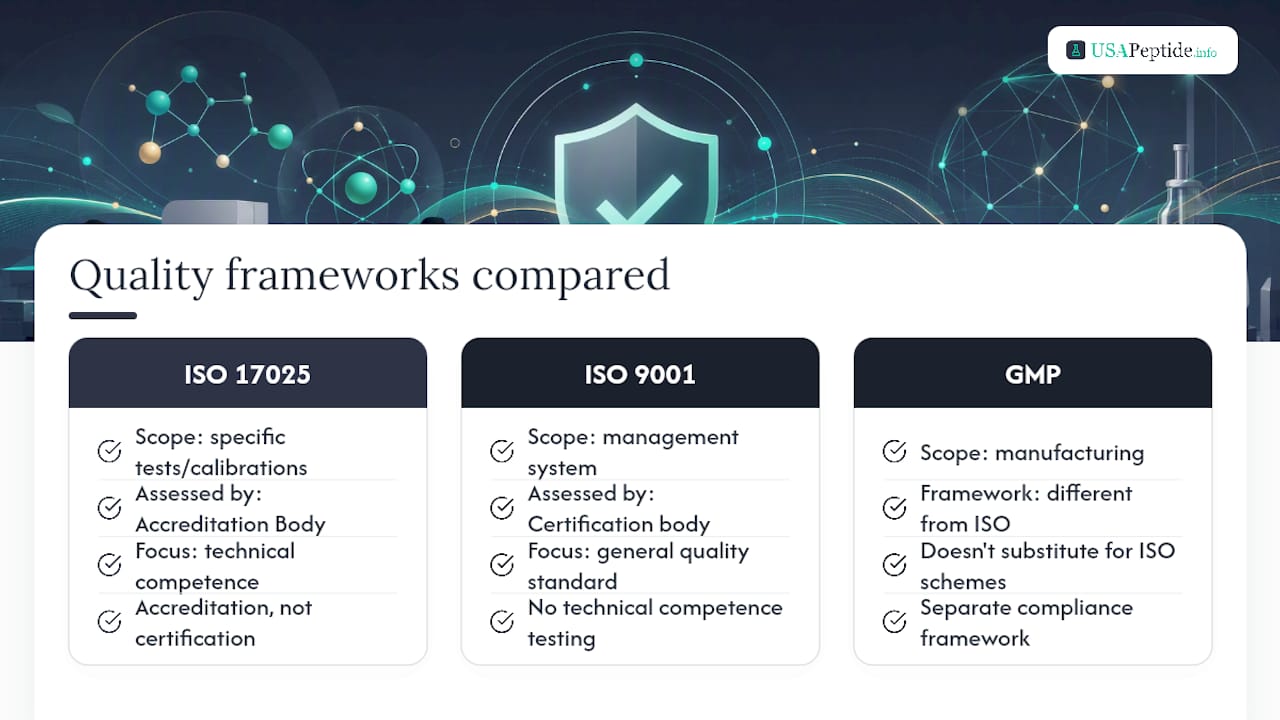
People often use "ISO 17025 certification" and "ISO 9001 certification" interchangeably. They're structurally different processes. Accreditation, granted by a designated Accreditation Body, attests to a lab's technical competence for a specific, published scope of tests or calibrations. ISO 9001 certification attests that a management system meets a general quality standard, with no technical competence testing involved, a distinction CASRAI's explainer lays out clearly.
The standard even allows two paths for meeting its management-system clauses: Option A, a standalone system built directly around ISO 17025's own requirements, or Option B, where a lab's existing ISO 9001-certified system is used to satisfy those same clauses. Either path still requires separate technical accreditation.
If you're vetting a supplier, request 17025 accreditation evidence and its exact scope, not just an ISO 9001 certificate. GMP compliance, where it applies to manufacturing, is a different framework still and doesn't substitute for either.
Who Needs ISO 17025 and How Scope Limits Apply
Testing labs, calibration labs, research centers, and regulatory labs all use this standard, and it applies wherever a client needs assurance that a specific result is technically sound. Scope is exacting by design: a lab might be accredited for tensile testing on metal but hold no accreditation for chemical residue analysis, even if it performs both. Always cross-check the specific test name and measurement range against what's published, not the lab's general reputation.
How ISO 17025 Accreditation Actually Gets Earned and Kept
Accreditation isn't a one-time paperwork exercise. It follows a defined sequence, and buyers can verify each stage independently.
- Document review. The accreditation body examines the lab's quality manual, procedures, and method validation records before ever visiting.
- On-site technical assessment. Trained assessors watch staff perform actual tests, review equipment calibration history, and interview personnel about method understanding.
- Measurement uncertainty demonstration. The lab must show, with data, how it calculated uncertainty for each accredited method, per ANAB's technical guidance.
- Surveillance visits. After initial accreditation, periodic surveillance checks confirm the lab still meets requirements, typically on an annual or biennial cycle depending on the accreditation body.
- Corrective action and re-assessment. Any nonconformity found during surveillance triggers a corrective action, and full re-assessment happens on a multi-year cycle to renew accreditation.
Every accreditation body maintains a public register listing accredited labs and their exact scopes. That register, not the lab's marketing page, is the authoritative source for what a lab is actually accredited to do.
Common Misunderstandings About ISO 17025 Worth Correcting
A few phrases cause real confusion. "ISO 17025 certification" is technically incorrect. The proper term is accreditation, and it only covers what's listed on the published scope, per ISO/IEC 17025 background. Another misconception: methods must come from a standards body. In reality, a lab can use its own developed method, as long as it's been validated and the validation is justified and documented.
- Ask the lab for its scope document, not just a certificate number.
- Request measurement uncertainty data for the specific test you need.
- Verify traceability evidence back to SI reference standards.
Pro Tip: Cross-reference the lab's accreditation number directly on the issuing body's website. A number alone means nothing without a live scope entry to match it.
Applying ISO 17025 to Peptide and Research-Grade Testing
For anyone sourcing research-grade peptides, an ISO 17025-accredited Certificate of Analysis (COA) carries more weight than a self-reported purity number, because the accreditation ties identity and purity claims to a validated method with documented uncertainty. USAPeptide's COA grading tool lets you check whether a supplier's COA includes the elements a genuine accredited report should have. Pair that with the peptide research glossary to decode technical terms like traceability and measurement uncertainty, and the dosage calculator once you've confirmed a compound's verified purity.
Before trusting any COA, take these steps:
- Check for an accreditation mark referencing the issuing body and scope.
- Confirm ≥99% HPLC purity claims are backed by a named method, not just a stated percentage.
- Cross-check the accreditation number against the issuing body's public register.
For applied context outside the peptide space, Airmed Fit illustrates how accredited lab testing gets used in broader clinical and consumer health scenarios.
If you're ready to evaluate specific compounds, USAPeptide's molecular profile database walks through mechanisms of action alongside sourcing guidance, and the tissue recovery peptide guide applies these same verification steps to compounds commonly used in repair-focused research.
What the Standard's Fine Print Actually Tells You
Most explainers stop at "ISO 17025 means the lab is competent" and leave it there. That's technically true and practically useless, because competence is scoped, not blanket. The real judgment call is whether readers check the scope register at all, and most don't. They see an accreditation mark on a COA and stop reading.

That's backward. The mark should be the start of your verification, not the end of it. A lab accredited for one calibration type isn't automatically qualified for a different test just because it holds a 17025 badge somewhere in its literature.
The other place conventional advice falls short: treating ISO 9001 and ISO 17025 as roughly equivalent quality signals. They answer different questions entirely, and conflating them lets underqualified technical claims hide behind a legitimate but irrelevant certificate.
If you take one thing from this, prioritize the scope document and the measurement uncertainty figure over the accreditation logo itself. The logo tells you a lab passed an assessment once. The scope tells you what it actually covers today.