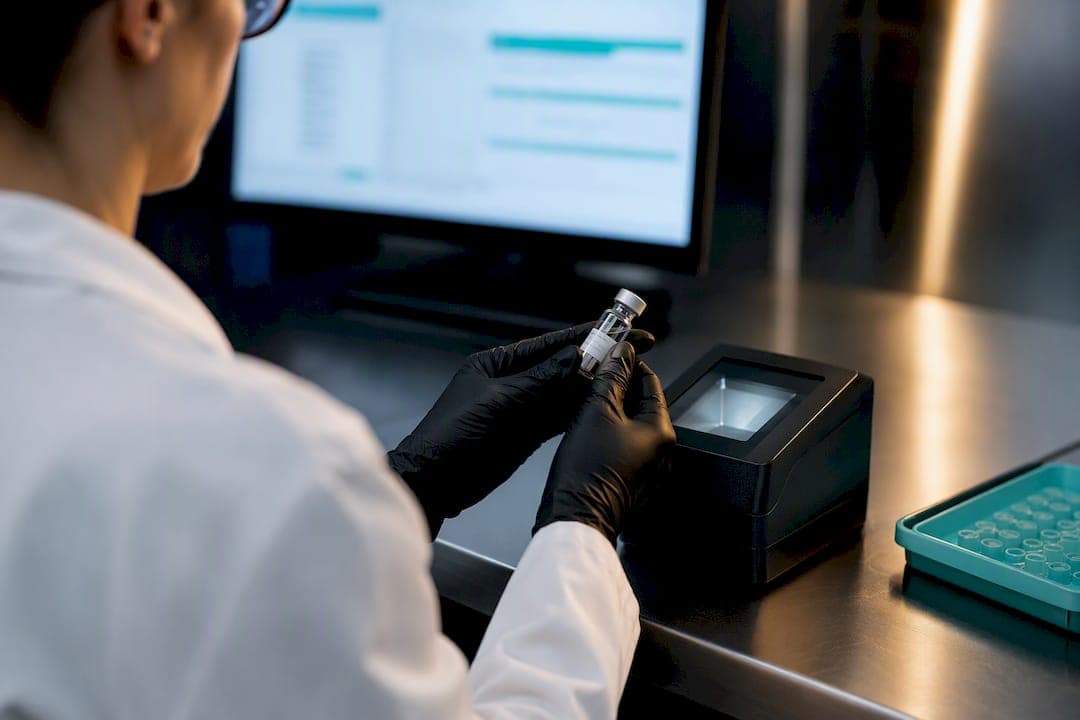
Require a lot-specific Certificate of Analysis tied to a named, ISO/IEC 17025-accredited testing lab that reports HPLC purity and LC-MS identity before accepting any shipment, following the steps outlined in Pharmazeutische Dokumentenübersetzung: Schritte im Überblick. The lot number on that COA must match the container label exactly, and raw chromatograms or mass spectra should be available on request. For work headed into animal models, add endotoxin (LAL) and sterility data to that list. Anything less is a documentation gap, not a supplier you can trust.
TL;DR:
- Only work with peptide suppliers who provide a lot-specific COA from an ISO 17025-accredited lab with full method details and chromatogram images.
- Verify the COA through the supplier’s portal or QR code and confirm the accreditation number matches the lab listed on the report.
- For in vivo experiments, ensure endotoxin, sterility, heavy metals, residual solvents, and potency are explicitly tested and reported.
- Quarantine each shipment until the lot number matches the COA, and request a corrected COA if any discrepancies occur.
- Prioritize documentation and accreditation over cost or lead time to reduce the risk of experiment failure due to unverified peptides.
Table of Contents
- How to Choose a Peptide Supplier: A Screening Checklist
- How Do You Verify a Peptide Certificate of Analysis?
- What QC Tests Should a Peptide Supplier Report?
- How Do You Qualify a Supplier Before You Buy?
- What Should Happen When a Peptide Shipment Arrives?
- How Do Cost and Lead Time Factor Into Supplier Selection?
- How USAPeptide's Tools Support the Checklist
- Why Documentation-First Procurement Matters More Than Price
- Put the Checklist to Work With USAPeptide's Tools
- Sources
- FAQ
How to Choose a Peptide Supplier: A Screening Checklist
Screening a new supplier before the first purchase order saves far more time than untangling a bad lot after the fact. The sequence below reflects how experienced procurement and QC teams actually work through vendor selection, moving from documentation to accreditation to operational fit.
-
Confirm the COA is lot-specific. It should name the testing lab, list the issue date, include method titles, and show a chromatogram, not a generic spec sheet reused across batches.
-
Verify accreditation by name and number. A supplier should point you to a named accreditation body and a registration number you can look up independently, with HPLC and LC-MS explicitly inside the accredited scope.
-
Check portal or QR verification. Suppliers offering direct lot lookup reduce the risk of an altered or mismatched PDF landing in your inbox.
-
Audit shipping and packaging controls. Cold-chain consistency, lot labeling on the outer package, and predictable lead times matter as much as the analytical data itself.
-
Ask for evidence of a quality program. A written sample-selection policy and a track record of reproducible COAs across lots signal a supplier who treats documentation as a process, not paperwork.
This peptide sourcing checklist walks through a similar six-point screen if you want a printable version for your QA file.
Pro Tip: Ask a prospective supplier for a sample COA from a lot they shipped at least six months ago. If they hesitate or send something that looks freshly generated, that is worth noting before you place an order.
How Do You Verify a Peptide Certificate of Analysis?
Start at the header. A usable COA names the supplier, the product, the lot number, the issue date, and carries a signature or report number tying it to a specific analyst or reviewer. Anything without a lot number is not a release record. It is marketing collateral wearing a lab coat.
The analytical section is where most shortcuts hide. Look for:
- Full method titles and version numbers, not just "HPLC" with no reference to the protocol used
- Acceptance criteria listed alongside actual results, not just a pass/fail stamp
- Chromatogram images and, ideally, mass spectra confirming identity
- A signature or analyst name tied to the report date
Once the document itself checks out, verify it. Use the supplier's lot-lookup portal or QR code rather than trusting the PDF in isolation. Confirm the testing lab's accreditation number in the accreditor's public register, since ISO/IEC 17025 accreditation is method-specific and periodically reassessed, not a blanket claim covering everything a lab does. If anything looks off, ask for raw chromatograms directly.
A COA that fails to link to a specific lot, arrives unsigned, or cannot be verified through a supplier portal is a documented red flag, not a minor omission. Purity claims in research-grade peptides span a wide range, from a moderate level up to very high purity, so a document that will not let you confirm which end of that range you actually received should stop the order.
What QC Tests Should a Peptide Supplier Report?
Each analytical test answers a different question, and knowing which one covers which risk keeps you from over-relying on a single number.
- HPLC purity reports main-peak area as a percentage of total peak area. For in vivo studies, research-grade peptides are generally expected at 95% purity or higher, though the acceptable floor depends on the experiment and what the remaining impurities actually are.
- LC-MS identity confirms the molecule is what the label claims, catching contamination or synthesis errors that HPLC alone can miss. Running both methods together, rather than treating either as sufficient on its own, is what orthogonal testing means in practice.
- Endotoxin (LAL) and sterility screening matter most for in vivo work or cell culture, where contamination can confound an entire study. A starting acceptance point some labs apply is under 1 EU/mg, though your protocol should set the actual threshold.
- Heavy metals (ICP-MS), residual solvents, and potency assays round out a fuller panel, and are worth requiring for any compound headed into a sensitive assay or a regulatory-adjacent project. Guidance on residual solvent testing covers when this data becomes necessary rather than optional.
Pro Tip: A standardized panel combining HPLC, LAL, rapid sterility screening, and ICP-MS with a few days' turnaround gives you a broad initial read on a new lot without waiting on a full battery of specialty assays.
How Do You Qualify a Supplier Before You Buy?
Treat qualification as a sequence, not a single decision. Document review comes first, portal or COA verification comes second, confirmatory in-house testing comes third when the risk profile calls for it, and periodic revalidation keeps the file current as lots and formulations change.
During a vendor call or audit, five questions tend to separate serious suppliers from the rest:
- Which lab performed the testing, and what is its accreditation number?
- What method titles and versions were used for purity and identity testing?
- How are samples selected for testing, batch composites or per-container pulls?
- What chain-of-custody documentation exists between synthesis and shipment?
- What temperature and packaging controls apply during transit?
For deciding when to trust a supplier COA versus running your own confirmatory test, weigh study stakes against supplier history. A documented supplier-qualification program that tracks COA data across multiple lots, rather than evaluating each shipment in isolation, catches drift a single snapshot would miss.
Keep a qualification file per supplier: PO-to-COA linkage, any discrepancy logs, and a revalidation schedule. This lot documentation checklist gives a usable template for the fields worth tracking.
What Should Happen When a Peptide Shipment Arrives?
Quarantine every incoming lot until the label and COA are confirmed to match. That means checking the lot number on the vial or package against the lot number printed on the certificate, not assuming they align because they arrived in the same box.
- Log the lot number, a copy of the COA, receiving date, and arrival temperature the moment the shipment lands
- Record who accepted the shipment, since that accountability matters if a discrepancy surfaces later
- If anything mismatches, quarantine immediately, run the supplier's portal lookup, and request a corrected COA in writing before releasing the material
- Hold the sample until the discrepancy resolves, rather than proceeding on the assumption it was a clerical error
Pro Tip: For time-critical or high-stakes studies, a rapid in-house identity confirmation before release adds a day but closes the gap between what the COA claims and what actually arrived.
How Do Cost and Lead Time Factor Into Supplier Selection?
The cheapest quote is rarely the cheapest outcome once you account for validation testing, storage losses on a rejected lot, and the cost of rerunning an experiment built on unverified material. Total cost of ownership includes all three, not just the invoice.
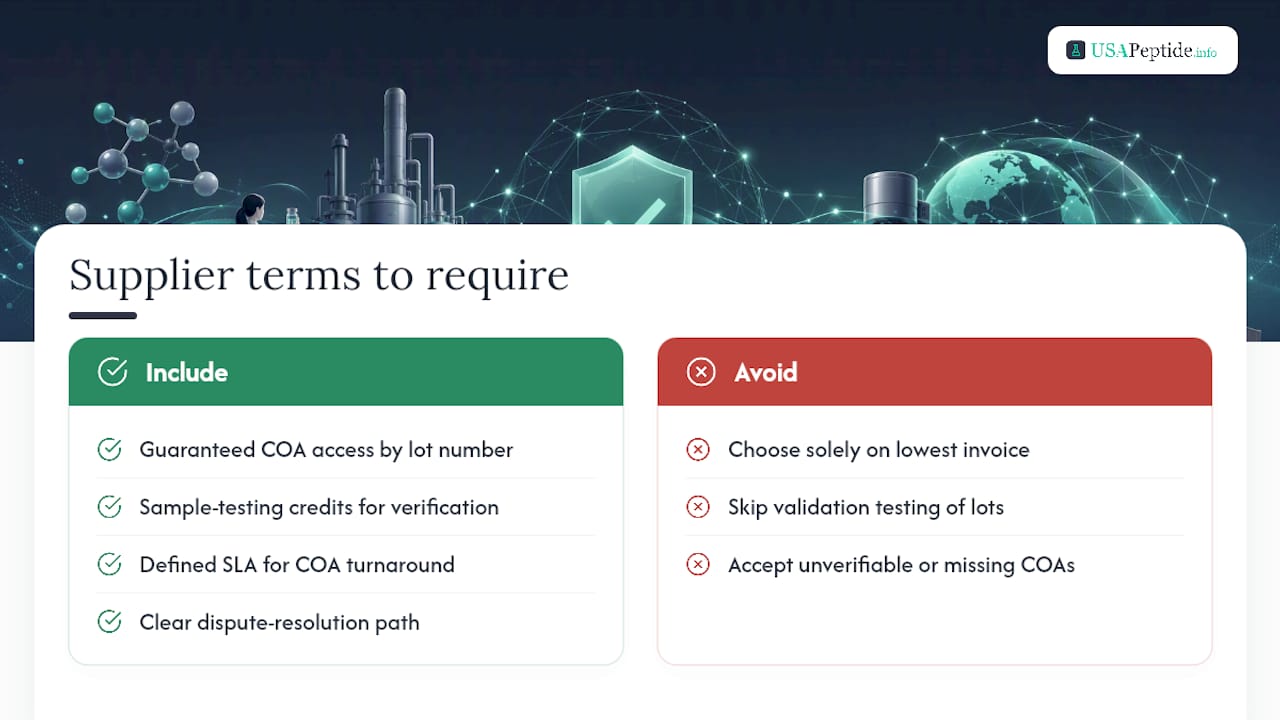
Same-day or expedited shipping earns its premium on time-sensitive protocols, less so for routine inventory restocking where a few extra days changes nothing. When negotiating terms, push for guaranteed COA access by lot number, sample-testing credits for periodic verification, a defined service-level agreement for COA turnaround, and a clear dispute-resolution path if a mismatch surfaces after delivery.
Worth writing into any supply agreement: a change-notice policy for formulation or synthesis-method updates, a COA retention commitment covering several years, and a documented sample-submission procedure for confirmatory testing.
How USAPeptide's Tools Support the Checklist
USAPeptide.info's COA grading tool checks incoming certificates against the fields this checklist covers, flagging missing method names, absent lot linkage, or other gaps before you commit a lot to a study. The platform's peptide dosage calculator supports experimental planning once identity and purity are confirmed, and molecular profile pages give researchers mechanism and reference data without starting from a blank literature search.
- Run a supplier's COA through the grading tool before your first order to catch documentation gaps early
- Cross-reference purity claims against molecular profile pages for the specific peptide in question
- Use supplier referral pages as a starting point for pre-vetted, COA-transparent vendors rather than screening cold
None of this replaces your own verification steps. It shortens the time each one takes.
Why Documentation-First Procurement Matters More Than Price
Reproducibility failures rarely trace back to a bad experiment design. They trace back to a peptide lot nobody fully verified before it went into the freezer. The emphasis on accreditation and COA transparency is based on the pattern that a documentation gap discovered mid-study costs far more than the extra time it takes to check a lot number against a certificate.
A COA-first purchasing habit does two things at once: it lowers the odds of a failed experiment traceable to material quality, and it gives you a clean audit trail if anyone ever asks how a compound was sourced. Build the checklist into your standard purchasing workflow, not just your onboarding process for new suppliers.
— USAPeptide Team
Put the Checklist to Work With USAPeptide's Tools
USAPeptide.info gives researchers what most supplier searches skip: a way to check the paperwork before you check out. Instead of taking a COA at face value, run it through the COA grading tool to flag missing methods, absent lot linkage, or formatting inconsistencies against the standards this article just covered.

If your project centers on metabolic research, the fat loss peptide category walks through GLP-1 and GIP compounds with the same COA-first framing. Browsing by research category rather than starting from a blank supplier search cuts a meaningful chunk of the qualification work described above. Start with the compound page relevant to your study, check the COA grading tool against whatever certificate your current supplier provides, and use that comparison to decide whether it is time to switch.
Sources
- What an ISO 17025 Accredited Peptide Lab Certifies — PeptideTrust
- Certificate of Analysis (COA) — CASRAI
- Peptide Quality Control: Essential Tests for Research-Use Peptides | ILS Laboratories
- ISO/IEC 17025 — ISO
- Peptide Purity Testing: HPLC, MS, Assay, and COAs | PepGuide
This article is general information, not a substitute for advice from a qualified doctor. Consult a qualified healthcare professional about your own circumstances before acting on anything here.
FAQ
What Is the Minimum Documentation to Require From a Peptide Supplier?
A lot-specific COA naming a testing lab, its accreditation number, method titles, and matching the physical lot label is the floor. Anything missing a lot of linkage or method names should be treated as incomplete, not just imperfect.
How Do I Confirm a Supplier's ISO 17025 Accreditation Is Real?
Ask for the accreditation body's name and registration number, then check that number in the accreditor's public register yourself. Confirm the scope covers the specific method, HPLC or LC-MS, used on your COA, since accreditation applies method by method.
What Purity Level Should Research-Grade Peptides Meet?
For in vivo studies, 95% purity or higher is a common benchmark, though the right threshold depends on your specific protocol and what the remaining impurities are. In vitro work sometimes tolerates a lower floor, but that decision should be documented, not assumed.
Can I Trust a Supplier's COA Without Independent Testing?
A COA is meaningful evidence but not a guarantee, particularly if you cannot verify the lot match or the testing lab's accreditation. A documented supplier-qualification program that periodically confirms COA accuracy through independent testing closes that gap.
Does USAPeptide Sell Peptides Directly?
USAPeptide.info functions as a reference and referral platform, offering molecular profiles, a dosage calculator, a COA grading tool, and connections to research-grade peptide suppliers across categories including GLP-1, tissue repair, and growth hormone compounds. Current details on referred suppliers and categories are available directly on the Usapeptide site.