
TB-500 is a synthetic fragment of thymosin beta-4 built around an actin-binding motif, and its principal mechanism runs through actin regulation, which drives cell migration and angiogenesis with downstream anti-inflammatory and anti-fibrotic effects. Evidence for this pathway is strong at the preclinical and analytical level, including metabolite data on Ac-LKKTE, but direct human trial data on the fragment itself remain limited.
TL;DR:
- TB-500's activity largely depends on its ability to sequester G-actin, influencing cell migration and blood vessel formation through downstream signaling pathways like ILK and Akt.
- The active motif LKKTET in thymosin beta-4 is retained in TB-500 and is responsible for its actin-binding and cell-migration effects, even outside the full protein.
- Metabolite analysis shows that Ac-LKKTE forms rapidly after administration and may contribute independently to wound healing, complicating the interpretation of TB-500's mechanism.
- Cellular effects of TB-500 include faster wound closure, enhanced angiogenesis, reduced inflammation, and modulation of fibrosis-related pathways, but these are primarily supported by preclinical data.
- Human safety data specific to TB-500 is limited, and experimental dosing protocols are based on animal studies and tissue remodeling timelines rather than established pharmacokinetics.
Table of Contents
- How Does TB-500 Work at the Molecular Level?
- What Molecular Interactions Explain TB-500's Actin-Binding Activity?
- What Cellular Effects Result From TB-500's Actin Regulation?
- How Is TB-500 Metabolized, and What Does That Mean for Dosing Studies?
- What Does the Evidence Actually Support?
- What Are the Safety and Regulatory Considerations?
- How Can Researchers Investigate TB-500 Mechanisms Reliably?
- Editorial Perspective: Why Metabolite Data Should Reframe TB-500 Research
- Sources
How Does TB-500 Work at the Molecular Level?
The core of the TB-500 mechanism sits in a single biochemical event: binding to monomeric actin. Actin exists in two states inside a cell, globular G-actin and filamentous F-actin, and the balance between them controls whether a cell sits still or moves. TB-500 sequesters G-actin, shifting the equilibrium and changing how quickly filaments assemble and disassemble at the cell's leading edge.
That shift matters because directional movement depends on rapid actin turnover. When G-actin is more available for regulated polymerization, cells extend lamellipodia and filopodia, the thin sheet-like and finger-like projections that pull a cell forward. Fibroblasts, keratinocytes, and endothelial cells all rely on this process to close wounds and build new vessels.
The signaling downstream of actin remodeling is where things get more interesting for researchers. Thymosin beta-4 activity connects to the integrin-linked kinase (ILK) pathway, which activates Akt, a kinase central to cell survival and growth signaling.
- ILK activation feeds into Akt phosphorylation, which supports cell survival under stress.
- Akt signaling intersects with mTOR pathways tied to protein synthesis and repair.
- Akt activation also promotes VEGF expression, linking actin dynamics directly to new blood vessel formation.
This chain, actin availability to ILK/Akt to VEGF, is documented for full-length thymosin beta-4 in a review of Tb4's regulatory roles in purinergic signaling and tissue repair, and it forms the theoretical backbone for how the TB-500 fragment is presumed to act.
What Molecular Interactions Explain TB-500's Actin-Binding Activity?
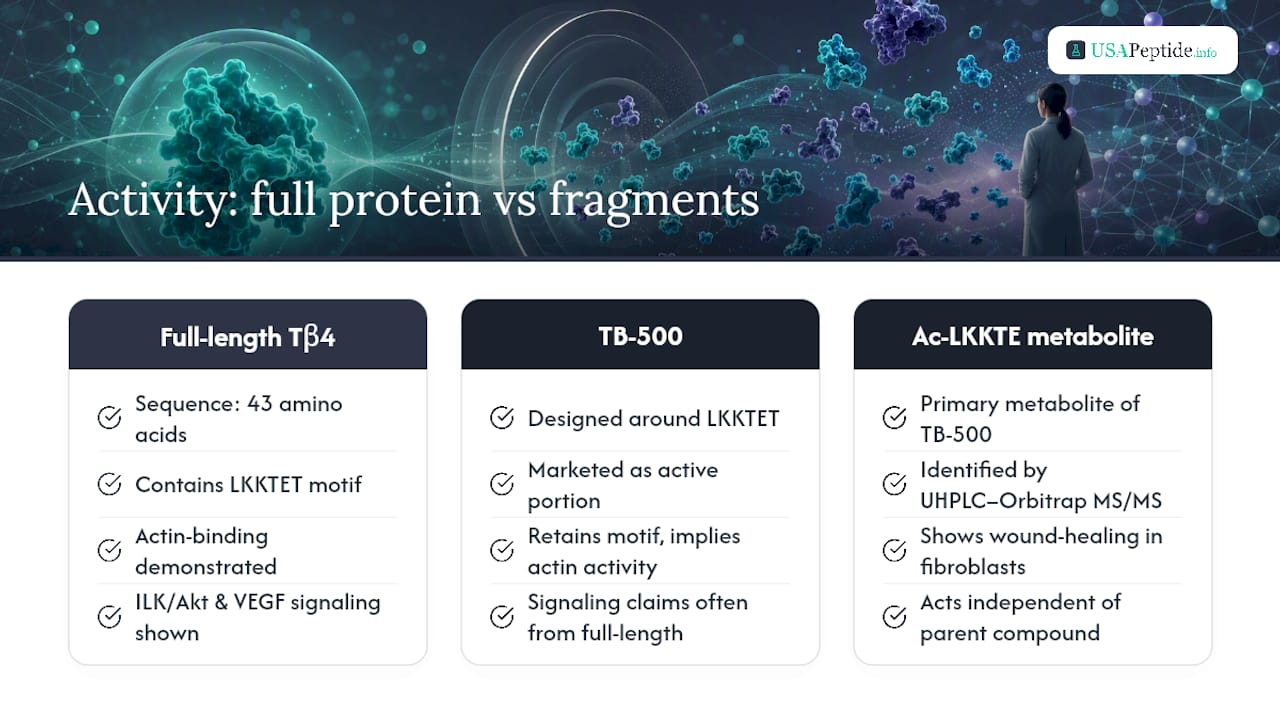
The actin-binding function of thymosin beta-4 traces back to a specific sequence, the LKKTET motif, identified in work mapping the protein's active sites down to short peptide fragments. Research using truncated peptide sequences found that fragments containing this motif retained meaningful actin-sequestering and cell-migration activity even without the full 43-amino-acid parent protein, a finding published in the FASEB Journal.
TB-500 is designed around this region, which explains why it is marketed as retaining the "active" portion of thymosin beta-4 rather than the whole molecule.
Metabolite finding: UHPLC-Q-Exactive Orbitrap MS/MS analysis of TB-500 in vitro and in rats identified Ac-LKKTE as a primary metabolite, and this metabolite showed measurable wound-healing activity in fibroblast assays independent of the parent compound.
That analytical metabolism study is significant because it shifts part of the mechanistic story away from TB-500 itself and toward what it becomes after enzymatic processing. Not every mechanistic claim circulating about TB-500 has been demonstrated for the fragment directly. Much of the ILK/Akt and VEGF signaling data comes from studies on full-length thymosin beta-4, not the isolated fragment, and researchers should track which claims apply to which molecule. PubChem's compound record for TB-500 provides the structural identifiers used across these analytical studies.
What Cellular Effects Result From TB-500's Actin Regulation?
Altered actin dynamics do not stay confined to the cytoskeleton. They cascade into the functional processes that define tissue repair, and each one can be measured directly in a lab setting.
- Fibroblast and keratinocyte migration accelerates as actin turnover increases, supporting faster wound-edge closure.
- Endothelial cell migration and capillary tube formation rise through Akt/VEGF signaling, driving angiogenesis into repairing tissue.
- Inflammation resolution appears linked to suppression of NF-κB signaling alongside a shift in macrophage phenotype from the pro-inflammatory M1 state toward the reparative M2 state.
- Anti-fibrotic activity shows up as modulation of TGF-β signaling, a pathway that governs whether healing tissue lays down organized collagen or excessive scar matrix.
Pro Tip: If you're designing a mechanism study, don't rely on a single readout. Pair a scratch-wound migration assay with a capillary tube formation assay and a cytokine panel, since actin-driven effects on migration, angiogenesis, and inflammation often move on different timelines.
Researchers commonly quantify these effects through migration assays, tube formation counts, cytokine panels for IL-6 and TNF-alpha, and collagen deposition metrics in dermal models, giving actin biology a concrete functional signature.
How Is TB-500 Metabolized, and What Does That Mean for Dosing Studies?
Metabolite data now sit at the center of how researchers should think about the TB-500 mechanism of action. The same UHPLC-MS/MS work that identified Ac-LKKTE as biologically active also tracked its appearance over time, finding primary metabolites present within the first six hours and longer-term metabolites detectable out to 72 hours in rat models, with no cytotoxicity observed for the parent compound or its metabolites in fibroblast assays.
| Parameter | Reported finding |
|---|---|
| Primary metabolite window | Detected within 6 hours post-exposure |
| Extended metabolite window | Detectable up to 72 hours |
| Active metabolite identified | Ac-LKKTE |
| Cytotoxicity in fibroblast assays | None observed for parent or metabolites |
| Formal human PK trials for the fragment | Not established |
Practical loading protocols used in research settings are often justified by tying dosing to collagen remodeling timelines over several weeks, not by validated human pharmacokinetic data. That gap matters. A detailed breakdown of half-life evidence and its limitations is available in USAPeptide's TB-500 half-life analysis, which is worth reading before assuming any dosing interval reflects confirmed clearance rates.
What Does the Evidence Actually Support?
Preclinical models supporting the broader thymosin beta-4 mechanism are genuinely robust. Cardiac studies show activation of epicardial progenitor cells tied to ILK/Akt signaling, a plausible bridge between developmental repair programs and adult regeneration, as described in the PMC review of Tb4's regulatory functions. Corneal and dermal wound models add further support for the actin-migration-angiogenesis chain.
Where the evidence thins out is the fragment-specific human data. Early clinical work on full-length thymosin beta-4 demonstrated safety and wound-healing signals in ocular and dermal indications, but that is a different molecule from the TB-500 fragment sold for research use. Analytical reviews caution that popular literature frequently blurs this distinction, attributing full-length Tb4's clinical results to TB-500 without direct evidence.
Careful attribution matters here: activity documented for the 43-amino-acid parent protein cannot be assumed to transfer identically to a shorter fragment, even one built around the same active motif.
A rigorous research agenda to close these gaps would prioritize:
- Tissue-level G-actin/F-actin ratio measurements as a direct molecular readout.
- Metabolite detection assays quantifying Ac-LKKTE alongside parent compound levels.
- Controlled trials with standardized wound-healing or angiogenesis imaging as functional endpoints.
- Longer-term safety monitoring, given unresolved questions around systemic use and any association with tumor-related signaling in some contexts.
What Are the Safety and Regulatory Considerations?
TB-500 has no FDA-approved systemic indication, and regulatory materials addressing compounding oversight make clear that peptides in this category fall outside standard drug approval pathways, a point documented in FDA compounding and oversight guidance. Safety data specific to the fragment in humans is sparse; most safety signals come from full-length Tb4 trials or preclinical fibroblast assays showing no observed cytotoxicity.
- No approved systemic use exists for TB-500 in humans.
- Full-length Tb4 trials reported acceptable safety in ocular and dermal contexts, but this does not automatically extend to the fragment.
- Purity and identity verification affect reproducibility. An unverified or mislabeled compound undermines any mechanistic conclusion drawn from it.
- Authenticated Certificates of Analysis are a baseline requirement for any lab attempting to correlate dosing with molecular or functional outcomes.
How Can Researchers Investigate TB-500 Mechanisms Reliably?
Reproducible mechanism research depends on knowing exactly what compound you are testing. USAPeptide's TB-500 molecular profile lays out the fragment's structure against full-length thymosin beta-4, and the platform's COA grading tool helps labs verify purity claims before those compounds ever touch an assay plate.
A workable first-pass mechanism study looks like this:
- Source ISO 17025-tested, high-purity material with a verified Certificate of Analysis.
- Confirm identity and concentration using UHPLC-MS/MS before dosing any assay system.
- Run parallel migration and capillary tube formation assays to capture actin-driven functional output.
- Quantify Ac-LKKTE alongside parent compound to separate metabolite-driven from parent-driven activity.
- Track cytokine and collagen deposition markers across a timeline matched to expected remodeling windows.
USAPeptide's recovery-focused peptide resource outlines complementary protocol considerations for labs building out a broader tissue-repair research program.
Editorial Perspective: Why Metabolite Data Should Reframe TB-500 Research
The conventional framing of TB-500 treats it as a simple stand-in for thymosin beta-4, a shortcut molecule carrying the same activity in a smaller package. The metabolite data complicate that story in a useful way. If Ac-LKKTE carries independent wound-healing activity, then some of what gets attributed to TB-500 "acting like" the parent protein may actually be a metabolite doing separate work downstream. That is not a minor technicality. It changes what a researcher should actually measure.
Too much discussion of TB-500's mechanism stops at "it binds actin" and treats that as the whole explanation. It is the starting point, not the conclusion. The real research priority is connecting that binding event to measurable, functional endpoints, migration rates, tube formation, cytokine shifts, while tracking metabolite concentrations alongside parent compound levels. Skipping that step means drawing conclusions from an incomplete chain of evidence. Researchers who verify compound purity first and pair it with proper analytical quantification will get mechanistic answers the rest of the field is still guessing at.
— USAPeptide Team
This article is general information, not a substitute for advice from a qualified doctor. Consult a qualified healthcare professional about your own circumstances before acting on anything here.
Sources
- Regenerative protein thymosin β‑4 is a novel regulator of purinergic signaling. PMC (open access).
- Biological activities of thymosin ß4 defined by active sites in short peptide sequences. The FASEB Journal. 2011.
- Simultaneous quantification of TB‑500 and its metabolites in in‑vitro experiments and rats by UHPLC‑Q‑Exactive orbitrap MS/MS ...
- PubChem compound record — TB‑500 (Thymosin beta‑4 fragment).
- FDA regulatory document (download).