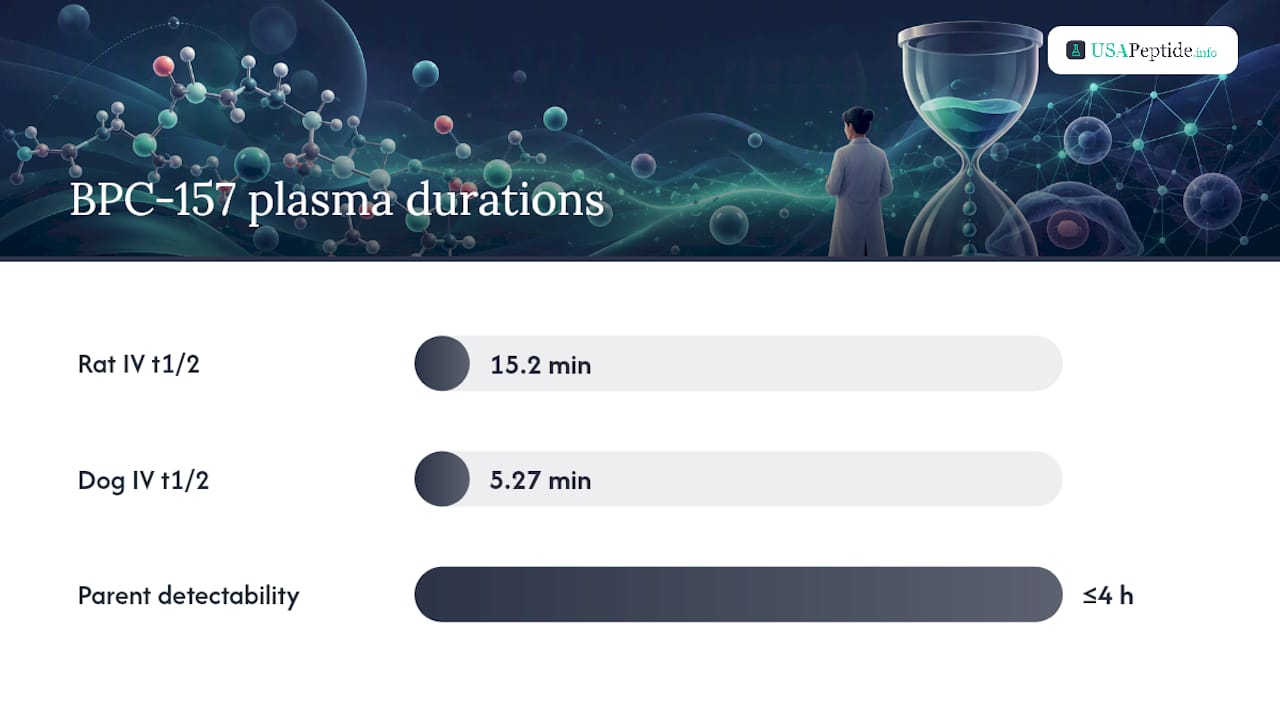
In controlled preclinical studies, BPC-157's plasma elimination half-life is under 30 minutes, averaging approximately 15 minutes after intravenous dosing in rats, with the parent compound often undetectable within 4 hours. That short plasma window does not mean short biological activity. A 2025 narrative review synthesizing multiple animal studies documents angiogenic and regenerative effects persisting for weeks to months after dosing stops, supporting a "molecular switch" interpretation rather than a sustained-concentration model.
Two points researchers should hold together from the start:
- Pharmacokinetic half-life (what an assay detects in plasma) is measured in minutes to a few hours, depending on species and route.
- Duration of biological effect (downstream signaling, tissue repair, gene expression changes) can outlast plasma detectability by days to months in animal models.
Human pharmacokinetic data for BPC-157 remain sparse. The systematic review by Emerging Use of BPC-157 in Orthopaedic Sports Medicine identified 35 preclinical studies and only 1 clinical study through June 2024, underscoring that nearly all PK numbers in circulation come from rodent and canine models rather than human trials.
Key Takeaways
BPC-157's plasma elimination half-life is under 30 minutes in preclinical animal studies, yet downstream biological effects can persist for weeks to months, a distinction that defines how researchers should design studies and interpret results.
| Point | Details |
|---|---|
| Plasma half-life is very short | Preclinical studies report t1/2 ~15.2 min (rat IV) and ~5.27 min (dog IV); parent compound undetectable within 4 hours. |
| Biological effects outlast plasma presence | Animal models document regenerative and angiogenic effects persisting weeks to months after dosing stops. |
| Route changes apparent half-life | IM bioavailability is lower in rats than in dogs; flip-flop kinetics extend apparent detectability for non-IV routes. |
| COA purity is a PK prerequisite | HPLC purity ≥99% and confirmed MS identity are required before any t1/2 measurement can be interpreted reliably. |
| USAPeptide COA tool supports verification | The USAPeptide COA grading tool helps researchers assess whether a supplier's documentation meets research-grade standards before conducting PK work. |
This article is general information, not a substitute for advice from a qualified doctor. Consult a qualified healthcare professional about your own circumstances before acting on anything here.
Table of Contents
- What does the published literature actually report for BPC-157 half-life?
- How does route of administration change apparent half-life?
- How is BPC-157 metabolized and excreted?
- Why can a short half-life still produce long-lasting effects?
- How was half-life measured, and where do reported numbers go wrong?
- What factors shift the observed half-life or duration of effect?
- Why do researchers use daily dosing when plasma half-life is so short?
- Why does peptide purity directly affect PK reliability?
- What is BPC-157's regulatory and safety status?
- Practical takeaways for researchers interpreting BPC-157 PK data
- An editorial perspective on interpreting BPC-157 pharmacokinetics
- Research tools from USAPeptide for peptide PK verification
- Sources
What does the published literature actually report for BPC-157 half-life?
The most reliable PK data come from a dedicated pharmacokinetics, distribution, metabolism, and excretion (ADME) study conducted in rats and beagle dogs, published in Frontiers in Pharmacology. Key findings from that primary PK dataset:
- Rats (IV): elimination half-life approximately 15.2 minutes; parent compound undetectable at 4 hours post-dose.
- Beagle dogs (IV): elimination half-life approximately 5.27 minutes, shorter than in rats.
- IM bioavailability: rats generally lower than in dogs, with rat bioavailability notably less than half that of beagle dogs.
- Tmax after IM injection: within minutes in both species; Cmax lower than IV by the degree of bioavailability difference.
The table below summarizes the most-cited preclinical PK data points and their methodological context.
| Study / Source | Species | Route | Reported t1/2 | Detectability Window | Key Assay / Note |
|---|---|---|---|---|---|
| Frontiers in Pharmacology ADME study | Rat | IV | ~15.2 min | Undetectable at 4 h | LC-MS/MS + radiolabel |
| Frontiers in Pharmacology ADME study | Beagle dog | IV | ~5.27 min | Undetectable at 4 h | LC-MS/MS + radiolabel |
| Frontiers in Pharmacology ADME study | Rat | IM | Not directly reported; inferred from bioavailability | Hours (lower Cmax) | LC-MS/MS |
| Frontiers in Pharmacology ADME study | Beagle dog | IM | Not directly reported; inferred from bioavailability | Hours (higher Cmax) | LC-MS/MS |
| Narrative review (PMC 2025) | Multiple (animal) | Various | Commonly <30 min | Days to months (biological effect) | Synthesis of multiple studies |
| Systematic review (PubMed 2025) | Primarily rodent | Various | Commonly <30 min | Limited; preclinical only | Systematic literature review |
The contrast between the rat and dog IV values (15.2 min vs. 5.27 min) is not a measurement error. It reflects genuine interspecies differences in clearance rate, a point that matters when extrapolating animal PK to human estimates.
How does route of administration change apparent half-life?
Route of administration is one of the strongest determinants of what a researcher actually measures when tracking BPC-157 plasma concentrations.
Intravenous (IV): The entire dose enters circulation immediately, producing the highest Cmax and the most accurate measurement of true elimination half-life. The ~15.2-minute rat figure and ~5.27-minute dog figure come from IV studies. Plasma concentrations fall steeply in the first 30 minutes, then become undetectable within hours.
Intramuscular (IM) and subcutaneous (SC): Absorption from the injection depot is slower, which delays Tmax and lowers Cmax relative to IV.
Oral and sublingual: Peptides face enzymatic degradation in the gastrointestinal tract, and BPC-157's oral bioavailability for systemic exposure is low. However, preclinical evidence suggests local gut effects may occur even when systemic plasma levels are negligible, because the peptide contacts mucosal tissue directly before degradation. Vendor and forum claims of multi-hour systemic detectability after oral dosing are generally not supported by peer-reviewed human PK data, as noted in analyses contrasting published PK work against marketing claims.
Pro Tip: When designing a PK study, collect plasma samples at 5, 10, 15, 30, 60, and 120 minutes post-dose for IV administration to capture the full elimination curve. For IM or SC routes, extend sampling to 4 hours and include a pre-dose baseline. Measuring only at 1-hour intervals will miss the Cmax entirely for IV and underestimate the absorption phase for IM.
How is BPC-157 metabolized and excreted?
BPC-157 follows a straightforward ADME pattern, though tissue-level data are less complete than plasma data.
Absorption: Route-dependent, as described above. Systemic absorption after oral dosing is low; IM and SC absorption is moderate and species-dependent.
Distribution: After IV dosing, the peptide distributes rapidly into tissues. Radiolabeled [³H]BPC-157 studies traced radioactivity to plasma, urine, and feces, indicating broad tissue distribution before elimination.
Metabolism: The primary ADME study used radiolabeled tracing to show that BPC-157 is metabolized in the liver into small peptide fragments and individual amino acids, including [³H]proline. These fragments then enter general amino acid metabolism.
Excretion: Metabolites are cleared primarily via urine, with biliary (fecal) excretion as a secondary pathway. The parent peptide itself is not excreted intact in meaningful quantities; what the kidneys clear are the amino acid breakdown products.
Key points on tissue retention:
- Most published studies measure plasma concentrations only; tissue metabolite profiling is less common and methodologically more demanding.
- Radiolabel studies provide the clearest picture of where the peptide and its fragments go, but they track total radioactivity, not necessarily intact parent peptide.
- The systematic review confirms hepatic metabolism and renal clearance as the primary elimination pathways, consistent with the ADME study findings.
Why can a short half-life still produce long-lasting effects?
This is the central interpretive challenge for anyone reading BPC-157 research. The apparent contradiction resolves once pharmacokinetic half-life and pharmacodynamic duration are treated as separate questions.
BPC-157 appears to function as a rapid molecular trigger rather than a compound that needs sustained plasma presence to produce its effects. Preclinical reviews cite rapid activation of signaling pathways including Akt1, endothelial nitric oxide synthase (eNOS), and vascular endothelial growth factor receptor 2 (VEGFR2), as well as downstream growth factor cascades. Once these pathways are activated, the downstream gene expression and cellular repair programs can continue independently of whether the parent peptide is still detectable in plasma.
Animal study examples from the 2025 narrative review illustrate this:
- Spinal cord functional improvements maintained up to 360 days in one animal model after a finite dosing period.
- Tendon healing outcomes sustained through the full observation window of reported studies.
- Angiogenic effects persisting for weeks after plasma concentrations had returned to baseline.
The practical implication for study design: measuring plasma BPC-157 concentration alone is insufficient to characterize the compound's pharmacological activity. Downstream biomarkers such as eNOS phosphorylation, VEGF expression, and tissue histology provide the pharmacodynamic picture that plasma PK cannot.
How was half-life measured, and where do reported numbers go wrong?
Understanding the assay behind a reported t1/2 is as important as the number itself. Three main measurement approaches appear in the BPC-157 literature:
Radioactivity tracking (radiolabels): [³H]-labeled BPC-157 is administered and radioactivity is traced in plasma, urine, and feces over time. This approach detects total radioactivity, including metabolite fragments, not just intact parent peptide. It is useful for excretion profiling but can overestimate parent compound detectability if metabolites carry the label.
LC-MS/MS (liquid chromatography-tandem mass spectrometry): The most specific method for quantifying intact parent peptide. The primary ADME study used LC-MS/MS alongside radiolabeling, which is why its t1/2 estimates are considered the most reliable in the literature. Detection limits are in the low nanogram-per-milliliter range.
Immunoassays (ELISA-based): Faster and cheaper than LC-MS/MS, but subject to cross-reactivity with peptide fragments that share epitopes with the parent compound. An immunoassay can report "detectable" signal hours after LC-MS/MS shows no intact peptide, producing artificially extended apparent half-life values.
The table below compares these approaches on the dimensions that matter most for PK reliability.
| Assay Type | Specificity for Parent Peptide | Detection Limit | Typical Sampling Schedule | Key Limitation |
|---|---|---|---|---|
| LC-MS/MS | High (sequence-specific) | Low ng/mL range | Every 5–30 min in early phase | Requires validated method; higher cost |
| Radiolabel ([³H]) | Low (detects all labeled fragments) | Very low (radioactivity) | Flexible; often hourly | Cannot distinguish parent from metabolites |
| Immunoassay (ELISA) | Moderate (epitope-dependent) | Low ng/mL range | Flexible | Cross-reactivity with fragments inflates t1/2 |
Common pitfalls that produce unreliable t1/2 estimates:
- Infrequent sampling: Collecting plasma only at 1-hour intervals after IV dosing misses the entire elimination curve for a compound with a 15-minute half-life.
- Failure to measure tissue metabolites: Plasma-only studies cannot confirm whether the compound accumulates in target tissues.
- Using immunoassays without LC-MS/MS confirmation: Cross-reactive fragments extend apparent detectability and inflate reported half-life.
- Relying on vendor or forum data: Many multi-hour detectability claims originate from non-validated assays or oral product marketing rather than peer-reviewed PK studies.
What factors shift the observed half-life or duration of effect?
No two BPC-157 studies are identical in their PK outputs, and the variation is not random. Several controllable and uncontrollable variables drive the differences.
- Species: Rats clear BPC-157 more slowly than beagle dogs (t1/2 ~15.2 min vs. ~5.27 min IV). Human clearance rates are unknown from peer-reviewed data.
- Dose: Linear PK characteristics were reported at the doses studied in the primary ADME work, meaning t1/2 does not change substantially across the tested dose range. At very high doses, saturation of metabolic enzymes could theoretically extend half-life, but this has not been systematically studied for BPC-157.
- Route: As detailed above, IV produces the shortest apparent t1/2; IM and SC produce longer apparent detectability due to absorption-phase overlap.
- Formulation and stabilizers: Lyophilized peptides reconstituted in bacteriostatic water behave differently from peptides in other vehicles. Stabilizers that slow degradation in solution can extend the effective dose delivered but do not change intrinsic metabolic half-life once absorbed.
- Peptide purity and contaminants: A sample containing 85% parent peptide and 15% degradation fragments will produce a different PK profile than a ≥99% pure sample. Impurities can interfere with assay readings and confound t1/2 calculations.
- Chemical modifications: PEGylation (attachment of polyethylene glycol chains) or lipidation substantially extends half-life for many peptides by reducing renal filtration and slowing proteolytic degradation. Prototype BPC-157 is unmodified; any vendor selling a "modified" or "stabilized" BPC-157 analog is selling a different compound with different PK properties.
Pro Tip: Before comparing two BPC-157 PK studies, check whether both used the same prototype sequence (Gly-Glu-Pro-Pro-Pro-Gly-Lys-Pro-Ala-Asp-Asp-Ala-Gly-Leu-Val, 15 amino acids). A single amino acid substitution or a PEGylated variant will have meaningfully different pharmacokinetics and should not be treated as equivalent.
Why do researchers use daily dosing when plasma half-life is so short?
The logic behind once-daily or twice-daily dosing schedules in preclinical BPC-157 research is not to maintain steady plasma concentrations. With a half-life under 30 minutes, steady state in the pharmacokinetic sense is not achievable with daily dosing intervals. Instead, the rationale is repeated activation of signaling cascades.
Each dose produces a brief plasma peak that triggers receptor engagement and downstream pathway activation (Akt1, eNOS, VEGFR2). Because the downstream effects persist beyond plasma clearance, repeated dosing adds new activation events on top of ongoing biological responses. The cumulative effect is greater tissue exposure to the signaling consequences of BPC-157, not to BPC-157 itself.
Dosing patterns discussed in online research communities, commonly in the range of low hundreds of micrograms once or twice daily, are empirical extrapolations from animal work rather than outputs of human clinical trials. Examine notes that these patterns are based on preclinical extrapolation and that human data are limited.
Key points for researchers designing dosing intervals:
- Twice-daily dosing doubles the number of peak activation opportunities per day relative to once-daily.
- The interval between doses (12 hours for twice-daily) is long enough that plasma concentrations return to baseline before the next dose, meaning each administration is pharmacokinetically independent.
- Duration of the dosing period in animal studies ranges from days to months depending on the endpoint; longer periods are associated with more durable functional outcomes in musculoskeletal and neurological models.
Regulatory reminder: BPC-157 is not approved by the FDA for human therapeutic use. Dosing information here is explanatory pharmacology for research context, not a clinical recommendation.
Why does peptide purity directly affect PK reliability?
A Certificate of Analysis (COA) is not a formality. For PK research, it is a prerequisite for interpreting results. A sample with significant impurities produces a different plasma concentration-time curve than a high-purity sample, and the difference can shift calculated t1/2 by a meaningful margin.
The tests that matter most for PK interpretation:
- HPLC purity (%): Confirms what fraction of the sample is intact parent peptide. A result below 95% means a substantial portion of the administered dose is not BPC-157. For reliable PK, ≥99% purity is the appropriate standard.
- Mass spectrometry (MS) identity: Confirms the molecular weight matches the expected sequence. A correct HPLC purity with an incorrect MS identity means the sample is a high-purity wrong compound.
- Water content (Karl Fischer titration): Affects the actual peptide mass in a given weight of lyophilized powder. High water content means the effective dose is lower than the weighed amount.
- Endotoxin (LAL test): Bacterial endotoxins cause inflammatory responses that can confound biological outcome measurements and create safety risks in animal studies.
How impurities confound assay results:
- Peptide fragments that share sequence with BPC-157 cross-react with immunoassays, inflating apparent plasma concentrations and extending calculated t1/2.
- Degradation products can have their own biological activity, making it impossible to attribute observed effects to BPC-157 specifically.
- Endotoxin contamination produces inflammatory signals that overlap with BPC-157's reported anti-inflammatory effects, obscuring the compound's true pharmacodynamic profile.
USAPeptide's COA grading tool allows researchers to assess whether a supplier's COA meets the minimum standards for PK-grade research. Verified high-purity material with a complete COA is the starting point for any study where half-life or duration of effect is the primary endpoint.
What is BPC-157's regulatory and safety status?
BPC-157 is not approved by the FDA for any human therapeutic indication. Under FDA human drug compounding guidance, unapproved peptides administered to humans outside of a clinical trial context carry regulatory and safety risks that researchers and clinicians should understand before conducting any work.
Safety considerations based on available evidence:
- Limited human data: The systematic review identified only one clinical study through June 2024. Adverse event profiles in humans are not well characterized.
- Potential immunogenicity: Peptides can trigger immune responses, particularly when administered repeatedly or when formulations contain impurities.
- Unregulated manufacturing: Without FDA oversight of the manufacturing process, batch-to-batch variability in purity and sterility is a real concern.
- WADA ban: BPC-157 is prohibited in sport under the World Anti-Doping Agency's list of prohibited substances, classified as a peptide hormone and growth factor.
For researchers conducting PK work:
- Institutional Animal Care and Use Committee (IACUC) approval is required for animal studies.
- Any human administration outside an approved Investigational New Drug (IND) application is not sanctioned by FDA.
- Transparent reporting of COA data, assay methods, species, route, and dose is a minimum standard for publishable PK research.
Practical takeaways for researchers interpreting BPC-157 PK data
- Expect plasma t1/2 under 30 minutes in animal IV and IM studies using LC-MS/MS; values reported as hours likely reflect immunoassay cross-reactivity or oral/sublingual product claims without peer-reviewed support.
- Design sampling to capture Tmax: For IV studies, collect at 5, 10, 15, 30, and 60 minutes minimum. For IM/SC, extend to 4 hours.
- Separate PK from PD: Short plasma half-life does not predict short biological effect duration. Measure downstream biomarkers (eNOS, VEGF, histology) alongside plasma concentrations.
- Verify COA before trusting vendor PK claims: HPLC purity ≥99%, confirmed MS identity, water content, and endotoxin results are the minimum acceptable standard.
- Report fully: Any published PK study should state assay type, sampling schedule, COA purity, species, and route. Omitting any of these makes the t1/2 figure uninterpretable.
- Apply regulatory caution: Human PK data are essentially absent from the peer-reviewed literature. Extrapolating animal PK to human dosing carries substantial uncertainty.
This article provides general scientific information for research purposes and does not constitute medical, clinical, or legal advice. Researchers should consult primary regulatory sources and qualified professionals before conducting studies involving BPC-157.
An editorial perspective on interpreting BPC-157 pharmacokinetics
The most common mistake researchers and clinicians make with BPC-157 is treating the plasma half-life number as the whole story. A 15-minute t1/2 sounds like a compound that barely matters, yet the animal literature consistently documents effects that outlast plasma detectability by orders of magnitude. That gap is not a contradiction. It is a signal that the relevant pharmacology happens at the receptor and gene expression level, not in the plasma compartment.
What the field actually needs is not more animal PK studies. The rat and dog data are reasonably well characterized. The gap is human PK: a properly designed first-in-human PK study with LC-MS/MS sampling, full COA documentation, and transparent reporting of dose, route, and assay method. Until that exists, every extrapolation from animal data to human dosing carries uncertainty that should be stated explicitly, not papered over with confident-sounding forum summaries or vendor claims.
The other underappreciated issue is assay selection. Researchers who use immunoassays without LC-MS/MS confirmation are measuring something, but not necessarily intact BPC-157. The difference between a 15-minute half-life and a 4-hour "detectability window" often comes down to whether the assay is measuring the parent peptide or its fragments. That distinction belongs in every methods section.
Research tools from USAPeptide for peptide PK verification
Researchers working with BPC-157 or any research-grade peptide face a consistent practical problem: vendor PK claims are often unsupported by the assay and purity data needed to trust them. USAPeptide addresses that directly.
The USAPeptide COA grading tool evaluates whether a supplier's Certificate of Analysis meets the minimum standards for research-grade use, checking for HPLC purity, MS identity, water content, and endotoxin results. The peptide reference database covers BPC-157 alongside dozens of other compounds, with mechanism summaries, peer-reviewed citations, and purity benchmarks in one place. For researchers comparing BPC-157 against other tissue-repair peptides, the recovery peptide category page provides structured comparisons grounded in preclinical evidence. Start with the COA grading tool before committing to any vendor's PK data.
Sources
Key studies and tools cited in this article, with evidence level notes:
- Pharmacokinetics, distribution, metabolism, and excretion of body-protective compound 157, a potential drug for treating various wounds, in rats and dogs
- Regeneration or Risk? A Narrative Review of BPC-157 for Musculoskeletal Healing - PMC
- Emerging Use of BPC-157 in Orthopaedic Sports Medicine: A Systematic Review
- BPC-157 benefits, dosage, and side effects
Note: All cited studies are preclinical unless otherwise stated. Human PK and safety data for BPC-157 are limited to one clinical study as of the systematic review's June 2024 search date.