The best available estimate for the TB-500 plasma half-life falls in the range of minutes to a few hours, with the most conservative inference placing clearance well under two hours after intravenous administration. That figure comes with a critical caveat: no formal published plasma half-life exists for the isolated TB-500 fragment, meaning the estimate is inferred from peptide-class characteristics and analogy to the parent protein, thymosin beta-4 (Tβ4), rather than measured directly in human subjects. For practical research planning, this uncertainty means sampling windows should be kept tight (within one to two hours post-administration for plasma), while dosing intervals are typically set by biological effect duration rather than plasma clearance alone.
Community protocols commonly use a loading phase of approximately 2–2.5 mg twice weekly, followed by a maintenance dose of roughly 2 mg weekly, though these patterns are mechanistic inferences rather than trial-validated regimens. Researchers designing pharmacokinetic (PK) studies should treat all half-life values as working estimates pending direct measurement.
Pro Tip: When designing a TB-500 PK pilot, plan plasma sampling at 15, 30, 60, and 120 minutes post-dose to capture the likely clearance window. Urine sampling should extend further, given that metabolite detection windows exceed intact-peptide plasma windows.
Key Takeaways
The TB-500 plasma half-life is estimated at minutes to a few hours based on peptide-class inference, with no direct human measurement published for the isolated fragment.
| Point | Details |
|---|---|
| Plasma half-life estimate | Inferred at minutes to low hours; no formal human PK data exist for the isolated TB-500 fragment. |
| Dosing framework | Community protocols use 2–2.5 mg twice weekly (loading) then ~2 mg weekly (maintenance); these are not trial-validated. |
| Storage and tb-500 shelf life | Lyophilized: store at -20°C for months; reconstituted with bacteriostatic water: refrigerate and use within 3–4 weeks. |
| Safety and regulatory status | TB-500 is unapproved for human use in the U.S.; IRB/IACUC oversight and FDA compounding compliance are required. |
| COA verification | Require ≥99% HPLC purity, a chromatogram, and MS confirmation before accepting any lot for study use. |
| USAPeptide resources | The platform's COA grading tool and dosage calculator support evidence-based TB-500 research workflows. |
Table of Contents
- What TB-500 is at the molecular level
- Pharmacokinetics: what the evidence actually shows
- Dosing frameworks used in research and community practice
- How route of administration changes the kinetics
- Stability, storage, and reconstitution best practices
- Safety signals, adverse effects, and U.S. regulatory status
- Monitoring, lab tests, and detection windows
- How to evaluate peptide quality: COAs, HPLC purity, and supplier vetting
- How USAPeptide reads the TB-500 half-life evidence
- USAPeptide supports qualified researchers at every step
- Primary sources and further reading
- Sources
What TB-500 is at the molecular level
TB-500 is the N-terminal acetylated 17–23 amino acid fragment of thymosin beta-4, with the sequence Ac-LKKTETQ and a nominal molecular weight of approximately 796 Da. That acetylation at the N-terminus is analytically significant: it distinguishes TB-500 from unmodified fragments and is the structural feature that WADA's metabolism study used to characterize metabolites and synthesize reference standards for anti-doping labs.
Researchers will encounter several naming variants across labels, COAs, and literature:
- TB-500 (trade/community name, most common in research supply contexts)
- Ac-LKKTETQ (sequence notation, preferred for analytical and COA documentation)
- Thymosin beta-4 fragment 17–23 or Tβ4 (17–23) (literature notation)
- Thymosin beta-4 acetylated N-terminal fragment (descriptive label on some COAs)
Full-length thymosin beta-4 is a 43-amino acid protein with a molecular weight of approximately 4,964 Da. Human IV PK data exist for Tβ4, with a plasma half-life of roughly 1–2 hours in healthy volunteers, but those values cannot be automatically applied to the isolated TB-500 fragment without direct measurement. The fragment's smaller size and different structural context alter its clearance kinetics meaningfully.
Pro Tip: In lab notes and when requesting analytical standards, always specify "Ac-LKKTETQ" alongside the TB-500 trade name and the molecular weight (796 Da). This prevents ambiguity with full-length Tβ4 or other fragments and ensures the correct reference standard is used in HPLC and MS confirmation.
Pharmacokinetics: what the evidence actually shows
The core data gap
No peer-reviewed study has directly measured plasma half-life for the isolated TB-500 fragment in humans. The best available inference places clearance in the range of minutes to low hours, extrapolated from the fragment's molecular size, peptide-class behavior, and analogy to full-length Tβ4. Rat PK and UHPLC-MS/MS analytical methods have been developed for TB-500 and its metabolites, but formal human PK parameters for the fragment remain unpublished as of 2026.
Key insight: Plasma half-life and biological effect duration are not the same thing for TB-500. The peptide's downstream signaling cascades, including actin-binding and cellular repair pathways, persist well beyond plasma clearance. A researcher who samples only at 4–6 hours post-dose may find plasma levels below detection while tissue-level effects remain active. This dissociation is why community dosing intervals (days to weeks) are far longer than any plasma half-life estimate would suggest.
Metabolism and clearance mechanisms
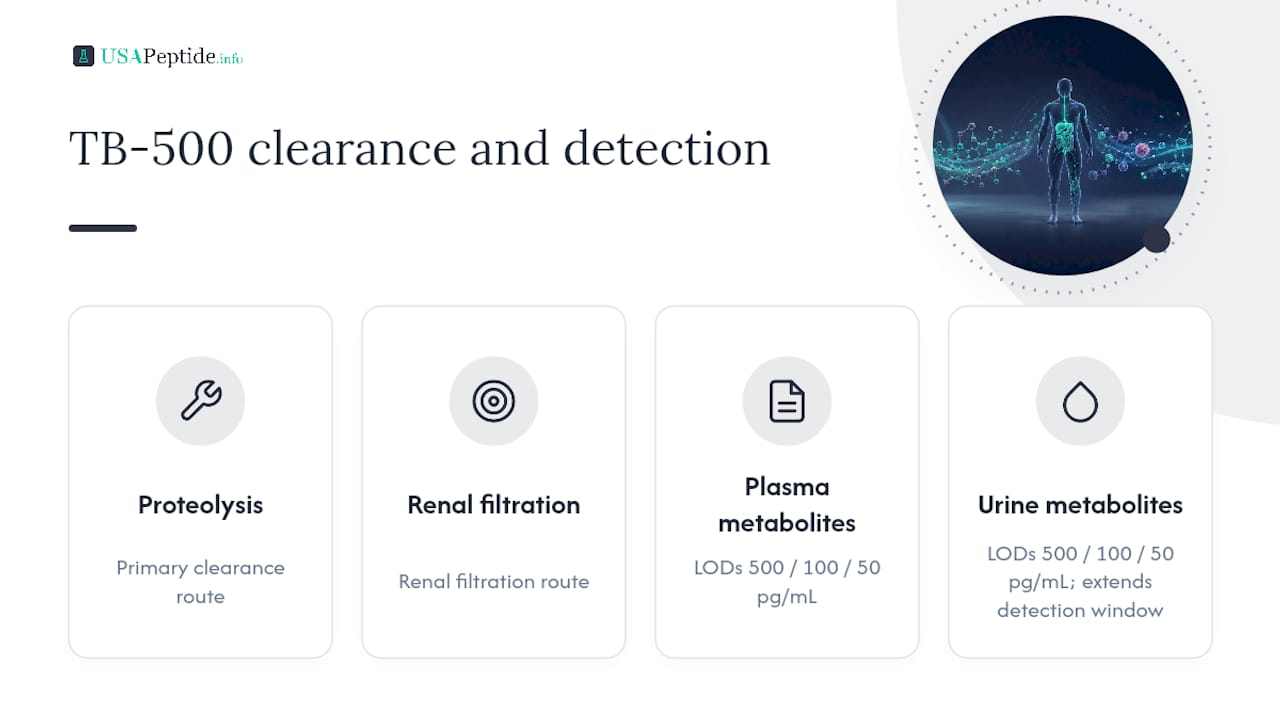
TB-500 is cleared primarily through proteolytic cleavage and renal filtration, consistent with small peptides of its molecular class. The WADA study identified specific metabolites in horse plasma and urine and used in vitro human matrices to map likely metabolism targets, reporting limits of detection for synthesized metabolites at 500 pg/mL, 100 pg/mL, and 50 pg/mL for select analytes. These metabolite LODs are analytically relevant: they indicate that detection in biological matrices is feasible at sub-nanogram concentrations, extending the effective detection window beyond intact-peptide plasma presence.
Dosing frameworks used in research and community practice
Loading and maintenance patterns
The most commonly reported community protocol follows a two-phase structure:
- Loading phase: 2–2.5 mg administered twice weekly for four to six weeks
- Maintenance phase: approximately 2 mg once weekly, continued as needed for the research endpoint
These patterns are documented by OptiPin's TB-500 analysis as community-derived and explicitly not validated by controlled PK trials for the TB-500 fragment. No peer-reviewed dose-ranging study has established an optimal dose, frequency, or duration for the isolated fragment in humans.
Researchers designing experiments should treat these ranges as starting reference points, not validated regimens. Dose selection for any institutional study requires independent justification based on the specific research question, species, and endpoint.
Safety caveat: TB-500 has not been approved for human use by the FDA. No formal human-dose PK trial for the isolated fragment has been published. Any research involving human subjects requires institutional review board (IRB) approval and full compliance with applicable U.S. regulations. Institutional oversight is not optional.
How route of administration changes the kinetics
Route of administration directly affects Tmax, apparent half-life, and tissue exposure, and those differences have real consequences for study design.
-
Intravenous (IV): Delivers the peptide directly into systemic circulation, producing the highest and fastest peak plasma concentration. Tmax is effectively at the moment of injection. This route gives the clearest picture of plasma clearance kinetics and is the appropriate choice when measuring half-life directly. Sampling should begin within minutes of administration.
-
Subcutaneous (SC): Absorption from the injection depot is slower, which delays Tmax and extends the apparent absorption phase. The result is a lower, broader plasma peak compared to IV. SC is the most common route in community practice and in many preclinical studies. For PK sampling, the plasma peak may occur 30–90 minutes post-injection, though this range is inferred rather than directly measured for TB-500.
-
Intramuscular (IM): Absorption kinetics fall between IV and SC, with faster uptake than SC due to greater local vascularity. IM may produce higher local tissue concentrations near the injection site, which can be relevant when studying localized repair endpoints.
Pro Tip: For reproducible PK data, standardize injection site, needle gauge, and injection volume across all subjects in a study. Variability in SC depot depth and local blood flow is a known source of inter-subject PK variance in peptide research. Document these parameters in every lab log entry.
For detection probability in plasma and urine, route matters considerably. IV administration produces the highest plasma concentrations and the best chance of detecting intact peptide in early samples. SC and IM routes may push intact-peptide plasma concentrations below assay LODs faster, making metabolite detection in urine the more reliable endpoint for later time points.
When the research goal is systemic kinetics, IV is the preferred route. When the goal is modeling community-use conditions or studying localized tissue effects, SC or IM better reflects real-world administration.
Stability, storage, and reconstitution best practices
Storage windows by form
Proper tb500 storage directly determines whether a compound retains its stated purity and potency through the study period. FormBlends' storage guide provides the following framework:
- Lyophilized (freeze-dried) TB-500: Store at -20°C for long-term stability, measured in months. Refrigeration at 2–8°C is acceptable for shorter periods. Room temperature storage should be minimized and is appropriate only for brief handling periods.
- Reconstituted with bacteriostatic water (0.9% benzyl alcohol): Refrigerate at 2–8°C; usable window is approximately 3–4 weeks.
- Reconstituted with plain sterile water: Refrigerate at 2–8°C; usable window drops to approximately 24 hours due to the absence of a preservative.
Freeze-thaw cycles degrade peptide integrity. Plan single-use aliquots when possible, particularly for reconstituted material. Each thaw introduces hydrolysis risk, and repeated cycling can reduce effective purity below the COA-stated value.
Reconstitution example
A 5 mg lyophilized vial reconstituted with 2.5 mL of bacteriostatic water yields a concentration of 2 mg/mL. At a 2 mg dose, that vial provides approximately 2.5 doses. With bacteriostatic water, the reconstituted vial remains usable for up to 3–4 weeks when refrigerated. Use the USAPeptide peptide dosage calculator to verify reconstitution math for specific vial sizes and dose targets before beginning a study.
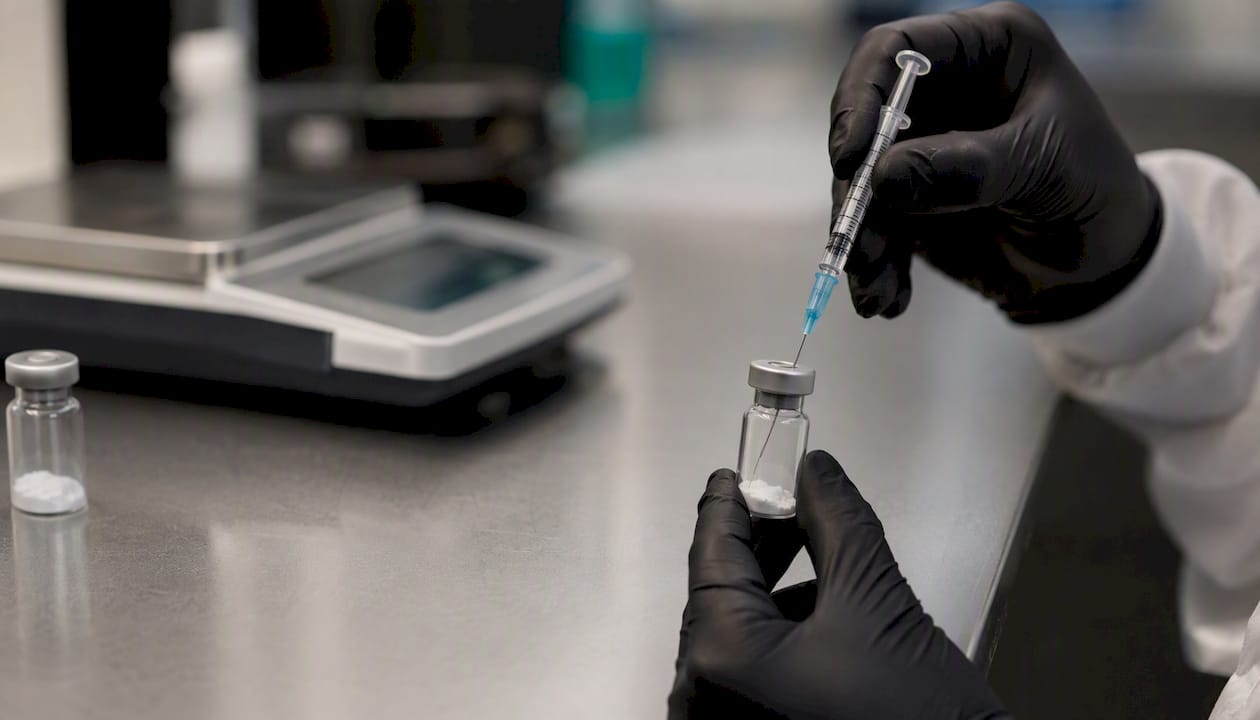
Pro Tip: Every reconstituted vial should have a lab log entry recording: lot number, COA ID, reconstitution date and time, preservative used (bacteriostatic vs. sterile water), calculated concentration, and the planned discard date. This documentation is required for reproducibility and for any institutional audit.
Sterile handling checklist:
- Work in a laminar flow hood or clean bench when possible.
- Swab vial septa with 70% isopropyl alcohol and allow to dry before puncturing.
- Inject bacteriostatic water slowly down the vial wall; do not vortex.
- Inspect for particulates or discoloration before use; discard if either is present.
- Label the vial immediately after reconstitution with all required log fields.
Safety signals, adverse effects, and U.S. regulatory status
Reported adverse effects
Evidence on TB-500 adverse effects in humans is limited to case reports and extrapolation from animal studies. No large-scale clinical safety trial exists for the isolated fragment. Reported and theorized concerns include:
- Injection-site reactions (redness, swelling, mild pain) — most commonly reported
- Transient fatigue or headache in anecdotal human accounts
- Theoretical concern regarding promotion of angiogenesis in oncology contexts, given Tβ4's role in cell migration and vascular remodeling
- Unknown long-term effects due to absence of controlled human safety data
Evidence level for all of the above is low: animal studies and community anecdote, not controlled clinical trials.
U.S. regulatory context
TB-500 is not FDA-approved for human use and is not on the FDA's 503A bulk drug substance list for compounding pharmacies. FDA compounding and bulk-substance guidance governs how research-use peptides may be handled under U.S. law, and researchers relying on compounded material must document institutional approvals and supplier COAs before use. The FDA's Pharmacy Compounding Advisory Committee continues to review bulk drug substance nominations, and the regulatory environment for peptide compounding remains active.
Regulatory note: TB-500 is classified as a research chemical in the United States. It is not approved for human therapeutic use, and its sale for human consumption is not permitted under current FDA regulations. Researchers must operate under appropriate institutional frameworks, including IRB oversight for any human-subjects research and IACUC approval for animal studies.
Anti-doping status
WADA has classified TB-500 as a prohibited substance under the category of peptide hormones and related substances. Anti-doping labs now have synthesized metabolite reference standards and a TB-500-d3 internal standard, significantly improving detectability. Researchers working with athletes or in sports science contexts should account for detection windows that extend beyond plasma clearance, given that metabolites persist in urine after intact peptide is no longer detectable in plasma.
Monitoring, lab tests, and detection windows
Recommended baseline and follow-up labs
For any research protocol involving TB-500 administration in animal or human subjects, a structured monitoring framework reduces confounding and supports safety documentation:
- Baseline: Complete blood count (CBC), comprehensive metabolic panel (CMP), renal function panel (creatinine, BUN, eGFR), and hepatic enzymes
- Periodic follow-up: Repeat CMP and renal panel at study midpoint and endpoint; CBC if hematologic effects are a study concern
- Endpoint-specific: Tissue biomarkers relevant to the repair or regeneration endpoint under study
Analytical assays and detection limits
UHPLC-MS/MS is the standard analytical method for detecting TB-500 and its metabolites in biological matrices. The WADA metabolism study reported limits of detection for synthesized metabolites at 50–500 pg/mL depending on the specific analyte and matrix. These LODs mean that sensitive targeted assays can detect metabolites in urine well after intact TB-500 has cleared from plasma, extending the practical detection window for anti-doping and PK purposes.
Methodology note: For PK and detection assays, plasma samples should be collected into EDTA tubes, centrifuged promptly, and stored at -80°C until analysis. Urine samples should be collected into polypropylene containers with no additives and stored frozen. Avoid repeated freeze-thaw cycles for analytical samples, as peptide and metabolite degradation will compress apparent detection windows and introduce quantitative error.
- Collect plasma samples at 15, 30, 60, and 120 minutes post-dose for intact-peptide detection.
- Collect urine samples at 0–4, 4–8, and 8–24 hours post-dose to capture metabolite excretion.
- Use a validated UHPLC-MS/MS method with the TB-500-d3 internal standard for quantitation.
- Report all LODs and LOQs alongside results; flag any samples with concentrations below LOQ as semi-quantitative.
Anti-doping labs treat TB-500 as a priority analyte. Researchers in sports science or performance contexts should assume that detection is feasible for at least 24 hours post-dose in urine, with the exact window dependent on dose, route, and individual metabolism.
How to evaluate peptide quality: COAs, HPLC purity, and supplier vetting
A COA is only as useful as the information it actually contains. Researchers should apply a consistent verification workflow before accepting any TB-500 lot for study use.
COA verification checklist
- Lot number: Confirm it matches the vial label exactly; mismatches indicate a documentation error or substitution.
- Peptide identity: Sequence (Ac-LKKTETQ) and molecular weight (~796 Da) must be explicitly stated.
- HPLC chromatogram: The chromatogram should be present, not just a summary value. Inspect peak shape and retention time.
- HPLC purity: Acceptance threshold is ≥99% for research-grade material. Values below this threshold introduce impurities that confound PK and biological results.
- Mass spectrometry (MS) confirmation: A matching m/z value confirms peptide identity independently of HPLC purity.
- Expiry / retest date: Confirm the lot is within its stated shelf life.
- Storage conditions: COA should specify recommended storage temperature for the lyophilized material.
Any of these should trigger a request for independent third-party testing before the lot is used in a study.*
What impurities mean for PK interpretation
Impurities in a TB-500 lot are not just a quality concern; they are a PK confound. When interpreting half-life or effect-duration data, purity directly affects the reliability of the result. The USAPeptide COA check tool provides a structured framework for evaluating supplier documents against these criteria.
Supplier vetting workflow
- Request the full COA with chromatogram and MS data before ordering.
- Verify the lot number against the supplier's online verification system if available.
- For critical studies, send an independent aliquot to a third-party ISO 17025-accredited lab for identity and purity confirmation.
- Document the COA ID, purity result, and verification date in the study master file.
For a practical example of how COA reporting and HPLC purity thresholds are documented in a peptide profile, the USAPeptide PT-141 profile illustrates the standard format used across the platform's reference entries.
How USAPeptide reads the TB-500 half-life evidence
The USAPeptide team applies a conservative evidence-grading approach to TB-500 pharmacokinetics. Because no direct human PK measurement exists for the isolated fragment, the platform treats the "minutes to low hours" plasma half-life estimate as a working lower bound, not a confirmed value. This means the platform recommends tight sampling windows for PK pilots and does not extrapolate dosing frequency from plasma clearance alone.
For researchers planning a TB-500 study, the recommended sequence is: verify COA purity first, select a route appropriate to the research question, design sampling around the conservative clearance estimate, and plan for metabolite detection in urine to extend the observable window. The platform's peptide dosage calculator and COA grading tool are operational resources designed to support exactly this workflow, translating molecular data into practical lab decisions.
The broader context for TB-500 in tissue repair research, including how its PK considerations compare with other recovery-focused peptides, is covered in the USAPeptide tissue recovery research guide.
USAPeptide supports qualified researchers at every step
USAPeptide.info gives qualified researchers a single reference point for TB-500 and related peptides: peer-reviewed research summaries, detailed molecular profiles, a COA grading tool for evaluating supplier documents, and a dosage calculator for reconstitution and dosing math.
For researchers sourcing TB-500 or comparable compounds for tissue repair studies, the USAPeptide recovery research guide provides a curated, evidence-graded overview of the current research landscape.
All compounds referenced on USAPeptide.info are intended for research use only. They are not approved for human therapeutic use. Researchers must obtain appropriate institutional approvals (IRB, IACUC) and comply with all applicable U.S. federal and state regulations before initiating any study. Consult qualified legal and regulatory counsel regarding compliance with FDA compounding and bulk-substance rules.
Primary sources and further reading
The sources below underpin the pharmacokinetic, metabolic, regulatory, and handling claims in this article.
- WADA TB-500 metabolism study: Characterizes TB-500 metabolites in horse plasma/urine and in vitro human matrices; reports LODs for synthesized metabolites (50–500 pg/mL); synthesizes TB-500-d3 internal standard for anti-doping labs. Primary source for metabolism, detection limits, and anti-doping context.
- Halflife-labs TB-500 PK review: States that no formal published plasma half-life exists for the isolated fragment; infers clearance at minutes to low hours. Primary source for evidence-grade caveat and BLUF half-life estimate.
- OptiPin TB-500 analysis: Documents community dosing patterns (2–2.5 mg loading, ~2 mg maintenance) and flags them as mechanistic inference rather than trial-validated. Source for dosing framework section.
- FormBlends TB-500 storage guide: Tabulates storage windows for lyophilized and reconstituted TB-500 with bacteriostatic vs. plain sterile water. Source for stability and handling section.
- FDA bulk drug substance compounding guidance: Governs legal and quality constraints for research-use peptides under 503A compounding rules in the U.S. Source for regulatory and compliance caveats.
- PubMed — thymosin beta-4 wound healing literature: Archives clinical and preclinical Tβ4 studies; human IV half-life of ~1–2 hours reported for full-length Tβ4 in healthy volunteers. Source for parent-protein PK comparison.
- Apotheon TB-500 compound monograph: Describes UHPLC-MS/MS method development for TB-500 and metabolites and notes limited human fragment PK data. Source for analytical methodology and detection context.
This article is general information, not a substitute for advice from a qualified doctor. Consult a qualified healthcare professional about your own circumstances before acting on anything here.
Sources
- Investigation of in vitro/ex vivo TB-500 metabolism, synthesis of relevant metabolites and detection limits in urine and plasma | World Anti Doping Agency
- TB-500 Half-Life: Not Established (Animal Data Only)
- TB-500 Storage Instructions: Complete Guide | FormBlends
- Fda