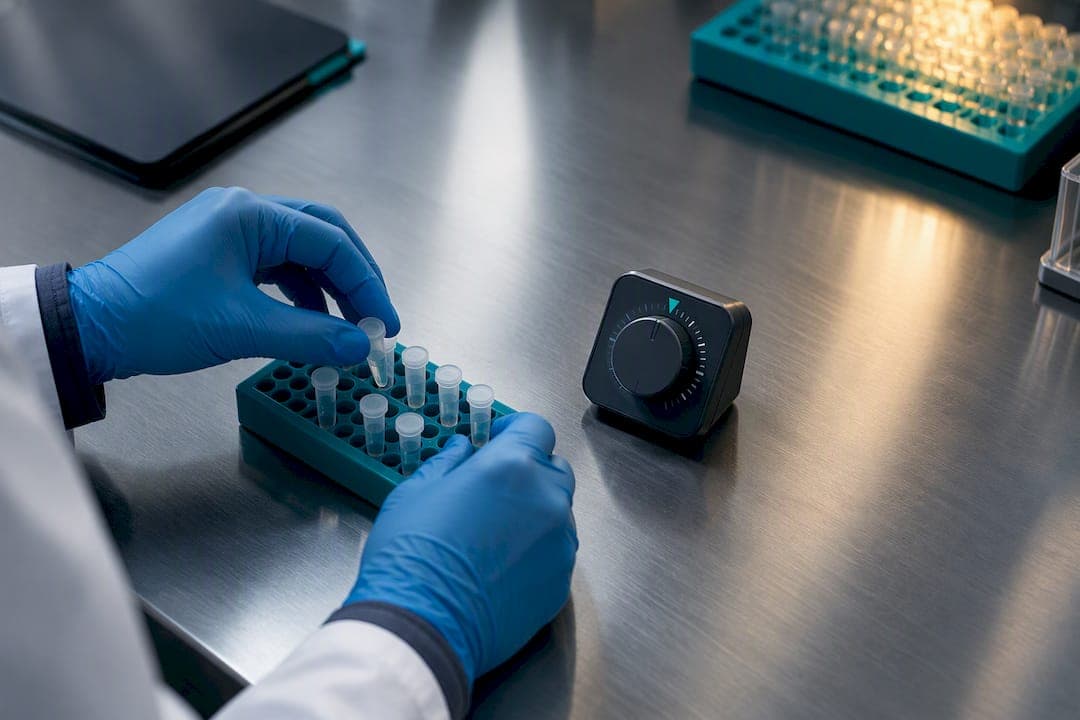
Ipamorelin's terminal plasma half-life sits at approximately 2 hours, based on the human pharmacokinetic/pharmacodynamic (PK/PD) modeling study that remains the field's primary reference point. That figure comes from model-derived estimates, not a large-scale trial, so treat it as the best current estimate rather than a fixed constant. Practically, this short half-life means ipamorelin clears fast and produces a single, discrete growth hormone (GH) pulse per dose rather than sustained elevation.
TL;DR:
- The human half-life of ipamorelin is about 2 hours, meaning it clears rapidly and triggers a single GH pulse per dose.
- GH levels peak around 30 to 60 minutes after administration and decline within 3 to 4 hours, while downstream effects like IGF-1 last much longer.
- Dosing protocols should account for its short half-life by spacing doses several hours apart and verifying compound purity with a Certificate of Analysis.
- Most data on ipamorelin’s half-life come from a small PK/PD study, so extrapolating additional timing and stacking strategies from community practice carries uncertainty.
- Accurate results depend on using verified material and considering that the pharmacokinetic half-life differs from the duration of GH activity and downstream biological effects.
Table of Contents
- Ipamorelin Half-Life: What the Human PK Data Show
- Why Does GH Release Outlast Ipamorelin's Plasma Levels?
- Routes of Administration and How Ipamorelin Gets Cleared
- What the Short Half-Life Means for Dosing Schedule Design
- How Solid Is the Ipamorelin Half-Life Evidence?
- Where to Verify Ipamorelin Data Before You Start a Study
- What Researchers Get Wrong About Ipamorelin's Half-Life
- Start Your Ipamorelin Research With Verified Compound Data
- Primary Sources for Ipamorelin Pharmacokinetics
- Sources
- FAQ
Ipamorelin Half-Life: What the Human PK Data Show
The most cited figure for ipamorelin half-life comes from a pharmacokinetic-pharmacodynamic modeling study conducted in human volunteers. That study reported dose-proportional kinetics with a terminal half-life near 2 hours, meaning concentration in plasma drops rather than accumulates across a dosing window.
Two other parameters matter just as much as the half-life number itself:
- Systemic clearance: about 0.078 L/h/kg, indicating the body removes ipamorelin from circulation relatively efficiently.
- Volume of distribution at steady state (Vdss): about 0.22 L/kg, suggesting the peptide stays largely within extracellular fluid rather than penetrating deep into tissue compartments.
Statistic: A terminal half-life near 2 hours, paired with clearance around 0.078 L/h/kg, tells you ipamorelin is cleared quickly enough that plasma levels fall to negligible concentrations well before a typical 24-hour dosing cycle resets.
Together, these numbers describe a molecule that spikes, acts, and exits. For anyone modeling exposure curves or planning sampling intervals, that combination sets a much tighter window than longer-acting growth hormone secretagogues.
Why Does GH Release Outlast Ipamorelin's Plasma Levels?
Peptide clearance and hormone response don't move at the same speed, and that gap is where a lot of confusion starts. Ipamorelin triggers GH release within minutes of subcutaneous or intravenous administration, with peak GH output occurring around 0.67 hours (roughly 40 minutes) post-dose according to the same PK/PD modeling work.
The sequence generally unfolds like this:
- Ipamorelin enters circulation and binds the growth hormone secretagogue receptor within minutes.
- GH secretion rises sharply, peaking around the 30 to 60 minute mark.
- GH declines exponentially over the following 3 to 4 hours as a single, self-limited pulse rather than a plateau.
- Downstream IGF-1, which binds IGFBP-3 and persists far longer than either ipamorelin or GH itself, extends the measurable biological signal well past the peptide's own clearance window.
That last step explains why researchers sometimes see effects "outlast" what the plasma pharmacokinetics would predict. Inter-individual variability in the pharmacodynamic response also tends to run higher than the variability in peptide concentration itself, so two subjects with near-identical plasma curves can still show different GH output.
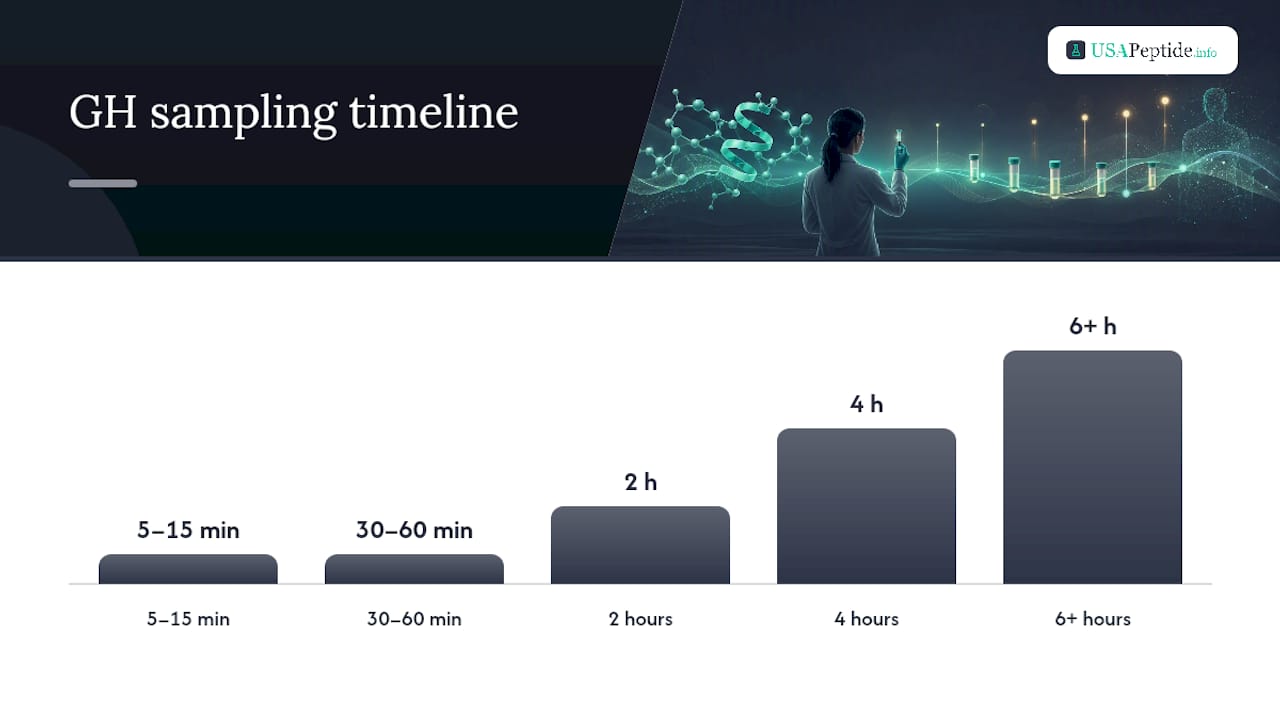
Pro Tip: If you're designing a sampling schedule, don't rely only on late time points. Capture early draws at 5 to 15 minutes and 30 to 60 minutes to catch the GH peak, then extend to 2, 4, and 6+ hours to document the decline curve accurately.
Routes of Administration and How Ipamorelin Gets Cleared
Human PK/PD data on ipamorelin come primarily from subcutaneous (SC) and intravenous (IV) administration. IV dosing produces immediate, fully bioavailable plasma concentrations, useful for establishing baseline kinetic parameters. SC dosing introduces an absorption phase, so peak concentration arrives slightly later, though the terminal half-life estimate stays consistent across routes in the modeling data.
Once in circulation, ipamorelin doesn't linger. Its clearance runs through a combination of pathways:
- Peptidase-mediated degradation, including dipeptidyl peptidase-IV (DPP-IV) and aminopeptidase activity, which break the peptide's amino acid backbone.
- Carboxypeptidase activity, trimming the peptide from its terminal end.
- Renal elimination, clearing smaller fragments and residual peptide from circulation.
Formulation stability matters here too. Reconstituted peptide solutions are vulnerable to degradation from heat, agitation, and repeated freeze-thaw cycles, which is why proper storage protocol has a direct bearing on whether the compound you're testing matches the kinetics reported in the literature.
What the Short Half-Life Means for Dosing Schedule Design
A 2-hour half-life doesn't support a "dose once and forget it" model. Because ipamorelin produces one discrete GH pulse per administration, researchers modeling repeated pulsatile GH release typically need multiple daily doses rather than a single injection.
A few design considerations follow directly from the pharmacokinetics:
- Spacing doses several hours apart allows each administration to generate its own distinct GH pulse rather than blunting receptor response through overlap.
- Some protocols pair a short-acting secretagogue like ipamorelin with a longer-acting GHRH analog to combine an acute pulse with sustained receptor priming, though the rationale for specific stacking combinations should trace back to primary PK/PD data, not forum consensus.
- Timing relative to sleep onset or a fasted state is sometimes discussed in community protocols, but none of that timing advice has been validated in the same controlled PK/PD study that established the core half-life figures.
Pro Tip: Before adopting a dosing interval you've seen repeated across research forums, check whether it traces back to an actual PK/PD study or just repeated anecdote. The 2-hour half-life is well-documented; specific stacking ratios and timing windows generally are not.
How Solid Is the Ipamorelin Half-Life Evidence?
The SUNY PK/PD modeling trial remains the strongest human data point available, and it has real strengths: it demonstrated dose-proportional kinetics and measured both PK and PD outcomes directly in volunteers rather than inferring one from the other.
It also has limits worth naming plainly:
- Sample sizes in this kind of specialized PK/PD trial run small relative to a Phase 3 drug study, which widens the confidence interval around every reported parameter.
- Some half-life figures circulating in secondary literature originate from animal or preclinical models, then get presented as human values without that distinction, so evidence origin matters when comparing numbers across sources.
- Modeling assumptions built into population PK/PD analysis carry their own uncertainty, even when the underlying data collection is sound.
Statistic: The same modeling work that produced the ~2-hour half-life estimate also found pharmacodynamic variability between subjects exceeding pharmacokinetic variability, meaning GH response differs more person to person than plasma concentration does.
On regulatory status, ipamorelin is not an FDA-approved drug. Researchers sourcing bulk material should review FDA guidance on bulk drug substances used in compounding under Section 503A, which outlines the regulatory framework governing compounded substances like this one.
Where to Verify Ipamorelin Data Before You Start a Study
Reliable PK/PD interpretation depends on knowing exactly what compound you're working with. USAPeptide.info maintains a detailed ipamorelin peptide profile covering molecular identifiers, mechanism notes, and practical handling guidance, alongside a COA grading tool built to assess whether a Certificate of Analysis actually supports the purity claims it makes.
They're prerequisites for reproducible PK/PD work, since impure or misidentified compound will not replicate the exposure curves reported in primary literature. Before starting a study, verify the COA and run a basic stability check on your reconstituted solution.
What Researchers Get Wrong About Ipamorelin's Half-Life
Most confusion around ipamorelin's kinetics comes from conflating three different things: how long the peptide stays in plasma, how long the GH pulse lasts, and how long downstream effects remain measurable. These are not the same number, and treating them as interchangeable leads to dosing assumptions the primary data doesn't actually support.
The approximately 2-hour half-life is well-modeled, but it describes clearance, not biological duration. A single-study foundation, however well-constructed, also deserves more scrutiny than it typically gets in community discussion. Dose-proportional kinetics and measured PD response are genuine strengths of the SUNY work, but one modeling study with a limited sample size is not the same evidentiary weight as a large replicated trial. Researchers building protocols on this compound should treat every downstream claim, particularly stacking ratios and timing windows, as an extrapolation until a study specifically tests it.
Anyone doing serious work here owes it to their data to start with verified material and a real read of the primary literature, not secondhand summaries of secondhand summaries.
— USAPeptide Team
Start Your Ipamorelin Research With Verified Compound Data
Getting clean PK/PD results starts with knowing exactly what's in the vial, and that's where a lot of research protocols quietly fall apart before the first dose is even drawn.
The ipamorelin peptide profile on USAPeptide.info covers identifiers, mechanism details, and handling notes in one place, and the site's COA grading tool lets you check a supplier's documentation against accreditation standards before you order. If your protocol involves GH secretagogue comparisons, the muscle growth research category lays out related compounds side by side. Visit Usapeptide to verify a COA, run your dosing math through the calculator, and get your next batch shipped the same day.
Primary Sources for Ipamorelin Pharmacokinetics
- SUNY PK/PD modeling study: the primary human dataset behind the ~2-hour half-life estimate.
- PubMed clinical reference: peer-reviewed literature underlying GH response timing.
- PubChem compound entry and CompTox Dashboard: chemical identifiers for methods and registry cross-checks.
- FDA compounding guidance: regulatory context for sourcing bulk peptide material.
This article is general information, not a substitute for advice from a qualified doctor. Consult a qualified healthcare professional about your own circumstances before acting on anything here.
Sources
- Pharmacokinetic-pharmacodynamic modeling of ipamorelin, a growth hormone releasing peptide, in human volunteers
- Ipamorelin — PubChem
- PubMed record: pharmacokinetic-pharmacodynamic modeling of ipamorelin (example)
- Bulk drug substances used in compounding under section 503A of the FD&C Act
FAQ
How Long Does Ipamorelin Stay in Your System?
Ipamorelin's terminal plasma half-life is approximately 2 hours. The GH pulse it triggers resolves faster, typically within 3 to 4 hours of dosing.
Do Researchers Need to Cycle Off Ipamorelin?
Cycling protocols vary widely across research contexts, and no primary PK/PD study directly establishes an optimal on/off schedule. Any cycling decision should reference the specific research objective and primary literature rather than general community practice.
How Can You Tell If Ipamorelin Is Producing a GH Response?
In a controlled research setting, GH response is measured through serial blood sampling, since ipamorelin produces peak GH output around 40 minutes post-dose followed by a decline over several hours. Tracking IGF-1 over a longer window can also indicate downstream biological activity, since IGF-1 persists well past the initial GH pulse.
Does Ipamorelin Increase Growth Hormone?
Yes. Ipamorelin acts on the growth hormone secretagogue receptor to trigger a discrete GH release episode, with GH rising within minutes of administration and peaking near 0.67 hours post-dose. Each dose generally produces one pulse rather than sustained elevation.