
Ipamorelin is a selective pentapeptide ghrelin receptor agonist that reproducibly raises growth hormone (GH) in preclinical and Phase I studies but lacks convincing, replicated human efficacy for therapeutic endpoints. Raun et al. (1998) established its molecular identity and selectivity profile in rats and swine, and the only completed randomized human trial, NCT01280344 (Helsinn Therapeutics), investigated postoperative GI recovery and failed to meet its primary endpoint. For researchers designing ipamorelin studies, three immediate implications follow from the current evidence base:
- Selective GH release is preclinically robust. Raun et al. demonstrated potent GH secretion without concurrent ACTH or cortisol elevation at GH-releasing doses, a selectivity advantage over GHRP-6 and GHRP-2.
- Human therapeutic efficacy is unproven. No completed Phase III trial exists, and the Phase II GI recovery trial did not achieve its primary efficacy outcome.
- The Phase II tolerability dataset is limited but usable. NCT01280344 provides adverse event frequencies and hormonal monitoring data that can inform safety monitoring plans for future investigational protocols.
Key Takeaways
Ipamorelin is a selective GHS-R1a agonist with robust preclinical GH-release data and a short human PK/PD dataset, but the only completed human efficacy RCT (NCT01280344) failed its primary endpoint and no Phase III trial exists.
| Point | Details |
|---|---|
| Selectivity is preclinically confirmed | Raun et al. (1998) showed GH release without ACTH or cortisol elevation at effective doses in rats and swine. |
| Human efficacy is unproven | NCT01280344 (Helsinn Phase II, postoperative GI recovery) did not meet its primary endpoint; no body composition RCT exists. |
| GH peaks at 30–60 minutes post-dose | Phase I data show GH returns to baseline within ~2–3 hours, requiring serial sampling within the first 90 minutes. |
| Not FDA-approved; IND required for human use | No Phase III trial or regulatory approval exists; human studies require IND status and IRB oversight. |
| USAPeptide tools support protocol preparation | The ipamorelin profile page, COA grading tool, and dosing calculator at USAPeptide help verify reagent quality and calculate research doses. |
Primary sources and authoritative links
- Raun et al. (1998) — PubMed PMID 9849822: The foundational characterization of ipamorelin's sequence, potency, and selectivity in rats and swine; the primary source for pharmacology and preclinical sections.
- Clinicaltrials: Registry entry for the Helsinn Phase II randomized trial of ipamorelin for postoperative GI recovery; documents design, dosing arms, and outcome framework.
- PMC7108996 — GH secretagogues review: Peer-reviewed synthesis of GH secretagogue pharmacology and body composition evidence; provides translational caution context.
- PubChem CID 20515892: Canonical chemical identifiers, molecular weight, and structural data for COA verification and reagent validation.
- Phase I PK/PD study — PubMed PMID 10427162: Human Phase I data confirming GH peak timing and selectivity in healthy volunteers.
- Peptide Garden synthesis: Critical synthesis of preclinical and clinical evidence, including the Phase II negative result and the absence of human body composition data.
- PeptideInsight profile: Compiled PK/PD observations, development history, and clinical trial status summary.
- PubMed PMID 31636018: Review confirming the absence of Phase III trials and FDA approval as of the most recent indexed literature.
This article provides general scientific information for qualified researchers and does not constitute medical, legal, or regulatory advice. Researchers should confirm current regulatory requirements with the FDA and institutional compliance officers before conducting human studies with ipamorelin.
This article is general information, not a substitute for advice from a qualified doctor. Consult a qualified healthcare professional about your own circumstances before acting on anything here.
Table of Contents
- ## 1. How ipamorelin works: molecular identity and receptor pharmacology
- ## 2. PK/PD parameters researchers need for study design
- ## 3. What preclinical studies show about efficacy and safety
- ## 4. Human clinical evidence: trials, results, and what remains untested
- ## 5. Safety profile, adverse events, and monitoring recommendations
- ## 6. U.S. regulatory status and how researchers legally source ipamorelin
- ## 7. Research gaps and the highest-priority next studies
- ## 8. Practical tools for researchers: COA verification, assay selection, and quality control
- Research-grade ipamorelin resources for qualified investigators
- Sources
## 1. How ipamorelin works: molecular identity and receptor pharmacology
Ipamorelin's canonical structure is the pentapeptide Aib-His-D-2-Nal-D-Phe-Lys-NH2, in which Aib (alpha-aminoisobutyric acid) at the N-terminus confers resistance to proteolytic degradation and D-amino acid substitutions at positions 3 and 4 reduce metabolic clearance. Its molecular weight is approximately 711.9 Da. These structural choices, made during Novo Nordisk's 1990s GHRP analog program, were deliberate: the goal was a compound that retained GH-releasing potency while shedding the off-target endocrine activity that limited GHRP-6 and GHRP-2.
The primary receptor target is GHS-R1a, the growth hormone secretagogue receptor subtype 1a, also known as the ghrelin receptor. Ipamorelin binds GHS-R1a on pituitary somatotrophs, activating a Gq/11-coupled signaling cascade that elevates intracellular calcium and stimulates GH exocytosis. Downstream, the released GH acts on hepatic receptors to drive IGF-1 synthesis, the principal anabolic mediator of the GH axis. Researchers designing mechanistic studies should note that GHS-R1a is also expressed in the hypothalamus, where ipamorelin may modulate GHRH tone, and in the GI tract, which explains the rationale for the Helsinn postoperative ileus trial.
Selectivity is ipamorelin's defining pharmacological feature. Raun et al. (1998) showed that at doses producing maximal GH release in rats and swine, ipamorelin did not significantly elevate ACTH or cortisol, in direct contrast to GHRP-6 and GHRP-2, which activate the HPA axis at GH-releasing doses. Prolactin was similarly unaffected. This selectivity profile reduces the confounding endocrine variables that complicate interpretation of GHRP-6 and GHRP-2 studies, making ipamorelin a cleaner pharmacological tool for isolating somatotroph-specific effects.
Key mechanistic points for study design:
- GHS-R1a agonism is the primary, well-characterized mechanism; secondary hypothalamic effects on GHRH release are plausible but less characterized.
- IGF-1 elevation is an expected downstream endpoint, though the magnitude and time course in humans require dedicated PK/PD sampling.
- Combination with GHRH analogs such as sermorelin produces synergistic GH release by engaging both the GHRH receptor and GHS-R1a simultaneously, a strategy used in some research protocols to maximize GH pulse amplitude.
- The PMC review on GH secretagogues notes that ipamorelin's distinct pharmacology positions it as a useful research tool for dissecting the GH axis, though it cautions against extrapolating animal body composition data to human therapeutic claims.
## 2. PK/PD parameters researchers need for study design
Half-life, absorption, and route of administration
Phase I human PK/PD studies characterize ipamorelin as having a short terminal half-life consistent with rapid clearance after IV administration. Published Phase I data indicate GH peaks occur approximately 30–60 minutes post-dose, with return to baseline within roughly 2–3 hours. Subcutaneous (SC) administration delays Tmax modestly relative to IV, with absorption kinetics that extend the GH response window slightly but do not substantially alter peak amplitude at equivalent doses. The NCT01280344 trial used IV administration for the postoperative GI recovery indication, reflecting the controlled clinical setting and the need for predictable exposure.
Dose-response and saturation behavior
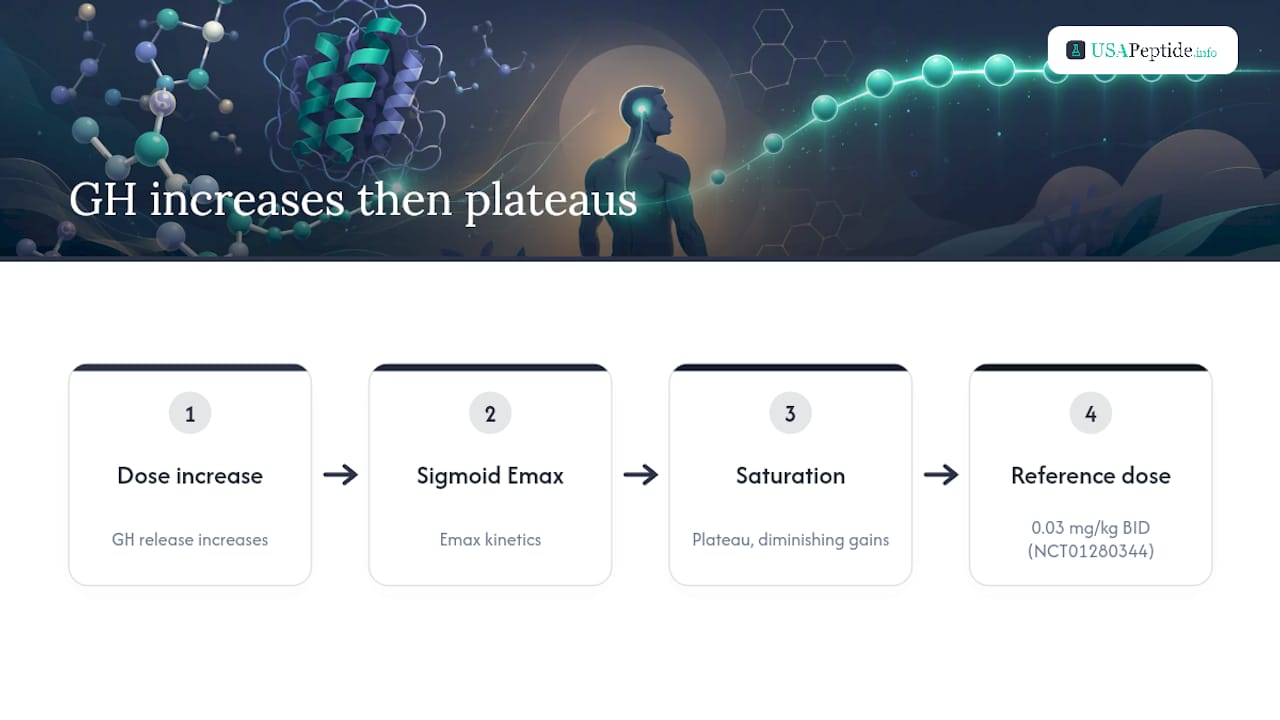
Ipamorelin's dose-response relationship follows sigmoid Emax kinetics. GH release increases with dose up to a saturation point, beyond which additional compound produces diminishing incremental GH output. This plateau behavior is relevant for dose selection in research protocols: doses above the apparent Emax add pharmacokinetic burden without proportional pharmacodynamic gain. The NCT01280344 trial used 0.03 mg/kg BID as one of its dosing arms, providing a reference point for IV research dosing in adult subjects.
Pulsatility and sampling schedule implications
Because GH secretion is inherently pulsatile, ipamorelin-stimulated GH peaks are superimposed on endogenous pulsatile release. Researchers must account for this when designing sampling schedules: a single post-dose GH measurement is insufficient to characterize the full response. Serial sampling within the first 90 minutes post-dose captures the stimulated peak, and continued sampling to 3 hours confirms return to baseline. Designs evaluating tachyphylaxis should include serial sampling across multiple dosing cycles.
Pro Tip: Schedule at least 6 blood draws in the first 90 minutes post-dose (e.g., at 0, 15, 30, 45, 60, and 90 minutes) and 2 additional draws at 120 and 180 minutes to fully characterize both the GH peak and the return to baseline window. This PK/PD insight is consistent with published Phase I sampling strategies.
| PK/PD Parameter | Reported Value / Range | Notes |
|---|---|---|
| Terminal half-life (IV) | Short; consistent with rapid clearance | Exact value varies by study; see Phase I references |
| Tmax (GH peak, IV) | ~30–60 minutes post-dose | Phase I human data |
| GH return to baseline | ~2–3 hours post-dose | Supports BID/TID dosing intervals |
| NCT01280344 IV dose | 0.03 mg/kg BID | Reference clinical research dose |
| Dose-response shape | Sigmoid Emax (saturation behavior) | Plateau observed at higher doses in preclinical models |
| SC vs IV Tmax | SC modestly delayed vs IV | Amplitude broadly comparable at equivalent doses |
## 3. What preclinical studies show about efficacy and safety
The foundational preclinical dataset for ipamorelin comes from Raun et al. (1998), which remains the most-cited primary source on the compound's pharmacology. Working in rat pituitary cell preparations and in vivo swine models, Raun's group demonstrated that ipamorelin produced potent, dose-dependent GH release with an ED50 and Emax profile competitive with GHRP-6 and GHRP-2. The critical distinction was selectivity: at doses producing maximal GH release, ipamorelin did not significantly increase ACTH, cortisol, or prolactin in either species.
Beyond the Raun selectivity findings, rodent bone growth models showed that sustained ipamorelin administration produced measurable increases in longitudinal bone growth, an endpoint mediated through the GH/IGF-1 axis. GI motility studies in rodents supported the rationale for the Helsinn clinical program: ipamorelin's GHS-R1a activity in the enteric nervous system appeared to accelerate GI recovery in animal models of postoperative ileus, providing the translational hypothesis that NCT01280344 was designed to test.
Species differences in potency and Emax are a practical concern for dose scaling. Rats tend to show higher relative GH responses per unit dose than swine, and swine data are generally considered more predictive of human PK/PD given their closer physiological similarity. Researchers scaling from rodent to human doses should apply allometric scaling with caution and anchor to the swine data where available.
Key translational limitations:
- Preclinical GH release endpoints do not directly predict human body composition outcomes; DXA-measured lean mass and fat mass require dedicated human RCTs.
- Animal GI motility models differ mechanistically from postoperative human ileus, which involves surgical trauma, anesthesia, and opioid exposure as confounders.
- No published carcinogenicity or chronic toxicology studies in standard rodent models are available in the peer-reviewed literature, a gap that limits long-term safety characterization.
- The PMC review explicitly cautions that animal body composition data for GH secretagogues should not be used to justify human therapeutic claims without corroborating RCT evidence.
## 4. Human clinical evidence: trials, results, and what remains untested
The Phase I landscape
Phase I human PK/PD studies established that ipamorelin produces dose-dependent GH peaks in healthy volunteers after IV administration, with a time course consistent with preclinical predictions. Published Phase I data confirmed the ~30–60 minute GH peak and ~2–3 hour return to baseline, and showed no clinically significant ACTH or cortisol elevations at GH-releasing doses, replicating the selectivity observed in animals. These studies provided the PK/PD rationale for the Helsinn Phase II program.
NCT01280344: the Helsinn Phase II GI recovery trial
The only completed Phase II randomized controlled trial is NCT01280344, sponsored by Helsinn Therapeutics. The trial enrolled adult patients undergoing bowel resection and randomized them to ipamorelin (including a 0.03 mg/kg BID IV arm) or placebo, with the primary endpoint focused on time to recovery of GI function. The trial was completed, and the registry entry documents the study design, dosing arms, and predefined efficacy and safety outcomes.
The trial did not meet its primary efficacy endpoint. Numeric trends in GI recovery parameters were observed in treated arms, but the differences did not reach statistical significance on the prespecified primary measure. This outcome is the single most important fact in the human clinical evidence base: the only adequately designed, placebo-controlled human efficacy trial of ipamorelin produced a negative result on its primary endpoint.
| Trial | Phase | Design | Indication | Key Dose | Primary Endpoint | Outcome |
|---|---|---|---|---|---|---|
| NCT01280344 | II | Randomized, placebo-controlled | Postoperative GI recovery (bowel resection) | 0.03 mg/kg BID IV | Time to GI function recovery | Primary endpoint not met |
| Phase I PK/PD studies | I | Open-label PK/PD | Healthy volunteers | Dose-ranging IV | GH peak, PK parameters | GH peaks confirmed; selectivity replicated |
What has never been tested in humans
The gap between marketed claims and actual trial evidence is substantial. No completed RCT has evaluated ipamorelin for:
- Body composition endpoints (lean mass, fat mass by DXA)
- Muscle strength or functional outcomes
- Long-term metabolic effects or IGF-1 normalization in deficient populations
- Anti-aging or cognitive endpoints
- Combination regimens with GHRH analogs in human subjects
A critical synthesis of the available evidence concludes that human efficacy for most marketed indications is unsupported by trial data, and that the selectivity advantage demonstrated preclinically has not translated into a proven clinical benefit in any completed RCT.
## 5. Safety profile, adverse events, and monitoring recommendations
Adverse events from the Phase II trial
The NCT01280344 trial provides the most structured human safety dataset for ipamorelin. Adverse events reported in the trial included nausea, vomiting, abdominal distension, hypokalemia, and insomnia. These events were observed in both active and placebo arms, reflecting the postoperative surgical context rather than ipamorelin-specific toxicity in most cases, though comparative rates between arms inform attribution. Serious adverse events (SAEs) were documented and coded per MedDRA conventions; the registry entry lists the safety outcome framework.

Hormonal safety profile
Across both preclinical and Phase I human studies, ipamorelin did not produce clinically significant elevations in ACTH, cortisol, or prolactin at GH-releasing doses. This distinguishes it from GHRP-6, which activates the HPA axis at effective GH doses and complicates safety monitoring in research subjects. The absence of cortisol elevation at therapeutic doses reduces the risk of HPA-axis suppression as a monitoring concern, though researchers should still include cortisol in baseline and follow-up panels.
No QT prolongation signals have been reported in the published literature for ipamorelin at research doses, though formal cardiac safety studies are not available in the peer-reviewed record.
Laboratory and metabolic monitoring checklist for human research
Researchers conducting human ipamorelin studies should include the following monitoring parameters:
- Hormonal panel: GH (serial, per sampling schedule), IGF-1 (baseline and follow-up), cortisol (baseline and post-dose), ACTH (baseline), prolactin (baseline)
- Metabolic panel: Fasting glucose, insulin, HbA1c at baseline and study end; GH can induce transient insulin resistance
- Electrolytes: Potassium (hypokalemia was observed in NCT01280344), sodium, magnesium
- ECG: Obtain at baseline; repeat if subjects report palpitations or if doses exceed published Phase I ranges
- Liver function tests: ALT, AST at baseline and follow-up for studies exceeding 4 weeks
Adverse event reporting and follow-up guidance
- Code all adverse events using MedDRA System Organ Class and Preferred Term conventions.
- Apply a 30-day follow-up window for SAEs after last dose, consistent with standard Phase II practice.
- Pre-specify stopping rules for GH or IGF-1 values exceeding 2 standard deviations above the age-adjusted reference range.
- Report any unexpected endocrine findings (ACTH or cortisol elevation above baseline) to the IRB as a protocol deviation requiring review.
- For studies using SC administration, monitor injection site reactions separately from systemic adverse events.
## 6. U.S. regulatory status and how researchers legally source ipamorelin
Ipamorelin is not approved by the FDA for any indication. No NDA, BLA, or 505(b)(2) application for ipamorelin has been approved, and no completed Phase III trial exists in the ClinicalTrials.gov registry. Published review literature confirms the absence of regulatory approval and Phase III data as of the most recent indexed records.
For research use in the United States, ipamorelin is procured as a research-grade compound through channels appropriate to the investigational context. The FDA's bulk drug substance framework and compounding regulations are relevant to any clinical or translational use; researchers and research pharmacies should consult current FDA guidance and institutional compliance officers before procuring compounded ipamorelin for human studies. This article does not constitute legal or regulatory advice.
For preclinical and in vitro research, procurement from suppliers holding ISO 17025 accreditation and providing Certificates of Analysis (COA) with HPLC purity data and mass spectrometry confirmation is the standard of practice.
Compliance checklist for institutional review boards and research pharmacies:
- Confirm IND (Investigational New Drug) status or exemption before any human administration.
- Obtain IRB approval with a protocol specifying ipamorelin's investigational status and the absence of FDA approval.
- Document the supplier's ISO 17025 accreditation and COA for every lot used in human studies.
- Verify that the compounding pharmacy (if applicable) operates under current FDA compounding guidance for investigational use.
- Maintain chain-of-custody documentation from supplier to dispensing.
- For comparison, tesamorelin provides a useful regulatory benchmark: it is an FDA-approved GHRH analog with a defined clinical development pathway, illustrating the evidentiary standard ipamorelin has not yet reached.
## 7. Research gaps and the highest-priority next studies
The current ipamorelin evidence base leaves several high-value clinical hypotheses untested. Prioritizing the following studies would most efficiently close the gap between preclinical promise and clinical utility.
-
Body composition RCT with DXA endpoints. A randomized, placebo-controlled trial measuring lean mass and fat mass by DXA in a defined population (e.g., older adults with age-related GH decline, or hypogonadal males) would directly test the most widely marketed claim. Sample size should be powered on a minimum clinically important difference in lean mass, with IGF-1 kinetics as a secondary pharmacodynamic endpoint.
-
Long-term metabolic effects study. A 6–12 month trial with fasting glucose, insulin sensitivity (HOMA-IR or hyperinsulinemic clamp), and HbA1c endpoints would characterize the metabolic risk profile of sustained GH elevation, a gap that limits safety characterization for chronic use.
-
Combination with GHRH analogs. A dose-ranging PK/PD study of ipamorelin combined with a GHRH analog (e.g., sermorelin or CJC-1295) in healthy volunteers would quantify the synergistic GH response and identify the optimal ratio and timing for combination protocols. This design should include receptor desensitization (tachyphylaxis) assessments across multiple dosing cycles.
-
Receptor desensitization and tachyphylaxis studies. Serial GH sampling across 7–14 days of continuous dosing would determine whether GHS-R1a downregulation attenuates the GH response over time, a mechanistic question with direct implications for dosing interval design.
-
Translational mechanistic signaling studies. In vitro work characterizing GHS-R1a internalization, beta-arrestin recruitment, and downstream MAPK versus PKC pathway activation would clarify whether ipamorelin's selectivity is receptor-level or post-receptor, informing rational analog design.
-
Pragmatic Phase II trial for a new indication. A go/no-go design with a 12-week treatment period, a primary endpoint of IGF-1 normalization (as a PD surrogate), and a prespecified interim analysis at week 6 would provide a decision-ready dataset within a feasible timeline. Enrollment of 60–80 subjects per arm provides 80% power to detect a moderate effect size on IGF-1 at a two-sided alpha of 0.05.
Pro Tip: When designing a body composition trial, include functional outcome measures (grip strength, 6-minute walk test) alongside DXA. Regulatory reviewers and journal editors increasingly require functional endpoints to establish clinical meaningfulness beyond body composition changes alone. For context on sleep-related peptide endpoints, which remain entirely untested for ipamorelin, that gap represents a low-cost add-on to any multi-endpoint Phase II design.
## 8. Practical tools for researchers: COA verification, assay selection, and quality control
Reagent quality is a non-negotiable prerequisite for interpretable ipamorelin studies. Researchers should request and review the COA before any lot is used in a study.
COA verification checklist:
- Confirm HPLC purity ≥99% with a chromatogram showing peak identity and integration.
- Verify molecular weight by MS against the theoretical value for Aib-His-D-2-Nal-D-Phe-Lys-NH2 (~711.9 Da); PubChem CID 20515892 provides the canonical reference.
- Check that the supplier holds ISO 17025 accreditation for the analytical methods used.
- Confirm lot-specific testing (not batch-representative certificates from a different lot).
- Verify storage conditions specified on the COA match your laboratory's capabilities (typically lyophilized powder at -20°C, protected from light).
Bioanalytical assay selection
For GH quantification, use a validated immunoassay calibrated against the WHO International Standard for GH (currently the 98/574 standard). ELISA-based assays are adequate for most research applications; chemiluminescent immunoassays offer lower detection limits for studies requiring sensitivity at baseline GH concentrations. IGF-1 should be measured by a validated immunoassay with acid-ethanol extraction to remove binding proteins, which otherwise suppress the signal.
Plasma samples for GH should be collected into EDTA tubes, centrifuged within 30 minutes of collection, and stored at -80°C until analysis. Freeze-thaw cycles degrade GH; limit to two cycles maximum.
Pro Tip: Use the USAPeptide COA grading tool to assess the legitimacy of a supplier's Certificate of Analysis before ordering. The tool evaluates key quality markers including HPLC purity documentation, MS confirmation, and ISO 17025 accreditation status, reducing the risk of procuring substandard material that would compromise study validity.
USAPeptide's ipamorelin peptide profile page provides the molecular profile, available COA information, and a research-oriented pharmacology summary that can support protocol preparation. The platform's dosing calculator assists with weight-based dose calculations for research protocols using mg/kg dosing regimens.
How this synthesis was compiled
Search strategy and inclusion criteria:
- Databases searched: PubMed, PMC, ClinicalTrials.gov, PubChem, and specialist peptide review sites, with searches conducted through early 2026.
- Inclusion criteria: Peer-reviewed publications (original research and systematic reviews), registered clinical trials with publicly available registry data, and validated preclinical models with quantitative GH or endocrine endpoints.
- Primary trial data: NCT01280344 registry entry guided the clinical evidence section; the Raun et al. (1998) publication served as the primary source for pharmacology and preclinical sections.
- Exclusion: Unpublished claims, non-peer-reviewed marketing materials, and anecdotal reports were excluded from evidence statements. Where synthesis sites (Peptide Garden, PeptideInsight) were cited, they were used for their synthesis and compilation value, not as primary data sources.
- Conflict of interest: This article was produced by the USAPeptide Team. USAPeptide operates as a research peptide reference platform and refers researchers to ISO 17025-accredited suppliers. All evidence statements are linked to primary or peer-reviewed sources.
The USAPeptide Team's perspective on responsible ipamorelin research
Ipamorelin's selectivity profile is genuinely useful. The ability to stimulate GH release without concurrent HPA axis activation is a pharmacological advantage that simplifies study design and reduces confounding in mechanistic experiments. That advantage is real, and it is well-supported by the Raun et al. data.
What the evidence does not support is the leap from "selective GH release in rats and swine" to "proven body composition benefits in humans." That leap is made routinely in wellness and anti-aging marketing, and it is not justified by the trial record. The Helsinn Phase II trial, the most rigorous human test of ipamorelin to date, failed its primary endpoint. No Phase III trial exists. No RCT has ever measured DXA-confirmed lean mass or fat mass in humans treated with ipamorelin.
Researchers considering ipamorelin studies should treat it as what it is: a pharmacologically interesting tool with a clean preclinical selectivity profile, a short human PK/PD dataset, and one negative Phase II result. The next studies that matter are adequately powered RCTs with meaningful endpoints, not further mechanistic replication of what Raun already showed in 1998. Prioritize study design rigor, pre-register your protocol, and resist the pressure to over-interpret Phase I PK/PD data as evidence of therapeutic efficacy.
Research-grade ipamorelin resources for qualified investigators
Researchers who have reviewed the evidence above and are preparing an ipamorelin study protocol need two things before ordering compound: verified molecular identity and a quality-assured reagent. USAPeptide provides both through its ipamorelin peptide profile, which documents the compound's sequence, molecular weight, and available COA data, and its COA grading tool, which evaluates supplier documentation against ISO 17025 and HPLC purity standards.

For researchers designing recovery or GI-focused studies, the tissue recovery peptide category provides comparative context on related compounds and endpoint frameworks. The platform's dosing calculator supports weight-based protocol calculations for mg/kg dosing regimens used in both preclinical and clinical research designs.
To access the ipamorelin molecular profile, COA verification tool, and dosing calculator, visit USAPeptide and navigate to the ipamorelin compound page. All tools are available to qualified researchers at no charge.
Sources
- Safety and Efficacy of Ipamorelin Compared to Placebo for the Recovery of Gastrointestinal Function
- Ipamorelin, the first selective growth hormone secretagogue
- Beyond the androgen receptor: the role of growth hormone secretagogues in the modern management of body composition in hypogonadal males
- Ipamorelin
- Ipamorelin: Evidence, Safety, and What the Research Actually Shows — Peptide Garden
- Ipamorelin: Research Evidence & Safety Profile | PeptideInsight