
Peptide delivery systems have matured unevenly across routes. Parenteral injection remains the clinical default, oral delivery is viable for a narrow set of potent peptides using permeation enhancers and device-assisted platforms. Transdermal or nanoparticle-based approaches are advancing but largely preclinical. Cell-penetrating peptides, peptide-drug conjugates, and self-assembled nanostructures now dominate design strategy discussions. For researchers, the near-term priority is matching a peptide's physicochemical profile to a delivery platform rather than chasing a universal carrier.
TL;DR:
- Parenteral injection remains the most reliable route for systemic peptide delivery despite patient burden and logistical challenges.
- Oral delivery faces significant barriers from acid, enzymes, and mucus, but potency can compensate for low bioavailability, as seen with GLP-1 agonists.
- Microneedle and combination transdermal systems can achieve systemic delivery but require complex formulations and combined enhancement strategies.
- Targeted intracellular delivery using receptor-specific peptides and endosomal escape techniques adds complexity but enables precise tissue and cell-level intervention.
- Early verification of peptide purity and molecular profile through accredited testing is essential before advancing any formulation or delivery platform.
Table of Contents
- What Are the Main Peptide Delivery Routes and Their Trade-Offs?
- How Do Molecular Engineering Strategies Improve Peptide Delivery?
- What Formulation Strategies Overcome Oral Peptide Delivery Barriers?
- Can Transdermal Systems Deliver Peptides Systemically?
- How Do Targeted and Intracellular Peptide Delivery Strategies Work?
- What Formulation and Manufacturing Factors Affect Clinical Translation?
- What Resources Does USAPeptide Provide for Delivery Research?
- What Should Researchers Check Before Selecting a Delivery Strategy?
- Where Is Peptide Delivery Research Headed?
- Where Can Researchers Source Peptides for Delivery Studies?
- Sources
What Are the Main Peptide Delivery Routes and Their Trade-Offs?
Route selection for any peptide delivery system starts with a hard constraint: peptides are large, polar, and enzymatically fragile molecules that biology actively works to destroy. Each administration route negotiates a different subset of these obstacles.
Parenteral delivery (subcutaneous, intravenous, intramuscular) remains the gold standard for bioavailability, typically achieving very high systemic exposure because it bypasses the gut and skin entirely. It's the default for peptides like insulin analogs, GLP-1 agonists in their injectable forms, and most research peptides used in tissue repair and metabolic studies. The tradeoff is obvious: patient burden, cold-chain logistics, and injection-site reactions.
Oral delivery faces the steepest uphill climb. Gastric acid, proteolytic enzymes, mucus layers, and intestinal epithelium combine to reduce systemic bioavailability to very low levels for most unmodified peptides, according to recent literature reviews on oral peptide pharmacokinetics. That said, low bioavailability doesn't equal clinical failure, a point worth returning to when discussing potency.
Transdermal and topical delivery avoids first-pass hepatic metabolism and offers sustained release, but the stratum corneum blocks passive diffusion of anything larger than roughly 500 Da, which rules out most peptides without a physical or chemical enhancement strategy.
Mucosal routes (nasal, buccal, pulmonary) offer a middle ground: thinner epithelial barriers and rich vasculature, but variable enzymatic activity and mucociliary clearance limit consistency.
Device-assisted oral systems represent a distinct category, using mechanical or microneedle-based mechanisms to inject the peptide directly through the gut wall, sidestepping enzymatic and permeability barriers rather than trying to out-formulate them.
Route choice ultimately follows the molecule. Key drivers include:
- Molecular weight and charge density, which dictate passive permeability across any epithelium
- Metabolic stability against local proteases (pepsin and trypsin in the gut, skin esterases in transdermal contexts)
- Required pharmacokinetic profile, since a peptide needing sustained plasma levels favors depot injections or transdermal patches over a fast-clearing oral dose
- Target tissue location, since local or regional delivery can tolerate lower systemic exposure than a peptide meant for distant organs
How Do Molecular Engineering Strategies Improve Peptide Delivery?
Formulation can only do so much if the peptide itself is fragile or membrane-impermeant. That's why a parallel track of molecular engineering strategies has grown alongside formulation science, modifying the peptide's own structure to survive delivery and reach its target.
Cell-penetrating peptides (CPPs) are short, typically cationic or amphipathic sequences (TAT, penetratin, and their derivatives) that promote cellular uptake by disrupting or crossing the plasma membrane. Their uptake mechanism depends heavily on concentration, cell type, and cargo size: at lower concentrations, CPPs tend to enter via endocytosis, while higher concentrations can trigger direct membrane translocation. The catch is that CPPs entering through endocytosis frequently become trapped in endosomes, where they are degraded before ever reaching the cytosol, a mechanistic bottleneck confirmed across multiple CPP mechanism reviews. Designing for the intended uptake route, and testing it directly, is not optional.
Peptide-drug conjugates (PDCs) attach a cytotoxic or therapeutic payload to a targeting peptide through a cleavable or stable linker. Linker chemistry determines everything: a linker cleaved too early releases payload systemically and causes off-target toxicity, while one that's too stable never releases the drug intracellularly. Receptor selection (integrins, somatostatin receptors, and others) governs tissue specificity, and this class has seen growing preclinical and early clinical trial activity, particularly in oncology.
Chemical modifications extend peptide half-life and resist enzymatic attack without changing the core pharmacophore too much:
- Cyclization locks the peptide backbone into a constrained conformation, blocking exopeptidase access
- D-amino acid substitution resists proteolysis because most proteases are stereospecific for L-amino acids
- PEGylation increases hydrodynamic size and reduces renal clearance, extending circulation time
- Lipidation (fatty acid conjugation, as used in semaglutide) promotes albumin binding, which slows clearance and can aid membrane association
Self-assembled nanostructures use peptide amphiphiles or beta-sheet-forming sequences that spontaneously organize into micelles, nanofibers, or hydrogels. Assembly kinetics and stability control the release profile: tighter packing and stronger intermolecular forces slow diffusion of encapsulated cargo, giving formulators a lever for sustained release without extra excipients.
| Strategy | Primary mechanism | Main design trade-off |
|---|---|---|
| CPPs | Membrane translocation or endocytosis | Endosomal entrapment vs. cytotoxicity at high dose |
| PDCs | Receptor-mediated targeted delivery | Linker stability vs. payload release efficiency |
| Cyclization | Conformational lock resists exopeptidases | Synthesis complexity vs. protease resistance gained |
| Lipidation | Albumin binding extends half-life | Added lipophilicity vs. formulation solubility |
| PEGylation | Steric shielding reduces clearance | Extended half-life vs. potential reduced receptor affinity |
| Self-assembled nanostructures | Physical encapsulation and sustained diffusion | Assembly stability vs. controlled release kinetics |
What Formulation Strategies Overcome Oral Peptide Delivery Barriers?
Oral peptide administration has to defeat four barriers stacked in sequence: gastric and intestinal proteolysis, the mucus layer, epithelial permeability, and hepatic first-pass metabolism. No single excipient solves all four, which is why modern oral peptide formulations are multi-component systems.
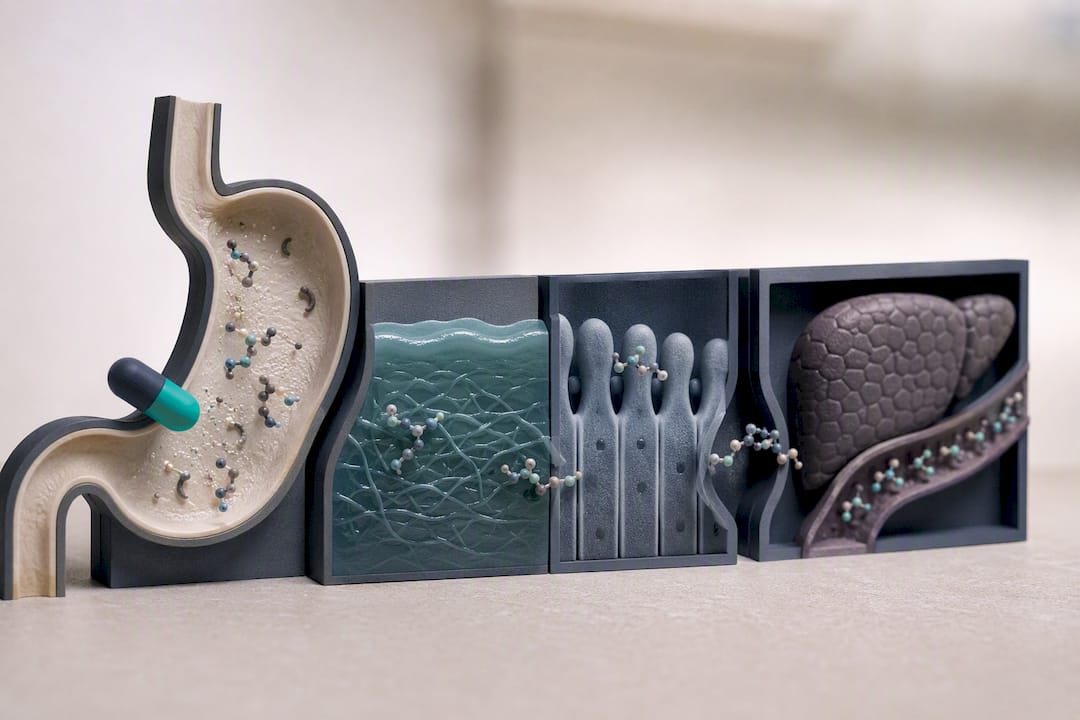
Permeation enhancers loosen tight junctions or transiently disrupt membrane integrity to let peptides cross the epithelium. Sodium caprate (C10) and medium-chain fatty acid derivatives open paracellular pathways. SNAC (salcaprozate sodium) and related agents work differently, forming transient non-covalent complexes with the peptide that improve monomeric permeation across the gastric epithelium, a mechanism central to the oral semaglutide platform. Bile salts and their synthetic analogs disrupt the mucus barrier and can co-solubilize lipophilic enhancers, though excessive use raises tolerability concerns.
Protease inhibitors (aprotinin, soybean trypsin inhibitor, camostat) block enzymatic degradation locally but risk disrupting normal digestive protein handling if absorbed systemically, so most formulations aim for localized, non-absorbed inhibitor activity.
pH modulators buffer the immediate microenvironment around the dosage form, protecting acid-labile peptides from gastric degradation before they reach the more favorable intestinal pH.
Mucoadhesive polymers prolong residence time at the absorption site, giving permeation enhancers more contact time to act before the dosage form transits past the absorptive window.
Translating a liquid prototype that works in a beaker into a stable, swallowable tablet is its own engineering problem. Excipients need to survive tableting pressure and dissolve in a coordinated sequence, releasing the enhancer and the peptide close enough together in space and time to actually work together. Losing that co-localization in the gut, where dosage form components can disperse before either becomes active, is a documented and common translational failure mode.
Pro Tip: When screening enhancer and peptide combinations in early formulation work, test the solid dosage form's disintegration and co-localization behavior in simulated intestinal fluid before moving to animal studies. A formulation that looks perfect in solution can fail entirely once tableted if the enhancer disperses faster than the peptide dissolves.
Device-assisted oral systems bypass the co-localization problem entirely. Ingestible mechanisms broadly grouped under names like microneedle capsules or self-orienting injector devices use a pH-triggered or enzymatically triggered mechanism to deploy a microneedle or jet injection directly into the intestinal wall, delivering the peptide without relying on passive absorption at all. These platforms remain in earlier clinical and preclinical stages relative to enhancer-based tablets, but reviews of oral peptide therapeutics treat them as a serious complementary track, not a novelty.
The clinical upside of all this engineering is worth stating plainly: a peptide with 1 to 2 percent oral bioavailability can still be therapeutically effective if it is potent enough at the receptor level. Oral GLP-1 receptor agonists are the clearest proof of concept, achieving meaningful glycemic control despite bioavailability figures that would sink a less potent molecule. That single data point reframes the entire oral delivery conversation: the goal isn't maximizing absorption, it's achieving sufficient absorption for a given potency. Detailed dosing considerations for GLP-1 class research peptides are covered in USAPeptide's GLP-1 agonists lab guide.
Can Transdermal Systems Deliver Peptides Systemically?
Passive transdermal delivery almost never works for peptides on its own. The stratum corneum's roughly 500 Da cutoff for passive diffusion excludes essentially every therapeutic peptide, which typically ranges from 1,000 Da into the tens of thousands. Getting a peptide through skin requires either a physical breach or a chemical trick to temporarily widen that gate.
Microneedle arrays are the most direct solution, creating micron-scale channels that physically bypass the stratum corneum without reaching pain-sensing nerve endings in the dermis. Three designs dominate current research:
- Solid microneedles pre-treat skin to create channels, followed by topical peptide application
- Dissolving microneedles encapsulate the peptide directly in a biodegradable matrix that dissolves after insertion, releasing payload as the needle material erodes
- Coated microneedles carry a dried peptide layer on the needle surface that dissolves rapidly on skin contact
Iontophoresis applies a low-level electric current to drive charged peptide molecules through skin via electrophoresis and electroosmosis, offering fine control over dose rate but limited depth of penetration on its own.
Sonophoresis uses ultrasound to disrupt lipid packing in the stratum corneum, temporarily increasing permeability, and is often paired with chemical enhancers for additive effect.
Reviews of transdermal peptide and protein delivery consistently note that combining approaches beats any single method, since chemical penetration enhancers paired with microneedles or iontophoresis can achieve sustained systemic delivery that avoids first-pass metabolism entirely, a meaningful advantage over oral routes for peptides that are heavily degraded by hepatic enzymes. More specifically, combining microneedles with dissolvable matrix carriers or iontophoresis substantially increases practical systemic uptake over either method alone, which is why most serious transdermal peptide programs now default to combination platforms rather than single-mechanism designs.
Formulation carriers matter here too. Hydrogel matrices, liposomal carriers embedded in patches, and lipid nanoparticle formulations all improve peptide stability and skin partitioning, but each added component (device plus drug plus carrier) increases regulatory complexity, since combination products typically require review pathways that address both the device and drug components together.
How Do Targeted and Intracellular Peptide Delivery Strategies Work?
Getting a peptide into general circulation solves only half the problem for many indications. Oncology, gene-modulating therapies, and intracellular signaling targets all require the peptide to reach a specific tissue and, often, a specific subcellular compartment.
Homing peptides and receptor-directed targeting exploit differential receptor expression between diseased and healthy tissue. Integrin-binding sequences (RGD motifs) target tumor neovasculature, HER2-directed peptides concentrate delivery in HER2-overexpressing breast cancer cells, and EGFR-targeting sequences serve a similar role in EGFR-driven tumors. These aren't single mechanisms but a class of receptor-targeting strategies, each requiring its own affinity optimization and specificity testing.
Endosomal escape is frequently the actual bottleneck once a targeted peptide gets into the cell. Receptor-mediated endocytosis delivers cargo into an endosome, and unless that cargo escapes before lysosomal fusion, it gets degraded without ever reaching its cytosolic or nuclear target. Three strategies address this:
- pH-sensitive carriers that destabilize as the endosome acidifies, releasing cargo into the cytoplasm
- Fusogenic lipids or peptides that mimic viral fusion mechanisms to disrupt the endosomal membrane directly
- Polymeric endosomolytic systems (proton-sponge polymers) that cause osmotic swelling and endosomal rupture
Reviews of CPP mechanisms consistently identify endosomal escape as the rate-limiting step for intracellular cargo delivery, which means early in vitro assays should test cytosolic delivery directly, not just cellular uptake, because a peptide can show strong uptake signal by microscopy while remaining almost entirely endosome-trapped.
Every targeting gain comes with a cost. Higher receptor affinity often means slower clearance from off-target tissue expressing the same receptor at lower density, and repeated dosing of targeting peptides can trigger immunogenic responses that reduce efficacy over subsequent doses. Balancing affinity against these off-target and immunogenicity risks is now a standard part of any targeted peptide delivery program's early screening.
What Formulation and Manufacturing Factors Affect Clinical Translation?
A peptide delivery system that works in a research lab often fails at scale, and the reasons are rarely exotic. They tend to be excipient sourcing, process reproducibility, and stability under real storage conditions.
Excipient selection has to account for more than compatibility in a single formulation batch. Regulatory agencies scrutinize excipient safety data at the doses required for permeation enhancement, since some enhancers effective at research concentrations exceed established safety thresholds for chronic human dosing. Co-localization, discussed earlier for oral solid dosage forms, remains the single most common point of translational failure when moving from liquid prototype to tablet.
Scalable and sustainable manufacturing is becoming a genuine bottleneck rather than a footnote. Peptide synthesis at commercial scale generates substantial solvent waste, and the industry's own literature increasingly frames sustainable, scalable manufacturing approaches as inseparable from a program's real-world clinical impact, not just an environmental afterthought. Supply chain resilience for specialized excipients like SNAC-class permeation enhancers adds another layer of CMC (chemistry, manufacturing, and controls) risk that formulation teams need to plan around early, not after Phase 1.
Reading translational signals accurately protects research time and budget:
- Track PK/PD targets against the specific receptor occupancy or plasma concentration needed for efficacy, not generic bioavailability benchmarks
- Use predictive animal models that account for species differences in gut enzyme expression and skin thickness, since a formulation that performs well in rodents can behave very differently in larger animals
- Check active clinical trial registries for comparable delivery platforms, since trial registry data reveals which formulation approaches are actually advancing versus stalling in early-phase studies
Excipient and carrier selection also benefits from cross-disciplinary formulation science. Antioxidant delivery technology, for instance, faces comparable stability and carrier-selection challenges, and the broader formulation strategies used for antioxidant delivery offer useful comparative context for peptide formulators evaluating carrier chemistries. For dosing translation once a platform is selected, USAPeptide's calculator-first dosing guide walks through reconstitution math relevant to PK planning.
What Resources Does USAPeptide Provide for Delivery Research?
Formulation decisions are only as good as the compound data behind them. USAPeptide's database provides molecular profiles and mechanism-of-action summaries for a wide range of research peptides, giving formulators a starting reference point before designing a delivery strategy around a given molecule.
Every listed compound is tested to ≥99% HPLC purity under ISO 17025-accredited protocols, with a Certificate of Analysis verifying identity for each batch. That matters directly for PK/PD reproducibility: a batch with unverified purity or unknown degradation products introduces variability that can masquerade as a delivery system failure when it's actually a compound quality problem.
Reproducibility in peptide delivery research depends on knowing exactly what's in the vial before testing how it crosses a membrane. A COA that hasn't been independently checked for internal consistency is a variable, not a constant.
The COA grading tool lets researchers assess whether a supplier's Certificate of Analysis meets expected legitimacy standards, an increasingly relevant check given how much delivery system research depends on knowing a peptide's true purity and identity before attributing any absorption or stability result to the formulation itself. The peptide dosing calculator supports reconstitution and dosing math for research-scale PK work.
What Should Researchers Check Before Selecting a Delivery Strategy?
Choosing a delivery platform comes down to matching molecular data to route constraints, not defaulting to whatever's most familiar in the lab.
- Confirm molecular weight, charge, and stability profile against gastric, epidermal, or serum protease exposure relevant to the intended route.
- Run early permeability screens (Caco-2 for oral, Franz cell for transdermal) before committing to a specific enhancer platform.
- Establish the PK target: peak concentration needs favor injection or microneedle, sustained exposure favors depot or transdermal systems.
- Test cytosolic delivery directly, not just cellular uptake, for any CPP or intracellular targeting strategy.
- Verify compound purity and identity through a COA before attributing any delivery result to formulation performance rather than compound quality.
Where Is Peptide Delivery Research Headed?
The next real gains in peptide delivery systems will come from computation, not just chemistry. Experts increasingly point to molecular docking and predictive modeling as the tools that will de-risk excipient selection before it ever reaches a bench, cutting down the trial-and-error cycles that currently define oral and transdermal formulation work.
We'd also push back gently on how the field talks about manufacturing. It gets treated as a downstream concern, something to solve after the science works. That's backwards. Sustainable, scalable synthesis constrains which delivery platforms are even viable candidates for a clinical program, and teams that ignore it early tend to redesign their formulation strategy later at far greater cost.
For researchers running these experiments now, the priority is simple: verify compound quality before troubleshooting delivery performance, and use tools like USAPeptide's COA grading system to remove that variable from the equation entirely.
— USAPeptide Team
Where Can Researchers Source Peptides for Delivery Studies?
Design work on CPPs, PDCs, or oral enhancer systems means little without a reliable, well-characterized peptide to test. USAPeptide's advantage for delivery researchers is straightforward: every compound in the database ships with a verified Certificate of Analysis and ISO 17025-accredited purity testing, so you're not spending weeks confirming basic identity before your actual delivery experiment even starts.

The peptide database covers molecular profiles for compounds spanning metabolic, tissue repair, and cognitive research categories, giving you mechanism-of-action context before you commit lab time to a formulation approach. The dosing calculator handles reconstitution math for PK planning, and the COA grading tool lets you independently verify a supplier's certificate before a batch ever reaches your bench. For sourcing research-grade compounds directly, USAPeptide's Peptriva resource center connects researchers to ISO 17025-accredited suppliers with same-day shipping. Start there if your next step is running an actual permeability or stability assay rather than another literature review.
This article is general information, not a substitute for advice from a qualified doctor. Consult a qualified healthcare professional about your own circumstances before acting on anything here.
Sources
- PubMed indexed article (2025–2026 literature summary)
- Nature Reviews Drug Discovery — Advances in oral peptide therapeutics