A trustworthy peptide COA has four elements that must all check out before you accept a batch: a batch or lot number matching the vial label, a named third-party laboratory with a verifiable Report ID, a visible HPLC chromatogram, and mass spectrometry data matching the theoretical mass within a stated tolerance. If any one of these is missing, inconsistent, or unverifiable, quarantine the material and request batch-specific raw data or independent testing before it enters an experiment.
TL;DR:
- Confirm that the batch number matches the vial label exactly and that the Report ID is unique and verifiable on the lab's official portal.
- Check that the COA includes a clear chromatogram with specific method parameters and a mass spectrum with observed mass within narrow tolerance limits.
- Ensure the COA lists a verified laboratory with accreditation, analyst signature, and recent analysis and issue dates, avoiding reused or outdated documents.
- Be cautious of identical chromatograms across lots, suspiciously perfect purity numbers, or missing raw data files that could indicate fabrication or manipulation.
- Request raw chromatogram and MS spectra if multiple verification checks fail, and keep a log of all COAs to identify patterns of documentation issues over time.
Table of Contents
- What Does Peptide COA Verification Actually Involve?
- A 12-Point COA Verification Checklist You Can Run in 5 to 10 Minutes
- How Do You Read an HPLC Purity Chromatogram?
- How Do You Compare Observed and Theoretical Mass on a COA?
- Why Purity Percentage Is Not the Same as Net Peptide Content
- When Do Endotoxin and Sterility Results Matter on a COA?
- How Do You Verify a Report ID Isn't Fabricated?
- What Should You Do When a COA Looks Suspicious?
- Walking Through an Annotated Sample COA
- USAPeptide Resources That Support COA Verification
- Why Rigorous COA Verification Protects Reproducibility
- How USAPeptide Supports Verified Procurement
- Sources
- FAQ
What Does Peptide COA Verification Actually Involve?
Peptide COA verification is the process of confirming that a Certificate of Analysis reflects real, batch-specific testing rather than a reused or fabricated document. It combines document forensics (checking Report IDs, dates, and lab credentials) with scientific literacy (reading chromatograms and mass spectra correctly). Researchers who skip this step risk building experiments on unverified material, which can quietly undermine reproducibility months later when results won't replicate.
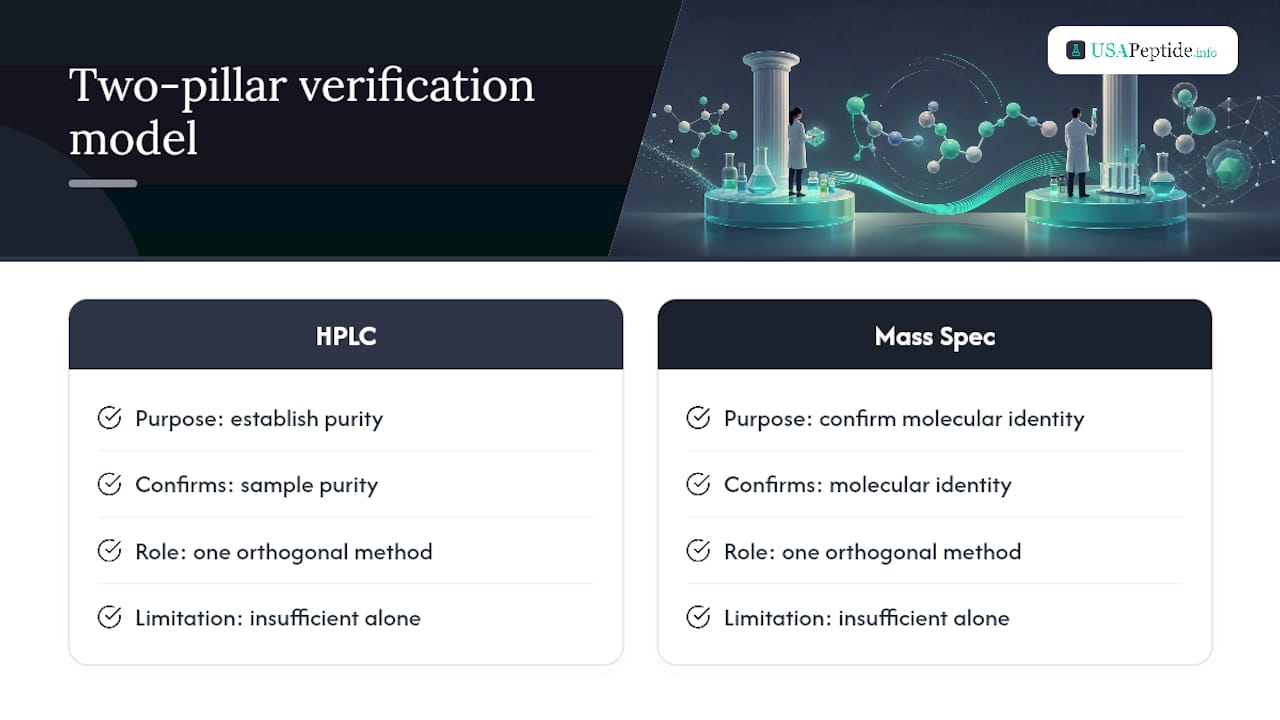
The standard industry term for this practice is analytical verification or COA authentication, and it rests on two pillars: identity confirmation and purity confirmation. Effective verification requires two orthogonal methods working together. HPLC establishes purity, while mass spectrometry confirms molecular identity, and neither method alone is sufficient. Understanding how these two data types interact is the foundation everything else in this guide builds on.
A 12-Point COA Verification Checklist You Can Run in 5 to 10 Minutes
Before any batch reaches the bench, run through this sequence. It takes less time than setting up a single assay.
- Batch or lot number: Confirm it appears on both the COA and the vial label, character for character.
- Named testing laboratory: Look for a real lab name, physical address, and stated accreditation, not just "third-party tested."
- Analysis and issue dates: A COA dated years before the batch shipped signals a reused or generic document.
- HPLC purity and chromatogram: The percentage alone means nothing without the visual trace and method parameters.
- Mass spectrometry identity data: Observed mass should sit within a narrow, stated tolerance of theoretical mass.
- Net peptide content and counterion note: Purity percentage and actual peptide mass per vial are two different numbers.
- Endotoxin, sterility, or residual solvent data: Required when the compound is intended for any application beyond simple in vitro dilution.
- Analyst signature and report version: A COA with no named analyst or version number is difficult to trace back to anyone accountable.
- Report ID or verification key: This should be unique per batch, not shared across multiple product listings.
- Visual red flags: Watch for identical chromatograms across different lots or suspiciously round purity numbers.
- Verification portal check: Confirm the Report ID resolves on the lab's own database, not just a vendor-hosted page.
- Escalation trigger: If two or more checks fail, request raw supporting files before using the material.
Pro Tip: Keep a running log of every COA your lab receives, along with the Report ID and verification date. When a supplier's documentation quality drifts over time, a log makes the pattern visible long before it becomes a real problem.
How Do You Read an HPLC Purity Chromatogram?
HPLC purity is calculated as area-under-curve, meaning the main peak's area divided by the total area of all detected peaks. That single percentage on the COA is a summary.
A technical COA lists specific method parameters that let you judge whether the run was rigorous. Before trusting the number, confirm the report states:
- The column type and dimensions used for separation
- Mobile phase composition and gradient profile
- Detection wavelength, commonly in the 214 to 220 nanometer range for peptide bonds
- Flow rate and total run time
Look at the trace itself for co-elution (two compounds overlapping in one peak), shoulders on the main peak, or a noisy, drifting baseline. Any of these reduces confidence in the stated purity figure, even when the number itself looks pristine. Our HPLC chromatogram interpretation guide walks through specific artifact patterns in more depth. HPLC alone, however, cannot confirm you have the right molecule. That's what mass spectrometry is for.
How Do You Compare Observed and Theoretical Mass on a COA?
Most peptide COAs report identity through either ESI-MS (electrospray ionization) or MALDI-TOF, and the report should specify which. Both should show an observed mass that you compare against the theoretical mass calculated from the peptide's amino acid sequence.
- Calculate theoretical mass by summing residue masses from the published sequence and subtracting water for each peptide bond formed, or use a peptide molecular weight calculator against the compound's listed sequence.
- Compare the observed mass to theoretical mass and check the stated tolerance. Legitimate reports typically show a small, nonzero deviation.
- Treat a suspiciously exact match (zero error to several decimal places) with skepticism. Real instruments carry measurable variance.
- Check the charge state notation ([M+H]+, [M+2H]2+, and similar), since a report that skips this detail is harder to independently verify.
- Request MS/MS fragment coverage when sequence confirmation matters, since a single mass hit can't rule out isobaric peptides or subtle modifications with matching mass.
Watch for mass shifts consistent with common modifications like oxidation, alkylation, or salt adducts. These shifts often point to storage or synthesis issues worth flagging even when the base identity looks correct.
Why Purity Percentage Is Not the Same as Net Peptide Content
Purity percentage tells you how clean the peptide is relative to other compounds in the vial. It says nothing about how much actual peptide is inside. Peptides are typically synthesized and shipped as salt forms, most commonly trifluoroacetate (TFA) or acetate salts, and both water content and counterion mass reduce the amount of active peptide per milligram of powder.
- A vial labeled 5 mg with a 99% HPLC purity may still contain meaningfully less than 5 mg of actual peptide once counterion and moisture content are factored in.
- Ask for net peptide content data alongside purity, ideally from quantitative NMR (qNMR), calibrated LC against a reference standard, or amino acid analysis.
- Without net content data, a high purity percentage can misstate the actual dose delivered in any downstream dilution.
For anyone running dose-response work, this distinction determines whether your results are reproducible in another lab using the same nominal concentration.
When Do Endotoxin and Sterility Results Matter on a COA?
Endotoxin and sterility testing become relevant whenever a compound is used in cell culture, injectable research models, or any application where bacterial contamination could confound results.
- LAL (Limulus Amebocyte Lysate) testing reports endotoxin levels in EU/mL or EU/mg, and the COA should state the method and detection limit, not just a pass/fail claim.
- Sterility testing confirms the absence of viable microorganisms and matters most for compounds entering live-cell or animal work.
- Residual solvent data should specify which solvents were tested and their limits, referencing frameworks like ICH Q3C for context on acceptable thresholds.
- FDA cGMP guidance provides the regulatory backdrop for why these tests exist and when they're expected for compounds intended beyond basic in vitro screening.
How Do You Verify a Report ID Isn't Fabricated?
Vendor QR codes and embedded links are convenient, but they route through pages the vendor controls. Type the lab's official verification URL directly into your browser instead, and search the Report ID there independently.
- Locate the lab's name and search for its official domain separately from any link the vendor supplied.
- Enter the Report ID manually on the lab's own verification portal or database.
- Check the COA's PDF metadata for creation and last-modified dates. Editing software timestamps sometimes reveal recent alterations to a document claiming to be years old.
- Reverse-image search the chromatogram or MS spectrum graphics. Identical images appearing across multiple unrelated product listings is a documented pattern in fabricated marketing COAs, which frequently lack raw data and verifiable analyst records entirely.
- If verification fails at any step, move to a direct blind verification request with the lab.
Pro Tip: When you email a lab for blind verification, share only the Report ID, compound name, and a high-resolution COA image. Don't volunteer the purity or mass values you expect to see. Forcing the lab to pull its own archived data, rather than confirm numbers you've already stated, removes the risk of a lab simply agreeing with whatever you send.
What Should You Do When a COA Looks Suspicious?
- Request batch-specific raw data from the vendor: original chromatogram files, MS spectra, the analyst's name, and chain-of-custody documentation.
- Send the issuing lab a blind verification request containing only the Report ID, compound name, analysis date, and COA image, nothing that hints at expected results.
- If the lab can't verify the report or won't respond, commission independent testing. Submitting a sealed retention sample to an accredited lab, without vendor context, eliminates any risk of cherry-picked results.
- Apply clear decision rules: accept only when all checks pass, quarantine when documentation is incomplete but not clearly falsified, and reject outright when verification actively fails.
Independent testing typically requires a small sample mass (often under 5 mg for HPLC and MS combined) with turnaround measured in business days rather than weeks, which makes this a realistic step even under research timelines.
Walking Through an Annotated Sample COA
Picture a COA for a synthetic peptide listing 99.1% HPLC purity, an MS result of 1,046.5 Da against a theoretical mass of 1,046.5 Da (zero error, no decimal), and no visible chromatogram image, just the summary numbers in a table.
- Circle the purity figure and ask whether a chromatogram image accompanies it. If not, that's your first flag.
- Circle the MS comparison. A zero-error match with no stated tolerance is unusual for a real instrument run and worth a direct question to the vendor.
- Check for a Report ID field. If present, stop and verify it on the lab's own portal before reading further.
- Look for an analyst name and signature line. Its absence, combined with the previous two flags, suggests a marketing document rather than a technical one.
- If two or more flags appear together, request the raw chromatogram and MS files, and log the COA with a note explaining why it was flagged.
Pro Tip: Build a simple spreadsheet with one row per COA and columns for each of the 12 checklist items. Marking pass/fail per column turns a subjective impression into a documented decision trail your lab can reference later.
USAPeptide Resources That Support COA Verification
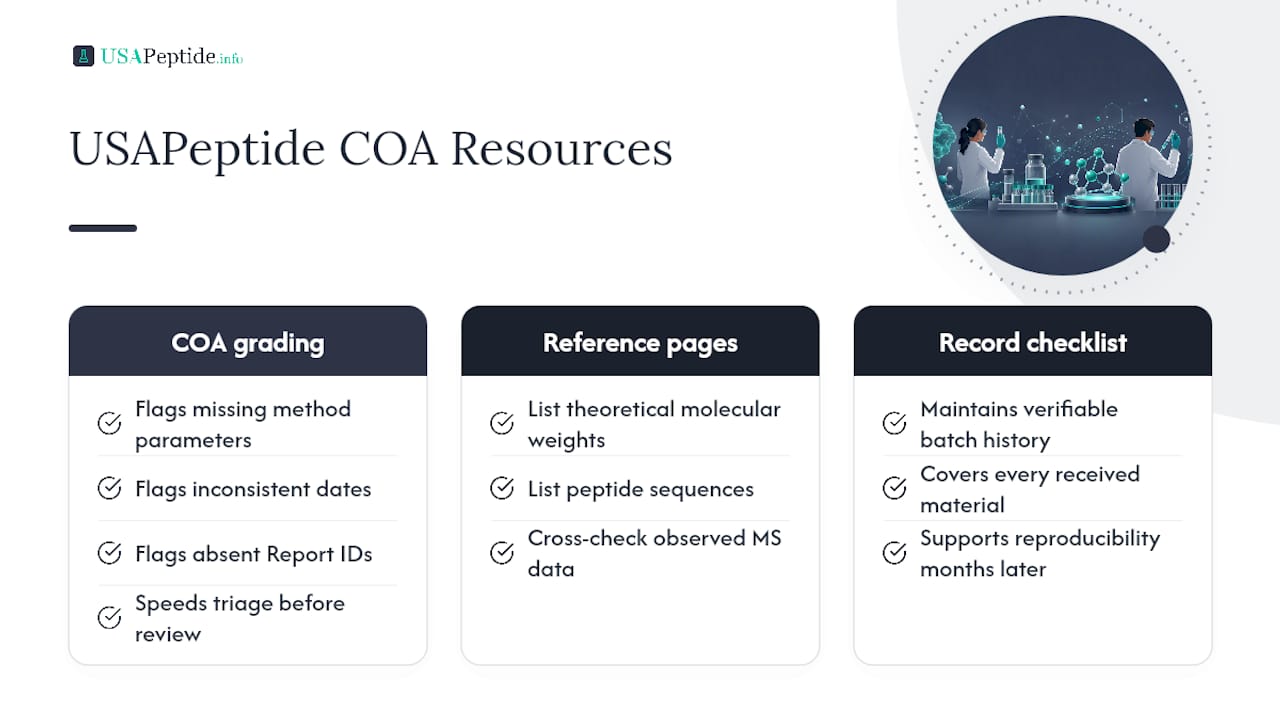
USAPeptide built its COA grading tool specifically to speed up the triage steps described above, flagging missing method parameters, inconsistent dates, or absent Report IDs before a researcher spends time on manual review. Paired with peptide reference pages that list theoretical molecular weights and sequences, it lets you cross-check observed MS data against a documented reference figure in one step. For lot recordkeeping, our COA record checklist outlines how to maintain a verifiable batch history across every material your lab receives, which matters when reproducibility gets questioned months after a study concludes.
Why Rigorous COA Verification Protects Reproducibility
Weak COA verification is a quiet threat to reproducibility. A batch that isn't what its paperwork claims can produce results nobody else can replicate, and the failure often surfaces only after months of work built on that assumption. Independent verification isn't extra caution bolted onto research; it's the same rigor researchers already apply to their own instruments, extended to the materials feeding into them. Use the checklist here, run the COA grading tool on your next batch, and don't hesitate to contact a lab directly when something doesn't add up.
— USAPeptide Team
How USAPeptide Supports Verified Procurement
USAPeptide is built around the exact workflow this guide describes: triage a COA with the grading tool, cross-check identity against detailed molecular profiles, and move forward only once the documentation holds up.

Every peptide profile on the platform includes sequence and molecular weight data you can use to independently verify MS results before you ever place an order, and the site's referrals point to suppliers offering ISO/IEC 17025-accredited testing and research-grade compounds at ≥99% HPLC purity. If your work involves metabolic or GLP-1 research, the fat loss research category walks through compound options alongside their documented purity standards. Start at the USAPeptide homepage to browse verified reference data, run a COA through the grading tool, and connect to suppliers whose documentation you can actually check.
Sources
- How to Read & Verify a Peptide COA (PeptideDefinition)
- Peptide third-party testing verification: a researcher's guide to analytical integrity
- Current Good Manufacturing Practice (cGMP) regulations — FDA
This article is general information, not a substitute for advice from a qualified doctor. Consult a qualified healthcare professional about your own circumstances before acting on anything here.
FAQ
How Do I Verify a COA?
Check that the batch number matches the vial label, confirm a named third-party lab with a verifiable Report ID, and review the HPLC chromatogram and mass spectrometry data against theoretical values. If any element is missing, use a COA grading tool or contact the issuing lab directly for blind verification.
What Is a COA Certification for Peptides?
A COA is a laboratory document confirming a specific batch's purity, identity, and safety characteristics through testing like HPLC and mass spectrometry. A legitimate one includes method parameters, raw chromatogram or spectrum images, an analyst signature, and a traceable Report ID rather than just summary numbers.
How Much Does It Cost to Get a COA on Peptides?
Independent third-party testing costs vary by lab and test scope, typically covering HPLC purity and MS identity as a baseline package, with endotoxin or sterility testing priced separately when required. Current pricing for verified, pre-tested compounds through USAPeptide's supplier referrals is available on the USAPeptide site.
What Is the Most Legit Peptide Company?
Legitimacy comes down to verifiable documentation, not brand reputation alone. Look for suppliers who provide ISO/IEC 17025-accredited testing, batch-specific COAs with raw chromatogram and MS data, and a traceable Report ID system.
Why Does a COA Need Both HPLC and Mass Spectrometry Data?
HPLC confirms purity by measuring how clean the sample is relative to other compounds, but it can't confirm you have the right molecule. Mass spectrometry data confirms molecular identity by matching observed mass to the theoretical mass, which is why both are needed together rather than either alone.