No published human study has measured oral bioavailability of BPC-157, so any specific absorption percentage circulating online is unverified. What researchers do have is animal intramuscular data showing measurable bioavailability and a plasma half-life under 30 minutes, plus in vitro evidence that the peptide survives human gastric juice intact. Gastric survival supports local gut effects, but it says nothing about whether the peptide crosses into systemic circulation.
TL;DR:
- No human studies have confirmed that oral BPC-157 reaches the bloodstream, and current data is limited to animal injections with bioavailability ranging from 14% to 51%.
- Laboratory tests show BPC-157 survives stomach acid for over 24 hours, supporting local gut effects but not systemic absorption.
- Extrapolating oral bioavailability from animal injectable data requires applying a broad 3x to 10x dose multiplier, which is unverified and uncertain.
- Without human plasma measurements, claims of specific oral absorption rates are speculative, and formulation, salt form, and degradation can significantly affect actual bioavailability.
- Researchers should source verified, high-purity BPC-157 from trusted suppliers, validate Certificates of Analysis independently, and interpret oral dosing claims as educated guesses rather than proven facts.
Table of Contents
- What Does the Research Say About BPC-157 Oral Bioavailability?
- How Much BPC-157 Actually Gets Absorbed in Animal Studies?
- Why Is BPC-157 Considered Stable in Stomach Acid?
- Why Doesn't Gastric Survival Prove BPC-157 Reaches the Bloodstream?
- How Should Researchers Interpret Oral Dosing Claims?
- What Are the Safety and Regulatory Considerations for BPC-157 Research?
- How Can Researchers Reduce Risk When Designing BPC-157 Studies?
- What Should Happen Next in BPC-157 Oral Research?
- Plan Your BPC-157 Research With Verified Material and Real Documentation
- Sources
- FAQ
What Does the Research Say About BPC-157 Oral Bioavailability?
The peer-reviewed evidence on BPC-157 pharmacokinetics comes almost entirely from injectable routes in animals, not oral dosing in humans. A 2022 paper by He et al. in Frontiers in Pharmacology remains the most detailed source on how the peptide moves through a living system, and it measured intravenous and intramuscular administration in rats and beagle dogs. It did not test oral dosing, and it did not measure plasma concentrations in either species after swallowing the compound.
That gap matters because it is the actual industry standard reference point for BPC-157 pharmacokinetics, and it defines what "known" means for this peptide. Reviews that followed the Frontiers paper have largely echoed the same conclusion: the data that exists is preclinical and parenteral, and the leap to oral human use rests on inference rather than measurement.
A few points define the current evidence base:
- No oral PK study in humans exists. As of 2026, no published research has measured plasma BPC-157 concentrations, Tmax, Cmax, or AUC after an oral dose in a human subject, a gap confirmed by the pharmacokinetic literature summarized on PubMed.
- Animal PK is limited to injectable routes. The Frontiers dataset covers IV and IM administration only.
- A separate biopharmaceutical review flags the missing human PK data as the central translational barrier for BPC-157, and it directly questions marketing claims that assume oral absorption without measurement, a point raised in reviews published on PMC.
- Human pilot work exists but skips PK. A handful of small human studies have looked at subjective outcomes or safety signals, but none of them included blood sampling designed to quantify how much peptide, if any, entered circulation.
None of this means oral BPC-157 does nothing. It means the specific claim, "X percent of an oral dose reaches your bloodstream," has no study behind it. Anyone citing a number for oral bioavailability of peptides like BPC-157 is either extrapolating from animal injectable data or repeating a figure with no traceable source.
How Much BPC-157 Actually Gets Absorbed in Animal Studies?
The only hard bioavailability numbers for BPC-157 come from intramuscular dosing in rats and dogs, and they vary enough between species to matter for anyone trying to extrapolate to human use. The Frontiers PK study reported absolute IM bioavailability of roughly 14% to 19% in rats and 45% to 51% in beagle dogs, with plasma elimination half-life staying under 30 minutes across both species regardless of route.
That's a striking gap. Dogs absorbed intramuscular BPC-157 roughly three times more efficiently than rats did, which is a reminder that peptide pharmacokinetics rarely translate cleanly across species. A few specifics from that dataset stand out:
- Rapid Tmax. Peak plasma concentration occurred quickly after IM dosing in both species, consistent with a small, water-soluble peptide that moves fast once it reaches tissue.
- Dose-proportional Cmax and AUC. The study observed a roughly linear relationship between administered dose and both peak concentration and total plasma exposure, suggesting no obvious saturation of absorption or clearance mechanisms within the tested range.
- Short half-life, consistent across routes. Whether given IV or IM, BPC-157 cleared from plasma in under 30 minutes, a detail with real implications for anyone designing a sampling schedule.
Why does the dog data matter more than the rat data for human extrapolation? Canine gastrointestinal and cardiovascular physiology tends to resemble human physiology more closely than rodent physiology does, which is why regulatory pharmacology programs frequently use dogs as the non-rodent species in preclinical packages. A 45% to 51% IM bioavailability figure in dogs is a more useful reference point for guessing at human IM absorption than the rat data, though "more useful" still falls well short of "predictive." Extrapolating from injectable bioavailability in either species to oral bioavailability in humans requires crossing a completely different absorption barrier, the gastrointestinal tract, that the Frontiers study never tested.
Why Is BPC-157 Considered Stable in Stomach Acid?
BPC-157 is unusual among peptides because it resists breakdown in an environment that destroys most others almost instantly. In vitro testing found the peptide remained intact in human gastric juice for more than 24 hours, a finding that stands in sharp contrast to how quickly stomach acid and pepsin typically shred peptide bonds.
That stability is the entire scientific basis for oral BPC-157 products. Without it, an oral capsule would make little pharmacological sense, since the peptide would degrade before it could do anything at all. With it, researchers have a plausible mechanism for local gastrointestinal effects, meaning the peptide could interact with stomach and intestinal tissue directly as it passes through.
A few distinctions are worth holding onto here:
- Gastric juice stability is not intestinal stability. Surviving stomach acid and pepsin says nothing about what happens once the peptide reaches the small intestine, where a different set of proteolytic enzymes, including trypsin and chymotrypsin, take over.
- Local action is not systemic absorption. A peptide can survive the gut lumen and still never cross the intestinal epithelium into the bloodstream in meaningful quantities.
- Animal oral studies support gut-local benefit, not systemic exposure. Rodent models using oral BPC-157, often delivered in drinking water, have reported protective effects on gastric ulcers and intestinal tissue. Those outcomes are consistent with local action in the gut, not with confirmed plasma uptake.
The gastric stability finding is genuinely important. It just answers a narrower question than most marketing copy implies.
Why Doesn't Gastric Survival Prove BPC-157 Reaches the Bloodstream?
Surviving the stomach is only the first of several barriers a peptide has to clear before it shows up in a blood draw, and BPC-157 has not been shown to clear the rest. Three separate obstacles stand between an intact peptide in the gut lumen and a measurable concentration in plasma.
First, intestinal proteases. Even a peptide resistant to gastric acid and pepsin can be cut apart by pancreatic and brush border enzymes once it reaches the small intestine. Second, the intestinal mucosal barrier itself is built to block large or moderately sized peptides from passing through intact. BPC-157 is a 15 amino acid peptide, small by protein standards but still far larger than the simple sugars and amino acids the gut is optimized to absorb. Third, even a peptide that does cross the intestinal wall faces hepatic first pass metabolism, since blood from the gut routes through the liver before reaching general circulation, and the liver is well equipped to break down peptide structures.
There's also a genuine paradox in the data that complicates interpretation. Plasma half-life measured under 30 minutes in the Frontiers PK study sits oddly next to the sustained biological effects reported in various animal models over hours or days, a disconnect discussed in mechanistic commentary on PMC. A peptide that clears plasma in under half an hour but keeps producing tissue effects for a day or more suggests the drug may act through a mechanism, tissue binding, receptor persistence, or local action, that a simple plasma concentration curve doesn't fully capture.
Specific measurements that remain missing from the literature:
- Plasma Cmax, Tmax, and AUC after an oral dose in any species, human or animal.
- A head-to-head oral PK comparison between BPC-157 acetate and BPC-157 arginate salt forms.
- Intestinal permeability data specific to BPC-157, as opposed to general assumptions based on peptide size.
Pro Tip: If you're evaluating an oral BPC-157 product claim, ask specifically whether it cites a plasma concentration measurement or a gastric stability finding. Those are two different things, and vendors sometimes present the second as if it were the first.
How Should Researchers Interpret Oral Dosing Claims?
Because no human oral PK study exists, any oral to injectable dose ratio you see is an extrapolation, not a measurement. The most commonly cited heuristic, drawn from preclinical dose equivalence work where oral arms needed higher doses to produce endpoints comparable to injectable arms, suggests a rough 3x to 10x multiplier for oral versus injectable nominal dosing. Treat that range as a starting point for thinking, not a validated conversion factor.
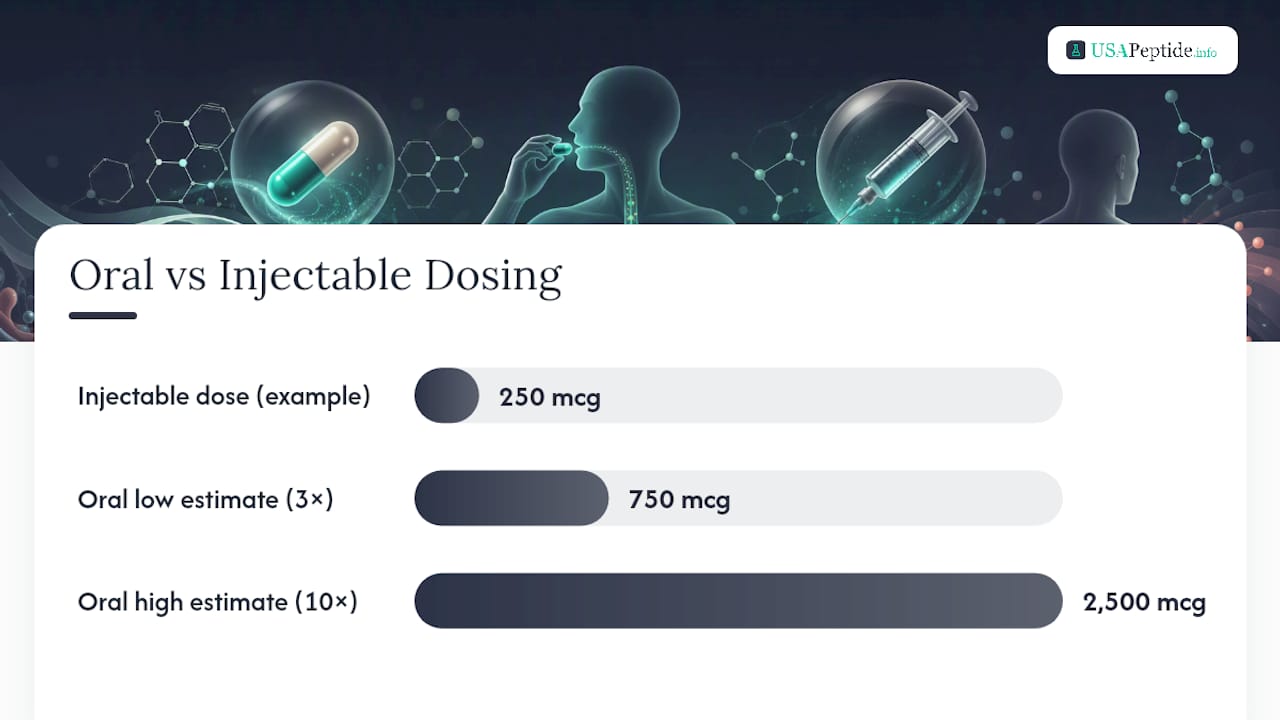
A worked example, for illustration only: if an injectable protocol uses 250 mcg, the 3x to 10x heuristic would put an oral nominal equivalent somewhere between 750 mcg and 2,500 mcg. That's a wide range, and it exists because the underlying animal data covers different endpoints, species, and salt forms, none of which map cleanly onto a single human dosing answer.
Before treating any oral BPC-157 product as equivalent to a known injectable dose, work through a short checklist:
- Confirm the salt form. Acetate and arginate salts are marketed with different absorption claims, but no published head-to-head oral PK data compares them directly. Treat arginate superiority claims as unverified.
- Verify potency independently. A Certificate of Analysis from the manufacturer is a starting point, not proof. Cross-check it against independent HPLC purity data where available.
- Account for degradation variability. Formulation, encapsulation method, and even how the capsule is stored can affect how much intact peptide survives to the point of ingestion, let alone absorption.
- Don't assume linear scaling. A dose that works at one level doesn't necessarily produce a proportional effect at 3x or 10x that amount; the animal PK data shows dose proportionality within tested ranges, not an established relationship for oral human dosing.
The honest summary: oral dosing heuristics for BPC-157 are educated guesses built on animal endpoint data, not measured human pharmacokinetics of peptides. Use them to frame a research question, not to make a therapeutic decision.
What Are the Safety and Regulatory Considerations for BPC-157 Research?
No randomized controlled trial in humans has established a safety or efficacy profile for BPC-157, by oral or injectable routes. That absence shapes everything else in this space: without human RCT data, any statement about how safe or effective the peptide is at a given oral dose is inference from animal work, not clinical evidence.
Access and regulatory status add another layer. The FDA has placed BPC-157 on lists that restrict compounding, and its advisory committee process continues to evaluate compounded peptide substances, which directly affects what is legally available for research use in the United States and shapes the feasibility of future clinical study.
For anyone conducting experimental work, a few practices reduce avoidable risk:
- Source material only from suppliers offering ISO 17025 accredited testing and a verifiable Certificate of Analysis.
- Cross-check any COA against independent assay data rather than accepting vendor documentation alone.
- Build conservative monitoring into any protocol, since the absence of human safety data means unknowns should be treated as unknowns, not as low risk by default.
- Recognize that institutional oversight (IRB review, informed consent, documented protocols) applies to any research involving human subjects, regardless of how the compound is sourced.
How Can Researchers Reduce Risk When Designing BPC-157 Studies?
Good pharmacokinetic research starts with good material, and that's where documentation tools matter as much as lab technique. A detailed molecular profile that lays out mechanism of action, prior findings, and sourcing considerations gives researchers a reference point before they ever open a vial.
A few tools apply directly to PK planning work:
- Peptide database. Cross-referencing molecular data and known half-life figures against a dedicated half-life resource helps researchers set realistic plasma sampling timepoints instead of guessing.
- COA grading tool. A Certificate of Analysis checker flags inconsistencies or red flags in vendor documentation before material enters a study, which matters given how much oral dosing uncertainty already traces back to unverified salt form and purity claims.
- Dosage calculator. Useful for translating research protocols into concrete handling quantities once a study design is finalized, though it doesn't substitute for independent potency verification.
- HPLC purity references. Comparing a vendor's stated purity against ≥99% HPLC benchmarks gives researchers a concrete quality floor to check against.
Pro Tip: Before running any oral versus injectable comparison, order material from a single verified batch and split it across both arms. Batch-to-batch variability can otherwise masquerade as a route-of-administration effect.
Independent HPLC-MS/MS validation, run outside the vendor's own testing, remains the strongest safeguard against acting on inflated purity or salt form claims.
What Should Happen Next in BPC-157 Oral Research?
The core problem hasn't changed since the Frontiers PK study came out: solid animal injectable data exists, gastric stability data exists, and the connection between them, oral bioavailability of BPC-157 in a living human, has never been measured. That's not a minor gap in an otherwise complete picture. It's the central unanswered question.
What would actually close it is a human oral PK study with plasma sampling at multiple early timepoints, paired with a head-to-head comparison of acetate versus arginate salt forms. Until that data exists, we think researchers should treat oral bioavailability figures as unverified and lean on the half-life and mechanism resources available for protocol planning, alongside the sourcing references below.
— USAPeptide Team
Plan Your BPC-157 Research With Verified Material and Real Documentation
Researchers dealing with the oral bioavailability question don't need another marketing claim, they need traceable purity data and a supplier that documents what's actually in the vial. USAPeptide's research peptide resource center connects qualified researchers to ISO 17025 accredited, ≥99% HPLC purity BPC-157, with same-day shipping and a Certificate of Analysis for every batch.
Before committing a protocol to paper, run any vendor's documentation through the COA grading tool to check it against known red flags in Certificate of Analysis formatting and content. Pair that with the peptide database for molecular reference data, dosage calculation support, and mechanism summaries you can cite directly in a study design. None of this is clinical advice, it's research infrastructure built for people who need their sourcing to hold up to scrutiny. Qualified researchers can start by reviewing available BPC-157 material and requesting a Certificate of Analysis before placing an order.
This article is general information, not a substitute for advice from a qualified doctor. Consult a qualified healthcare professional about your own circumstances before acting on anything here.
Sources
- Pharmacokinetics, distribution, metabolism, and excretion of BPC157 (Frontiers, 2022)
- Pharmacokinetics, distribution, metabolism, and excretion of ... (PubMed record summarizing PK data, 2026)
FAQ
Can You Absorb BPC-157 Orally?
Some of it likely survives digestion, since it resists breakdown in gastric juice for over 24 hours, but no study has measured how much, if any, reaches the bloodstream after an oral dose in humans.
Is BPC-157 Better Injected or Taken Orally?
Injectable routes have measured bioavailability data (14% to 19% in rats, 45% to 51% in dogs) and a defined half-life, while oral use has no equivalent human or animal plasma measurement, making injectable the only route with quantified systemic bioavailability of peptides so far.
How Much BPC-157 Should Someone Take Orally?
There's no validated oral dose because no human PK study exists. Researchers commonly reference a 3x to 10x oral to injectable ratio drawn from preclinical dose equivalence data, but that figure carries substantial uncertainty and shouldn't be treated as an established conversion.
Can Peptides Generally Be Absorbed Orally?
Most peptides face the same barriers, gastric and intestinal enzyme degradation, poor membrane permeability, and hepatic first pass metabolism, which is why oral peptide bioavailability is typically low unless a peptide has unusual stability, like BPC-157 shows in gastric juice, or the formulation includes specific absorption enhancers.