PT-141 (bremelanotide) works by binding melanocortin 4 receptors, with secondary action at MC3R, in hypothalamic and limbic circuits including the paraventricular nucleus. That receptor engagement triggers a cAMP/PKA signaling cascade that raises central arousal and lowers the threshold for sexual response. The drug does not create desire from nothing. It amplifies the brain's response to erotic stimuli through downstream dopamine, noradrenaline, and oxytocin release.
TL;DR:
- PT-141’s effectiveness relies on central MC4R activation, with the strongest affinity (~2.7 nM Ki) at MC4R compared to MC3R, and negligible activity at MC2R, limiting adrenal effects.
- Its signaling cascade involves Gs protein activation, increased cAMP, and PKA activation, which enhances neuronal excitability and promotes neurotransmitter release related to arousal.
- The drug’s impact depends heavily on erotic stimuli, with studies showing around a threefold increase in erectile response only when combined with visual sexual cues.
- Adverse effects mainly include nausea and flushing, with small, transient blood pressure increases, requiring monitoring, especially in patients with cardiovascular risks.
Table of Contents
- What Is PT-141's Mechanism at the Receptor Level?
- How Does the MC4R Signaling Cascade Increase Arousal?
- Which Brain Circuits Carry PT-141's Signal to the Body?
- Do Animal and Human Studies Show the Same Arousal Effects?
- How Long Does It Take PT-141 to Reach Peak Effect?
- What Do the Pivotal Clinical Trials Actually Show?
- What Are PT-141's Common Side Effects and Contraindications?
- How Does PT-141 Compare Mechanistically to PDE5 Inhibitors?
- What Research Questions Remain Unanswered About PT-141?
- How USAPeptide Supports Rigorous PT-141 Research
- A Note From the USAPeptide Team
- Where to Find High-Purity Reagents for Melanocortin Research
- Sources
- FAQ
What Is PT-141's Mechanism at the Receptor Level?
PT-141's receptor pharmacology explains why it acts on the brain rather than directly on vascular tissue. The peptide is a synthetic analog of alpha-melanocyte stimulating hormone, and it binds melanocortin receptors with distinct affinities across subtypes. Its selectivity profile is what separates it mechanistically from erectile dysfunction drugs that work on blood vessels.
MC4R is the primary driver of PT-141's central effects. Binding studies report a Ki near 2.7 nanomolar at MC4R, compared to roughly 4.1 nanomolar at MC3R, according to a mechanistic review of melanocortin receptors and penile erection. MC3R contributes a secondary, supportive role, largely in hypothalamic feeding and energy circuits that overlap with arousal-related nuclei, but MC4R activation accounts for most of the pro-sexual signaling researchers have documented.
What PT-141 does not do matters just as much as what it does. The peptide shows negligible engagement with MC2R, the receptor subtype that mediates adrenocorticotropic hormone signaling in the adrenal cortex. That lack of MC2R activity is the pharmacological reason bremelanotide does not meaningfully stimulate cortisol release or adrenal steroidogenesis at therapeutic doses, distinguishing it from nonselective melanocortin agonists that carry that risk.
Receptor distribution reinforces the central selectivity story. MC4R expression concentrates heavily in hypothalamic and limbic structures, while peripheral melanocortin activity (skin pigmentation via MC1R, adrenal function via MC2R) runs through entirely separate receptor populations. This distribution pattern explains why PT-141's dominant clinical signal is neurological rather than vascular.
Key pharmacological points researchers cite most often:
- MC4R affinity (~2.7 nM Ki) exceeds MC3R affinity (~4.1 nM Ki), making MC4R the dominant functional target.
- MC2R engagement is negligible, limiting direct adrenal cortisol effects.
- MC4R density is highest in hypothalamic and limbic regions, not peripheral vascular tissue.
- MC1R-mediated pigmentation effects are a separate, lower-affinity pathway noted in product labeling rather than a primary CNS action.
For clinicians evaluating PT-141 against other agents in the melanocortin family, this selectivity profile is the foundation for every downstream mechanistic claim, from signaling cascades to circuit-level effects covered next.
How Does the MC4R Signaling Cascade Increase Arousal?
MC4R is a Gs-coupled G protein-coupled receptor, and its downstream signaling explains how a single binding event turns into a measurable behavioral effect. Binding of PT-141 to MC4R activates the Gs alpha subunit, which stimulates adenylate cyclase. That enzyme converts ATP into cyclic AMP, and the resulting rise in intracellular cAMP activates protein kinase A.
Cell-based experiments back this pathway directly. HEK-293 cells engineered to express MC4R show measurable cAMP increases when exposed to PT-141, confirming that receptor engagement translates into functional second-messenger signaling rather than simple binding without downstream effect, per the melanocortin receptor mechanistic review. This in vitro evidence is part of why researchers consider the MC4R/cAMP/PKA axis the accepted mechanistic backbone for PT-141's central activity, rather than a theoretical model.
PKA activation then changes neuronal behavior at the ion channel level. Phosphorylation by PKA modulates voltage-gated calcium and potassium channels in hypothalamic neurons, altering firing patterns and making these cells more responsive to excitatory input. That shift in excitability is what links a biochemical cascade to an actual change in neural output.
The functional consequence is increased neurotransmitter exocytosis in circuits tied to motivation and arousal. PKA-mediated phosphorylation of synaptic proteins facilitates vesicle release, which increases downstream dopamine and noradrenergic signaling in mesolimbic and hypothalamic projections. Dopamine release in reward-related circuits corresponds to increased sexual motivation, while noradrenergic tone contributes to the general arousal state that primes genital response circuits.
Oxytocin fits into this cascade as a parallel output rather than a separate mechanism. Mechanistic reviews link paraventricular nucleus activation, which follows MC4R stimulation, to increased oxytocin release along descending spinal projections, connecting central signaling to peripheral genital effects, as described in the same mechanistic review.
The signaling sequence, step by step:
- PT-141 binds MC4R, activating the coupled Gs protein.
- Gs alpha stimulates adenylate cyclase, raising intracellular cAMP.
- cAMP activates protein kinase A (PKA).
- PKA phosphorylates ion channels and synaptic proteins, increasing neuronal excitability.
- Increased excitability drives dopamine, noradrenaline, and oxytocin release in arousal-relevant circuits.
That cascade, from a single receptor binding event to neurotransmitter release, is the mechanistic core that every clinical outcome discussed later in this article traces back to.
Which Brain Circuits Carry PT-141's Signal to the Body?
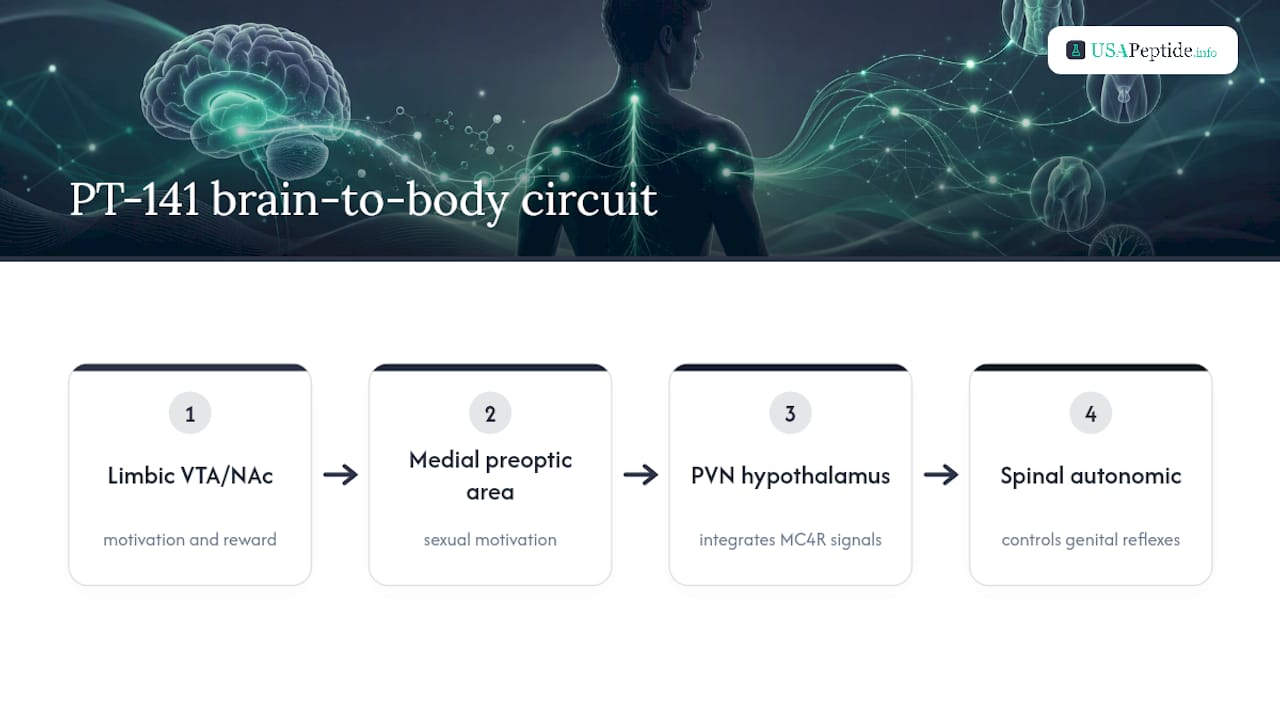
MC4R activation does not happen everywhere at once. It concentrates in specific hypothalamic and limbic nodes that form a circuit running from motivational centers down to spinal outputs controlling genital response. Understanding this anatomy is what separates a receptor-level explanation from a clinically useful one.
The paraventricular nucleus of the hypothalamus sits at the center of this circuit. PVN neurons expressing MC4R integrate incoming sensory and hormonal signals and, once activated, send descending projections that influence autonomic outflow to the genitals. Animal studies using c-Fos immunohistochemistry, a marker of recent neuronal activation. They consistently show PVN activation following systemic PT-141 administration, alongside spontaneous erectile responses in rodent models documented in the mechanistic review.
The medial preoptic area works alongside the PVN as a second key node. This region has long been recognized in animal physiology as central to sexual motivation and copulatory behavior, and its dense MC4R expression positions it as a likely integration point for PT-141's pro-motivational effects. Retrograde tracing studies in animal models support anatomical connections between preoptic and paraventricular neurons and spinal autonomic centers that ultimately govern genital blood flow and reflex activity.
Limbic structures extend the circuit into reward and motivation territory. The nucleus accumbens and ventral tegmental area, both parts of the mesolimbic dopamine pathway, receive modulatory input tied to melanocortin signaling. This is mechanistically significant because it explains why PT-141's effects read as increased desire and motivation, not just genital engorgement. A drug that only acted on spinal reflex arcs would not be expected to shift subjective arousal or desire scores the way PT-141 does in human trials.
Descending output from these hypothalamic and limbic nodes reaches spinal autonomic centers that control smooth muscle relaxation in genital tissue. Central facilitation effectively lowers the threshold at which peripheral erotic stimulation triggers a full reflex response, rather than generating that response independently. This is the anatomical basis for the stimulus-dependence property discussed in the next section.
Sex differences appear in the literature but remain incompletely characterized. Most detailed circuit-tracing and c-Fos work comes from male animal models focused on erectile physiology, while human trials supporting the approved indication involve premenopausal women with hypoactive sexual desire disorder. Researchers generally agree the MC4R/PVN/preoptic circuit operates in both sexes, but the relative weighting of desire versus peripheral genital effects likely differs, and this remains an area calling for more targeted neuroimaging work.
Do Animal and Human Studies Show the Same Arousal Effects?
Mechanistic pathways only matter clinically if they produce measurable outcomes, and PT-141's animal and human data align closely with what the receptor and circuit evidence predicts. The results also reveal one of the most clinically important properties of the drug: its effects depend on the presence of erotic stimulation.
Animal studies established this early. Systemic PT-141 administration in rats produced spontaneous erections alongside c-Fos activation in hypothalamic nuclei, confirming that the receptor-to-behavior link holds up outside cell culture. Intranasal doses around 50 μg/kg produced statistically significant erectile responses in these models, according to the mechanistic review.
Human data reinforces the stimulus-dependence pattern in a way that matters directly for clinical interpretation. In controlled trials pairing PT-141 with visual sexual stimulation, RigiScan measurements, which objectively record penile rigidity and tumescence, showed roughly a threefold increase in erectile activity compared to baseline when 20 mg of intranasal PT-141 was administered alongside visual erotic cues.
PT-141 combined with visual sexual stimulation produced roughly a threefold increase in RigiScan-measured erectile activity compared to baseline in phase II trials at the 20 mg intranasal dose, according to mechanistic review data.
That threefold figure only appeared when erotic stimulation was present. This is the practical meaning of "stimulus-dependent facilitation": PT-141 amplifies the neural response to an existing erotic cue rather than generating arousal in the absence of any stimulus. A researcher designing a trial protocol without controlled stimulation is likely to underestimate the drug's true effect size, a point emphasized in analysis of early PT-141 human trials.
At-home phase II studies extended this into functional outcomes using the International Index of Erectile Function (IIEF). In one at-home study covering 203 completed attempts, normal erectile function (IIEF-EF score above 26) was significantly higher in the 15 to 20 mg dose range compared to placebo, demonstrating a clear dose-response relationship, per the same mechanistic review. That dose-response relationship, rising responder rates as dose increases within this range, is consistent with a receptor occupancy model rather than an all-or-nothing pharmacological switch.
How Long Does It Take PT-141 to Reach Peak Effect?
Timing matters enormously for both research design and clinical counseling, and PT-141's pharmacokinetics vary by route and formulation in ways that are easy to overlook if you assume all bremelanotide products behave identically.
Early intranasal studies reported time-to-maximum-concentration (Tmax) figures near 30 minutes in some dosing groups, with reported time-to-onset of clinical effect ranging from roughly 34 to 63 minutes across subjects in one phase I trial, according to PubMed-indexed data on early PT-141 human studies. Serum half-life in an intranasal maximum-dose group measured close to 120 minutes in that same body of work, giving researchers a rough window for when plasma concentrations, and presumably central receptor occupancy, begin to decline meaningfully.
That pharmacokinetic profile does not automatically transfer to the FDA-approved product. Bremelanotide's approved formulation, marketed as Vyleesi, uses a subcutaneous injection rather than the intranasal route studied in most of the mechanistic literature above. The Vyleesi product label documents its own dosing regimen and pharmacokinetic profile specific to subcutaneous delivery, and researchers should not assume intranasal PK data applies directly to the approved product.
Practical timing points for research and clinical planning:
- Intranasal investigational formulations showed Tmax around 30 minutes in early trials, with onset commonly reported between 34 and 63 minutes.
- Reported intranasal serum half-life near 120 minutes suggests a multi-hour window of potential central activity.
- The approved subcutaneous Vyleesi formulation has its own distinct PK profile documented on the FDA label, not interchangeable with intranasal research data.
- Interindividual variability in onset timing has been substantial enough that fixed pre-activity dosing windows should be treated as approximate, not exact.
Pro Tip: When designing or interpreting a study protocol, treat intranasal PK data and subcutaneous Vyleesi PK data as two separate datasets. Conflating them is one of the more common errors in secondary literature on bremelanotide.
What Do the Pivotal Clinical Trials Actually Show?
The clinical evidence behind PT-141's mechanism spans animal pharmacology, early-phase human dosing studies, and the pivotal trials that eventually supported FDA approval. Each layer adds a different kind of proof.
Early animal work established basic dose-response relationships and confirmed the receptor mechanism translates into behavior. Rats receiving intranasal PT-141 around 50 μg/kg showed significant erectile responses paired with hypothalamic c-Fos activation, giving researchers a direct anatomical correlate for the behavioral effect.
Phase I human trials moved the question into safety and pharmacokinetics. Intranasal doses ranging from 4 to 20 mg produced statistically significant RigiScan-measured erectile responses in healthy subjects, and notably, in men who had an inadequate response to sildenafil, a signal that PT-141's central mechanism can produce effects independent of the peripheral vascular pathway sildenafil targets, according to PubMed data on early human trials.
Phase II at-home studies added functional, patient-reported outcomes to the objective RigiScan data. The 203-attempt at-home cohort showing 50 to 53 percent normal-function IIEF scores at 15 to 20 mg doses, against roughly 10 percent on placebo, represents one of the clearer dose-response signals in the mechanistic literature.
Combination studies pushed the mechanistic story further. Pairing 7.5 mg intranasal PT-141 with 25 mg sildenafil produced greater base rigidity duration than sildenafil alone, without a substantial increase in adverse events, according to the mechanistic review of combination data.
Combining low-dose PT-141 with sildenafil produced longer base rigidity duration than sildenafil alone, supporting an additive rather than redundant mechanism between central and peripheral pathways.
A few caveats deserve attention when weighing this evidence:
- Most quantitative RigiScan and IIEF figures come from relatively small early-phase cohorts, not large multicenter phase III programs.
- Trial protocols that included visual sexual stimulation produced substantially stronger effect sizes than those without it, underscoring the stimulus-dependence property.
- External validity for at-home combination studies is limited by self-reported attempt logs, which introduce more variability than lab-based RigiScan sessions.
- The FDA approval for Vyleesi rests on trials specific to the subcutaneous formulation and the HSDD indication in premenopausal women, per the FDA approval announcement, which is a distinct dataset from the intranasal erectile-function trials cited above.
What Are PT-141's Common Side Effects and Contraindications?
Nausea is the adverse effect that shows up most consistently across PT-141 trials, and it is dose-related. Gastrointestinal effects, primarily nausea, were the leading cause of discontinuation at higher doses in clinical trials, according to the mechanistic review's safety data. Flushing is the second most frequently reported effect, consistent with the drug's melanocortin receptor activity, since related pathways influence cutaneous vasodilation.
Cardiovascular signals appear in the data but read as small and transient rather than alarming in most reported analyses. Mean systolic blood pressure increases cited in some mechanistic literature run around 1.9 mmHg, a modest shift, though it still warrants monitoring in trial protocols and clinical use, particularly in patients with existing cardiovascular disease or uncontrolled hypertension.
The approved Vyleesi label lists specific contraindications that any researcher or clinician working with bremelanotide should treat as the governing reference, since it reflects the reviewed subcutaneous formulation rather than investigational intranasal data. The label documents adverse reactions and administration guidance specific to that approved route, per the FDA-published Vyleesi label.
Practical monitoring points drawn from trial protocols and the approved label:
- Track nausea incidence and severity by dose; it is the most common reason for discontinuation and often dose-limiting before cardiovascular effects become relevant.
- Monitor blood pressure at baseline and post-dose, especially in populations with cardiovascular risk factors, given the small but measurable systolic BP signal.
- Flushing episodes are generally self-limited but should be documented consistently across study visits for accurate adverse-event reporting.
- Any protocol involving repeated dosing should track for cumulative effects, since most published safety data comes from single-dose or short-duration studies rather than chronic administration.
Pro Tip: Cardiovascular monitoring deserves the same protocol rigor whether a study is testing PT-141 for desire outcomes or for erectile response endpoints. The blood pressure signal does not appear to be indication-specific, so applying a lighter monitoring standard to one use case than another is not supported by the safety data.
How Does PT-141 Compare Mechanistically to PDE5 Inhibitors?
PDE5 inhibitors and PT-141 work through mechanisms that do not overlap at the molecular level, and that distinction has direct implications for when each is the more rational choice. Sildenafil and related PDE5 inhibitors act peripherally, blocking the breakdown of cyclic GMP in penile smooth muscle following nitric oxide release, which prolongs vasodilation and supports erection in men who already have adequate arousal and neural signaling.
PT-141 acts upstream of that vascular event, operating on central MC4R-expressing circuits that govern desire and the neural facilitation of genital response. This means PT-141 addresses cases where central arousal or motivational signaling is the limiting factor, while PDE5 inhibitors address cases where vascular smooth muscle response is the bottleneck despite adequate desire and neural drive.
Combination trial data supports treating these as complementary rather than competing mechanisms. The additive rigidity-duration effect seen when low-dose intranasal PT-141 was paired with sildenafil, discussed in the clinical evidence section, indicates the two pathways do not simply duplicate each other's effect, which is consistent with their distinct molecular targets, as described in the mechanistic review.
Where each mechanism tends to matter most:
- Central deficits, low desire, diminished arousal response to erotic cues, are the theoretical domain where a melanocortin agonist mechanism is more directly relevant than a vasodilator.
- Primary vascular insufficiency, adequate desire but inadequate erectile rigidity, is the domain where PDE5 inhibition is the more direct mechanistic fit.
- Patients who show inadequate response to sildenafil alone represent a population where central-acting agents have shown measurable additional effect in trial data, suggesting the vascular pathway was not the sole limiting factor for that subgroup.
- Combination protocols in trials have not shown a substantial increase in adverse events relative to either agent alone, though this observation comes from limited-duration studies.
What Research Questions Remain Unanswered About PT-141?
Several mechanistic questions remain genuinely open, and researchers designing new studies should treat these as priority targets rather than settled science.
Long-term receptor regulation is one of the biggest gaps. Nearly all published pharmacodynamic and behavioral data comes from single-dose or short-duration protocols. Whether repeated MC4R agonism produces receptor desensitization, downregulation, or tolerance over weeks or months of use has not been well characterized in the published mechanistic literature, and this matters directly for any sustained-use clinical application.
Sex differences in circuit weighting also need targeted study. Much of the detailed hypothalamic circuit-tracing work comes from male animal models focused on erectile physiology, while the pivotal human trials supporting FDA approval, per the FDA's Vyleesi approval documentation, involve premenopausal women and a desire-focused endpoint rather than erectile function. Reconciling these two literatures with matched neuroimaging protocols would meaningfully sharpen the mechanistic picture.
Human neurotransmitter dynamics remain largely inferred rather than directly measured. Dopamine, noradrenaline, and oxytocin involvement rest heavily on animal tracing studies and cell-culture cAMP data; direct human neurochemical measurement during PT-141 administration, using techniques like functional neuroimaging paired with PET ligand studies, would strengthen the causal chain considerably.
Recommended experimental approaches for researchers pursuing this gap include neuroimaging protocols that track hypothalamic and mesolimbic activation in real time, mixed-endpoint designs that pair objective RigiScan measurement with validated patient-reported outcome instruments, and crossover trial structures with tightly controlled erotic-stimulus conditions to isolate the stimulus-dependence variable from baseline drug effect. Sample sizes in this literature have generally been small, and larger, adequately powered crossover designs would help clarify effect-size estimates that current small-cohort data can only approximate.
How USAPeptide Supports Rigorous PT-141 Research
Mechanistic clarity depends on reagent quality just as much as trial design. A receptor-binding study or cAMP assay built on a poorly characterized peptide batch introduces noise that no amount of statistical correction can fully remove. USAPeptide's molecular profile for PT-141 compiles receptor affinity data, mechanistic summaries, and trial results into a single reference point for researchers structuring their own protocols.
Verifying reagent identity before running an assay is not optional in mechanistic work. USAPeptide's COA grading tool evaluates whether a Certificate of Analysis reflects the purity and identity claims a supplier makes, helping researchers catch discrepancies before a compound reaches the bench. Paired with a dosage calculator built for research contexts, this reduces the kind of batch-to-batch variability that can quietly distort dose-response curves in melanocortin pharmacology studies.
For researchers tracking the broader melanocortin and CNS peptide literature, USAPeptide's peptide research news page aggregates recent publications and regulatory developments relevant to ongoing mechanistic work, including studies adjacent to PT-141's receptor family.
A Note From the USAPeptide Team
PT-141's mechanism offers a genuinely useful model for central sexual arousal pharmacology, but the promise of melanocortin modulation should not outrun the caution its data demands. Off-label use divorced from proper dosing evidence, or built on unverified reagent sourcing, undermines both patient safety and the research record. Ethical oversight and reagent purity are not separate concerns from mechanistic accuracy. They are part of it. Researchers with protocol or sourcing questions are welcome to reach out to USAPeptide directly.
— USAPeptide Team
Where to Find High-Purity Reagents for Melanocortin Research
Mechanistic studies on MC4R and MC3R signaling are only as trustworthy as the compounds behind them. A peptide research platform is built around that principle, pairing detailed peptide profiles with tools that let researchers verify what they are actually working with before committing lab time to an assay.

The Peptriva Research Peptide Resource Center aggregates high-purity, ISO 17025-accredited compound sourcing alongside the molecular documentation researchers need to design defensible protocols. That combination matters specifically for CNS-acting peptides like bremelanotide, where a small shift in actual purity can shift receptor-binding results enough to muddy a dose-response curve. Running a Certificate of Analysis through the COA grading tool before ordering is a fast way to catch inconsistencies that would otherwise show up as unexplained variance three weeks into an experiment. Researchers evaluating dosing protocols across peptide categories may also find value in comparing methodology against other clinical-dosing literature, such as this trial-based dosing analysis covering a different compound class.
If reagent variability has been a recurring headache in melanocortin work, start by checking your current supplier's COA against the grading tool, then browse the Peptriva center for verified sourcing options before your next order.
Sources
Every mechanistic and clinical claim in this article traces back to a small set of primary sources worth bookmarking directly.
- Melanocortin Receptors, Melanotropic Peptides and Penile Erection
- Evaluation of PT-141 in early human studies (PubMed)
This article is general information, not a substitute for advice from a qualified doctor. Consult a qualified healthcare professional about your own circumstances before acting on anything here.
FAQ
How does PT-141 work?
PT-141 binds MC4R and MC3R in hypothalamic and limbic circuits, triggering a cAMP/PKA signaling cascade that increases neuronal excitability and downstream dopamine, noradrenaline, and oxytocin release, which together facilitate sexual arousal and genital response.
Is PT-141 better than Viagra?
They are not directly comparable because they work through different mechanisms. PT-141 acts centrally on desire and arousal signaling, while sildenafil (Viagra) acts peripherally on vascular smooth muscle, and trial data shows they can produce additive effects when combined.
Does PT-141 work immediately?
No. Reported onset in early intranasal trials ranged from roughly 34 to 63 minutes, with Tmax near 30 minutes in some dosing groups, and the drug's effect depends on the presence of erotic stimulation rather than acting instantly on its own.
Who should not take PT-141?
Bremelanotide (Vyleesi) carries specific contraindications documented on its FDA label, including considerations for cardiovascular risk given its association with small, transient blood pressure increases; anyone considering it should review that label and consult a clinician before use.