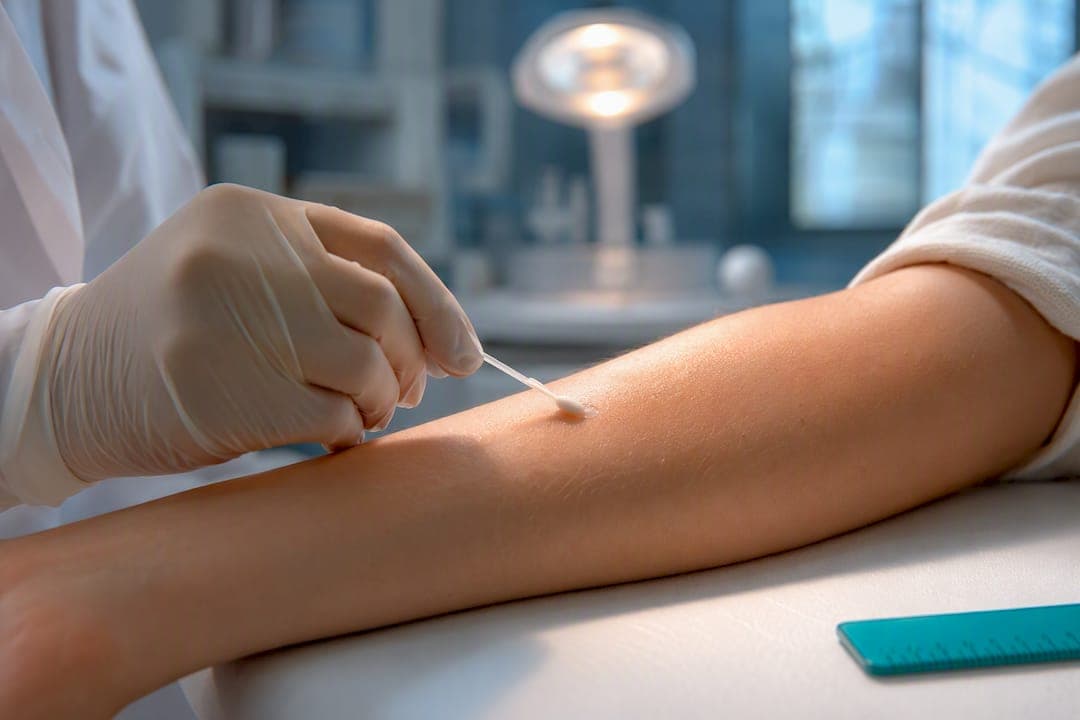
GHK-Cu research is strongest for topical skin and wound repair, where mechanistic data and small human trials converge. Systemic and injectable use remains unproven in humans, with essentially no controlled trial data and sparse safety and pharmacokinetic records. Registered trials like ClinicalTrials.gov's NCT07437586 signal active clinical translation, but researchers should treat anything beyond topical application as a hypothesis, not an established finding.
TL;DR:
- Human systemic and injectable GHK-Cu data are lacking, with no controlled trials measuring absorption, distribution, or clearance in humans.
- Current evidence mainly supports topical GHK-Cu for skin repair, with small, often industry-funded studies showing modest improvements over 12 weeks.
- Animal and cell studies show potential for wound healing and gene regulation, but dose translation to humans remains uncertain due to differing pharmacokinetics.
- The only registered human trial (CuHeal) focuses on topical application for wound healing, with results expected in 2027.
- Safety profiles are favorable for topical use, but systemic or injectable applications lack safety data and are considered experimental.
Table of Contents
- Ghk-Cu Research: Mapping the Published Evidence
- Molecular Mechanisms and Putative Targets
- In Vitro and Animal Models: Wound Healing Data
- Human Clinical Evidence: Topical Trials and Endpoints
- Registered Clinical Trials to Watch
- Safety Signals, Regulatory Status, and Dosing
- Research Resources and a Quality-Control Checklist
- USAPeptide Team Perspective: Where This Research Needs to Go Next
- Sources
Ghk-Cu Research: Mapping the Published Evidence
The literature on GHK-Cu splits cleanly into three tiers, and knowing which tier a claim comes from matters more than the claim itself. Review-level synthesis anchors the field: Pickart's 2018 analysis compiles decades of data showing the peptide stimulates vascular and nerve outgrowth, boosts collagen and elastin synthesis, and modulates thousands of human genes. A companion review, GHK Peptide as a Natural Modulator of Multiple Cellular Pathways, lays out the mechanistic groundwork researchers cite most often when designing new studies.
Below the reviews sit primary studies, unevenly distributed across models:
- Preclinical wound-healing work spans rats, mice, rabbits, and pigs, with decades of accumulated data on accelerated closure and angiogenesis.
- Human topical randomized trials exist but are few, small, and rarely replicated independently.
- A 2025 murine colitis study in Frontiers in Pharmacology extends the evidence base beyond skin, into mucosal healing.
- Exactly one registered Phase 2 human trial (NCT07437586) is currently recruiting for a skin-specific endpoint.
The gap that matters most: injectable or systemic human pharmacokinetic data. No published controlled trial has measured absorption, distribution, or clearance of GHK-Cu delivered by any non-topical route in people. Anyone drawing conclusions about systemic dosing is extrapolating from cosmetic-grade topical data or rodent models, not from human evidence.
Molecular Mechanisms and Putative Targets
GHK-Cu's central trick is copper chemistry. The tripeptide coordinates copper(II) tightly enough to silence its redox activity, which lets it deliver copper to tissue without generating the oxidative damage free copper ions typically cause. That coordination chemistry is the mechanistic anchor for most downstream effects researchers have documented.
Gene-expression work complicates the simple "copper delivery" story. Connectivity Map profiling referenced in Pickart's review shows GHK-Cu shifts expression across a large fraction of the human genome, touching genes tied to tissue regeneration, stress response, and inflammation control. That breadth suggests the peptide does more than shuttle copper. It appears to act as a broader regulatory signal.
Downstream, the evidence points to several converging pathways:
- Upregulation of collagen and glycosaminoglycan synthesis in dermal fibroblasts.
- Modulation of matrix metalloproteinase and TIMP balance, relevant to tissue remodeling.
- NF‑κB pathway involvement in inflammatory signaling, mostly demonstrated in vitro.
- SIRT1 upregulation paired with p-STAT3 suppression, documented in a 2025 murine colitis model.
Most of these pathway findings come from in vitro or animal work. The NF‑κB and SIRT1/STAT3 mechanisms in particular have not been confirmed in human tissue samples, which leaves a real gap between the molecular story and clinical proof.
In Vitro and Animal Models: Wound Healing Data
Preclinical evidence for GHK-Cu is deep but methodologically uneven. Four patterns recur across the animal and cell-culture literature:
- Rodent, rabbit, and pig wound models. Studies across these species report accelerated wound closure and improved angiogenesis, typically using topical concentrations in the microgram-to-milligram range applied daily over one to three weeks.
- Fibroblast and keratinocyte culture work. Cell-based experiments consistently show increased collagen and elastin output alongside elevated antioxidant enzyme expression, supporting the tissue-repair mechanism at the cellular level.
- Non-skin models. The 2025 colitis study found GHK-Cu promoted mucosal healing in a DSS-induced murine model, with SIRT1 and STAT3 signaling confirmed through co-culture and silencing experiments. Lung fibrosis models show similar directional signals.
- Recurring limitations. Most studies use a single dose, run for days rather than months, and skip pharmacokinetic sampling entirely, which makes dose translation to humans genuinely difficult.
That last point deserves emphasis: a strong animal signal does not automatically scale to a validated human dose.
Human Clinical Evidence: Topical Trials and Endpoints
Human data exist, but they are thin compared to the preclinical record. The most cited example is a 12-week facial study, described in Pickart's review, that reported improvements in skin laxity, wrinkle depth, and skin density among 71 women using a topical GHK-Cu formulation.
The effect sizes that matter:
- Measurable, statistically reported improvement across multiple skin parameters after 12 weeks of daily topical application.
- Sample sizes in the range of dozens of participants, not hundreds.
- Limited independent replication of the specific formulations and outcome measures used.
Trial quality varies. Some published studies report randomization and blinding; others read closer to open-label cosmetic evaluations with industry funding, which is a legitimate reason to weight the findings cautiously rather than dismiss them. What's consistently missing is any injectable or systemic human randomized controlled trial. Every rigorous human dataset on GHK-Cu to date involves topical application to skin. Researchers extrapolating to other routes are working without a human evidence base.
A useful outside reference point on collagen-stimulation endpoints and how dermatologists frame them clinically is this practical overview of collagen production mechanisms, which helps contextualize what "improvement" typically means in skin trials.
Registered Clinical Trials to Watch
One trial currently anchors the translational pipeline. NCT07437586 ("CuHeal") is a Phase 2, randomized, double-blind, split-wound design comparing topical 0.1% w/w GHK-Cu gel against vehicle on standardized punch-biopsy wounds. The primary endpoint is time to complete re-epithelialization.
- Status: recruiting, with an estimated enrollment of 60 participants.
- Design: split-wound, which lets each participant serve as their own control.
- Expected primary completion: 2027.
No other actively recruiting trial in the public registry currently targets GHK-Cu specifically at this scale, which makes CuHeal the single most important readout to track over the next two years.
Safety Signals, Regulatory Status, and Dosing
GHK-Cu is not FDA-approved as a therapeutic agent. It circulates commercially as a cosmetic ingredient and, separately, as a research compound sold for laboratory use, not human administration outside registered trials.
- Topical trials report generally mild adverse events, mostly local irritation, with no serious safety signals in the published record.
- Systemic or injectable use carries theoretical copper-homeostasis risks that have never been tested in controlled human trials, so no safety profile exists for that route.
- The CuHeal trial protocol uses a 0.1% w/w gel applied once daily for 14 days, a concentration and schedule drawn directly from the registered trial design.
- No validated systemic dosing regimen exists in the literature for any species, human or animal, at a level suitable for direct extrapolation.
Pro Tip: If you're designing a human protocol involving GHK-Cu, build in serum and tissue copper assays, baseline and follow-up liver function panels, and pharmacokinetic sampling from day one. The absence of PK data in the existing literature is the single biggest obstacle to interpreting any new trial result.
Research Resources and a Quality-Control Checklist
Manufacturing consistency is a recognized bottleneck for GHK-Cu translation, with recent process-engineering reviews calling for standardized production methods and tighter impurity profiling. That inconsistency between suppliers is exactly why a Certificate of Analysis matters before any batch enters a study.
Before accepting research material, confirm the supplier documents:
- HPLC purity of 99% or higher, with the chromatogram included, not just a summary number.
- Confirmed identity via mass spectrometry.
- Endotoxin testing results, particularly for any protocol involving cell culture or animal dosing.
- ISO 17025-accredited testing, which indicates the lab itself meets recognized competence standards.
USAPeptide's GHK-Cu peptide dossier consolidates molecular profile data alongside COA verification tools, and the COA-checking tool flags common red flags in supplier documentation before material reaches your bench.
USAPeptide Team Perspective: Where This Research Needs to Go Next
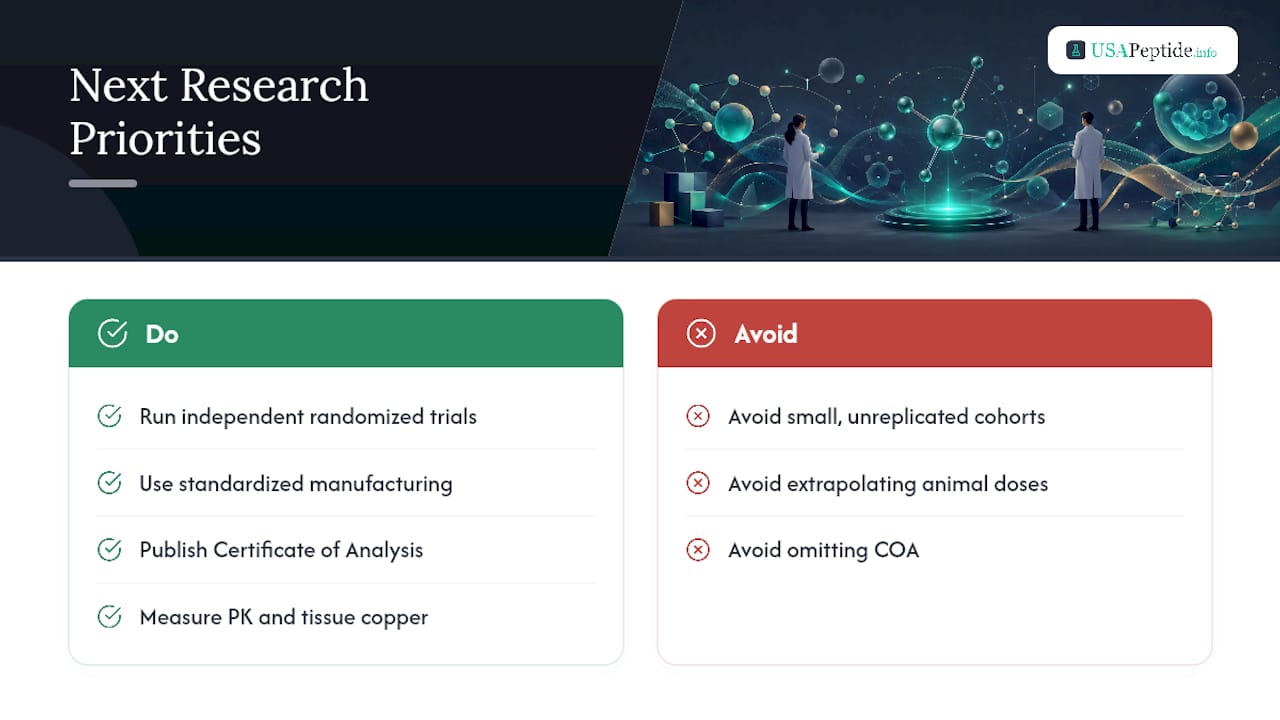
The field's biggest weakness isn't the mechanism, it's reproducibility. Too many topical trials share small cohorts and unreplicated formulations. Priority one should be independent RCTs with standardized manufacturing, paired with actual pharmacokinetic and tissue-copper assays rather than assumed extrapolation from animal doses.
Every human study going forward should publish its Certificate of Analysis alongside its results. A trial is only as credible as the material tested. Researchers planning translational work can find dosing calculators and dossier data in USAPeptide's resource center to support that planning process.
— USAPeptide Team
This article is general information, not a substitute for advice from a qualified doctor. Consult a qualified healthcare professional about your own circumstances before acting on anything here.
Sources
- Regenerative and Protective Actions of the GHK-Cu Peptide in the Light of the New Gene Data
- Topical GHK-Cu Gel for Acute Skin Wound Healing (CuHeal)
- Exploring the beneficial effects of GHK-Cu on an experimental model of colitis and the underlying mechanisms
- GHK-Cu as a multifunctional copper peptide: synthesis routes, process engineering and emerging applications