
Tesamorelin (Egrifta) is an FDA-approved synthetic growth hormone-releasing hormone (GHRH) analogue with a well-characterized clinical record for reducing visceral adipose tissue (VAT) and hepatic fat in people living with HIV (PLWH) who have HIV-associated lipodystrophy. The evidence base spans multiple randomized controlled trials, a 12-month multicenter NAFLD study and a recent meta-analysis confirming consistent, statistically significant reductions in VAT and liver fat. This is not a general weight-loss agent; its effects are selective for visceral and hepatic depots, and long-term cardiovascular or neurocognitive endpoints remain unestablished.
Immediate clinical takeaways:
- Primary indication: Reduction of excess abdominal fat in PLWH with HIV-associated lipodystrophy (FDA-approved as Egrifta).
- Trial dose: 2 mg subcutaneously once daily, with 26-week primary endpoints in pivotal studies and 12-month follow-up in the NAFLD trial.
- Key safety flags: Monitor fasting glucose at initiation (transient early rise possible), track IGF-1 levels, watch for injection-site reactions and arthralgia; use with caution in patients with active or prior malignancy.
- Durability: VAT re-accumulates after discontinuation, suggesting that ongoing therapy is required to maintain the effect.
Key Takeaways
Tesamorelin produces consistent, statistically significant reductions in visceral adipose tissue and hepatic fat in PLWH, with a well-characterized adverse-event profile and an FDA-approved indication as Egrifta for HIV-associated lipodystrophy.
| Point | Details |
|---|---|
| VAT and hepatic fat reduction | Meta-analysis confirms VAT MD of −27.71 cm² and hepatic fat MD of −4.28% across five RCTs. |
| Liver-disease signal | The 12-month NAFLD trial showed −4.1% absolute hepatic fat reduction and lower fibrosis progression (4% vs 35% in placebo). |
| Safety monitoring priorities | Monitor fasting glucose at initiation for transient rise; track IGF-1 periodically; screen for malignancy before and during treatment. |
| Durability limitation | VAT re-accumulates after discontinuation; long-term or maintenance therapy is required to sustain fat-reduction effects. |
| USAPeptide research tools | The COA grading tool, tesamorelin peptide profile, and peptide glossary at USAPeptide.info support rigorous research-grade compound verification. |
Table of Contents
- What does tesamorelin research show across randomized trials?
- Key trial designs and outcomes you need to evaluate
- How does tesamorelin work at the molecular level?
- What is the safety profile of tesamorelin in clinical trials?
- Dosing, treatment duration, and what happens after stopping
- What is tesamorelin's regulatory status in the United States?
- Where does the evidence fall short, and what research gaps remain?
- Practical guidance for researchers and clinicians
- The most important next steps for tesamorelin research
- USAPeptide research tools for qualified investigators
- Primary sources and recommended readings
- Sources
What does tesamorelin research show across randomized trials?
Tesamorelin research now encompasses several well-designed randomized controlled trials and at least one published meta-analysis, giving clinicians a reasonably clear picture of effect sizes and their limits. The pooled meta-analysis of five RCTs found a mean difference in VAT of −27.71 cm² (95% CI: −38.37, −17.06) and a mean difference in hepatic fat percentage of −4.28% (95% CI: −6.31, −2.24), with lean body mass increasing by a mean of 1.42 kg (95% CI: 1.13, 1.71). These are modest-to-moderate effect sizes, but they are consistent across trials and statistically robust.
The pattern across studies is specific: visceral and hepatic fat fall, subcutaneous adipose tissue and BMI change minimally, and lean mass increases slightly. That selectivity matters for endpoint design. Researchers who expect broad body-composition shifts will be disappointed; those targeting visceral depots and liver fat will find a reliable signal.
Metabolic markers across trials:
- IGF-1 rises substantially in all tesamorelin arms, confirming pharmacodynamic activity and serving as a useful compliance and response marker.
- Triglycerides and the total cholesterol-to-HDL ratio improved in the NEJM pivotal trial, though lipid effects are secondary endpoints and not uniformly reported.
- Fasting glucose shows a transient early increase shortly after initiation, but pooled data do not demonstrate clinically important long-term glycemic deterioration.
- Waist circumference decreases significantly in most trials, consistent with the VAT reduction signal.
Statistic callout: The meta-analysis reported a VAT mean difference of −27.71 cm² and a hepatic fat mean difference of −4.28% across five RCTs, with lean body mass increasing by 1.42 kg — a pattern of visceral-selective fat reduction that holds across study populations.
The certainty of evidence for VAT reduction is moderate-to-high by conventional GRADE criteria, given the consistency across trials, the use of validated imaging (CT and MRI), and the intention-to-treat analyses in pivotal studies. Evidence for hepatic fat reduction is moderate, supported by both the 6-month Massachusetts General Hospital trial and the 12-month NAFLD-specific study. Evidence for hard clinical endpoints (cardiovascular events, liver fibrosis resolution, neurocognition) remains insufficient.
Key trial designs and outcomes you need to evaluate
NEJM pivotal multicenter RCT
The pivotal multicenter trial published in the New England Journal of Medicine enrolled PLWH with excess abdominal fat and randomized participants to tesamorelin 2 mg SC daily or placebo for 26 weeks. The primary endpoint was change in VAT measured by CT. Tesamorelin produced a 15.2% decrease in VAT versus a 5.0% increase in the placebo group. Secondary endpoints included triglycerides and total cholesterol-to-HDL ratio, both of which improved. IGF-1 levels rose substantially in the treatment arm. Antibody formation against tesamorelin was observed in a subset of participants; long-term clinical implications of those antibodies remain incompletely characterized.
6-month VAT and liver-fat RCT (Massachusetts General Hospital)
This randomized clinical trial enrolled PLWH with abdominal fat accumulation and measured both VAT by CT and hepatic fat by magnetic resonance spectroscopy (MRS). Tesamorelin produced a treatment effect of −42 cm² in VAT and a net effect of −2.9 lipid-to-water percent in liver fat. Fasting glucose increased transiently at 2 weeks but was not significantly different from placebo at 6 months, providing the primary basis for the glucose-monitoring recommendation at initiation rather than as an ongoing concern.
12-month NAFLD multicenter RCT
The most liver-focused tesamorelin study to date enrolled PLWH with NAFLD confirmed by MRS and randomized them to tesamorelin 2 mg daily or placebo for 52 weeks. Hepatic fat fraction fell by an absolute −4.1% (95% CI: −7.6, −0.7; P=0.02) in the tesamorelin group. This is the strongest liver-specific signal in the tesamorelin literature, though histologic NASH resolution was not a primary endpoint.
Fat-quality imaging study (Jordan et al., 2021)
This imaging-based analysis extended the mechanistic picture by showing that tesamorelin increases visceral adipose tissue density independent of changes in fat quantity. Changes in adipose tissue composition, not just volume, may contribute to the metabolic improvements observed in trials. This finding is exploratory but relevant for researchers designing studies that use imaging-derived fat-quality metrics.
Neurocognition phase 2 trial
A randomized open-label phase 2 trial enrolled 73 virally suppressed PLWH with abdominal obesity in a 3:2 randomization to tesamorelin versus standard of care. Waist circumference decreased significantly, but between-group neurocognitive performance at 6 months did not reach statistical significance. This trial was underpowered for cognitive endpoints and should be read as hypothesis-generating, not confirmatory.
Methodology notes across trials:
- Imaging modalities: CT for VAT (high sensitivity for depot-specific fat), MRS for hepatic fat fraction (gold standard for non-invasive liver fat quantification), DXA for trunk and limb fat.
- Most pivotal trials used intention-to-treat analysis with last-observation-carried-forward imputation.
- Blinding was maintained in all major RCTs; the neurocognition trial was open-label, limiting its interpretive weight.
- Sample sizes in individual trials ranged from approximately 73 to several hundred participants; the meta-analysis pooled five RCTs to improve precision.
How does tesamorelin work at the molecular level?
Tesamorelin is a synthetic analogue of endogenous GHRH(1-44), the hypothalamic peptide that stimulates pituitary somatotrophs to release growth hormone. Its key structural modification is an N-terminal trans-3-hexenoyl group, which extends the peptide's half-life compared with native GHRH and supports more sustained pulsatile GH secretion after subcutaneous injection. This design preserves the physiological pulsatility of GH release rather than producing the continuous supraphysiologic exposure associated with exogenous recombinant GH.
The mechanistic pathway proceeds as follows: subcutaneous tesamorelin binds pituitary GHRH receptors, stimulating endogenous pulsatile GH secretion. Elevated GH then promotes lipolysis preferentially in visceral and hepatic fat depots, which are more sensitive to GH-mediated lipolytic signaling than subcutaneous depots. IGF-1 rises as a downstream marker of GH activity and is measurable in serum within weeks of initiating therapy. For a comparative look at how GHRH analogues differ mechanistically from GH-releasing peptides, the sermorelin profile and GHRP-2 profile on USAPeptide provide useful mechanistic contrast.
Pharmacokinetics summary:
- Route: subcutaneous injection, typically into the abdomen.
- The trans-3-hexenoyl modification extends half-life relative to native GHRH(1-44), supporting once-daily dosing.
- Absorption from the subcutaneous depot is relatively rapid; peak GH stimulation occurs within the first few hours post-injection.
- Antibody formation against tesamorelin has been observed in clinical trials; whether antibodies attenuate the pharmacodynamic response over time is not fully resolved.
- Clearance follows peptide metabolism pathways; no dose adjustment for renal or hepatic impairment is formally established in the current label.
The selectivity for visceral and hepatic depots, rather than subcutaneous fat, is consistent with the known biology of GH-mediated lipolysis and explains why BMI and subcutaneous fat change minimally in trials. Imaging data showing changes in adipose tissue density independent of volume reduction add another layer to this picture, suggesting compositional remodeling of visceral fat beyond simple volume loss.
Pro Tip: IGF-1 is the most practical pharmacodynamic marker in clinical and research settings. A failure to see IGF-1 rise after several weeks of tesamorelin suggests poor absorption, injection technique issues, or antibody interference, and warrants investigation before attributing a lack of efficacy to the compound itself.
Statistic callout: The NEJM pivotal trial documented a 15.2% decrease in VAT in the tesamorelin group versus a 5.0% increase in placebo, a difference consistent with GH-mediated, depot-selective lipolysis rather than generalized fat loss.
What is the safety profile of tesamorelin in clinical trials?
The adverse-event profile of tesamorelin is well-characterized across multiple RCTs. Most events are mild-to-moderate and manageable, though several require active monitoring.
Frequent adverse events from RCTs and meta-analysis:
- Injection-site reactions (erythema, pruritus, pain): among the most commonly reported local events across trials.
- Arthralgia and myalgia: reported in a meaningful proportion of participants; typically mild and often transient.
- Paresthesia: peripheral tingling or numbness, consistent with GH-axis activation effects on fluid and nerve function.
- Peripheral edema: related to GH-mediated fluid retention, generally mild.
These four categories were confirmed in the pooled meta-analysis as the dominant adverse-event signals across the five included RCTs.
IGF-1 elevation and cancer risk
The NCBI clinical review report on Egrifta notes that tesamorelin increases serum IGF-1 levels and that regulators flagged a theoretical concern about tumor progression in patients with active or prior malignancy. This concern derives from the known role of the GH/IGF-1 axis in cell proliferation. No clinical trial has demonstrated a causal increase in cancer incidence with tesamorelin, but the theoretical signal is sufficient to warrant contraindication in patients with active malignancy and caution in those with a history of cancer.
Glycemic effects
Fasting glucose increases transiently shortly after initiation, as documented in the Massachusetts General Hospital trial. Pooled data do not show clinically important long-term glycemic deterioration, but the early signal is real and monitoring is warranted. Patients with pre-existing diabetes or impaired fasting glucose require closer follow-up during the first 4–8 weeks.
Monitoring checklist for clinicians
- Baseline: Fasting glucose and HbA1c, fasting lipid panel, serum IGF-1, and imaging baseline (CT or MRI for VAT; MRS for hepatic fat if liver disease is a concern).
- Weeks 2–4: Repeat fasting glucose to capture the transient early rise; assess for injection-site reactions and arthralgia.
- Month 3: Fasting glucose, IGF-1 (to confirm pharmacodynamic response), and clinical assessment of musculoskeletal symptoms.
- Month 6: Full metabolic panel, repeat imaging for primary endpoint assessment, IGF-1, and adverse-event review.
- Ongoing (if continuing beyond 6 months): Annual or semi-annual imaging, fasting glucose, and IGF-1; reassess cancer history and risk factors.
Red-flag triggers for discontinuation: new or recurrent malignancy, severe or progressive edema, confirmed diabetes with poor glycemic control attributable to tesamorelin, or severe injection-site hypersensitivity.
Contraindications and special populations:
- Active malignancy or history of malignancy where IGF-1 elevation poses unacceptable risk.
- Pregnancy and breastfeeding: safety has not been established; use is not recommended.
- Disruption of the hypothalamic-pituitary axis (e.g., pituitary tumor, prior cranial radiation) may blunt or eliminate the pharmacodynamic response.
Dosing, treatment duration, and what happens after stopping
Standard trial regimen
Every pivotal and major secondary tesamorelin trial used a dose of 2 mg subcutaneously once daily, injected into the abdomen. This is also the FDA-labeled dose for Egrifta. No dose-ranging study has established a superior alternative regimen in PLWH, and dose escalation is not supported by current evidence.
Timeline of effect
- Weeks 2–4: Transient fasting glucose rise possible; IGF-1 begins to increase, confirming pharmacodynamic activity.
- Weeks 8–12: Measurable VAT reduction detectable by CT in most responders; waist circumference begins to decrease.
- Month 6 (26 weeks): Primary endpoint in pivotal trials; VAT reduction of approximately 15% and treatment effects of −42 cm² in VAT and −2.9 lipid-to-water percent in hepatic fat documented at this timepoint.
- Month 12: The NAFLD trial demonstrated continued hepatic fat reduction (−4.1% absolute) and lower fibrosis progression rates at 52 weeks, suggesting benefit accrues beyond 6 months for liver endpoints.
Adherence and administration considerations
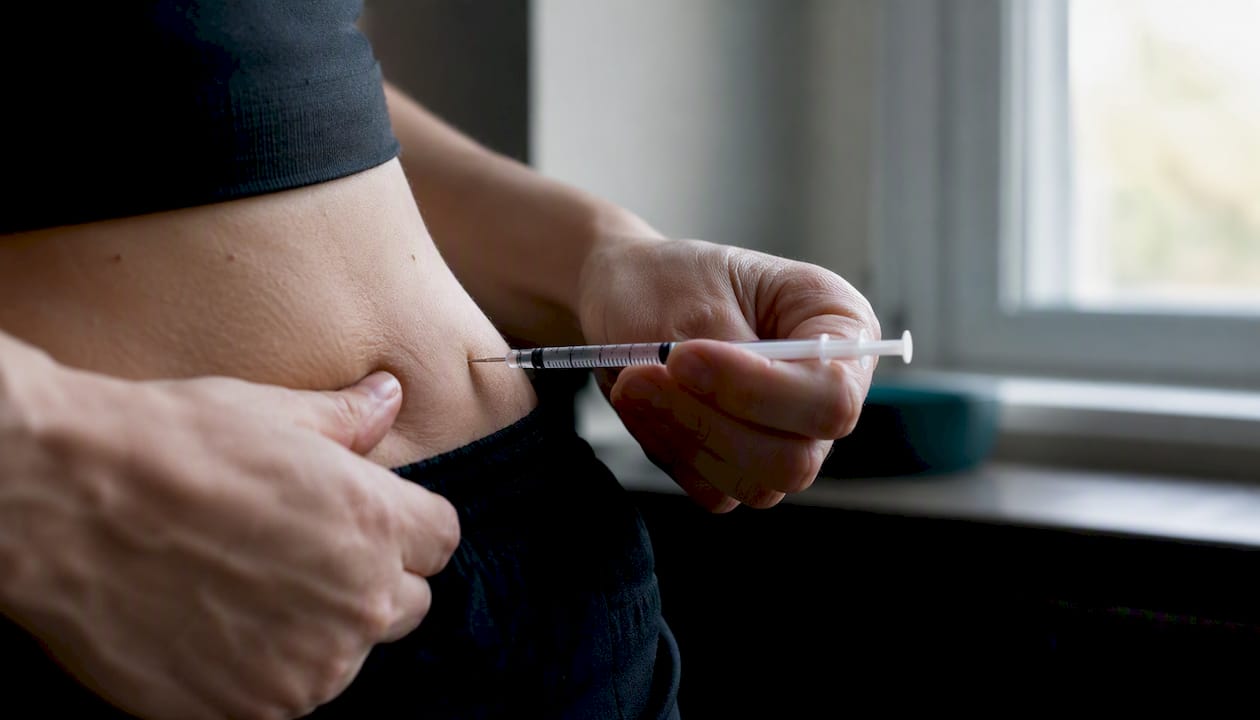
Self-injection into the abdomen is the standard technique. Rotating injection sites within the abdominal region reduces local reactions. Injection-site reactions are among the most common reasons for early discontinuation in trials. Proper reconstitution and storage of the lyophilized peptide are critical for maintaining potency; handling protocols should follow manufacturer or study-protocol specifications.
Discontinuation and VAT re-accumulation
VAT re-accumulates after stopping tesamorelin. This is one of the most clinically significant findings across the tesamorelin literature: the fat-reduction effect is not durable without continued therapy. For clinicians, this means that treatment decisions should account for long-term management plans rather than short-course use. For researchers, it raises the question of whether intermittent or maintenance dosing strategies could preserve benefit at lower cumulative exposure, an area that remains understudied.
Key dosing and durability points:
- 2 mg SC daily is the only dose used in pivotal trials and the FDA-labeled dose.
- 26-week primary endpoints are standard; 12-month data exist for liver-fat outcomes.
- VAT re-accumulation after discontinuation is documented and clinically meaningful.
- No approved maintenance or intermittent dosing protocol currently exists.
What is tesamorelin's regulatory status in the United States?
Tesamorelin is marketed in the United States as Egrifta and holds FDA approval for a single indication: reduction of excess abdominal fat in adults with HIV-associated lipodystrophy. This is a narrow, well-defined label. The approval was based on the pivotal RCT data showing VAT reduction by CT, and the label specifies 2 mg SC daily as the approved dose.
The NCBI clinical review report documents that the regulatory assessment included a careful review of IGF-1 elevation and the theoretical cancer-risk concern, which is reflected in the label's contraindication for active malignancy and the monitoring guidance for IGF-1 levels.
Label-specified clinical requirements:
- Confirm HIV-associated lipodystrophy with excess abdominal fat before initiating.
- Assess for active malignancy and contraindicate if present.
- Monitor IGF-1 periodically; consider dose modification or discontinuation if IGF-1 rises above age- and sex-adjusted normal ranges.
- Evaluate for diabetes or glucose intolerance at baseline and during early treatment.
Off-label research uses
The two most actively studied off-label applications are NAFLD in PLWH (supported by the 12-month multicenter trial, though not yet a labeled indication) and neurocognitive impairment in virally suppressed PLWH (supported only by a small phase 2 trial with nonsignificant cognitive endpoints). Researchers designing off-label protocols should frame these as hypothesis-testing studies, use validated imaging or cognitive endpoints, and include appropriate IRB review and informed-consent language that distinguishes research use from approved therapeutic use.
Pro Tip: When designing an off-label tesamorelin protocol, pre-specify whether the primary endpoint is a fat-quantity measure (VAT by CT, HFF by MRS) or a clinical outcome (fibrosis stage, cognitive score). Fat-quantity endpoints have established effect sizes from prior trials and are statistically powered at realistic sample sizes; clinical outcome endpoints require substantially larger cohorts and longer follow-up.
Statistic callout: The 12-month NAFLD trial found that 35% of placebo participants showed fibrosis progression versus 4% in the tesamorelin arm (P=0.007 for achieving hepatic fat fraction below 5%), the strongest liver-specific signal in the tesamorelin evidence base.
Where does the evidence fall short, and what research gaps remain?
Limitations of current trials
The tesamorelin evidence base has several structural limitations that affect generalizability. Most pivotal trials enrolled predominantly male, older cohorts on established antiretroviral therapy (ART) regimens. Women, younger PLWH, and those on newer ART classes are underrepresented, limiting confidence in effect-size estimates for those groups. Sample sizes in individual trials are adequate for fat-quantity endpoints but underpowered for secondary metabolic and clinical outcomes. Follow-up rarely extends beyond 12 months, leaving long-term cardiovascular, hepatic, and oncologic outcomes uncharacterized.
The neurocognition trial enrolled only 73 participants and used an open-label design, making its nonsignificant cognitive findings difficult to interpret definitively. Whether a larger, blinded trial would show a cognitive benefit remains an open question.
Priority research gaps
- Long-term cardiovascular outcomes: No trial has been powered or designed to assess whether VAT reduction with tesamorelin translates into reduced cardiovascular events in PLWH.
- Histologic NASH resolution: The 12-month NAFLD trial used MRS for liver fat and reported fibrosis progression rates, but liver biopsy-confirmed NASH resolution was not a primary endpoint. A histology-based trial would substantially strengthen the liver-disease evidence.
- Durability after discontinuation: The re-accumulation of VAT after stopping is documented, but structured trials of intermittent or maintenance dosing strategies have not been conducted.
- Non-HIV NAFLD populations: All major trials enrolled PLWH. Whether tesamorelin's liver-fat effects generalize to non-HIV NAFLD populations is unknown and represents a potentially large unmet need.
- Biomarkers predicting response: IGF-1 rise confirms pharmacodynamic activity but does not reliably predict the magnitude of VAT or liver-fat reduction. Identifying baseline predictors of response would improve patient selection.
- Dose optimization: The 2 mg daily dose was selected for pivotal trials without published dose-ranging data. Whether lower doses achieve comparable fat reduction with a better tolerability profile is untested.
- Sex-specific and age-specific effects: Enrollment of more women and younger participants would allow subgroup analyses with adequate power.
Pro Tip: For researchers applying for NIH or industry funding, the combination of a histology endpoint (liver biopsy for NASH resolution) with a validated fat-imaging co-primary (MRS for HFF) in a non-HIV NAFLD population represents the highest-value gap in the current literature. Pairing tesamorelin with a metabolic co-intervention (e.g., dietary modification) as a factorial design would also address the durability question.
Practical guidance for researchers and clinicians
Study-design checklist
Researchers planning a tesamorelin trial should address the following before protocol finalization:
- Eligibility criteria: Define the target population precisely (PLWH with lipodystrophy, PLWH with NAFLD, or non-HIV NAFLD). Specify ART regimen requirements, minimum VAT or HFF thresholds by imaging, and exclusion criteria for active malignancy and pregnancy.
- Primary endpoint and imaging modality: CT for VAT (high sensitivity, radiation exposure), MRS for hepatic fat fraction (gold standard, no radiation), DXA for trunk/limb fat (lower cost, less depot-specific). Match the modality to the primary question.
- Blinding and randomization: Double-blind, placebo-controlled designs are the standard. Open-label designs are acceptable for phase 2 hypothesis-generating work but limit interpretive weight for efficacy claims.
- Statistical endpoints: Use intention-to-treat as the primary analysis. Pre-specify the minimum clinically important difference for the primary endpoint; for VAT, prior trials suggest a treatment effect of −27 to −42 cm² is achievable. Power calculations should account for dropout rates of 15–25% observed in prior studies.
- Safety monitoring: Pre-specify IGF-1 thresholds for dose modification, glucose monitoring intervals, and criteria for discontinuation.
Monitoring template for safety and efficacy visits
- Screening/baseline: Fasting glucose, HbA1c, fasting lipid panel, IGF-1, imaging (CT or MRS), cancer history review, pregnancy test where applicable.
- Week 2: Fasting glucose (transient rise window), injection-site assessment, symptom review.
- Month 3: Fasting glucose, IGF-1, musculoskeletal symptom assessment, adverse-event capture.
- Month 6: Full metabolic panel, repeat imaging, IGF-1, adverse-event review, primary endpoint assessment.
- Month 12 (if applicable): Repeat imaging, fasting glucose, IGF-1, fibrosis assessment if liver biopsy is in protocol.
COA verification and sourcing guidance for research-grade peptides
For researchers sourcing tesamorelin for preclinical or non-clinical studies, rigorous quality assurance is non-negotiable. The following steps apply to any research-grade peptide procurement:
- Request a Certificate of Analysis (COA) from the supplier for the specific lot being ordered.
- Confirm HPLC purity is reported at ≥99% and that the method (reverse-phase HPLC) is specified.
- Verify that the COA was issued by an ISO 17025-accredited third-party laboratory, not an in-house facility.
- Check that the molecular weight and sequence identity are confirmed by mass spectrometry (MS) data on the COA.
- Confirm lot number on the COA matches the lot number on the vial label upon receipt.
- Review storage conditions specified on the COA; lyophilized peptides typically require storage at −20°C or below, with reconstituted solutions used promptly or stored at 4°C for short periods.
Pro Tip: A COA that lists only HPLC purity without mass spectrometry identity confirmation is insufficient for publication-quality research. Sequence identity by MS is the minimum standard for confirming you have the correct peptide, not just a pure unknown compound.
For international sourcing context and practical notes on translating trial data into research practice, the tesamorelin sourcing guide from AuPeptideLabs offers a useful comparative perspective, though researchers should apply US regulatory standards and supplier criteria for domestic procurement.
Data reproducibility notes: Lyophilized tesamorelin should be stored at −20°C and protected from light. Reconstitute with bacteriostatic water per protocol specifications. Avoid repeated freeze-thaw cycles, which degrade peptide integrity. Document lot numbers, reconstitution dates, and storage conditions in study records to support reproducibility.
The most important next steps for tesamorelin research
From an editorial standpoint, tesamorelin occupies an unusual position in the metabolic peptide literature: it has a stronger evidence base than most research peptides, yet that evidence is concentrated in a narrow population (PLWH with lipodystrophy) and a narrow set of endpoints (VAT and hepatic fat by imaging). The translational promise is real. The 12-month NAFLD trial's fibrosis-progression signal is the most clinically meaningful finding in the literature and deserves a follow-up study powered for histologic endpoints.
The priority for funders and investigators should be a well-powered, double-blind, placebo-controlled trial in non-HIV NAFLD patients with liver biopsy as the primary endpoint, paired with MRS as a co-primary. That design would answer the most consequential open question: whether tesamorelin's liver-fat effects translate into histologic NASH resolution in a population far larger than PLWH. Biomarker development, specifically identifying baseline predictors of hepatic fat response, should run in parallel. Without predictive biomarkers, patient selection for future trials will remain inefficient.
The neurocognitive question is worth pursuing in a properly powered, blinded trial, but it should not consume resources ahead of the liver-disease question, where the mechanistic rationale and preliminary effect sizes are stronger.
USAPeptide research tools for qualified investigators
Researchers working with tesamorelin need more than a literature summary. USAPeptide provides a structured set of reference tools designed for qualified investigators: the tesamorelin peptide profile covers molecular structure, the GHRH(1-44) analogue mechanism, and trial summaries in a single reference page. The COA grading tool lets researchers evaluate the legitimacy of Certificates of Analysis before committing to a lot, checking for ISO 17025 accreditation, MS identity confirmation, and HPLC purity reporting.

The peptide research glossary defines the technical terms used across tesamorelin studies, from GHRH and IGF-1 to MRS and DXA, reducing the lookup burden during protocol development. The fat-loss peptide research guide provides comparative context on metabolic peptides for researchers evaluating endpoint selection across compound classes.
All compounds referenced through USAPeptide are research-grade, intended for qualified laboratories and preclinical research use only. They are not approved for human therapeutic use outside of FDA-labeled indications. Researchers should confirm all applicable federal and institutional regulations before ordering.
Visit Usapeptide to access the full peptide database, COA grading tool, and dosage calculator.
Primary sources and recommended readings
Researchers should consult the following primary sources, prioritized by reading need:
- Start here for pooled effect sizes and safety data: Body composition, hepatic fat, metabolic, and safety outcomes of Tesamorelin: A meta-analysis of RCTs — the most comprehensive quantitative synthesis available.
- For liver-disease and fibrosis endpoints: Effects of Tesamorelin on Nonalcoholic Fatty Liver Disease in HIV: A Randomized, Double-Blind, Multicenter Trial — 12-month data with fibrosis progression rates.
- For pivotal trial methodology and metabolic endpoints: Metabolic Effects of a Growth Hormone-Releasing Factor in Patients with HIV, NEJM — the foundational RCT for VAT reduction and lipid effects.
- For 6-month VAT and liver-fat data with glucose monitoring context: Effect of Tesamorelin on Visceral Fat and Liver Fat in HIV-Infected Patients: A Randomized Clinical Trial — Massachusetts General Hospital trial with MRS liver-fat data.
- For fat-quality and adipose tissue composition findings: Tesamorelin Improves Fat Quality Independent of Changes in Fat Quantity — mechanistic imaging study.
- For regulatory and safety framing: Clinical Review Report: Tesamorelin (Egrifta), NCBI — regulatory assessment including IGF-1 and cancer-risk discussion.
- For neurocognition trial limitations: Effects of Tesamorelin on Neurocognitive Impairment in Persons With HIV and Abdominal Obesity — phase 2 open-label trial; read as hypothesis-generating only.
For sex-specific considerations in peptide research design, the evidence-based guide on peptides for women from AuPeptideLabs offers a useful framing of inclusion criteria and generalizability issues relevant to tesamorelin trial design.
This article provides general scientific and educational information about tesamorelin research. It is not a substitute for professional medical advice, clinical judgment, or regulatory guidance. Clinicians and researchers should consult current FDA labeling, institutional review requirements, and qualified specialists before initiating any tesamorelin protocol.
Sources
- Body composition, hepatic fat, metabolic, and safety outcomes of Tesamorelin, a GHRH analogue, in HIV-associated lipodystrophy: A meta-analysis of randomized controlled trials
- Effects of Tesamorelin on Nonalcoholic Fatty Liver Disease in HIV: A Randomized, Double-Blind, Multicenter Trial
- Metabolic Effects of a Growth Hormone–Releasing Factor in Patients with HIV | New England Journal of Medicine
- Effect of Tesamorelin on Visceral Fat and Liver Fat in HIV-Infected Patients With Abdominal Fat Accumulation: A Randomized Clinical Trial
- Tesamorelin Improves Fat Quality Independent of Changes in Fat Quantity
- Results - Clinical Review Report: Tesamorelin (Egrifta) - NCBI