TB-500 lacks robust human efficacy data, and recent analytical work suggests the parent fragment may not even be the active molecule. A 2024 UHPLC-Q-Exactive orbitrap MS/MS study found that its metabolite, Ac-LKKTE, drove wound-healing activity in fibroblast assays while intact TB-500 did not. A 2026 scoping review, WADA's metabolism project, and a newly registered Phase 1/2 trial round out the current evidence base.
TL;DR:
- The wound-healing activity attributed to TB-500 mainly stems from its metabolite Ac-LKKTE, not the intact parent fragment.
- TB-500 undergoes rapid C-terminal cleavage, with its metabolite Ac-LKKTE persisting up to 72 hours, making metabolite measurement essential for accurate analysis.
- Most preclinical tissue repair evidence favors full-length thymosin beta-4 rather than the TB-500 fragment, with limited specific data on the fragment's efficacy.
- Human clinical trials on TB-500 are scarce, with ongoing studies focusing on safety and pharmacokinetics, and no large-scale efficacy data exist.
- Analytical detection of TB-500 relies heavily on metabolite standards, and study designs must incorporate validated, metabolite-specific assays for reliable results.
Table of Contents
- What Does TB-500 Research Say About Its Mechanism of Action?
- How Is TB-500 Metabolized, and What Are the Detection Limits?
- What Does Preclinical Evidence Show for Tissue Repair?
- Is There Human Clinical Evidence for TB-500?
- What Is Known About TB-500 Safety and Anti-Doping Status?
- Practical Guidance for Designing Rigorous TB-500 Research
- How Immunogenic Is TB-500, and Should Researchers Screen for Antibodies?
- How Does TB-500 Compare With Related Regenerative Peptides?
- What Preclinical Model Standards Should TB-500 Studies Follow?
- What Limits Current TB-500 Detection and Research Methods?
- Research Priorities and Where TB-500 Evidence Needs to Go Next
- How USAPeptide.info Supports Rigorous TB-500 Research
- Sources
What Does TB-500 Research Say About Its Mechanism of Action?
TB-500 is the synthetic name commonly applied to the 17-23 amino acid fragment (Ac-LKKTETQ) derived from thymosin beta-4 (Tβ4), the 43-residue actin-binding protein found in nearly every mammalian cell type. Most of what researchers cite as the "TB-500 mechanism" is actually Tβ4 biology extrapolated downward onto a seven-residue fragment, and that distinction matters more than most summaries let on.
Tβ4's best-characterized property is G-actin sequestration. It binds monomeric actin at a 1:1 ratio and buffers the pool of free G-actin available for polymerization into filamentous actin (F-actin). Cell biologists sometimes call this the "actin rheostat" model: by controlling how much unpolymerized actin sits ready in the cytoplasm, Tβ4 modulates how fast a cell can extend lamellipodia, remodel its cytoskeleton, and migrate toward a wound edge or a chemical gradient. Foundational reviews of thymosin beta-4 biology document this actin-binding function alongside downstream effects on cell migration, angiogenesis, and reduced apoptosis across multiple tissue types.
That mechanistic chain, actin binding leading to cytoskeletal remodeling leading to migration leading to tissue-level repair, is well supported for full-length Tβ4 in cell culture and rodent tissue. What is far less settled is how much of that chain survives intact in the truncated 17-23 fragment sold and studied as TB-500.
What is fragment-specific versus inferred from Tβ4
The actin-binding domain of Tβ4 sits primarily in a different region of the peptide than the 17-23 sequence. Researchers have long questioned whether the isolated fragment retains meaningful actin affinity on its own, or whether its biological activity, where observed, comes from something else entirely, including its metabolites.
- Actin binding: well documented for full-length Tβ4; not independently confirmed for the isolated 17-23 fragment in the same structural detail.
- Cell migration promotion: shown in Tβ4 studies across keratinocytes, endothelial cells, and cardiac progenitor cells; fragment-specific migration data are sparser and inconsistent.
- Angiogenesis support: a repeated finding in Tβ4 literature; TB-500-specific angiogenesis data exist mainly as extensions of Tβ4 assumptions rather than independent replication.
- Wound-healing activity: here the newer analytic work actually flips the expected direction. The metabolite Ac-LKKTE showed significant wound-healing activity in fibroblast assays, while the parent TB-500 fragment did not, in that same UHPLC-MS/MS study.
Pro Tip: When you design an endpoint around "TB-500 mechanism of action," specify in your protocol whether you are measuring the parent fragment's direct effect or a downstream metabolite's effect. Conflating the two is one of the most common interpretive errors in early-phase peptide research, and it can silently invalidate a dose-response curve.
For investigators choosing endpoints, this distinction should drive assay selection. Cell migration assays (scratch/wound assays, transwell migration) and angiogenesis assays (tube formation, chorioallantoic membrane) remain reasonable functional readouts, but pairing them with a biomarker panel that separately tracks parent compound and metabolite concentration is the only way to know which molecule is actually producing an observed effect. A TB-500 peptide reference profile covering compound specifications and molecular data is a useful starting point for anchoring assay design to accurate structural information.
How Is TB-500 Metabolized, and What Are the Detection Limits?
TB-500 undergoes serial C-terminal cleavage almost immediately after exposure to biological matrices, while its N-terminal acetylation protects that end from enzymatic degradation. This asymmetric breakdown pattern is why metabolite tracking, not parent-compound tracking, has become the preferred analytic strategy in both pharmacokinetic and anti-doping contexts.
The 2024 UHPLC-Q-Exactive orbitrap study mapped this time course directly in rats. Ac-LK appeared at its highest concentration in the 0 to 6 hour window after exposure, then declined rapidly. Ac-LKK, by contrast, remained detectable for up to 72 hours, making it the more durable biomarker of prior exposure. Ac-LKKTE, the metabolite retaining most of the parent's C-terminal sequence, was the one that showed measurable wound-healing activity in the fibroblast model.
World Anti-Doping Agency (WADA) researchers independently characterized this metabolic profile for screening purposes and established limits of detection for the major species:
WADA's project also synthesized certified reference standards for each of these metabolites, plus a heavy-labeled TB-500 internal standard, specifically so anti-doping laboratories could implement consistent, validated screening methods rather than relying on unverified in-house synthesis.
For researchers running their own pharmacokinetic sampling, a few practical points follow directly from this metabolic map:
- Sample early (0 to 6 hours) if Ac-LK is your target analyte; it clears quickly and a delayed draw will miss the peak.
- Extend sampling to 72 hours if Ac-LKK is the biomarker of interest, since it persists far longer than the parent fragment or Ac-LK.
- Because M(1-5) has the lowest published LOD at 50 pg/mL, it is often the most sensitive target for confirming prior exposure even at low doses.
- Validate extraction recovery specifically at these low picogram-per-milliliter concentrations; standard peptide extraction protocols optimized for microgram-range analytes routinely underperform here.
This metabolic reality also reframes what a "TB-500 half-life" question is really asking. The parent compound's half-life is short and analytically almost irrelevant compared to the persistence profile of its downstream metabolites, a distinction covered in more depth in USAPeptide's breakdown of TB-500 pharmacokinetics. Any PK/PD model built on parent-compound concentration alone will systematically understate total biological exposure.
What Does Preclinical Evidence Show for Tissue Repair?
Preclinical data on tissue repair split cleanly along the same line drawn in the mechanism section: strong signal for full-length Tβ4, thinner and less consistent signal for the isolated TB-500 fragment.
In cell-based models, Tβ4 has repeatedly promoted keratinocyte and fibroblast migration in scratch-wound assays, accelerated closure rates relative to untreated controls, and supported endothelial tubulogenesis in angiogenesis assays. These are the cellular building blocks of the "faster wound closure" and "tissue regeneration" claims that circulate around TB-500 more broadly, even though many of the underlying experiments used the full 43-residue protein rather than the fragment.
Rodent studies extend this pattern into whole-tissue outcomes, showing measurable improvements in dermal wound closure rates and reduced scarring markers after Tβ4 administration. The 2024 UHPLC-MS/MS work adds a fragment-specific data point to this picture, but a counterintuitive one: in the same rat model used to trace metabolism, it was the Ac-LKKTE metabolite, not injected TB-500 itself, that produced significant wound-healing activity in the paired fibroblast screen.
A few caveats matter for anyone trying to translate these findings into a study design:
- Most positive tissue-repair signals in the literature trace back to full-length Tβ4, not the 17-23 fragment marketed and studied as TB-500.
- Rodent dermal wound models measure closure rate and histologic markers well, but musculoskeletal claims, tendon strength, ligament integrity, cartilage repair, have far fewer dedicated animal studies behind them.
- Long-term functional and biomechanical endpoints (load-to-failure testing, gait analysis, range-of-motion recovery) remain largely absent from the published TB-500 dataset.
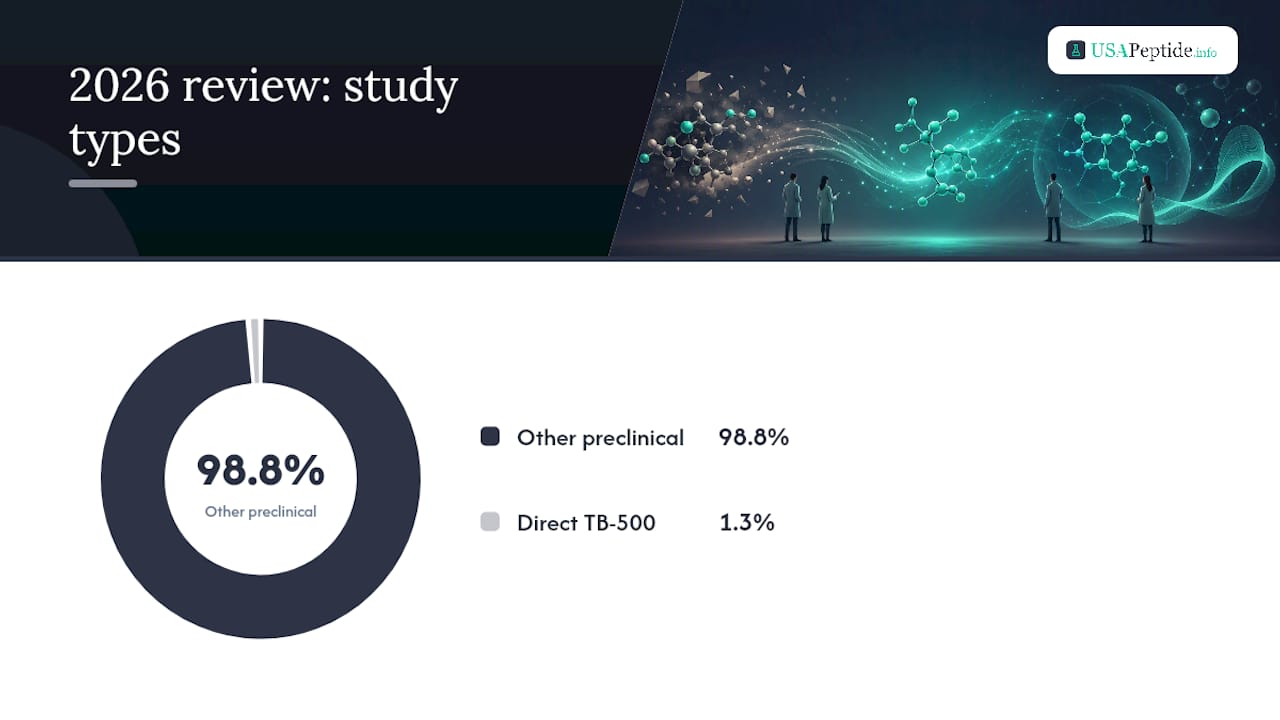
- The 2026 scoping review covering 80 studies found the literature weighted heavily toward preclinical and mechanistic work, with direct TB-500 evidence limited to a single included study.
That last point deserves emphasis for anyone drafting a grant proposal or IRB submission: the field has a large, credible Tβ4 preclinical foundation, but it has not yet built an equally large fragment-specific foundation underneath it. Investigators planning musculoskeletal repair studies should treat biomechanical strength and histologic integrity as co-primary outcomes rather than defaulting to wound-closure percentages or molecular biomarkers alone, since closure rate can improve without any corresponding gain in tissue mechanical strength.
Is There Human Clinical Evidence for TB-500?
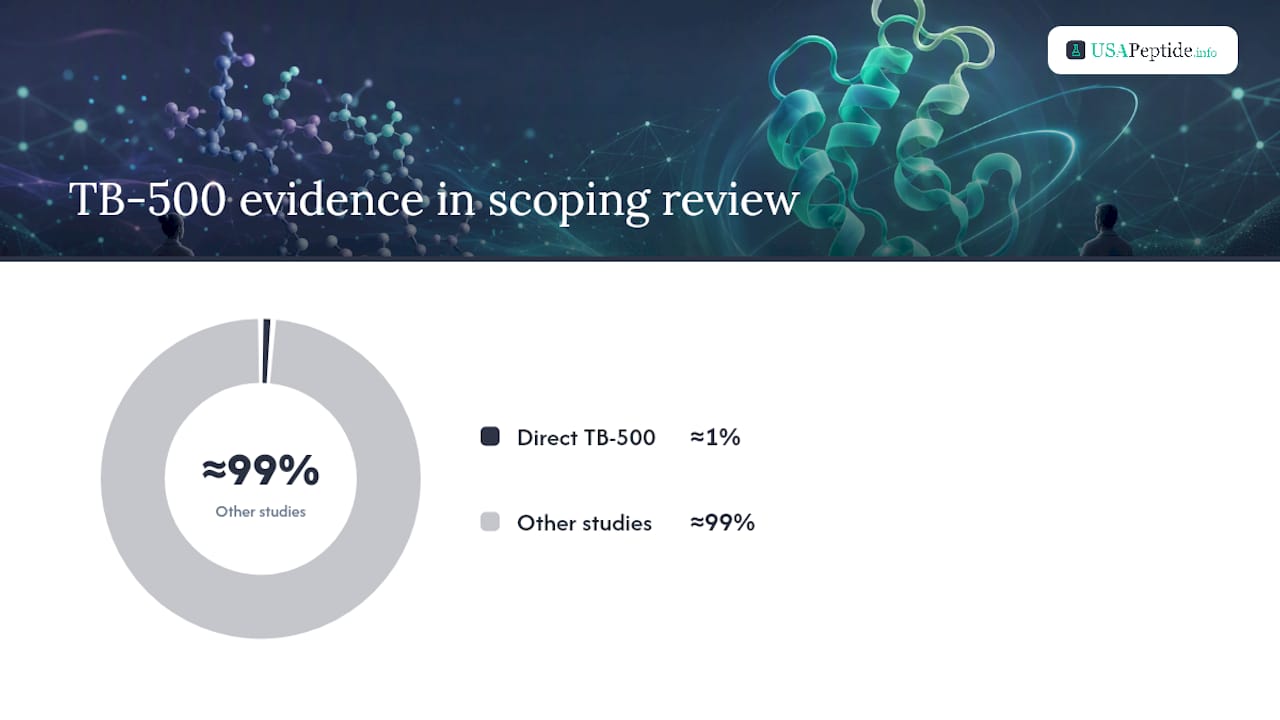
Published human data on thymosin beta-4 concentrate almost entirely in ocular and topical wound settings, using the full-length protein rather than the TB-500 fragment. Randomized trials of the fragment itself in humans are minimal to nonexistent in the published record, a gap the 2026 scoping review explicitly flagged when it found direct TB-500 human evidence limited to essentially a single included study across its full 80-study dataset.
That gap is starting to close, at least structurally. A 2026 ClinicalTrials.gov record (NCT07487363) describes a Phase 1/2, randomized, double-blind, placebo-controlled, sequential dose-escalation study of TB-500 in adults with stable atherosclerotic cardiovascular disease, with a recruitment start date in February 2026. The design is worth studying regardless of therapeutic area, because it illustrates what a methodologically serious fragment trial looks like:
- Primary focus: safety, tolerability, and pharmacokinetics across sequential dose cohorts rather than a headline efficacy claim.
- Exploratory endpoints: vascular biomarkers including flow-mediated dilation (FMD) and high-sensitivity C-reactive protein (hs-CRP), used as mechanistic signals rather than definitive outcomes.
- Control structure: placebo-controlled with dose escalation, the standard architecture for establishing a safe human dose range before any efficacy claim is attempted.
For clinician-investigators evaluating what would actually constitute convincing evidence for musculoskeletal or soft-tissue repair claims, the bar sits well above what currently exists. A credible human dataset would need adequately powered sample sizes (not the small pilot cohorts typical of early peptide research), pre-registered functional and biomechanical endpoints rather than surrogate biomarkers alone, and metabolite-aware pharmacokinetic sampling given what the analytical studies have already revealed about Ac-LKKTE's independent activity. None of that currently exists in the public trial record for TB-500 specifically.
What Is Known About TB-500 Safety and Anti-Doping Status?
TB-500 has no FDA approval for any human therapeutic indication, and it should be classified plainly as a research compound rather than a treatment. Preclinical tolerability signals in cell and animal models have generally been favorable, without the acute toxicity findings that would halt a research program outright, but "generally favorable in rodents" is a long way from an established human safety profile.
Formal human dose-escalation data are only now beginning to accumulate through registered trials like NCT07487363, and until that program and others like it report results, dosing guidance for TB-500 in any human context remains speculative. Researchers designing early-phase protocols should treat dose-escalation methodology, not efficacy hunting, as the immediate priority.
WADA's analytical program established limits of detection down to 50 pg/mL for the Ac-LKKTE metabolite, 100 pg/mL for Ac-LKK, and 500 pg/mL for Ac-LK, in urine and plasma.
These figures carry direct implications for anti-doping and research-participant screening alike:
- Sensitivity at the picogram level means low-dose exposure is detectable well after any acute pharmacologic effect has faded.
- Laboratories without WADA's synthesized reference standards risk both false negatives and mischaracterization of which metabolite produced a given signal.
- Any trial enrolling athletes or competitive-sport participants should screen for TB-500 metabolite exposure using validated LC-MS/MS methods rather than relying on self-report alone, given how persistent Ac-LKK remains at 72 hours post-exposure.
Practical Guidance for Designing Rigorous TB-500 Research
Getting a clean, defensible dataset out of TB-500 research depends less on dose selection and more on assay quality upstream of it. Three practical requirements separate reproducible studies from ones that generate noise.
- Use synthesized, authenticated metabolite standards. Ac-LK, Ac-LKK, and Ac-LKKTE each need their own certified reference standard, plus a stable-isotope-labeled internal standard for the parent compound, before running LC-MS/MS quantification. Skipping this step is the single most common source of misattributed activity in peptide bioanalytics, since a lab without authenticated standards cannot reliably distinguish parent-compound signal from metabolite signal.
- Structure early-phase human work as randomized, double-blind, placebo-controlled dose escalation. The NCT07487363 design is a reasonable template: sequential dose cohorts, PK and metabolite profiling built in from the start, hard safety endpoints as primary outcomes, and exploratory biomarkers layered on top rather than substituted in.
- Verify compound identity and purity before dosing anything. HPLC purity at or above 99% and testing through an ISO 17025 accredited laboratory should be non-negotiable prerequisites, not nice-to-haves, for any compound entering an animal or cell-based protocol.
Pro Tip: Before you run a single assay, grade the Certificate of Analysis on the compound you plan to use. A COA that lacks batch-specific HPLC purity data, mass spectrometry identity confirmation, or a traceable lot number is not sufficient documentation for a reproducible study, no matter how legitimate the supplier looks on paper.
USAPeptide.info's COA grading tool was built around exactly this checklist, letting investigators evaluate a supplier's documentation against ISO 17025 and purity benchmarks before a compound ever reaches the bench. Pairing that verification step with a dosing calculator for research-scale planning removes two of the more common sources of variance between labs attempting to replicate the same protocol.
How Immunogenic Is TB-500, and Should Researchers Screen for Antibodies?
Immunogenicity data specific to the TB-500 fragment are limited, which is itself a notable gap given how much repeated dosing appears in both preclinical protocols and unregulated human use. Short synthetic peptides generally carry lower intrinsic immunogenic risk than larger recombinant proteins, since their small size and lack of complex tertiary structure make them poor targets for robust antibody formation. That said, "generally lower risk" is a class-level assumption, not a fragment-specific finding, and it does not substitute for direct measurement.
Repeated administration of any peptide, including short fragments, carries some theoretical risk of anti-drug antibody (ADA) development, particularly if manufacturing impurities or aggregated peptide species are present in the dosed material. This is another place where compound purity intersects directly with study validity: aggregated or impure peptide preparations are more likely to trigger an immune response than a well-characterized, high-purity batch, and an ADA response midway through a dosing protocol can confound both efficacy and pharmacokinetic readouts.
No dedicated human immunogenicity studies for TB-500 currently exist in the published record. Investigators running multi-dose animal protocols or planning repeated human dosing in future trials should build in ADA screening (typically via ELISA-based anti-peptide antibody assays) as a standard safety and data-integrity measure, not an afterthought added after unexplained efficacy drift appears in later dosing cycles.
How Does TB-500 Compare With Related Regenerative Peptides?
TB-500's mechanistic niche, actin regulation supporting cell migration, sits alongside several other research peptides that target tissue repair through different pathways entirely. Understanding those distinctions helps investigators choose the right compound for the biological question actually being asked, rather than defaulting to whichever peptide has the most name recognition.
BPC-157, for instance, works through a largely separate mechanism involving growth factor upregulation and angiogenic signaling in gut and tendon tissue models, with its own distinct evidence base and gaps. Growth-hormone-secretagogue peptides like ipamorelin operate through an entirely different endocrine pathway, stimulating growth hormone release rather than acting directly on cytoskeletal dynamics. Comparing these categories side by side matters because a researcher studying tendon repair, for example, may find a stronger existing preclinical dataset in one category than in TB-500's actin-mediated pathway specifically.
None of these compounds should be treated as interchangeable substitutes for TB-500 in a study design; the mechanistic pathways differ enough that swapping one for another changes what a positive or negative result actually means. A comparative overview of peptides used in tissue recovery research lays out these mechanistic distinctions in more detail, which is useful groundwork before finalizing which compound fits a given hypothesis.
What Preclinical Model Standards Should TB-500 Studies Follow?
Preclinical TB-500 research would benefit from more consistency in three areas: model selection, dosing regimen reporting, and endpoint standardization. Right now, studies vary widely in whether they test the parent fragment, full-length Tβ4, or a mixture without clearly separating results, which makes cross-study comparison difficult.
A reasonable baseline protocol includes a rodent dermal wound or musculoskeletal injury model with clearly randomized treatment and vehicle-control arms, dosing that reports both concentration and confirmed compound purity, and a metabolite-aware sampling schedule matched to the time-course data already established, early sampling for Ac-LK, extended windows for Ac-LKK. Endpoint selection should pair molecular or histologic markers with a functional measure whenever the injury model allows it: biomechanical load testing for tendon and ligament models, closure-rate imaging plus tensile strength testing for dermal models.
Reporting should explicitly state which molecular species was administered, parent TB-500, full-length Tβ4, or a specific isolated metabolite, since the field's current ambiguity on this point is precisely why interpreting the existing literature is so difficult. Standardizing this single reporting practice across future preclinical work would do more to accelerate reliable conclusions than any single new experiment could.
What Limits Current TB-500 Detection and Research Methods?
Detection and research on TB-500 face a shared structural problem: the parent compound degrades too fast to be a reliable analytical target, forcing the entire field toward metabolite-based proxies that carry their own interpretive complications.
Because Ac-LK, Ac-LKK, and Ac-LKKTE each have different formation rates, persistence windows, and apparently different biological activity, a lab measuring only one metabolite can miss the full exposure and activity picture. Assays lacking WADA's synthesized reference standards or a heavy-labeled internal standard risk both false negatives and misattributed bioactivity, since without an authentic standard for comparison, it becomes difficult to confirm that a detected signal is genuinely the target metabolite rather than a structurally similar interferent.
There is also a broader evidentiary limitation sitting underneath the analytical one: the small number of dedicated fragment-specific studies means detection methods have been validated against a thin dataset. Expanding the number of independent labs using WADA's certified standards, and publishing metabolite-specific PK data across more animal models before scaling into human trials, would meaningfully strengthen the field's analytical foundation.
Research Priorities and Where TB-500 Evidence Needs to Go Next
The honest read on TB-500 in 2026 is mechanistic promise paired with clinical immaturity. The actin-binding story borrowed from full-length Tβ4 is compelling, and the discovery that Ac-LKKTE, not the parent fragment, drives measurable wound-healing activity in fibroblast assays is exactly the kind of finding that should reshape how the next generation of studies gets designed.
We think the field's priorities are clear. Analytical assays need to standardize around authenticated metabolite standards rather than parent-compound quantification alone. Early human pharmacokinetic and pharmacodynamic trials need metabolite-specific endpoints built in from the first dose cohort, following the template NCT07487363 has already set. And every lab working with TB-500, whether in a cell culture hood or a rodent facility, needs transparent Certificate of Analysis practices as a baseline, not an afterthought bolted on after a reviewer asks about purity.
Registering trials publicly and sharing authenticated metabolite standards across labs would do more to accelerate reproducible TB-500 research than any single new efficacy study. The compound's story is still being written at the metabolite level, and getting that chemistry right now will save the field years of confused, contradictory findings later.
— USAPeptide Team
How USAPeptide.info Supports Rigorous TB-500 Research
USAPeptide.info is built specifically for the workflow this article just described: verify the compound, understand the metabolism, plan the dose, then run the study. Where a generic peptide vendor gives you a product page and a checkout button, USAPeptide.info gives you the molecular profile, a COA grading tool that checks a supplier's documentation against ISO 17025 and purity benchmarks, and a dosing calculator built for research-scale planning, all before you commit a batch to the bench.

Given everything the analytical literature shows about metabolite-driven activity and picogram-level detection sensitivity, compound identity and purity are not a formality; they are the difference between a clean dataset and an unexplained variance you cannot trace six months into a study.
Start by checking your current supplier's documentation using the COA grading tool, then visit the Peptriva Research Peptide Resource Center to source ISO 17025 accredited, research-grade TB-500 with same-day shipping for your next protocol.
This article is general information, not a substitute for advice from a qualified doctor. Consult a qualified healthcare professional about your own circumstances before acting on anything here.