Selank shows consistent anxiolytic and neuroprotective signals across Russian preclinical models and small clinical studies, but the Western evidence base is limited and requires larger, randomized, placebo-controlled trials before clinical adoption outside Russia and Ukraine. The compound is a synthetic heptapeptide analog of tuftsin (Thr-Lys-Pro-Arg-Pro-Gly-Pro), registered by the Russian Ministry of Health for generalized anxiety disorder (GAD) and neurasthenia, and available as a 0.15% intranasal solution. Mechanistic work points to GABAergic gene-expression modulation, enkephalinase inhibition, and BDNF upregulation as the primary pharmacological drivers.
The human evidence base consists of three modest Russian comparative trials totaling roughly 190–200 patients, none of which meet Western Phase 3 standards for randomization, placebo control, or multicenter design. Preclinical data are more extensive: Volkova et al. documented rapid, time-dependent gene-expression changes in rat frontal cortex (45 genes at 1 hour, 22 genes at 3 hours), and a Springer RNA-seq study in a transient middle cerebral artery occlusion (tMCAO) model identified 118 differentially expressed genes at 4.5 hours post-ischemia, predominantly downregulated, suggesting a compensatory neuroprotective transcriptomic effect.
Key evidence signals at a glance:
- Anxiolytic efficacy: Reported equivalence to benzodiazepines (medazepam, phenazepam) on HAM-A in small Russian comparative trials, without sedation or withdrawal
- Neuroprotection: RNA-seq in tMCAO rats shows 118 DEGs with compensatory downregulation of ischemia-upregulated genes
- Mechanism: Multi-pathway, including GABAergic gene-expression modulation, enkephalinase inhibition, and BDNF upregulation
- Regulatory status: Approved in Russia and Ukraine; investigational compound in the US, EU, and most other markets
- Evidence maturity: Preclinical data are promising; human data are preliminary and geographically concentrated
For investigators considering further study, the evidence justifies a well-designed Phase 2 randomized controlled trial in GAD populations, with rigorous pharmacokinetic sampling and blinded outcome assessment.
Key Takeaways
Selank's anxiolytic and neuroprotective signals are mechanistically coherent and consistent across preclinical models, but the human evidence base remains too small and methodologically limited to support clinical adoption outside Russia and Ukraine without further rigorous trials.
| Point | Details |
|---|---|
| Preclinical signal is consistent | Multiple rodent models and transcriptomic studies show anxiolytic and neuroprotective effects, including 118 DEGs in tMCAO ischemia. |
| Human evidence is preliminary | Three Russian comparative trials (~190–200 patients total) lack placebo control, blinding, and multicenter design. |
| Mechanism is multi-pathway | GABAergic gene-expression modulation, enkephalinase inhibition, and BDNF upregulation each contribute to the pharmacological profile. |
| Regulatory status limits clinical use | Approved in Russia and Ukraine; investigational in the US and EU, requiring IND filing and IRB approval for human studies. |
| USAPeptide supports study planning | The COA grading tool and dosage calculator at USAPeptide help investigators verify supplier documentation and plan research protocols to ISO 17025 standards. |
Primary sources and databases for further research
The following sources provide the highest-value entry points for investigators conducting a systematic literature review on Selank.
- Volkova et al. (2016) — PMC: The primary source for GABAergic gene-expression time-course data in rat frontal cortex; essential for any mechanistic study design
- Filatova et al. (2017) — Frontiers in Pharmacology: IMR-32 cell-culture data showing model-dependent mechanistic interactions; critical for interpreting in vitro vs. in vivo divergence
- Springer tMCAO RNA-seq study: RNA-seq evidence for neuroprotective transcriptomic effects in ischemia; the most recent and methodologically detailed preclinical study available
- PeptideInsight Selank profile: Structured clinical synthesis covering registration status, trial summaries, dosing formulations, and safety profile; useful as a secondary clinical reference
- RethinkPeptides Selank review: Clinical-focused synthesis of Russian comparative trial data and benzodiazepine equivalence claims
- PubMed / PMC: Search "Selank" AND "anxiety" OR "GABA" OR "BDNF" for the full indexed literature; filter by publication date to capture recent transcriptomic work
- ClinicalTrials.gov: Search "Selank" to identify any registered trials; as of the current literature review, no Western-registered trials appear in the database
- eLIBRARY.ru and CyberLeninka: Russian-language databases containing primary clinical trial reports not fully indexed in PubMed; essential for accessing the original Seredenin and Syunyakov clinical data
- USAPeptide news and research updates: Timely commentary on new peptide transcriptomic and mRNA studies, including Selank-relevant preclinical developments
This article is general information, not a substitute for advice from a qualified doctor. Consult a qualified healthcare professional about your own circumstances before acting on anything here.
Table of Contents
- What does the selank research record show? A study-level overview
- How does Selank work at the molecular level?
- What do animal and in vitro studies tell us?
- What does the human clinical evidence show?
- Doses and pharmacokinetics reported in studies
- What safety signals have been reported?
- Regulatory status and research availability
- What are the key evidence gaps and research priorities?
- Practical resources for planning Selank research
- The USAPeptide team's perspective on Selank's research trajectory
- USAPeptide resources for Selank investigators
- Sources
What does the selank research record show? A study-level overview
The table below covers the highest-priority published studies across preclinical and clinical domains, with structured fields for design, sample, dose/route, primary endpoints, main findings, and key limitations.
| Study | Design | n / Model | Dose / Route | Primary Endpoints | Main Findings | Limitations |
|---|---|---|---|---|---|---|
| Volkova et al. (2016) — PMC | In vivo rat; qPCR gene-expression time course | Wistar rats | Not specified per kg; single administration | GABAergic gene expression at 1 h and 3 h in frontal cortex | 45 genes changed at 1 h with a strong positive correlation versus GABA; by 3 h fewer genes changed with a negative correlation | No behavioral endpoints; single species; no dose-response curve |
| Filatova et al. (2017) — Frontiers | In vitro; IMR-32 human neuroblastoma cells | Cell line | Concentration-matched to in vivo | GABAergic mRNA levels; interaction with GABA and olanzapine | Selank alone: no mRNA changes; Selank + GABA suppressed GABA effects; Selank + olanzapine amplified changes | Cell line ≠ intact CNS; no PK context; single time point |
| Springer tMCAO RNA-seq (2026) | In vivo rat; RNA-seq post-ischemia | Wistar rats; tMCAO model | Administered post-ischemia | DEGs at 4.5 h; pathway enrichment | 118 DEGs; 99 downregulated; compensatory neuroprotective profile; immune/complement targets | Single time point post-ischemia; no behavioral outcomes reported |
| Russian GAD comparative trials (Seredenin et al.; Syunyakov et al.) | Open-label and comparative; no placebo arm | small patient groups in three trials | 0.15 mg intranasal TID; 14–28 days | HAM-A, CGI, Spielberger anxiety scales | Anxiolytic equivalence to medazepam/phenazepam; antiasthenic and psychostimulant properties; no sedation or withdrawal | No placebo; no blinding; single-country; no CONSORT reporting |
| Ershov et al. (2020) — functional connectomics | Observational; healthy volunteers | Small human sample | Not publicly specified | CNS functional connectivity | Objective CNS activity correlated with Selank administration | No clinical population; no anxiety endpoints; sample size not published |
Evidence strength note: The preclinical transcriptomic studies carry moderate internal validity within their models but limited translational power. The clinical comparative trials provide directional efficacy signals but lack the methodological controls required for regulatory-grade evidence in Western markets.
How does Selank work at the molecular level?
Selank's pharmacological profile is best understood as multi-pathway rather than single-target. Three mechanisms have the most experimental support.
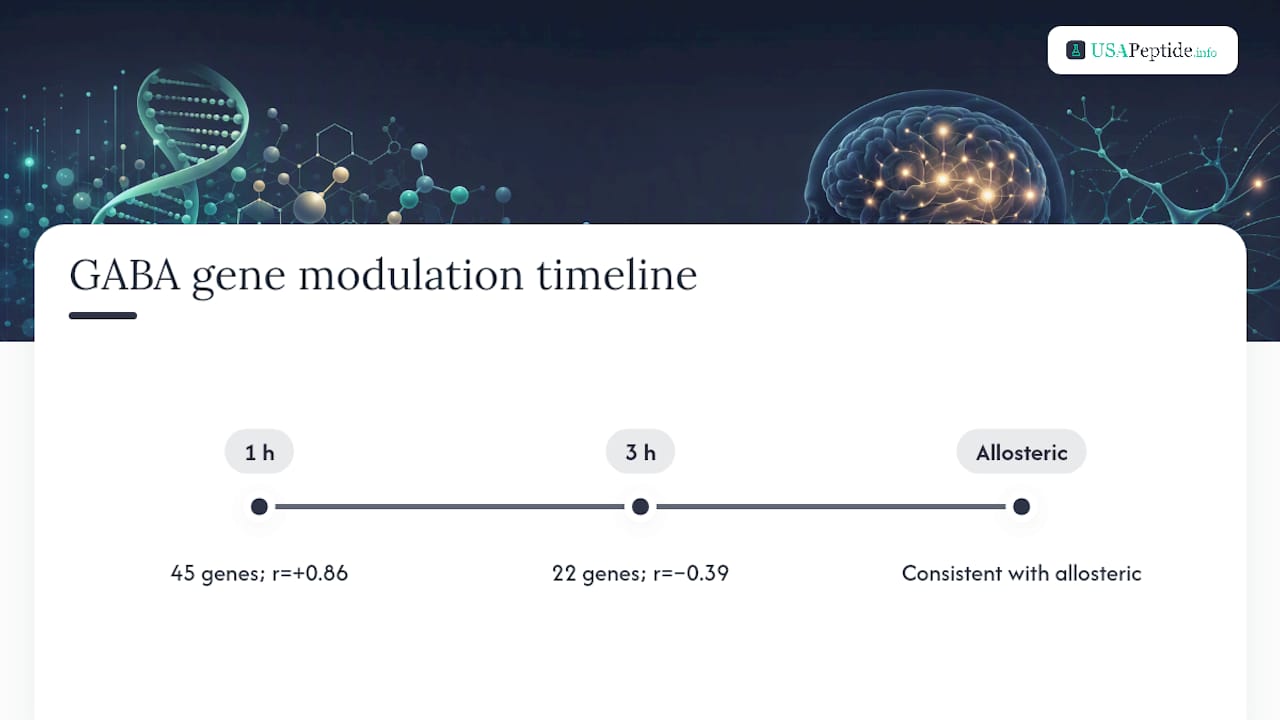
GABAergic gene-expression modulation is the most thoroughly characterized. Volkova et al. showed that a single Selank administration in Wistar rats changed the expression of 45 GABAergic genes at 1 hour, with a strong positive correlation (r = 0.86) between Selank's gene-expression profile and that of GABA itself. By 3 hours, only 22 genes remained differentially expressed and the correlation reversed (r = −0.39), indicating a time-dependent shift in the direction of modulation. This pattern is consistent with allosteric rather than orthosteric receptor engagement: the peptide appears to alter the receptor's responsiveness to endogenous GABA rather than directly occupying the agonist binding site.
The Frontiers cell-culture study complicates this picture usefully. In IMR-32 human neuroblastoma cells, Selank alone produced no significant mRNA changes in the same GABAergic gene set. When combined with GABA, it suppressed GABA-induced expression changes; when combined with olanzapine, it amplified olanzapine's effects. The divergence between in vivo and in vitro findings is not a contradiction but a model-dependent signal: intact CNS circuitry, endogenous neurotransmitter tone, and systemic peptide distribution all shape the outcome in ways a neuroblastoma cell line cannot replicate.
Enkephalinase inhibition is the second well-supported mechanism. Selank inhibits enzymes that degrade endogenous enkephalins, effectively prolonging the activity of endogenous opioid peptides at their receptors. This could contribute to anxiolytic effects through mu- and delta-opioid receptor pathways independently of GABA, and may partly explain the absence of benzodiazepine-typical sedation in clinical reports.
BDNF upregulation represents the third pathway. Animal studies report increases in BDNF mRNA at 3 hours and protein-level increases at 24 hours in rat hippocampus, consistent with a neuroprotective and neuroplasticity-promoting effect. The tMCAO RNA-seq data extend this picture: Selank produced 118 DEGs in ischemic rat brain at 4.5 hours, with 99 predominantly downregulated genes compensating for ischemia-induced upregulation, and pathway analysis implicated immune and complement system targets alongside neuronal survival pathways.
Cross-talk with serotonergic and dopaminergic systems has been proposed based on behavioral pharmacology data, but direct receptor-binding evidence for these interactions remains limited in the published literature.
Pro Tip: To distinguish allosteric from orthosteric modulation experimentally, combine receptor-binding kinetics (association/dissociation rate constants with and without Selank) with competition radioligand assays and a time-course qPCR panel at 1 h, 3 h, and 24 h. A shift in Bmax without a change in Kd, alongside the time-dependent gene-expression reversal seen by Volkova et al., would constitute strong evidence for allosteric engagement.
What do animal and in vitro studies tell us?
Preclinical data for Selank span behavioral pharmacology, molecular neuroscience, and transcriptomics across several rodent models. The signal is consistent but not uniform across all endpoints.
Behavioral models consistently show anxiolytic effects. Chronic unpredictable stress protocols in Wistar and WAG/Rij rats demonstrate reduced anxiety-like behavior on elevated plus-maze and open-field tests following intranasal Selank administration. WAG/Rij rats, which carry a genetic predisposition to absence epilepsy and comorbid anxiety, provide a clinically relevant model for GAD-like phenotypes. Dose ranges in these models typically fall in the microgram-per-kilogram range via intranasal delivery, though published dose-response curves are sparse.

Transcriptomic models provide the most mechanistically detailed data. The tMCAO ischemia model is particularly informative for neuroprotection research: RNA-seq analysis at 4.5 hours post-occlusion identified 118 DEGs (fold change >1.5, Padj < 0.05), with 99 downregulated relative to saline-treated ischemic controls. The enriched pathways included immune regulation and complement activation, suggesting Selank may modulate neuroinflammatory cascades in the acute ischemic window. This positions the compound as a candidate for early neuroprotective adjunct studies, not just anxiolysis research.
The following table summarizes the key preclinical models and their primary findings:
| Model | Species / Cell Line | Dose / Route | Primary Endpoints | Key Findings |
|---|---|---|---|---|
| Chronic unpredictable stress | Wistar rat | Intranasal, μg/kg range | Elevated plus-maze, open-field | Reduced anxiety-like behavior; no sedation |
| WAG/Rij genetic anxiety model | WAG/Rij rat | Intranasal | Behavioral anxiety indices | Anxiolytic effects in genetically predisposed animals |
| tMCAO ischemia | Wistar rat | Post-ischemia administration | RNA-seq DEGs at 4.5 h | 118 DEGs; 99 downregulated; immune/complement pathway modulation |
| GABAergic gene-expression | Wistar rat frontal cortex | Single administration | qPCR at 1 h and 3 h | 45 DEGs at 1 h (r = 0.86 vs. GABA); 22 DEGs at 3 h (r = −0.39) |
| IMR-32 cell culture | Human neuroblastoma | Concentration-matched | GABAergic mRNA panel | No change with Selank alone; interaction effects with GABA and olanzapine |
Translational caveats deserve direct attention. Intranasal delivery in rodents does not map straightforwardly to human intranasal pharmacokinetics: nasal cavity geometry, mucosal surface area, and olfactory-to-CNS transport differ substantially between species. The IMR-32 cell-culture findings underscore a second caveat: model-dependent effects mean that negative in vitro results do not negate in vivo activity, and vice versa. Researchers should not treat any single model as definitive. Reproducibility is a further concern; most published preclinical studies originate from a small cluster of Russian laboratories, and independent replication in Western facilities has not been published.
For researchers planning new preclinical work, validated behavioral assays (elevated plus-maze, light-dark box, Vogel conflict test) combined with neurochemical endpoints (BDNF protein, enkephalin levels, GABAergic receptor binding) provide the strongest translational bridge to clinical anxiolytic efficacy. Transcriptomic endpoints add mechanistic depth but require careful time-point selection based on the 1-hour and 3-hour windows identified by Volkova et al. For broader context on preclinical peptide methodology, the nootropic peptides research guide from AuPeptideLabs covers translational considerations applicable to Selank study design.
Pro Tip: When designing a preclinical Selank study, include at least three time points for neurochemical sampling (1 h, 3 h, 24 h) and pair behavioral endpoints with BDNF protein quantification in hippocampus. This combination directly tests the mechanistic chain from gene expression to protein to behavior and produces data that translate more cleanly to clinical biomarker selection.
What does the human clinical evidence show?
The direct answer is that human evidence for Selank is limited, geographically concentrated, and methodologically preliminary. No large, multicenter, randomized, placebo-controlled Phase 3 trials appear in the Western literature.
The primary human evidence base consists of three small Russian comparative trials totaling roughly 190–200 patients. The best-characterized single study enrolled approximately 62 patients with GAD or neurasthenia and compared intranasal Selank (0.15 mg three times daily for 14–28 days) against benzodiazepine comparators (medazepam or phenazepam). Outcome scales included the Hamilton Anxiety Rating Scale (HAM-A), the Clinical Global Impression (CGI), and the Spielberger State-Trait Anxiety Inventory. Reported results showed anxiolytic equivalence to the benzodiazepine comparators, with additional antiasthenic and psychostimulant properties not typically seen with benzodiazepines.
Study quality assessment:
- Placebo control: Absent in all reported comparative trials; active comparator design only
- Randomization: Not clearly described or verified in available English-language summaries
- Blinding: Not confirmed in available reports
- Trial registration: No ClinicalTrials.gov or EudraCT registrations identified
- CONSORT adherence: Not reported
- Sample size justification: No power calculations published
Beyond anxiety outcomes, the clinical reports describe a favorable safety profile: no sedation, no tolerance development, and no withdrawal syndrome in the reported samples. This distinguishes Selank from benzodiazepines on clinically meaningful dimensions, though the absence of a placebo arm means these safety comparisons carry limited inferential weight.
Functional neuroimaging data from Ershov et al. (2020) provide objective evidence of CNS activity in healthy volunteers, with functional connectivity changes correlated with Selank administration. This is a small, observational study without clinical endpoints, but it confirms that the compound reaches and affects the central nervous system in humans at the doses studied.
What a rigorous future clinical trial would require:
- Randomized, double-blind, placebo-controlled parallel-group design
- Sample size calculated for 80% power to detect a clinically meaningful HAM-A change (typically ≥5 points)
- Multicenter design with sites outside Russia to address geographic bias
- Standardized intranasal formulation with documented bioavailability
- Pharmacokinetic sampling at baseline, 1 h, 3 h, and 24 h post-dose
- Pre-specified secondary endpoints: CGI, Spielberger, cognitive battery (e.g., CANTAB), BDNF plasma levels
- Minimum 4-week treatment period with 2-week follow-up for withdrawal assessment
- Prospective trial registration and CONSORT-compliant reporting
For researchers interested in Selank's potential overlap with sleep and anxiolytic endpoints, the USAPeptide sleep peptide research page covers related compounds and study design considerations.
Doses and pharmacokinetics reported in studies
The standard clinical dose used in Russian trials is 0.15 mg intranasally three times daily, delivered as a 0.15% intranasal solution. This corresponds to the registered formulation approved by the Russian Ministry of Health. Animal models use intranasal delivery in the microgram-per-kilogram range, though published dose-response curves with defined ED50 values are not available in the accessible literature.
Onset and duration observations:
- Gene-expression changes in rat frontal cortex appear within 1 hour of administration and shift in character by 3 hours, indicating a rapid central effect with time-dependent modulation
- BDNF mRNA increases are detectable at 3 hours; protein-level increases appear at 24 hours in hippocampal tissue
- Behavioral anxiolytic effects in rodent models are reported within the first hour post-administration
- In human clinical reports, onset of anxiolytic effect is described as occurring within the first days of a multi-day regimen, though single-dose onset data are not clearly reported
Pharmacokinetic knowledge gaps are substantial. No published PK studies in humans provide plasma concentration-time profiles, bioavailability estimates, half-life, volume of distribution, or clearance parameters for intranasal Selank. This is a critical gap for any investigator planning a clinical study: without PK data, dose selection for new trials rests on empirical precedent rather than pharmacological rationale.
Pro Tip: For a combined acute PD/PK study in healthy volunteers, plan sampling at baseline, 30 min, 1 h, 3 h, 6 h, and 24 h post-dose. Pair plasma peptide quantification (LC-MS/MS) with BDNF plasma levels, HAM-A or STAI-State scores, and EEG or functional connectivity measures at the same time points. This design generates the PK/PD correlation data the field currently lacks and directly informs dose selection for a Phase 2 efficacy trial.
What safety signals have been reported?
Across published preclinical and clinical studies, Selank shows a favorable tolerability profile. No severe adverse events, sedation, dependence, or withdrawal syndrome have been reported in the small clinical series. This is the most clinically meaningful safety distinction from benzodiazepines, though the evidence base supporting it is limited in scale and rigor.
Specific safety findings from published studies:
- No sedation or cognitive impairment reported in clinical comparative trials at 0.15 mg intranasal TID
- No tolerance development observed over 14–28-day treatment courses in reported samples
- No withdrawal syndrome reported on discontinuation, in contrast to benzodiazepine comparators
- No amnestic effects reported, unlike some benzodiazepines at comparable anxiolytic doses
- Preclinical toxicology data in rodents show no overt toxicity at doses used in behavioral studies
Immunogenicity is a theoretical concern for any exogenous peptide. Selank's small molecular weight (seven amino acids, approximately 863 Da) and its structural similarity to the endogenous peptide tuftsin reduce but do not eliminate immunogenic risk. No clinical immunogenicity events have been reported in the published literature, but systematic immunogenicity monitoring has not been described in available study reports.
Safety checklist for investigators designing human studies:
- Baseline labs: complete blood count, comprehensive metabolic panel, liver function tests
- Exclusion criteria: known peptide hypersensitivity, concurrent benzodiazepine or opioid use, pregnancy, lactation, severe hepatic or renal impairment
- Monitoring window: minimum weekly assessments during treatment; 2-week post-discontinuation follow-up
- Adverse event reporting: pre-specified AE definitions aligned with MedDRA coding; independent safety monitoring committee for any trial >50 participants
Areas where safety data are absent or insufficient:
- Overdose thresholds and management: no published data
- Long-term use beyond 28 days: no systematic data
- Pregnancy and lactation: no data; exclusion from trials is appropriate until studied
- Drug-drug interactions: no formal interaction studies published; opioid and GABAergic drug combinations warrant particular caution given the proposed mechanisms
The peptide procurement and safety guide from AuPeptideLabs covers supply-chain and handling safety considerations relevant to labs sourcing Selank for human studies.
Regulatory status and research availability
Selank is registered for therapeutic use in Russia and Ukraine, where it is prescribed for GAD and neurasthenia as a 0.15% intranasal solution. Outside these markets, it carries no regulatory approval: in the United States it is an investigational compound with no FDA Investigational New Drug (IND) application on public record, and the European Medicines Agency (EMA) has not evaluated it for marketing authorization.
This status has direct practical implications for researchers:
- US-based investigators wishing to administer Selank to human subjects must file an IND with the FDA before initiating any clinical trial, regardless of the compound's approved status elsewhere
- IRB/ethics review is required for any human study; the absence of Western Phase 3 data means IRBs will scrutinize the risk-benefit justification carefully
- Import and permitting: Selank is not a scheduled controlled substance in the US, but import of research-grade peptides requires compliance with FDA import regulations and, where applicable, DEA oversight if the study involves concurrent controlled substances
- Preclinical use in qualified laboratory settings does not require an IND but does require institutional IACUC approval for animal studies
Researchers sourcing Selank for in vitro or animal work should require a Certificate of Analysis (COA) from an ISO 17025-accredited analytical laboratory confirming identity (LC-MS or HPLC-MS), purity (≥99% by HPLC), endotoxin levels (LAL assay), and residual solvents. Supplier verification against ISO 17025 accreditation records is a non-negotiable step for any study intended for publication or regulatory submission.
A COA missing any of these elements should be escalated to an independent accredited lab for confirmatory testing before the compound enters any study.*
What are the key evidence gaps and research priorities?
The main limitations of the current Selank evidence base are geographic concentration, small clinical samples, absence of placebo-controlled multicenter trials, and limited pharmacokinetic characterization. These are not minor methodological shortcomings; they represent the difference between a promising investigational signal and evidence sufficient to guide clinical practice.
Priority research questions, ranked by scientific and clinical urgency:
- A randomized, double-blind, placebo-controlled Phase 2 trial in DSM-5-defined GAD (n ≥ 150 per arm) with HAM-A as the primary endpoint and CGI, STAI, and cognitive battery as pre-specified secondaries
- A dedicated PK/PD study in healthy volunteers generating plasma concentration-time profiles, bioavailability estimates, and PK/PD correlations with BDNF and functional neuroimaging endpoints
- Independent replication of the tMCAO transcriptomic findings in a non-Russian laboratory, with extended time points (1 h, 4.5 h, 24 h, 72 h) and behavioral outcome measures
- Long-term safety study (≥12 weeks) with systematic monitoring for tolerance, dependence, and immunogenicity
- Formal drug-drug interaction studies with GABAergic agents, opioids, and SSRIs given the proposed multi-pathway mechanism
Methodological pitfalls to avoid in future studies:
- Non-randomized comparative designs against active comparators without placebo arms inflate apparent efficacy by failing to control for regression to the mean and natural symptom course
- Lack of blinding in open-label designs introduces substantial performance and detection bias for subjective anxiety scales
- Incomplete dose and endpoint reporting makes meta-analysis impossible and limits reproducibility
- Single-time-point transcriptomic sampling misses the time-dependent gene-expression dynamics documented by Volkova et al.
Recommended endpoints for a comprehensive Phase 2 trial:
- Primary: HAM-A total score change from baseline at week 4
- Secondary: CGI-Improvement, STAI-State, Montreal Cognitive Assessment (MoCA), plasma BDNF
- Exploratory: Resting-state fMRI functional connectivity, RNA-seq in PBMCs as a peripheral transcriptomic proxy, enkephalin plasma levels
- Safety: AE incidence, CIWA-B (benzodiazepine withdrawal scale) at discontinuation, immunogenicity panel
Practical resources for planning Selank research
Qualified investigators planning Selank studies need more than published literature; they need verified sourcing, analytical documentation, and protocol infrastructure. The following resources address each of these needs directly.
COA verification and supplier assessment:
- USAPeptide's COA grading tool evaluates the legitimacy of Certificates of Analysis against ISO 17025 standards, flagging missing analytical elements and accreditation gaps
- Required analytical tests for research-grade Selank: HPLC purity (≥99%), LC-MS identity confirmation, LAL endotoxin assay, ICH Q3C residual solvent panel, and sterility testing for any formulation intended for in vivo use
- Supplier verification: cross-reference the testing laboratory's ISO 17025 accreditation number against the ILAC MRA directory before accepting any COA
Dosage calculation and protocol planning:
- The USAPeptide peptide dosage calculator converts published μg/kg animal doses to human equivalent doses using standard body surface area scaling, which is the appropriate starting point for first-in-human dose selection
- For intranasal formulations, note that the 0.15% solution used in Russian trials delivers 0.15 mg per 100 μL; researchers preparing custom concentrations should verify delivered dose per actuation with gravimetric testing
Storage and handling for intranasal formulations:
- Lyophilized Selank: store at −20°C, protected from light and moisture; reconstitute in sterile bacteriostatic water immediately before use
- Reconstituted solution: stable for up to 28 days at 4°C per manufacturer guidance; do not freeze reconstituted material
- Intranasal delivery devices: calibrated nasal spray pumps (100 μL per actuation) are required for dose accuracy; validate actuation volume before study initiation
Protocol components researchers commonly need:
- Informed consent language covering investigational peptide status, absence of FDA approval, and known/unknown risk profile
- PK sampling timepoints: baseline, 30 min, 1 h, 3 h, 6 h, 24 h (see dosing section)
- Adverse event reporting forms aligned with MedDRA coding and ICH E6(R2) GCP requirements
- IACUC protocol template elements for intranasal peptide administration in rodents (restraint method, volume per nostril, recovery monitoring)
For broader peptide terminology used across these protocols, the USAPeptide research glossary defines over 40 technical terms including BDNF, enkephalinase, and intranasal bioavailability concepts.
Pro Tip: COA red flags that warrant immediate escalation to an independent accredited lab: (1) purity stated without a chromatogram, (2) endotoxin result absent or stated as "passed" without a numeric value, (3) the testing lab's ISO 17025 accreditation number cannot be verified in the ILAC MRA directory, (4) the molecular weight confirmation is missing or shows a mass shift >2 Da from the theoretical value for Selank (~863 Da). Any one of these flags is sufficient reason to reject the lot for in vivo use.
How studies were selected and appraised for this synthesis
This synthesis drew on PubMed, PubMed Central (PMC), Frontiers in Pharmacology, Springer, and Google Scholar searches using the terms "Selank," "Selank anxiety," "Selank gene expression," "Selank GABA," "Selank BDNF," and "Selank clinical trial," with no language restriction applied to the initial search but with English-language full texts or abstracts prioritized for detailed appraisal. The search covered publications through early 2026.
Inclusion criteria:
- Peer-reviewed original research articles, registered clinical trial reports, or structured abstracts with identifiable study design
- Studies reporting at least one quantitative outcome (behavioral, molecular, or clinical scale score)
- Studies specifying dose, route, and species or patient population
Exclusion criteria:
- Review articles and editorials without primary data
- Conference abstracts without accessible full text or supplementary data
- Studies where Selank dose or route was not specified
Appraisal criteria applied to each study:
- Sample size and statistical power (adequate vs. underpowered)
- Presence of control arm (placebo, vehicle, or active comparator)
- Blinding (double-blind, single-blind, or open-label)
- Pre-specified endpoints and outcome reporting completeness
- Reproducibility (independent replication vs. single-group findings)
- Conflict of interest disclosure
Limitations of this literature search: The majority of primary clinical data for Selank exists in Russian-language publications not fully indexed in English-language databases. This synthesis relies on English-language summaries, abstracts, and secondary sources for those studies, which introduces a risk of incomplete or imprecise representation of the original findings. Unpublished data from Russian regulatory submissions are not accessible. Researchers seeking the full clinical evidence base should consult Russian-language databases (eLIBRARY.ru, CyberLeninka) and contact the original research groups directly.
The USAPeptide team's perspective on Selank's research trajectory
Selank occupies an unusual position in the peptide research space: it has a more developed mechanistic rationale than most investigational peptides of comparable size, a registered clinical indication in one major market, and a safety profile that, while based on limited data, does not raise the acute red flags that have derailed other anxiolytic candidates. Yet the Western research community has largely not engaged with it, and the existing clinical data would not survive peer review at a major journal without substantial methodological upgrading.
The mechanistic story is genuinely interesting. The time-dependent reversal of GABAergic gene-expression correlation from r = 0.86 at 1 hour to r = −0.39 at 3 hours is not a noise artifact; it suggests a dynamic, state-dependent interaction with the GABAergic system that is worth characterizing properly. The tMCAO transcriptomic data extend the compound's potential relevance well beyond anxiety into neuroprotection, where the therapeutic window question is clinically urgent. These are not incremental findings.
What the field needs is not more preclinical replication in the same rodent models by the same research groups. It needs a well-powered, placebo-controlled, multicenter Phase 2 trial in a Western GAD population, a dedicated PK/PD study, and independent transcriptomic replication. The infrastructure for this exists; the will to fund it has not materialized, partly because Selank's Russian registration removes the commercial incentive for a Western sponsor to run the trials needed for FDA or EMA approval.
For investigators considering Selank as a research target, the practical recommendation is straightforward: treat the existing evidence as a strong hypothesis-generating signal, design studies that can actually answer the mechanistic and efficacy questions, and use verified, COA-documented research-grade material from ISO 17025-accredited suppliers. The compound's promise is real. The evidence gap is equally real, and closing it requires methodological rigor that the current literature has not yet delivered.
USAPeptide resources for Selank investigators
Researchers planning Selank studies face a specific set of procurement and documentation challenges: an investigational compound with no FDA approval, limited published PK data, and a small pool of verified suppliers. USAPeptide addresses these directly through its COA grading tool, peptide dosage calculator, and supplier verification guidance, all built around ISO 17025 accreditation standards.
The COA verification tool at USAPeptide evaluates supplier documentation against the five analytical elements required for research-grade peptides: HPLC purity, MS identity, endotoxin, residual solvents, and accreditation verification. The dosage calculator on the USAPeptide main platform converts animal-model doses to human equivalent starting points using body surface area scaling, which is the standard approach for first-in-human dose estimation. For investigators also exploring Selank's neuroprotective potential, the USAPeptide neuroprotection and recovery research page covers related compounds and study design frameworks. USAPeptide is an informational and referral resource, not a clinical provider or compounding pharmacy. The next step for any qualified investigator is to use the COA grading tool to verify supplier documentation before committing to a research lot.
Sources
- Selank Administration Affects the Expression of Some Genes Involved in GABAergic Neurotransmission - PMC
- GABA, Selank, and Olanzapine Affect the Expression of Genes Involved in GABAergic Neurotransmission in IMR-32 Cells - Frontiers
- Transcriptomic Effects of Peptide Drug Selank during Early Experimental Cerebral Ischemia in Rats | Springer
- Selank: Research Evidence & Safety Profile | PeptideInsight