
Longevity peptides are not a proven anti-aging treatment. That is the honest, evidence-weighted verdict. A small number of peptide classes, particularly GLP-1 receptor agonists like semaglutide and tirzepatide, carry strong human randomized controlled trial data for metabolic and cardiovascular outcomes that directly affect healthspan. Most other peptides marketed for aging reversal, including BPC-157, TB-500, epitalon, and MOTS-c, remain supported largely by preclinical or anecdotal evidence, and experts warn that self-administration without validated dosing is experimental and risky.
Evidence badges at a glance:
- GLP-1 receptor agonists (semaglutide, tirzepatide): Strong human RCTs for metabolic and cardiovascular outcomes
- GH secretagogues (sermorelin, ipamorelin, CJC-1295): Small clinical trials showing IGF-1 and body-composition changes; long-term longevity benefit unproven
- BPC-157, TB-500: Strong animal data, minimal human data
- Epitalon, Semax, MOTS-c, Thymosin alpha-1: Mostly preclinical or limited early-phase human data
Prioritized recommendations:
- Prioritize FDA-approved therapies and evidence-based lifestyle interventions first
- Consider peptides only under clinical supervision, with baseline labs and a documented monitoring plan
- Avoid unverified online vendors; require ISO 17025-accredited Certificates of Analysis before any research use
Key Takeaways
Longevity peptides span a wide evidence spectrum: GLP-1 receptor agonists have strong human RCT support for healthspan-relevant outcomes, while most other marketed peptides remain preclinical or anecdotal, and none are FDA-approved for anti-aging.
| Point | Details |
|---|---|
| Evidence varies sharply by class | GLP-1 drugs (semaglutide, tirzepatide) have human RCT support; BPC-157, MOTS-c, and epitalon are preclinical only. |
| No longevity approval exists | No peptide carries an FDA anti-aging or lifespan-extension indication as of 2026. |
| Clinical supervision is non-negotiable | Baseline labs, a documented monitoring plan, and a prescribing clinician are minimum requirements before any peptide protocol. |
| COA and ISO 17025 accreditation are the quality floor | Reject any supplier that cannot provide lot-matched HPLC/LC-MS data from an independently accredited laboratory. |
| USAPeptide supports verified research | USAPeptide.info offers a COA grading tool, ISO 17025-accredited supplier referrals, and evidence-tiered research summaries for clinicians and qualified researchers. |
Table of Contents
- What peptides are and why they matter to aging biology
- How peptides act on the key pathways of aging
- Peptide-by-peptide evidence: what the research actually shows
- What the FDA has actually approved and what "research-only" means
- Known risks and what you should watch for
- How to evaluate peptide quality and avoid dangerous suppliers
- If you and your clinician decide to proceed: a clinical roadmap
- A practical checklist for verifying suppliers and clinical oversight
- Who might reasonably consider peptides now and what the safest path looks like
- The USAPeptide Team's perspective on responsible peptide research
- USAPeptide.info: a research-grade reference for clinicians and researchers
- Sources
What peptides are and why they matter to aging biology
Peptides are short chains of amino acids, typically fewer than 50 residues, that act as signaling molecules in the body. The distinction from proteins is functional as much as structural: proteins are large, structurally complex molecules that perform structural or enzymatic roles, while peptides are compact enough to bind specific receptors with high selectivity and trigger discrete downstream effects. That targetability is what makes them therapeutically interesting.
Clinical precedent for peptide drugs is well established. Insulin, a 51-amino-acid peptide, has been used therapeutically since 1922. GLP-1 receptor agonists, synthetic analogs of the gut-derived glucagon-like peptide-1, are now among the most prescribed drugs in the United States for type 2 diabetes and obesity. Oxytocin, vasopressin, and several gonadotropin-releasing hormone analogs are all approved peptide drugs with decades of safety data. These examples matter because they demonstrate that peptides can be powerful medicines, but they also illustrate that approval requires rigorous clinical trials, not just a plausible mechanism.
When a peptide binds its receptor, it typically initiates a cascade: receptor activation triggers intracellular second messengers (cAMP, PI3K/Akt, MAPK pathways), which then regulate gene expression or enzyme activity in the target tissue. The specificity of that receptor-binding step is what separates a well-characterized peptide drug from a poorly understood research compound. For aging biology, the question is whether any peptide can reliably modulate the molecular hallmarks of aging, including genomic instability, mitochondrial dysfunction, chronic inflammation, and stem-cell exhaustion, at a clinically meaningful level in humans.
How peptides act on the key pathways of aging
Peptides act on discrete aging-relevant pathways, and understanding which pathway a given compound targets helps clarify both its potential and its limits. The five most discussed mechanisms in the longevity peptide literature are the growth hormone/IGF-1 axis, mitochondrial signaling, angiogenesis and tissue repair, immune modulation, and neurotrophic signaling.
| Mechanism | How peptide modulation is proposed to affect aging | Evidence tier |
|---|---|---|
| GH/IGF-1 axis | GH secretagogues stimulate pulsatile GH release, raising IGF-1; may support lean mass and metabolic function in deficient older adults | Small human trials; long-term safety unclear |
| Mitochondrial signaling | Mitochondria-targeting peptides (e.g., SS-31/elamipretide) reduce oxidative stress and support ATP production | Phase II/III trials for rare disease; aging endpoints preclinical |
| Angiogenesis and tissue repair | Peptides like BPC-157 and TB-500 may promote blood vessel formation and cytoskeletal repair in injured tissue | Robust animal data; human RCT data absent |
| Immune modulation | Thymosin alpha-1 and related thymic peptides modulate T-cell function and inflammatory cytokine profiles | Limited human data, mostly in immunocompromised populations |
| Neurotrophic effects | Semax and related peptides may upregulate BDNF and support neuroprotection | Mostly preclinical; some small Russian clinical studies |
"The translation from animal or cell models to humans is inconsistent, and there have been real harms from unregulated injections. Mechanistic promise does not equal clinical proof." Cedars-Sinai experts note this gap when evaluating peptide therapies for aging.
One nuance deserves explicit attention: stimulating repair and regenerative pathways is not inherently safe. Upregulating growth factors and angiogenic signals can, in theory, support the growth of pre-existing malignant cells. This theoretical oncologic risk is not confirmed in human peptide trials, but it is the reason that anyone with a personal or family history of cancer should approach GH-stimulating or angiogenic peptides with particular caution and physician oversight.
Peptide-by-peptide evidence: what the research actually shows
Evidence quality varies sharply across peptide classes. GLP-1 receptor agonists sit at the top of the evidence hierarchy; most other compounds marketed as anti-aging supplements are supported by animal studies or small, often uncontrolled human trials. No peptide has been proven to extend human lifespan, and biomarker improvements do not automatically translate to hard longevity endpoints.
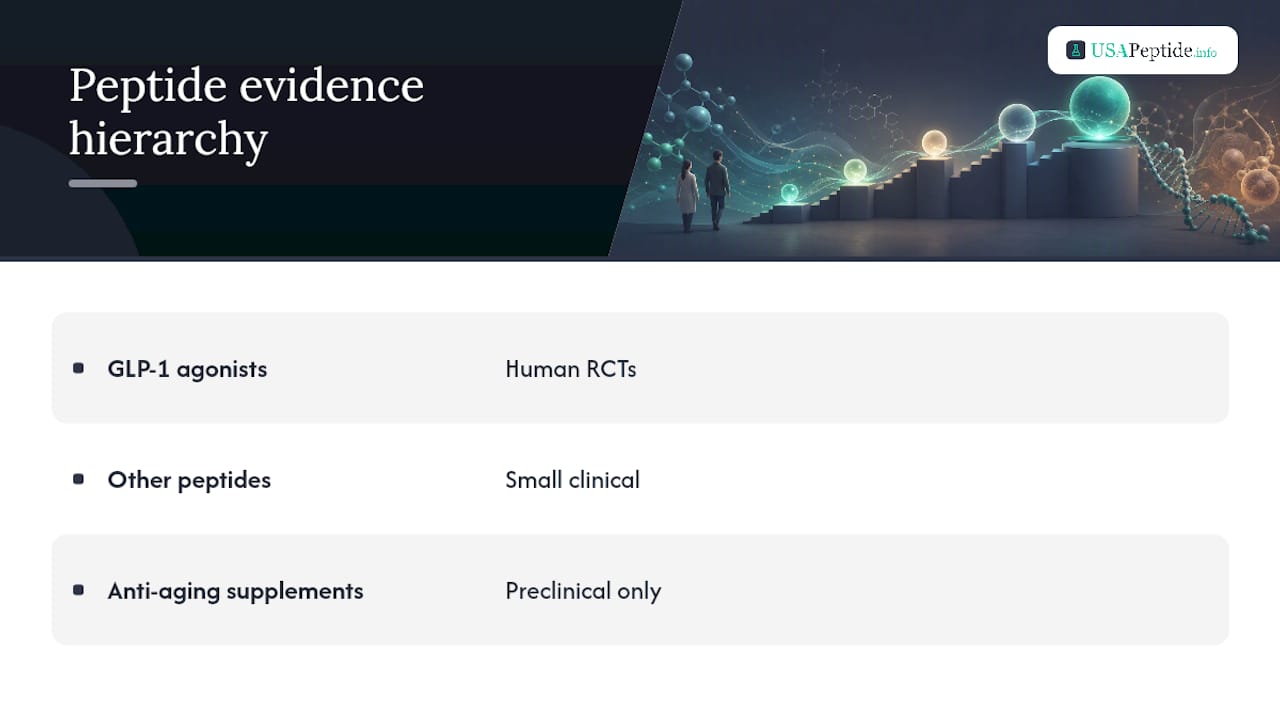
Evidence rating key used below: Human RCTs = multiple large randomized controlled trials; Small clinical = phase I/II or limited controlled human studies; Preclinical only = animal or cell data, no meaningful human trials.
1. Semaglutide
Evidence: Human RCTs. Semaglutide is a GLP-1 receptor agonist approved by the FDA for type 2 diabetes (Ozempic) and obesity (Wegovy). Large randomized trials published in the New England Journal of Medicine demonstrate significant reductions in cardiovascular events, body weight, and inflammatory markers, all of which are relevant to healthspan. It is not approved for longevity or anti-aging. Primary risks include nausea, pancreatitis, and thyroid C-cell concerns; monitoring includes thyroid function and pancreatic enzymes in at-risk individuals.

2. Tirzepatide
Evidence: Human RCTs. Tirzepatide is a dual GIP/GLP-1 receptor agonist approved for type 2 diabetes (Mounjaro) and obesity (Zepbound). Clinical trials show superior weight reduction compared to semaglutide in head-to-head data, along with improvements in insulin sensitivity and lipid profiles. Like semaglutide, its relevance to longevity is indirect: it addresses metabolic drivers of age-related disease rather than aging biology directly. Monitoring needs mirror those of semaglutide, with attention to gastrointestinal tolerability.
3. Sermorelin
Evidence: Small clinical. Sermorelin is a synthetic analog of growth hormone-releasing hormone (GHRH) that stimulates the pituitary to release GH. It has been FDA-approved for pediatric GH deficiency and has been studied in older adults with GH insufficiency. Controlled trials report increases in IGF-1 and lean body mass, but these findings do not establish longevity benefit in healthy adults. Sermorelin is no longer commercially manufactured by major pharmaceutical companies; it is available through compounding pharmacies under specific conditions. Monitoring: IGF-1 levels, fasting glucose, and signs of fluid retention.
4. Ipamorelin
Evidence: Small clinical. Ipamorelin is a selective growth hormone secretagogue receptor (GHSR) agonist with a favorable selectivity profile: it stimulates GH release with minimal effect on cortisol or prolactin, which distinguishes it from older GH secretagogues. Human data are limited to small studies, primarily examining GH pulse amplitude and body composition in specific populations. Its research profile for sleep-related GH release is also of interest. Regulatory status: research-only in the U.S. outside of compounding. Key monitoring: IGF-1, fasting insulin.
5. CJC-1295
Evidence: Small clinical. CJC-1295 is a GHRH analog with a prolonged half-life due to drug affinity complex (DAC) technology. Whether sustained IGF-1 elevation is preferable to pulsatile release for aging outcomes is unresolved. CJC-1295 is often combined with ipamorelin in research protocols; detailed GH secretagogue profiles are available for researchers reviewing this combination. Regulatory status: research-only. Monitoring: IGF-1, glucose tolerance.
6. BPC-157
Evidence: Preclinical only. BPC-157 (Body Protection Compound-157) is a 15-amino-acid peptide derived from a gastric protein. Animal studies report accelerated tendon, ligament, and gut healing, along with neuroprotective and angiogenic effects. The mechanistic data in rodents are genuinely compelling. However, no peer-reviewed human RCTs have been published. Clinical experts at Cedars-Sinai note that the gap between animal models and human outcomes for BPC-157 remains wide, and unregulated injections have caused adverse events. Detailed tissue-repair research profiles are available for laboratory reference.

7. TB-500
Evidence: Preclinical only. TB-500 is a synthetic fragment of thymosin beta-4, a protein involved in actin polymerization, cell migration, and angiogenesis. Animal data suggest wound-healing and cardiac-protective effects. Like BPC-157, human clinical trial data are absent. TB-500 is sometimes combined with BPC-157 in what practitioners call "Wolverine stacks," a combination that has no controlled human safety or efficacy data. Regulatory status: research-only; not approved for human use in the U.S.
8. Thymosin alpha-1
Evidence: Small clinical. Thymosin alpha-1 (Tα1) is a thymic peptide that modulates T-cell differentiation and innate immune signaling. It has been studied in clinical settings for hepatitis B, hepatitis C, and as an adjunct in cancer immunotherapy in several countries. In the U.S., it is not FDA-approved for any indication and is classified as research-only. The immune-modulation data are more developed than for most peptides in this category, but aging-specific endpoints have not been the focus of controlled trials.
9. Epitalon
Evidence: Preclinical only. Epitalon is a tetrapeptide (Ala-Glu-Asp-Gly) derived from the pineal gland extract epithalamin. Russian research groups have published studies suggesting telomere elongation and extended lifespan in animal models, along with some small human observational data on melatonin regulation. These findings have not been replicated in large, independent, peer-reviewed human trials. Epitalon is not approved by the FDA and is available only as a research compound.
10. Semax
Evidence: Preclinical, limited small clinical. Semax is a synthetic heptapeptide analog of ACTH(4-10) developed in Russia, where it holds approval for cognitive and neuroprotective indications. It is reported to upregulate BDNF and support neuroplasticity in animal models. Small Russian clinical studies exist, but they have not been replicated in large Western RCTs. In the U.S., Semax is not FDA-approved and is available only for research purposes.
11. MOTS-c
Evidence: Preclinical only. MOTS-c is a mitochondria-derived peptide encoded in the mitochondrial genome. It represents a genuinely novel class of signaling molecule, but human trial data are essentially absent. MOTS-c is among the most speculative compounds in the longevity peptide space despite its mechanistic novelty.
Synthesis: GLP-1 receptor agonists and, to a lesser degree, GH secretagogues like sermorelin represent the highest-priority classes for research-minded clinicians because they have the most human data. BPC-157, MOTS-c, epitalon, and Semax remain speculative from a human-evidence standpoint, however promising their preclinical profiles may be.
Statistic callout: According to NPR's reporting on the peptide market, many widely marketed longevity peptides are supported largely by preclinical or anecdotal evidence, with experts characterizing self-administration without validated dosing as experimental.
What the FDA has actually approved and what "research-only" means
No peptide is FDA-approved for longevity or anti-aging. That is the unambiguous regulatory reality. Several peptide drugs are approved for other indications: semaglutide and tirzepatide for metabolic disease, sermorelin historically for pediatric GH deficiency, and elamipretide (SS-31) for Barth syndrome, a rare mitochondrial disease. FDA product labeling provides the authoritative dosing, safety, and contraindication data for approved compounds and is the reference standard clinicians should consult.
The "research-only" designation means a compound has not been reviewed or approved for human therapeutic use. Purchasing and possessing research-grade peptides is not inherently illegal in the U.S., but administering them to humans outside of an approved clinical trial or a licensed compounding pharmacy prescription falls outside FDA-regulated pathways.
Compounding pharmacies occupy a specific legal space. Under Section 503A and 503B of the Federal Food, Drug, and Cosmetic Act, licensed compounding pharmacies can prepare certain peptides for individual patients with a valid prescription. However, the FDA maintains lists of bulk drug substances that may present significant safety risks and restricts their use in compounding. Several peptides, including BPC-157, have appeared on these restricted lists, which limits their legal availability through compounding channels.
Key regulatory points:
- No peptide carries an FDA anti-aging or longevity indication
- GLP-1 drugs are approved for metabolic disease, not aging per se
- Compounding pharmacies can legally supply some peptides by prescription, but not those on the FDA's restricted bulk-substance list
- Self-administering research-grade peptides purchased online is outside FDA-approved pathways and carries legal and safety risk
- Recent FDA enforcement actions have targeted compounded semaglutide and tirzepatide as shortages resolve; the regulatory environment for compounded peptides is actively evolving
Known risks and what you should watch for
Significant unknowns remain, and some risks are immediate rather than theoretical. Cedars-Sinai experts document real-world harms from unregulated peptide injections, including hospitalizations from contaminated products and incorrect dosing.
Tangible risks to understand before any peptide use:
- Contaminated products: Unverified online vendors frequently sell peptides with incorrect purity, wrong sequence, or bacterial endotoxin contamination
- Injection-site infections: Subcutaneous and intramuscular injections carry infection risk, particularly with non-sterile technique or non-sterile products
- Endocrine disruption: GH-stimulating peptides can suppress natural GH pulsatility or alter insulin sensitivity with prolonged use
- Kidney and liver toxicity: Some peptides have not been evaluated for organ toxicity in humans; abnormal CMP values should trigger immediate discontinuation
- Theoretical tumor promotion: Angiogenic and growth-promoting peptides carry a theoretical risk of accelerating pre-existing malignancies
- Incorrect dosing: Validated human dosing protocols do not exist for most research-grade peptides; self-dosing is inherently experimental
Stop criteria, consult a physician immediately if you observe:
- Unexplained weight loss or rapid weight gain
- Abnormal liver or kidney function on labs
- Gynecomastia or other hormonal changes
- Severe allergic or anaphylactic reactions
- New lumps, unexplained bleeding, or skin changes
Drug interactions are a real concern. GH secretagogues can blunt the efficacy of insulin or oral hypoglycemics by raising blood glucose. Thymosin alpha-1 may interact with immunosuppressive regimens. Absolute contraindications include active malignancy, pregnancy, and breastfeeding for virtually all unapproved peptides. Anyone on anticoagulants, immunosuppressants, or insulin should discuss peptide use explicitly with their prescribing physician before proceeding.
How to evaluate peptide quality and avoid dangerous suppliers
Always prioritize ISO 17025-accredited third-party testing and a verifiable Certificate of Analysis (COA) with HPLC or LC-MS purity data. A COA from a non-accredited internal lab is not independent verification; it is the supplier grading their own work.
COA elements to verify before accepting any peptide for research:
- Lot number matching the physical vial label
- Expiration date and storage conditions
- Assay method specified (HPLC, LC-MS, or both)
- Purity percentage (≥99% is the standard for research-grade compounds)
- Impurities profile, not just a single purity figure
- Name and accreditation number of the testing laboratory
- Sequence confirmation (mass spectrometry confirming the correct amino acid sequence)
The difference between research-grade, compounded, and consumer-sold "supplement" peptides matters legally and practically. Research-grade compounds are sold for laboratory use only, not for human administration. Compounded peptides require a physician prescription and are prepared by a licensed pharmacy under USP standards. Consumer-sold "peptide supplements" are often oral formulations with no meaningful bioavailability for intact peptides, or they are mislabeled products with no regulatory oversight.
Pro Tip: If a clinician is supervising a research protocol, request the raw chromatogram from the testing lab, not just the summary COA. Cross-check the lot number directly with the accredited laboratory to confirm the document is authentic. The USAPeptide COA grading tool provides a structured framework for evaluating COA legitimacy before any research use.
If you and your clinician decide to proceed: a clinical roadmap
Follow a clinician-led, biomarker-driven pathway. Self-dosing without baseline labs and a monitoring plan removes the only objective measure of whether a peptide is helping or causing harm.
Step-by-step clinical pathway:
- Baseline assessment: Complete metabolic panel (CMP), CBC, fasting insulin, IGF-1, lipid panel, hsCRP, full hormone panel (testosterone, estradiol, DHEA-S, thyroid), and body composition (DEXA preferred)
- Risk screening: Document personal and family cancer history, current medications, pregnancy status, and any autoimmune or organ-function concerns
- Peptide selection: Choose based on a documented, measurable deficit (e.g., low IGF-1 for a GH secretagogue trial) rather than general wellness goals
- Conservative dosing: Start at the lowest published research dose; titrate slowly with lab reassessment before increasing
- Scheduled monitoring: Repeat IGF-1, CMP, fasting insulin, and lipid panel at 6–8 weeks, then every 3 months during active use
- Functional outcome measures: Track objective metrics (body composition, validated cognitive assessments, inflammatory markers) rather than subjective wellbeing alone
- Stop rules: Pre-specify the lab thresholds and clinical signs that will trigger discontinuation before starting
Standard monitoring panel:
- IGF-1 (primary marker for GH-axis peptides)
- CMP (liver and kidney function)
- Fasting insulin and glucose
- Lipid panel
- hsCRP (inflammatory marker)
- CBC
- Full hormone panel
- Optional: DEXA or body composition at baseline and 6 months; targeted organ imaging when clinically indicated
Expected timelines vary by peptide class. GLP-1 receptor agonists typically produce measurable metabolic changes within 4–12 weeks. GH secretagogues may show IGF-1 changes within 4–6 weeks, but body-composition shifts take 3–6 months. Tissue-repair peptides like BPC-157 are often used in shorter cycles (4–8 weeks) for specific injury contexts, though human data on optimal duration are absent. Small early changes in a single biomarker are not sufficient evidence of benefit; clinically meaningful outcomes require sustained, multi-marker improvement.
A practical checklist for verifying suppliers and clinical oversight
A short set of minimum trust criteria separates credible research-grade sourcing from the unregulated online market.
Minimum supplier trust criteria:
- ISO 17025 laboratory accreditation for the testing lab (not the vendor's in-house lab)
- COA with HPLC and LC-MS data, lot-matched to the product
- Sequence confirmation by mass spectrometry
- Publicly listed accreditation number that can be independently verified
- No claims of human therapeutic use on the product page (research-only labeling)
Questions to ask a prescribing clinician:
- "What specific deficit or biomarker are we targeting with this peptide?"
- "What is your stop criterion if labs move in the wrong direction?"
- "Which compounding pharmacy do you use, and is it 503A or 503B accredited?"
- "How will you monitor for endocrine disruption over the course of treatment?"
- "What peer-reviewed human data supports the dose you are recommending?"
USAPeptide's peptide research glossary defines technical terms including HPLC, COA, ISO 17025, and GH secretagogue for researchers and clinicians who need precise definitions. The platform's COA grading tool and anti-aging research summaries provide structured frameworks for evaluating both supplier credibility and the underlying science before any research decision.
Who might reasonably consider peptides now and what the safest path looks like
The clearest recommendation is to prioritize FDA-approved therapies and evidence-based lifestyle interventions first. Peptides should be considered only under physician supervision and only when they address a measurable, documented deficit.
Three prioritized next steps:
- Get baseline labs before any peptide discussion: IGF-1, CMP, fasting insulin, lipid panel, hsCRP, and a full hormone panel establish the objective foundation for any subsequent decision
- Consult a clinician experienced in peptide research, not a wellness influencer or online forum; ask the verification questions listed above and expect documented answers
- Insist on COA and accredited lab testing for any compound under consideration; reject any supplier that cannot provide ISO 17025-verified purity and sequence confirmation
One legal and ethical point deserves plain statement: self-administering research-grade peptides purchased from unregulated online vendors for human use is outside FDA-approved pathways, carries personal legal risk, and removes the safety net of clinical oversight. The ethical obligation to informed consent and monitored use applies whether the context is formal research or supervised clinical practice.
This article provides general educational information about peptide research and is not a substitute for professional medical advice. Consult a licensed physician before considering any peptide therapy.
The USAPeptide Team's perspective on responsible peptide research
The science of longevity peptides is genuinely exciting. The mechanistic rationale for targeting the GH/IGF axis, mitochondrial function, and immune senescence is grounded in real biology, and the clinical success of GLP-1 receptor agonists demonstrates that peptide drugs can produce meaningful, measurable improvements in healthspan-relevant outcomes. That progress is worth taking seriously.
What concerns the USAPeptide Team is the gap between that legitimate scientific excitement and the way many compounds are being used in practice. Protocols circulating in wellness communities often lack any physiological rationale for their dosing, and the absence of validated human dosing data means that self-administration is, by definition, experimental. The real-world harms documented by clinical centers, including hospitalizations from contaminated products and adverse endocrine effects, are not hypothetical. They are the predictable consequence of bypassing the quality controls and clinical oversight that make pharmaceutical research safe.
The team's position is straightforward: the most responsible use of peptide science right now is to support rigorous, well-documented research under clinical supervision, using compounds with verified purity and a clear, measurable rationale. Clinicians and qualified researchers who want to engage with this field rigorously are the audience USAPeptide is built to serve, and the platform's COA grading tool, molecular profiles, and research summaries exist specifically to support that standard of practice.
USAPeptide.info: a research-grade reference for clinicians and researchers
Usapeptide provides peer-reviewed research summaries, detailed molecular profiles, and a COA grading tool designed for clinicians and qualified researchers who need structured, verifiable information before making any sourcing or protocol decision.

The platform's COA grading tool evaluates Certificate of Analysis legitimacy against ISO 17025 accreditation standards, HPLC/LC-MS purity benchmarks, and sequence-confirmation requirements. Its research database covers the full spectrum of peptides discussed in this article, from GLP-1 receptor agonists to mitochondrial-targeting compounds, with evidence-tier ratings and regulatory status notes for each. For researchers evaluating GH secretagogues, tissue-repair compounds, or immune-modulating peptides, USAPeptide's ISO 17025-accredited supplier referrals provide a vetted starting point that unregulated online vendors cannot match.
To verify a COA or access the full peptide research database, visit Usapeptide. Consult a licensed physician before considering any peptide for human use; these compounds are intended for qualified research contexts only.
Sources
The following sources were used in preparing this article and represent the most authoritative references for further research on longevity peptides:
- Peptides take off as a DIY treatment but is that a good idea? : NPR
- Peptide Therapy: What the Science Shows About BPC-157, TB-500 and Wolverine Stacks | Cedars-Sinai
- FDA - Certain bulk drug substances used in compounding may present significant safety risks
- NEJM — recent randomized trials relevant to metabolic interventions
- PubMed indexed clinical literature (example entry)