This reference covers seven GLP-1 receptor agonist research peptides used in U.S. preclinical studies: semaglutide, liraglutide, exenatide, lixisenatide, dulaglutide, tirzepatide, and native GLP-1 (7–36) amide. Each entry below includes molecular identifiers (MW, formula, CAS/InChIKey where available), COA verification checkpoints (RP-HPLC purity thresholds, MS identity confirmation), preclinical dosing ranges by species and route, and storage and reconstitution guidance. Ordering and cold-chain logistics for U.S. laboratories are covered in the final sections.
- Seven GLP-1 receptor agonist research peptides, profiled with molecular identifiers
- COA verification checklist: RP-HPLC chromatogram plus MS identity, both required
- Preclinical dosing ranges (mice, rats) with a worked mg/kg calculation example
- Storage, reconstitution, and cold-chain guidance for U.S. labs
- ISO/IEC 17025 testing as the primary supplier quality signal throughout
Key Takeaways
Research-grade GLP-1 receptor agonists require lot-specific COAs with both RP-HPLC chromatograms and MS identity confirmation before any preclinical use.
| Point | Details |
|---|---|
| COA minimum standard | Every lot needs an RP-HPLC chromatogram with a stated purity % and MS identity; both are required, not interchangeable. |
| Purity thresholds | HPLC ≥95% is the floor for in vitro work; sensitive binding or cell-based assays warrant ≥98% lots. |
| Purity-adjusted dosing | A lot at 95% purity delivers only 950 µg active peptide per 1 mg powder; always enter COA purity into the dosage calculator. |
| Injectable endotoxin limit | For parenteral animal studies, endotoxin below 1 EU/mg is the standard reference threshold; confirm LAL results on the COA. |
| USAPeptide tools | The COA grading tool and purity-adjusted dosage calculator at USAPeptide.info support lot verification and dose preparation for all seven GLP-1 peptides covered here. |
This article is general information, not a substitute for advice from a qualified doctor. Consult a qualified healthcare professional about your own circumstances before acting on anything here.
Table of Contents
- What does the GLP-1 agonists list include for research use?
- Molecular profiles and COA requirements for each peptide
- Preclinical dosing guidance for GLP-1 receptor agonists
- How to verify a peptide Certificate of Analysis
- U.S. regulatory and safety compliance for RUO GLP-1 peptides
- Ordering and cold-chain checklist for U.S. labs
- How the peptide dosage calculator and COA grading tool work
- What the USAPeptide team sees most often in the field
- USAPeptide supports your GLP-1 research from COA to dosing
- Sources
What does the GLP-1 agonists list include for research use?
The seven GLP-1 receptor agonist research peptides below are the most commonly sourced compounds for metabolic and endocrine preclinical studies in U.S. laboratories. Molecular weights and formulas are theoretical values for the research-grade forms.
Pro Tip: Before ordering any lot, request the InChIKey or PubChem CID from the vendor and cross-reference it against the NIST WebBook or PubChem database. A lot-specific COA without a matching InChIKey is an unverified identity claim.
Molecular profiles and COA requirements for each peptide
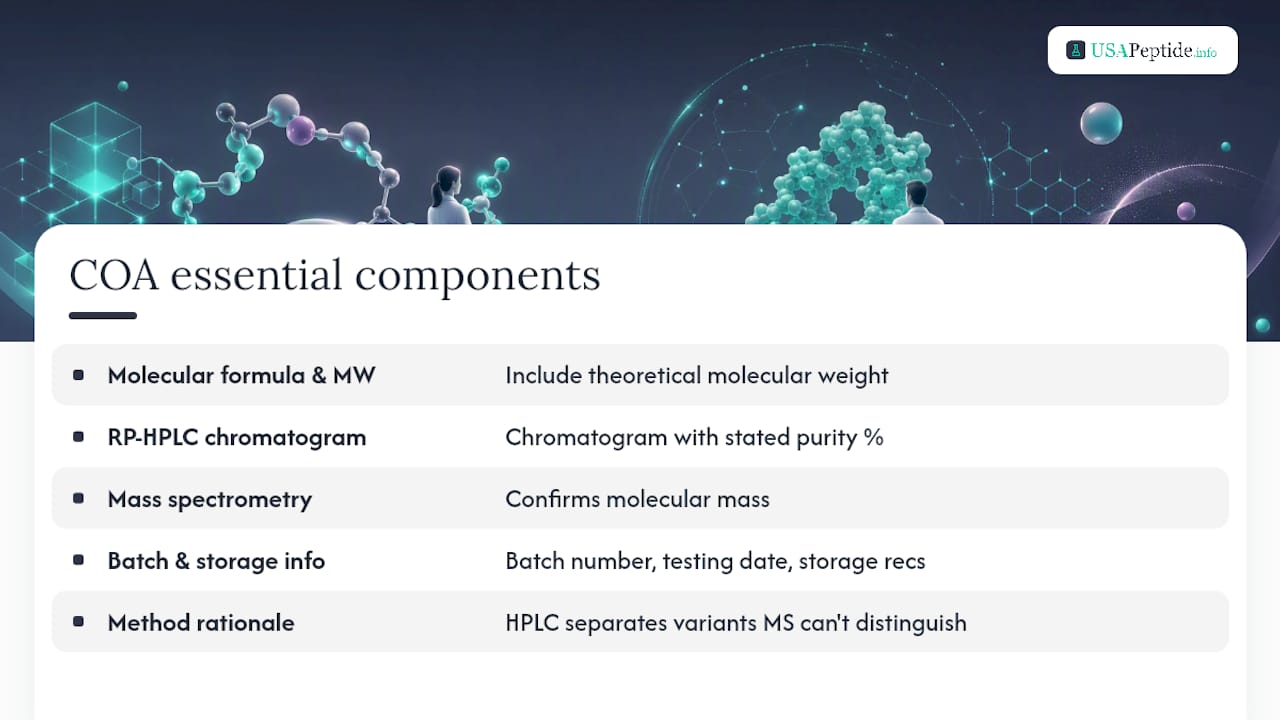
A credible COA for any synthetic peptide must include the molecular formula, theoretical molecular weight, an RP-HPLC chromatogram with a stated purity percentage, and mass spectrometry data confirming molecular mass, along with the batch number, testing date, and storage recommendations. RP-HPLC is the primary purity method; MS confirms identity but cannot reliably distinguish deamidated or isoaspartate variants that share nearly identical masses. Those variants separate by retention time on HPLC, which is why both methods are required on every COA.
Semaglutide (research grade)
Theoretical MW: 4,113 Da. Formula: C₁₈₇H₂₉₁N₄₅O₅₉. CAS: 910463-68-2. The Aib8 substitution and C18 fatty diacid linker at Lys26 distinguish semaglutide from liraglutide at the sequence level. Common impurities include oxidized Met, deamidated Asn, and truncated deletion sequences. See the semaglutide molecular profile for full sequence and COA field guidance.
Liraglutide (research grade)
Theoretical MW: 3,751.24 Da, formula C₁₇₂H₂₆₅N₄₃O₅₁, stored at −20°C, with supplier-reported HPLC purity ≥95%. The C16 fatty acid at Lys26 and Arg34 substitution extend half-life in vivo. Deamidation at Asn residues is the most common degradation pathway; a well-resolved HPLC chromatogram will show the deamidated shoulder as a distinct peak.
Exenatide (research grade)
Theoretical MW: 4,186 Da. Formula: C₁₈₄H₂₈₂N₅₀O₆₀S. CAS: 141758-74-9. Exenatide is a 39-amino acid peptide derived from exendin-4. The single Met residue is an oxidation risk during storage; COAs should show Met-sulfoxide as a quantified impurity peak, not an absent one.
Lixisenatide (research grade)
Theoretical MW: 4,858 Da. Formula: C₂₁₅H₃₄₇N₆₁O₆₅S. CAS: 320367-13-3. The C-terminal hexalysine extension relative to exenatide increases receptor residence time. Truncated C-terminal variants are the principal impurity class; MS/MS fragmentation is the most reliable method to detect them.
Dulaglutide (research grade)
Dulaglutide is a fusion protein (~59,669 Da) linking a modified GLP-1 analog to an IgG4 Fc domain via a small peptide linker. Its large size means standard RP-HPLC conditions used for small peptides may not resolve all impurity species; SEC-HPLC and SDS-PAGE are additional QC methods appropriate for this compound.
Tirzepatide (research grade)
Theoretical MW: 4,813 Da. Formula: C₂₂₅H₃₄₈N₄₈O₆₈. CAS: 2023788-19-2. Tirzepatide is a dual GIP/GLP-1 receptor agonist with a C18 fatty diacid at Lys34. Its dual-agonist pharmacology makes it a distinct research tool from single-axis GLP-1 peptides. Acylation-site variants and aggregation products are the main impurity concerns.
Native GLP-1 (7–36) amide
Theoretical MW: 3,297.68 Da. Formula: C₁₄₉H₂₂₅N₄₃O₄₂. CAS: 107444-51-9. This is the endogenous truncated form produced by proglucagon cleavage. No acylation or fusion modifications are present, making it the reference ligand for GLP-1 receptor binding assays. It is highly susceptible to DPP-4 cleavage in biological matrices; researchers should account for this in assay design.
A professional COA should include lot identifier, date, HPLC chromatogram, MS identity, Karl Fischer water content, and endotoxin results for injectables.
Key purity signal: RP-HPLC separates deamidated and isoaspartate variants that MS cannot distinguish by mass alone. A COA missing the full chromatogram cannot confirm purity — only identity.
Pro Tip: Flag any COA that lists impurities only as "not detected" without showing the chromatogram baseline. Deamidation and oxidation products are almost always present at low levels in real lots; a chromatogram that shows them quantified is more credible than one that claims zero.
Preclinical dosing guidance for GLP-1 receptor agonists
Species and route both affect the effective dose substantially. The ranges below reflect published preclinical literature for rodent models. They are provided as reference starting points, not protocol-specific recommendations.
Acylated analogs (semaglutide, liraglutide) may require brief sonication or gentle warming to 37°C for full dissolution. Avoid vortexing, which promotes aggregation. Typical working concentrations are 0.1–1.0 mg/mL.
Reconstituted stability: Most GLP-1 research peptides are stable for 24–72 hours at 4°C after reconstitution; some acylated forms maintain activity for up to 7 days at 4°C in the absence of repeated freeze-thaw cycles. Lyophilized stock stored at −20°C is stable for 12–24 months when kept dry and sealed.
Worked dosing example (semaglutide, mouse):
- Target dose: 0.05 mg/kg SC in a 25 g mouse
- Required mass: 0.05 mg/kg × 0.025 kg = 0.00125 mg = 1.25 µg
- Reconstitute at 0.1 mg/mL (100 µg/mL) in sterile WFI
- Injection volume: 1.25 µg ÷ 100 µg/mL = 0.0125 mL = 12.5 µL
- Adjust for COA-reported purity: if lot purity = 96%, weigh out 1.25 µg ÷ 0.96 = 1.30 µg of peptide powder
Use the peptide dosage calculator to run this calculation with your lot's actual purity percentage, animal weight, and target concentration. The calculator accepts purity-adjusted inputs directly.
Pro Tip: For SC injections in mice, a 27–29 gauge needle and a maximum volume of 10 µL/g body weight are standard. Exceeding that volume causes local irritation that can confound metabolic endpoints.
How to verify a peptide Certificate of Analysis
A lot-specific COA with an RP-HPLC chromatogram and MS identity confirmation is the minimum credible evidence for any research-grade GLP-1 peptide. ISO/IEC 17025 accreditation of the testing laboratory is the strongest single vendor quality signal available.
Stepwise COA verification checklist:
- Confirm the lot number on the COA matches the vial label exactly.
- Review the full HPLC chromatogram: look for a dominant main peak, quantified impurity peaks, and a stated purity percentage with retention time.
- Confirm MS observed mass matches theoretical mass within instrument tolerance (typically ±0.1 Da for small peptides, ±0.02% for larger fusion proteins).
- Check that the HPLC method is described (column type, gradient, detection wavelength) — not just "HPLC performed."
- Verify the testing date and analyst or QA signature are present.
- For injectable preparations, confirm endotoxin results (LAL test); endotoxin below 1 EU/mg is the standard reference threshold for parenteral use in animal studies.
- For hygroscopic peptides, check Karl Fischer water content.
Red flags to reject immediately:
- No chromatogram attached, or a chromatogram with no labeled axes or purity percentage
- MS identity provided without any HPLC purity data
- A "perpetual" COA with no lot number or a lot number that does not match the vial
- Method descriptions that read "meets specification" with no instrument or column details
- Missing analyst name, date, or QA signature
Pro Tip: For critical studies, request third-party testing from an ISO/IEC 17025-accredited lab independent of the supplier. Retain scanned COAs in your LIMS with lot number, receipt date, and study protocol reference attached.
Purity threshold reminder: HPLC ≥95% is the accepted floor for most in vitro assays. Sensitive receptor-binding, cell-based, or in vivo studies benefit from ≥98% purity lots, which should be specified at the time of order.
U.S. regulatory and safety compliance for RUO GLP-1 peptides
Research-grade GLP-1 peptides are supplied as Research Use Only (RUO) reagents. They are not approved for human use, not intended for clinical administration, and must be handled under institutional policies governing research chemicals. Labs ordering these compounds must observe IACUC oversight for all animal dosing work and comply with institutional hazardous materials policies.
U.S. compliance checkpoints:
- RUO labeling: Confirm every vial and COA carries an explicit "For Research Use Only — Not for Human Use" statement before accepting a shipment.
- IACUC protocol coverage: Animal dosing, route, frequency, and endpoints must be covered by an active, approved IACUC protocol. Dose ranges outside the approved protocol require an amendment before use.
- IATA shipping rules: Peptides shipped on dry ice are subject to IATA Dangerous Goods Regulations (UN 1845). Confirm the vendor ships with proper dry-ice labeling and documentation.
- OSHA Hazard Communication: An SDS must be on file for every compound in use. GLP-1 peptides are generally low acute-hazard materials, but SDS documentation is required regardless.
- Endotoxin and sterility for injectables: For parenteral animal studies, LAL endotoxin testing and documented sterile filtration steps are expected. Endotoxin below 1 EU/mg is the standard reference threshold.
Pro Tip: Keep a single compliance folder per lot: COA, SDS, IACUC protocol reference, and shipping manifest. An audit-ready folder takes under five minutes to assemble at receipt and saves hours during IACUC or institutional review.
Chemically, research-grade semaglutide and tirzepatide can be identical to pharmaceutical API, but their regulatory status is entirely different — RUO compounds carry no FDA approval for any use and must never be administered to humans.
Ordering and cold-chain checklist for U.S. labs
Confirm a lot-specific COA before the shipment leaves the vendor. Cold-chain integrity at receipt is as important as purity on paper.
Pre-order and receipt checklist:
- Request the lot-specific COA before shipment confirmation; vendors that cannot supply a per-lot COA should be treated with caution for preclinical work.
- Confirm ISO/IEC 17025 testing documentation is available for the lot.
- Arrange same-day cold-chain receipt: have a designated receiver and a −20°C freezer space ready before the package arrives.
- On receipt, verify the lot number on the vial matches the COA exactly.
- Log temperature indicators from the shipping package before discarding.
- Store lyophilized peptides at −20°C in a desiccated, sealed container; avoid repeated temperature cycling.
- Enter lot number, receipt date, storage location, and COA reference into LIMS immediately.
- Dispose of expired or degraded material per institutional chemical waste policy.
Pro Tip: Aliquot lyophilized stock into single-use portions before first reconstitution. Each freeze-thaw cycle degrades peptide integrity; pre-aliquoting eliminates the need to refreeze reconstituted material.
How the peptide dosage calculator and COA grading tool work
USAPeptide's peptide dosage calculator accepts four inputs: animal weight (g), target dose (mg/kg), lot purity (% from COA), and desired working concentration (mg/mL). The output is the adjusted mass of peptide to weigh and the injection volume to prepare. Entering the COA purity percentage directly corrects for the actual peptide content in the lot, which is the step most manual calculations skip.
The COA grading tool at Usapeptide scores a submitted COA against a structured checklist: HPLC purity and chromatogram presence, MS identity confirmation, lot traceability, ISO/IEC 17025 testing, Karl Fischer, and endotoxin fields. The output is a grade with flagged gaps.
Worked example using both tools for a new semaglutide lot:
- Upload or enter COA data into the COA grading tool; confirm HPLC ≥95%, MS match, lot number present, and endotoxin field populated.
- Note the lot purity percentage (e.g., 97.2%).
- Open the dosage calculator; enter: animal weight = 25 g, target dose = 0.05 mg/kg, purity = 97.2%, working concentration = 0.1 mg/mL.
- Record the calculator output (adjusted mass and injection volume) on a prep sheet.
- Save the prep sheet and COA PDF together in LIMS, tagged with the lot number and study protocol ID.
Pro Tip: Cross-reference the peptide research glossary for definitions of RP-HPLC, LAL, Karl Fischer, and InChIKey before submitting a COA to the grading tool. Knowing what each field measures helps you interpret a flagged gap correctly.
Purity-adjusted dosing matters: A lot at 95% purity contains only 950 µg of active peptide per 1 mg of powder. Skipping the purity correction systematically underdoses every animal in the study.
What the USAPeptide team sees most often in the field
The most common procurement failure is accepting a COA that looks complete at a glance but lacks a chromatogram. The second most common issue is a lot number on the COA that does not match the vial, which usually means the vendor recycled a reference COA across multiple batches.
When a new lot arrives, the USAPeptide team recommends this sequence: verify the lot number match first, then open the COA and check for the chromatogram before anything else. If either check fails, contact the vendor before the vial is opened. For critical in vivo studies, independent third-party endotoxin testing is worth the cost, particularly for injectable preparations where endotoxin contamination can confound inflammatory endpoints.
USAPeptide supports your GLP-1 research from COA to dosing
USAPeptide.info gives U.S. laboratories a single reference point for GLP-1 receptor agonist research peptides: detailed molecular profiles, a COA grading tool that scores lot documentation against a structured checklist, and a purity-adjusted dosage calculator that eliminates manual calculation errors. The platform links to ISO/IEC 17025-tested suppliers so labs can move from verification to order without switching platforms.

All compounds referenced on USAPeptide.info are Research Use Only (RUO) and are not intended for human use. For labs focused on metabolic research endpoints, the fat loss research peptide overview provides additional context on GLP-1 and related compounds. Start with the USAPeptide research peptide reference to access molecular profiles, the COA grading tool, and the dosage calculator for your next preclinical study.
Sources
- Liraglutide product page | Tocris Bioscience