Fmoc is the default protecting-group strategy for routine solid phase peptide synthesis, especially on automated synthesizers. Boc becomes the better choice in two specific situations: sequences prone to aggregation or heavy hydrophobic stretches, and projects requiring an on-resin C-terminal α-thioester for native chemical ligation (NCL). Every other decision follows from those two exceptions.
Three axes determine which strategy fits a given project:
- Acid or base sensitivity of the sequence and any side-chain modifications
- Aggregation risk, driven by hydrophobicity and beta-sheet-forming stretches
- Downstream chemistry needs, particularly whether a C-terminal thioester is required
The comparison table, mechanistic explanation, and a step-by-step decision checklist follow below, along with guidance on verifying reagent quality through Certificates of Analysis before you commit resin time to either route.
Key Takeaways
The right protecting-group strategy depends on sequence chemistry, aggregation risk, and downstream needs, not on a fixed lab preference for Fmoc or Boc.
| Point | Details |
|---|---|
| Fmoc is the routine default | Automated synthesizers, modern coupling reagents, and acid-sensitive modifications all favor Fmoc/tBu chemistry. |
| Boc solves specific problems | Aggregation-prone sequences and on-resin C-terminal thioesters for NCL are the clearest cases for Boc/Bn. |
| Mechanism drives orthogonality | Base-mediated Fmoc removal and acid-mediated Boc removal dictate which side-chain protecting groups pair safely with each. |
| Conversion is a real fallback | Published transprotection methods let you switch from Fmoc to Boc on resin mid-project when sequence problems emerge. |
| Verification matters as much as chemistry | Checking COAs and HPLC purity before and after synthesis catches problems no protecting-group choice can prevent on its own. |
Table of Contents
- FMOC vs BOC: A Side-by-Side Comparison
- How Do Fmoc and Boc Removal Actually Work?
- Which Strategy Handles Difficult Sequences Better?
- What Equipment and Safety Precautions Does Each Method Require?
- How Do You Choose Fmoc or Boc for Your Project?
- How USAPeptide Helps You Verify Reagents and Results
- Where Did Fmoc and Boc Strategies Come From?
- How Stable Are Fmoc and Boc Groups Under Synthesis Conditions?
- Does Fmoc or Boc Chemistry Produce Cleaner Peptides?
- What Do Fmoc and Boc Reagents Cost, and How Available Are They?
- What Are the Environmental Tradeoffs Between the Two Strategies?
- The Case Against Treating This as a Binary Choice
- Sources
FMOC vs BOC: A Side-by-Side Comparison
The two strategies diverge at nearly every stage of synthesis, from the reagents you keep on the shelf to the equipment your lab needs to run a final cleavage safely.
| Factor | Fmoc Strategy | Boc Strategy |
|---|---|---|
| Deprotection conditions | Base-mediated, piperidine in DMF, basic pH | Acid-mediated, TFA or stronger, pH roughly 1–2 |
| Final cleavage | TFA-based cocktails with scavengers | Historically HF or comparable strong-acid cleavage |
| Orthogonality | Pairs with acid-labile tBu-type side-chain groups | Pairs with benzyl-type (Bn) side-chain groups |
| Best-for peptide types | Acid-sensitive modifications, routine and automated synthesis | Aggregation-prone, hydrophobic, or beta-sheet-forming sequences |
| Equipment/safety | Standard fume hood, TFA waste handling | HF-rated glassware and ventilation, or strong-acid-compatible setup |
| Scalability | Well suited to automated, high-throughput platforms | Common in specialized manufacturing runs, including thioester production |
A few operational consequences fall out of that table. Fmoc chemistry lets you monitor deprotection visually, since dibenzofulvene byproducts absorb UV light, which is one reason automated synthesizers favor it. Boc workflows depend on strong acid at every deprotection cycle, so in-situ neutralization80014-b) becomes a standard technique rather than an occasional fix. Cost per building block tends to favor Boc reagents, but that saving is often offset by the equipment and safety overhead that strong-acid cleavage demands.
How Do Fmoc and Boc Removal Actually Work?
Fmoc deprotection runs through base-mediated elimination. Piperidine abstracts a proton beta to the carbamate, the ring collapses to release dibenzofulvene, and carbamic acid decomposes to free the amine and carbon dioxide. Dibenzofulvene is reactive enough to re-alkylate the freed amine if it isn't scavenged, which is why piperidine is used in excess and why some protocols add scavengers to soak up the byproduct before it causes side reactions.
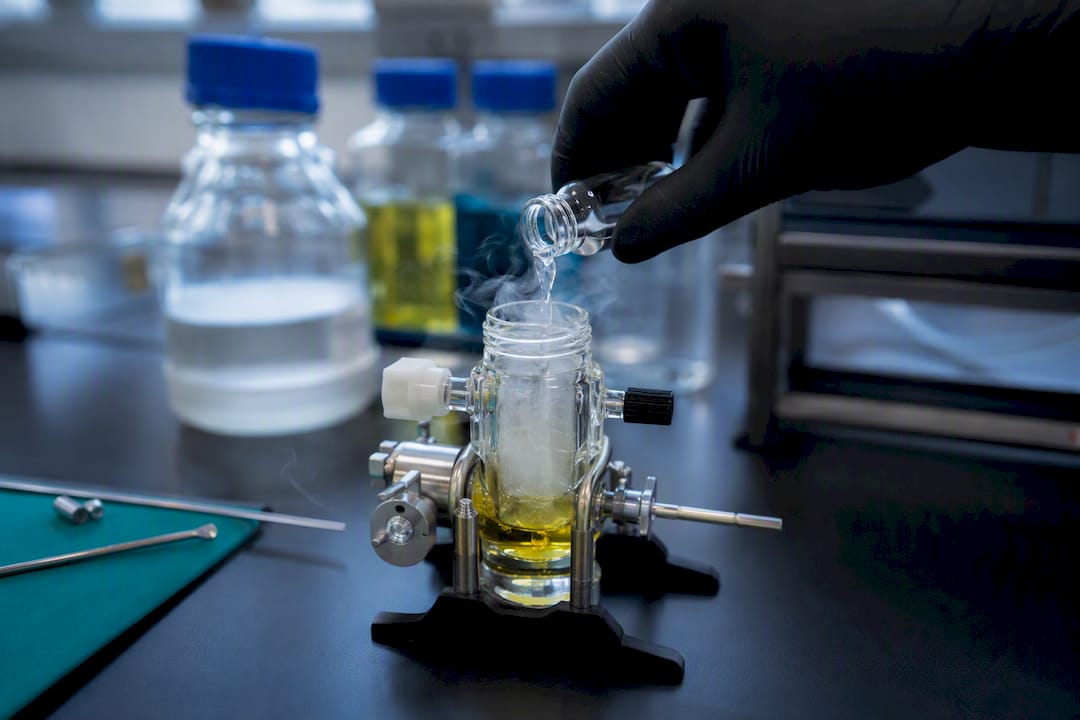
Boc deprotection follows a completely different path. Strong acid protonates the carbamate oxygen, and the molecule fragments through a tert-butyl cation intermediate that gets trapped by scavengers, leaving carbamic acid to decompose into the free amine and carbon dioxide. That tert-butyl cation is aggressive enough to alkylate sensitive side chains if scavenger concentration is too low, which explains why Boc cleavage cocktails are formulated so carefully.
Orthogonality follows directly from this split. Fmoc's base-labile backbone pairs naturally with acid-labile tBu-type side-chain protection, since removing one doesn't touch the other. Boc's acid-labile backbone pairs with benzyl-type (Bn) groups removed under different, harsher acidic or hydrogenolysis conditions.
- Fmoc/tBu: base removes backbone, mild acid removes side chains
- Boc/Bn: acid removes backbone, stronger acid or catalytic hydrogenation removes side chains
Statistic callout: Documented transprotection procedures01350-1) allow one-pot conversion of Fmoc carbamates into Boc carbamates directly on resin, giving researchers a literature-backed fallback if a project's needs change mid-synthesis rather than forcing a restart from scratch.
Which Strategy Handles Difficult Sequences Better?
Sequence-dependent behavior is where the FMOC vs BOC decision gets genuinely interesting, because the answer isn't fixed. It depends on what you're synthesizing.
- Acid-sensitive modifications favor Fmoc. Glycosylated and sulfated residues generally can't survive repeated strong-acid exposure, so Fmoc's base-mediated cycle is the safer route.
- Automated platforms favor Fmoc. Modern coupling reagents like HATU and HBTU integrate cleanly with Fmoc workflows, improving coupling efficiency and reducing racemization on synthesizer platforms.
- C-terminal thioesters for NCL are the clearest exception. Boc-SPPS has historically enabled direct on-resin thioester installation; Fmoc routes need post-assembly chemistry or specialized linkers to reach the same endpoint.
Pro Tip: If you're stuck on a sequence that aggregates under Fmoc conditions, try pseudoproline dipeptide inserts or a lower-loading resin before switching chemistries entirely. Sometimes the fix is in the resin, not the protecting group.
What Equipment and Safety Precautions Does Each Method Require?
Final cleavage is where the two strategies diverge most sharply on infrastructure. Fmoc/TFA cleavage workflows need standard fume hoods and TFA-compatible glassware. Boc's historical reliance on HF cleavage demands dedicated HF-rated apparatus, specialized ventilation, and a documented neutralization procedure before disposal.
- Piperidine and DMF require good ventilation and standard organic-solvent PPE
- TFA cleavage needs acid-resistant gloves and eye protection, plus scavenger cocktails to trap reactive byproducts
- HF workflows require calcium gluconate on hand, HF-specific training, and an emergency response plan
- TFA salts and HF waste both carry specific disposal requirements your institution's EHS office will dictate
Pro Tip: Before scaling any Boc project that uses HF cleavage, confirm your facility's HF-handling certification is current. This is not a step to improvise on synthesis day.
How Do You Choose Fmoc or Boc for Your Project?
Work through these questions in order, and the right strategy usually becomes obvious by step three.
- Does the sequence carry acid-sensitive modifications like glycosylation or sulfation? If yes, default to Fmoc.
- Is the sequence hydrophobic or prone to aggregation, with repeated beta-sheet-forming motifs? If yes, weigh Boc with in-situ neutralization.
- Does the project need an on-resin C-terminal thioester for native chemical ligation? If yes, Boc remains the more direct route, though Fmoc workarounds exist with added steps.
- What equipment and waste infrastructure does your lab already have? HF-rated glassware is a real constraint if your facility lacks it.
- Does the project need automated, high-throughput synthesis? Fmoc's compatibility with modern coupling reagents makes it the practical default here.
For routine peptides, start with Fmoc. For glycopeptides, stay with Fmoc and add mild-acid-compatible protecting groups. For hydrophobic or difficult sequences, test Boc. For NCL substrates, plan around Boc unless a Fmoc-compatible thioester linker is already validated for your sequence. After synthesis, run HPLC and screen retention patterns for deletion peptides, incomplete deprotection adducts, and aspartimide formation, since each protecting-group strategy produces a distinct side-product signature.
How USAPeptide Helps You Verify Reagents and Results
Choosing the right chemistry only pays off if the building blocks going into your synthesis are what the label says they are. USAPeptide's reference platform is built around that verification step.
- ISO 17025-accredited Certificates of Analysis for protected amino acids and resins
- A COA grading tool that flags inconsistencies before you commit resin time
- ≥99% HPLC purity documentation for finished research peptides
- A dosage calculator and glossary covering SPPS terminology including Fmoc, Boc, and NCL
A practical workflow looks like this: verify the COA on a protected amino acid before purchase, confirm identity and purity claims match the certificate, run the synthesis, then re-verify the final peptide's HPLC trace against the expected retention pattern.
A Certificate of Analysis is only as useful as your ability to read it critically. Cross-checking purity claims against independent HPLC data before and after synthesis catches problems a label alone won't reveal.
Where Did Fmoc and Boc Strategies Come From?
Boc chemistry came first. Boc-SPPS traces back to the original solid phase peptide synthesis method developed in the 1960s, when strong-acid deprotection was the only practical way to remove a carbamate protecting group without degrading the growing peptide chain on resin. For roughly two decades, Boc/Bn was the standard approach, and HF cleavage became the accepted, if hazardous, final step for releasing peptides from resin.
Fmoc emerged later as researchers looked for a milder alternative that would avoid repeated strong-acid exposure and the specialized HF equipment Boc synthesis required. The base-labile carbamate offered a genuinely orthogonal system: side chains protected with acid-labile tBu-type groups stayed intact through repeated piperidine deprotection cycles, and final cleavage could be handled with TFA instead of HF.
That shift mattered for a simple infrastructure reason: TFA cleavage doesn't require the specialized HF-rated glassware, ventilation, and neutralization protocols that Boc final cleavage historically demanded. As automated synthesizers became standard lab equipment through the 1980s and 1990s, Fmoc's compatibility with milder reagents and its UV-visible deprotection monitoring made it the natural fit for high-throughput platforms. Boc never disappeared. It persisted in applications, like native chemical ligation substrates, where its particular chemistry still offers a more direct route than Fmoc alternatives.
How Stable Are Fmoc and Boc Groups Under Synthesis Conditions?
Stability under real synthesis conditions is where theoretical orthogonality either holds up or falls apart. Fmoc groups are stable to the mild acids used for tBu-type side-chain deprotection but vulnerable to any base stronger than what's needed for coupling reagent activation. That vulnerability matters most with certain coupling reagents or extended reaction times, where trace base exposure can cause premature Fmoc loss and out-of-sequence insertions.
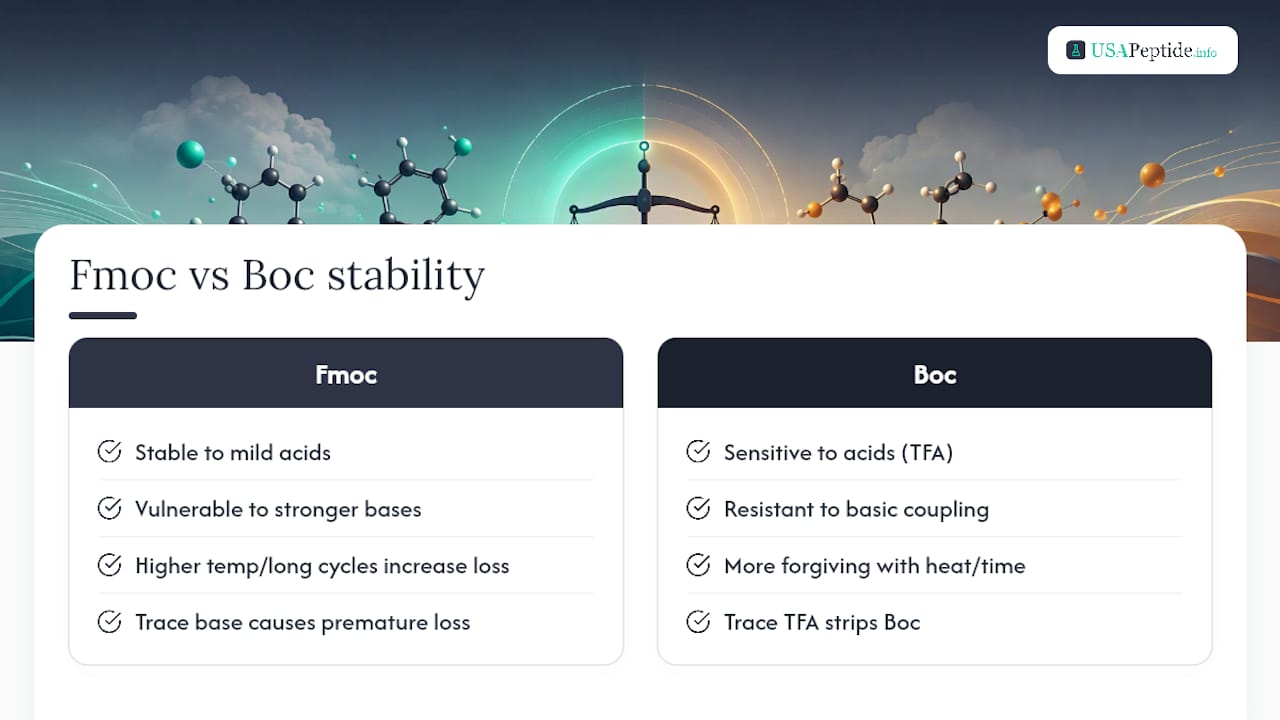
Boc groups run the opposite risk profile. They withstand the basic conditions used during coupling steps but are sensitive to acids well below the strength needed for full deprotection. Trace TFA contamination from shared glassware or improperly rinsed resin can start stripping Boc groups prematurely, which is a known troubleshooting culprit in shared-equipment labs running both chemistries.
Temperature and reaction time both interact with these baseline stability profiles. Extended coupling cycles at elevated temperature increase the odds of unwanted Fmoc loss during synthesis, particularly in the presence of tertiary amine bases used to activate certain coupling reagents. Boc stability under similar extended heating is generally more forgiving, since the strong-acid threshold for cleavage sits well above what coupling conditions typically introduce. This is one more reason difficult, long sequences synthesized under Boc chemistry sometimes show more consistent stepwise yields.
Does Fmoc or Boc Chemistry Produce Cleaner Peptides?
Purity outcomes trace back to the same mechanistic differences covered earlier, but they show up concretely in the final HPLC trace. Fmoc synthesis, when paired with modern coupling reagents like HATU or HBTU, tends to produce fewer racemization-related side products because coupling activation is fast and efficient, minimizing the time reactive intermediates spend in solution before amide bond formation.
Boc synthesis carries a different purity risk profile. Repeated strong-acid exposure across every deprotection cycle raises the cumulative chance of side-chain alkylation by the tert-butyl cation intermediate if scavenger concentration isn't carefully managed. That risk is manageable with proper scavenger cocktails, but it demands more attention per cycle than Fmoc's base-mediated approach typically requires.
Aggregation-prone sequences flip this comparison. A sequence that aggregates under Fmoc's basic deprotection conditions can produce truncated products and deletion peptides from incomplete coupling, dragging down both purity and yield regardless of how clean the chemistry is in principle. In those cases, Boc's transient N-terminal protonation can actually improve overall purity by keeping the growing chain more accessible to incoming activated amino acids.
The practical takeaway: neither strategy is inherently cleaner. Purity and yield depend on matching the chemistry to the sequence's specific failure mode, then verifying the result. That's why post-synthesis HPLC screening against a known Certificate of Analysis matters as much as the protecting-group decision itself, and it's a step worth building into every project regardless of which chemistry you choose.
What Do Fmoc and Boc Reagents Cost, and How Available Are They?
Reagent economics factor into the decision, though rarely as the deciding factor on their own. Boc-protected amino acids are often cheaper per building block than their Fmoc-protected counterparts, reflecting decades of established manufacturing processes and simpler protecting-group installation chemistry.
That per-unit savings comes with a tradeoff. Boc workflows require HF-compatible equipment, specialized ventilation, and documented safety training that represent a real fixed cost most academic and smaller industrial labs don't already have in place. Fmoc reagents, while sometimes pricier per building block, plug into infrastructure that's now standard across most peptide synthesis facilities: automated synthesizers, TFA-compatible fume hoods, and widely available coupling reagents like HATU and HBTU.
Availability follows a similar pattern. Fmoc-protected non-canonical amino acids and specialty building blocks have expanded significantly as automated Fmoc synthesis became the industry default, giving researchers a broader catalog to pull from for modified or unusual sequences. Boc-protected building blocks remain available but the catalog for non-canonical variants tends to be narrower, since fewer suppliers maintain the acid-stable protecting chemistry these builds require.
For labs running occasional difficult sequences or NCL substrates, the higher per-cycle safety overhead of Boc chemistry is usually justified by the synthesis outcome. For labs running high volumes of routine peptides, Fmoc's lower equipment overhead and broader reagent catalog typically win on total cost of ownership, even when individual building blocks cost more.
What Are the Environmental Tradeoffs Between the Two Strategies?
Neither Fmoc nor Boc chemistry is environmentally clean, but the waste streams differ enough to matter for lab planning. Fmoc synthesis generates piperidine and DMF waste at every deprotection cycle, both of which require proper solvent recovery or disposal under standard organic waste protocols. TFA-based final cleavage adds acidic waste that needs neutralization before disposal, though it doesn't require the specialized handling that HF demands.
Boc synthesis's traditional reliance on HF for final cleavage creates a more hazardous waste stream. HF neutralization requires calcium-based treatment before the waste can be safely disposed of, and many facilities need vendor-managed HF waste programs rather than standard institutional disposal. That added handling step represents a real environmental and safety cost beyond what a simple reagent-cost comparison captures.
Green chemistry efforts in SPPS have focused more on reducing DMF and piperidine volumes than on eliminating either core strategy, since both remain chemically necessary for their respective deprotection mechanisms. Lower-volume synthesis, solvent recycling programs, and greener DMF alternatives are active areas of methodological improvement that apply more directly to Fmoc workflows, given DMF's dominant role there. For Boc chemistry, the more meaningful environmental lever is minimizing HF cleavage volume and ensuring every batch goes through proper vendor-managed neutralization rather than ad hoc institutional disposal.
Scale matters here too. A single small academic synthesis generates a fraction of the waste that a manufacturing-scale Boc thioester production run does, which is why environmental and safety planning should scale with project size rather than defaulting to the same protocol regardless of batch volume.
The Case Against Treating This as a Binary Choice
The conventional framing of FMOC vs BOC as a permanent, lab-wide policy decision misses what the mechanistic evidence actually supports: this is a per-sequence decision, not a lab identity. Labs that pick one strategy and stick with it regardless of sequence often burn weeks troubleshooting aggregation problems that a documented protecting-group switch could have avoided from the start.
What's underappreciated is how often the two strategies can coexist within a single project timeline. The transprotection literature makes clear that converting Fmoc to Boc on resin is a real, published fallback, not a theoretical option. Researchers who treat that conversion pathway as available from the outset make better early decisions about resin and linker choice.
The most consistent failure we see in project planning is skipping the reagent verification step. A synthesis can follow every mechanistic best practice and still underperform if the starting Fmoc- or Boc-protected amino acid was mislabeled or under-pure. Verify the Certificate of Analysis before you commit resin time, not after a failed HPLC trace forces you to ask why.
— USAPeptide Team
Sources
- PMC article discussing SPPS strategies and sequence-dependent considerations
- Transprotection in solid phase peptide synthesis: conversion of Fmoc into Boc derivatives (PubMed 23444272)